
CINE-499 · Lesson 1 of 12 · 30 min
The capstone brief, assessment and choosing a project
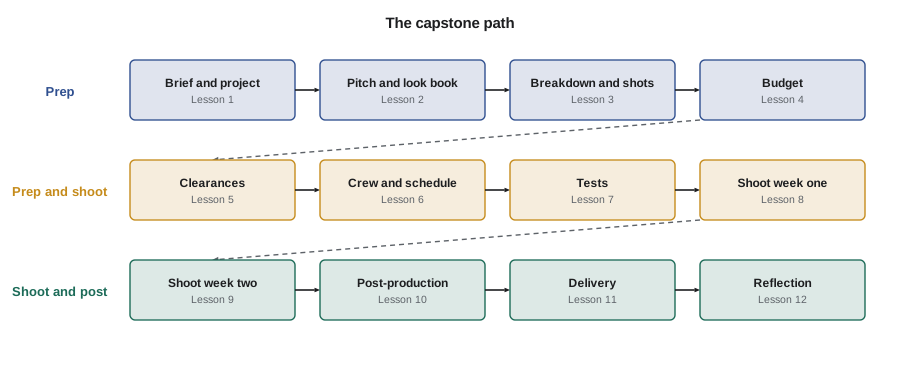
The capstone is where the whole cinematography program comes together. Over the term you will act as director of photography on a complete short film, from the first conversation with a director to the final graded master and a festival plan. Nothing in this course is new theory. Exposure and lenses come from the early camera courses, lighting craft from CINE-301, color and grading from CINE-310, set safety from CINE-340, narrative prep from CINE-401 and the business of crewing from CINE-420. What is new is doing all of it at once, on a real schedule, with a real team, and making the trade-offs that a classroom exercise never forces. Each lesson in this course is one stage of that journey. By the end you should have a finished film, a prep package, a reel-ready set of shots and an honest written reflection on what worked and what did not.
This first lesson sets out the brief, explains how the capstone is assessed and helps you choose a project that is ambitious enough to show your skills but small enough to finish well. The most common reason capstone films fail is not lack of talent. It is scope: a script with too many locations, too many night exteriors, a car chase or a crowd scene that a student crew cannot light, schedule or afford. Choosing well now saves weeks of pain later.
The capstone brief
The brief describes what you must deliver. Read it as a contract between you and the program.
- A short film of 5 to 10 minutes of finished running time, shot and finished by the team during the term, with you as the credited director of photography.
- A prep package: look book, shot list and overheads for every scene, lighting plots for at least two key scenes, a camera and pipeline document, a schedule and a budget.
- A test report showing lens, look and wardrobe or makeup tests, with conclusions that changed what you did on the shoot.
- A production log kept daily: set-ups achieved, problems, decisions and data reports.
- A graded master and a festival-ready deliverable set (Lesson 11), plus a 60 to 90 second excerpt for your reel.
- A written reflection of 1,500 to 2,500 words that assesses your own work against the rubric and records what you would do differently.
The film itself does not need to be expensive or technically flashy. It needs to show clear visual thinking, controlled images, sound collaboration with the director and professional process. A carefully shot two-hander in one apartment will usually score higher than an over-reached action film with uneven exposure and missed coverage.
How the capstone is assessed
Assessment looks at both the product and the process. Many programs weight them roughly equally, because a lucky film made with chaotic process teaches less than a modest film made with excellent process. The rubric below is typical; your instructor's version may differ, so always work from the one you are given.
| Criterion | What assessors look for | Weight |
|---|---|---|
| Visual storytelling | Images that serve the story, a consistent visual grammar, motivated choices | 25 % |
| Technical control | Exposure, focus, color, framing and continuity under control | 20 % |
| Prep package | Complete, usable look book, shot lists, overheads, plots, schedule and budget | 15 % |
| Collaboration and leadership | Working relationship with the director, crew management, communication | 15 % |
| Problem solving | Decisions under pressure, documented in the log and reflection | 10 % |
| Post and delivery | Grade supervision, deliverables complete and to specification | 10 % |
| Reflection | Honest, specific self-assessment linked to evidence | 5 % |
Look at how much of the grade depends on documentation. If you solved a hard problem on day three but never wrote it down, the assessor cannot credit it. Keep the production log from the first prep meeting, not just the shoot days.
Worked problem
Scoring against the rubric
A team's film scores 80 % for visual storytelling, 70 % for technical control, 90 % for the prep package, 85 % for collaboration, 60 % for problem solving, 75 % for post and delivery and 80 % for reflection. Using the weights in the table, what is the overall mark?
Show solution
- Visual storytelling: 0.25 × 80 = 20.0.
- Technical control: 0.20 × 70 = 14.0.
- Prep package: 0.15 × 90 = 13.5.
- Collaboration: 0.15 × 85 = 12.75.
- Problem solving: 0.10 × 60 = 6.0.
- Post and delivery: 0.10 × 75 = 7.5.
- Reflection: 0.05 × 80 = 4.0.
- Total: 20.0 + 14.0 + 13.5 + 12.75 + 6.0 + 7.5 + 4.0 = 77.75.
Answer: About 78 %. The weakest area, problem solving, cost the most relative to its weight; better logging of decisions would likely raise it quickly.
Finding a director and a script
In most programs the DP is paired with a director, or teams form around scripts. Either way, the relationship matters more than the script. You will spend weeks together under pressure. Before you commit, have a real conversation.
- Ask what the film is about in one sentence, and what the director wants an audience to feel at the end.
- Ask which films, photographs or paintings the director keeps returning to, and listen for whether they talk about images or only plot.
- Ask how they like to work: shot lists or discovery on the day, rehearsal or no rehearsal, monitors at video village or beside the camera.
- Share your own reel and talk honestly about what you want to learn.
- Agree on how decisions will be made when you disagree, before you disagree.
If the conversation feels like a negotiation from the start, consider another pairing. A capstone is a long collaboration, and the best films usually come from teams who trust each other enough to argue productively.
Scoping the script
Scope is the single biggest predictor of a finished film. A useful rule of thumb in student and micro-budget work is that a crew can shoot about two to four pages of a simple dialogue script per day, and much less for action, stunts, effects, children, animals, water, cars or night exteriors. A ten-page script with eight locations and three night exteriors is not a weekend project. Read the script with a pencil and count.
| Feature | Why it costs more | Possible simplification |
|---|---|---|
| Many locations | Company moves, permits, lighting from scratch each time | Combine scenes into fewer locations |
| Night exteriors | Large lighting units, power, permits, short nights in summer | Shoot at dusk, use practical sources, move inside |
| Cars and driving | Traffic control, safety, rigging, permits | Parked car, process trailer substitute, rewrite |
| Crowds | Extras, wardrobe, food, releases | Fewer people, tighter frames |
| Children and animals | Working-hour limits, guardians, handlers | Older actor, off-screen animal |
| Weapons, stunts, effects | Specialists, permits, safety officers | Imply the action, cut away |
| Period settings | Art department, wardrobe, locked-off views | Contemporary setting or tight frames |
None of these features is forbidden. A night exterior might be the most important scene in the film. The point is to spend your limited resources on the scenes that matter most and simplify the rest.
Worked problem
Estimating shoot days from page count
A script is 9 pages long. About 6 pages are simple interior dialogue in one apartment, 2 pages are an exterior walk at dusk and 1 page is a night exterior with a car. Planning rates are 3 pages per day for simple interiors, 1.5 pages per day for the dusk exterior and 1 page per day for the night car scene. How many shoot days are needed, and how might the team cut it to four?
Show solution
- Interiors: 6 ÷ 3 = 2 days.
- Dusk exterior: 2 ÷ 1.5 ≈ 1.3 days.
- Night car scene: 1 ÷ 1 = 1 day.
- Total: 2 + 1.3 + 1 ≈ 4.3 days, so plan 5 days.
- To reach 4 days, the team could stage the car scene as a parked car at dusk on the same location as the walk, saving most of a night day.
Answer: About 4.3 days, rounded up to 5. Combining the car scene with the dusk exterior could bring it to 4.
What makes a good capstone for a cinematographer
Some scripts give the DP more to do than others. A strong capstone project for your reel usually has:
- At least one scene with a clear visual idea, such as a single source, a long take, a change in light over time or a distinctive point of view.
- A contrast between scenes, so the look can evolve with the story.
- Locations you can control, with access to power and time to pre-light.
- Performances that reward careful framing and focus.
- A finishing path that lets you supervise the grade.
Projects that rely entirely on found locations with no control, or that are mostly coverage of people talking on phones, give you less to show. That does not make them bad films, but talk with the director about where the visual heart of the film lies.
Roles, credits and ownership
Agree early on credits, ownership and use of the material. Most programs have a standard agreement that says who owns the film (often the director, the producer, the institution or a shared arrangement) and what each crew member may use for their portfolio. As DP you want written permission to use excerpts on your reel and website, to enter the film in festivals with the team's consent and to receive a cinematography credit in the agreed form.
- Read the program's intellectual property and release policies before shooting.
- Make sure every crew member and performer signs the releases the program requires.
- Agree who controls festival submissions and online release, because premiere rules (Lesson 11) can be broken by an early upload.
- Keep copies of all signed paperwork in the production's shared drive.
The capstone timeline
A typical term-long capstone runs about 12 to 15 weeks. The exact calendar depends on your program, but the order rarely changes.
| Weeks | Stage | Key outputs |
|---|---|---|
| 1–2 | Brief, pairing, script choice | Project proposal, scope check |
| 3–4 | Pitch and look book, breakdown | Look book, shot list draft |
| 5–6 | Budget, clearances, crew, schedule, tests | Budget, permits, schedule, test report |
| 7–8 | Production | Footage, logs, data reports |
| 9–12 | Post-production | Locked cut, graded master, mix |
| 13–14 | Delivery and festival plan | Deliverables, reel excerpt |
| 15 | Reflection and critique | Written reflection, presentation |
The common failure is a slipping start. If script choice takes four weeks instead of two, the time is usually stolen from post, which is exactly where the cinematographer's grade supervision happens. Protect the post weeks.
Worked problem
Working back from the screening date
The final screening is in week 15. Post needs 4 weeks and delivery 1 week. Production is planned for 5 shoot days with a weekend between them, taking about 2 weeks. What is the latest week production can finish, and when must prep end?
Show solution
- Delivery must finish by the end of week 14, so delivery starts in week 14.
- Post takes weeks 10 to 13, so it must start by week 10.
- Production must finish by the end of week 9 and therefore start in week 8.
- Prep must be complete by the end of week 7.
Answer: Production must wrap by the end of week 9 and prep must finish in week 7, leaving weeks 1 to 7 for everything before the shoot.
Writing the project proposal
Most programs ask for a short proposal before a project is approved. Keep it to two pages.
- Title, logline and running time.
- Director, DP, producer and key crew.
- A paragraph on the visual approach, with two or three reference images described in words.
- Locations, with a note on access, power and control.
- An outline schedule and a rough budget range.
- Known risks, such as night work, minors, weapons or water, and how you will manage them.
- What each key creative wants to learn.
The proposal is your first prep document. Instructors use it to spot scope problems early, so be honest about risks rather than hiding them.
Common mistakes
MistakeThe most ambitious script makes the best capstone.
InsteadA well-scoped script that the team can shoot and finish to a high standard usually makes a stronger film and a better reel.
MistakeProcess does not matter if the film looks good.
InsteadMost capstone rubrics weight documented process heavily, so keep logs and prep documents from day one.
MistakeScript choice can take as long as it needs.
InsteadTime lost at the start is usually stolen from post-production, where the DP supervises the grade.
MistakeOwnership and credits can be sorted out after the film is finished.
InsteadAgree ownership, credits, reel use and festival control in writing before the shoot.
MistakeEvery difficult feature in the script must be shot as written.
InsteadSpend resources on the scenes that matter most and simplify the rest with the director.
Summary and key terms
- The capstone asks you to act as DP on a complete short film and document every stage.
- Deliverables include the film, a prep package, a test report, a production log, a graded master, a reel excerpt and a written reflection.
- Assessment weighs process as well as product, so documentation earns marks.
- Scope is the main predictor of a finished film; count pages and locations and simplify costly features.
- Choose a director you can argue with productively and agree how disagreements will be settled.
- Agree ownership, credits, reel use and festival control in writing before shooting.
- Work back from the screening date and protect the post-production weeks.
- Capstone
- A final project that brings together the skills of a whole program.
- Brief
- The document that sets out what a project must deliver and how it will be assessed.
- Rubric
- A table of assessment criteria, descriptions and weights.
- Scope
- The size and difficulty of a project relative to the time and resources available.
- Page count
- The length of a script measured in pages, used to estimate shooting time.
- Production log
- A daily record of set-ups, decisions, problems and data.
- Prep package
- The look book, shot lists, overheads, plots, schedule, budget and pipeline document prepared before shooting.
- Project proposal
- A short document used to approve a project before prep begins.
- Reel excerpt
- A short section of finished work used in a cinematographer's demo reel.
- Company move
- Moving the whole unit from one location to another during a shoot day.
Practice problems
Work each problem on paper first, then reveal the answer to check.
List four deliverables in a typical capstone brief.
Show answer
Any four of the film, prep package, test report, production log, graded master and deliverables, reel excerpt and written reflection.
Why do capstone rubrics weight process?
Show answer
Documented process shows planning, collaboration and problem solving, which a lucky result does not prove.
A film scores 90 % on a criterion weighted 25 % and 60 % on one weighted 10 %. What do these two contribute?
Show answer
22.5 + 6 = 28.5 points.
Name three script features that multiply cost.
Show answer
Any three of many locations, night exteriors, cars, crowds, children or animals, weapons or stunts, period settings.
An 8-page script is all simple interiors at 3 pages per day. How many days?
Show answer
8 ÷ 3 ≈ 2.7, so plan 3 days.
What should you ask a director before agreeing to shoot their film?
Show answer
What it is about, what the audience should feel, their references, how they work and how disagreements will be settled.
Why agree festival control early?
Show answer
An early online release can break premiere rules for festivals.
If post needs 4 weeks and delivery 1 week before a week-15 screening, when must post start?
Show answer
By week 10.
What belongs in a project proposal?
Show answer
Logline, team, visual approach, locations, outline schedule and budget, risks and learning goals.
What makes a script good for a DP's reel?
Show answer
A clear visual idea, contrast between scenes, controllable locations, performances that reward framing and a finishing path the DP can supervise.
Lesson quiz · 5 questions
Score 60% or more to complete this lesson.
Create a free account to save your progress, take quizzes and earn a certificate.