
CINE-499 · Lesson 2 of 12 · 29 min
Developing the pitch and look book
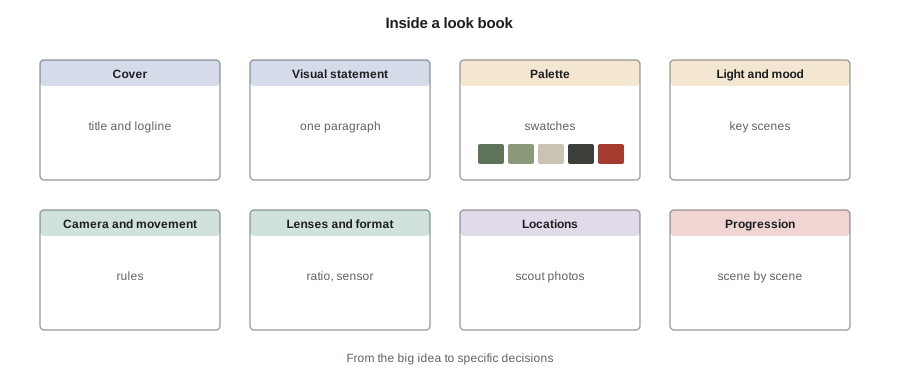
Once the script is chosen, the director and DP need a shared picture of the film before anyone spends money. The look book is that picture. It is a short document, usually 10 to 25 pages, that shows how the film will look and feel and why. It persuades funders, crew and locations that the team knows what it is doing, and it becomes the reference the whole department returns to when decisions get hard on set. CINE-401 introduced look books and visual grammar in general terms. In the capstone you build one for a real film, use it to pitch, and then hold yourself to it through production and the grade.
This lesson covers the pitch conversation, how to turn a director's ideas into a visual concept, how to describe references without copying them, how to set visual rules for camera, lens, light and color, and how to present the look book so that it actually guides the shoot.
The pitch conversation with the director
Start with listening. A good first prep meeting is mostly the director talking about the story and the DP asking questions. Write down the words the director uses about feeling: lonely, trapped, warm, tense, dreamlike, matter-of-fact. Those words become the brief for your images.
- What is the emotional arc of the main character, scene by scene?
- Whose point of view are we in, and does it change?
- Should the audience feel close to the characters or observe them from a distance?
- Is the world of the film heightened or naturalistic?
- Where is the turning point, and should the look change there?
- What must the audience never see, or only see late?
After the conversation, write a one-paragraph visual statement in your own words and send it back. If the director replies that you have understood, you have a foundation. If not, you have found the gap early, which is far cheaper than finding it on set.
From story to visual concept
A visual concept is a short idea that organizes many decisions. It might be a metaphor, a rule or a progression. Strong concepts are simple enough to remember under pressure.
- A progression: the frame widens as the character opens up, starting with tight singles and ending with a wide two-shot.
- A contrast: the family home is warm, soft and static; the workplace is cool, hard and handheld.
- A rule: the camera never moves unless the main character moves.
- A metaphor: the apartment as an aquarium, seen through glass and reflections.
- A source idea: every scene is lit as if by a single window or practical that we can see or sense.
Each concept should answer the question "why this image and not another?" When a gaffer asks why the light comes from screen left or an editor wonders why there are no close-ups until the last scene, the concept gives the answer.
References without copying
Look books traditionally use reference images: film frames, photographs and paintings. In a professional pitch, images show tone faster than words. For coursework, and in this course's materials, describe references in words and use your own test photographs where possible. Copying a famous frame is not a visual concept, and borrowed images carry rights questions if the look book is published or shared widely.
- Describe what you take from a reference: "low, warm practical light with deep shadow beyond the table" rather than "like a famous film".
- Shoot your own reference stills on location with a phone or stills camera, lit the way you plan to light.
- Use color swatches, fabric samples and location photographs to show palette and texture.
- Note what you are rejecting as well as what you are borrowing.
- Credit any third-party images you do include in a private pitch document and do not publish them.
Your own location photographs are the most persuasive references of all, because they show the actual space and prove that you have scouted it.
Visual grammar: setting the rules
Grammar means the consistent choices that make a film feel like one piece. CINE-401 covered the elements; here you choose them for your film and write them down.
| Element | Decision to make | Example choice |
|---|---|---|
| Aspect ratio | Shape of the frame | 2.39:1 for isolation in wide spaces |
| Format and camera | Capture medium, sensor size | Large-format digital for shallow depth |
| Lens family | Focal lengths, character of the glass | Vintage primes at 32, 50 and 85 mm only |
| Camera movement | Static, handheld, dolly, gimbal | Locked off until the turning point, then handheld |
| Shot size progression | How close we get, when | No close-ups until scene 6 |
| Light quality | Hard or soft, source direction | Soft window light from frame left |
| Contrast | Key-to-fill ratio, black level | High contrast, deep blacks |
| Color palette | Dominant and accent colors | Muted greens with one red accent |
| Texture | Grain, diffusion, halation | Light grain, no diffusion |
Rules are tools, not laws. A grammar that says "no close-ups until scene 6" makes the first close-up powerful. Break a rule only on purpose, and write down why.
Worked problem
Choosing an aspect ratio for a UHD capture
The team will shoot on a camera recording 3,840 × 2,160 pixels and wants to finish at 2.39:1. How many active image lines will the finished frame use, and what share of the sensor height is that?
Show solution
- Active height = 3,840 ÷ 2.39 ≈ 1,607 lines.
- Share of sensor height = 1,607 ÷ 2,160 ≈ 0.744, about 74 %.
Answer: About 1,607 lines, roughly 74 % of the recorded height. Frame lines must be set accordingly, and the extra height gives a little room to reposition in post.
Color palette and production design
The DP does not own color alone. Production design, costume and makeup create most of what is in front of the lens. Agree a palette with the director and the production designer early, then show it in the look book as swatches with names and rough values.
- Choose one or two dominant colors, a supporting neutral and an accent used sparingly.
- Check skin tones against the palette; strong green or magenta walls can shift faces.
- Ask costume for fabric swatches and test them on camera under your planned light (Lesson 7).
- Think about contrast between characters or worlds rather than a single overall tint.
- Agree what the grade will do and what must be achieved in camera; a strong palette in the art department usually beats a heavy-handed grade.
Light and mood pages
For each key scene, write a few lines about the light: the motivating source, the time of day, the quality and the contrast. A simple mood sketch, even a hand drawing with an arrow for the key light, communicates more than a paragraph. Later these pages become the start of your lighting plots (Lesson 3).
- Scene 2, kitchen, morning: soft daylight from the window behind the sink, warm practical over the stove, low contrast, faces open.
- Scene 5, bedroom, night: single bedside lamp, hard shadow on the far wall, high contrast, cool moonlight edge through the curtains.
- Scene 8, rooftop, dusk: ambient sky as the key, small LED panel for eye light, shot in a 20-minute window.
Worked problem
Planning a dusk window
On the shoot date, sunset is at 19:42. The team judges that usable dusk light for the rooftop scene lasts from 10 minutes before sunset to 25 minutes after. Each set-up takes 7 minutes once lit. How many set-ups can be shot in the window, and what should the shot list do?
Show solution
- Window length = 10 + 25 = 35 minutes.
- Set-ups = 35 ÷ 7 = 5.
- Plan 4 set-ups and keep 1 slot as a safety margin.
Answer: About 5 set-ups at best, so the shot list should plan 4, ordered from widest (which needs the most sky) to tightest, with lighting pre-set before sunset.
Camera movement and lens philosophy
Movement and lens choice change how an audience relates to characters. Write a short philosophy and then a few concrete rules.
- Wide lenses close to actors create intimacy and slight distortion; long lenses from a distance create observation and compression.
- A static camera can feel calm, formal or trapped depending on the composition.
- Handheld can feel immediate, anxious or documentary; a gimbal floats and can feel dreamlike.
- A dolly push draws the audience into a thought; a pull isolates.
- A limited lens set, such as three focal lengths, makes the film coherent and speeds up decisions on set.
Match the philosophy to your resources. A rule of "every move on dolly track" is meaningless if you have no dolly and no grip to lay track.
Worked problem
Matching field of view across sensor sizes
The director loved the look of a 35 mm lens on a camera with a 24.9 mm-wide sensor. The capstone camera has a 36 mm-wide sensor. What focal length gives about the same horizontal field of view?
Show solution
- Field of view matches when the focal length scales with sensor width.
- Equivalent focal length = 35 × (36 ÷ 24.9) ≈ 50.6 mm.
Answer: About 50 mm gives a similar horizontal field of view on the larger sensor, though depth of field at the same stop will be shallower.
Format, camera and pipeline in the look book
Include a page that states the capture format, frame rate, resolution, aspect ratio and color pipeline at a high level. This is where creative and technical meet. The detailed camera and pipeline document comes later, but the look book should show that the look is achievable with the equipment the program has.
- Camera and recording format, with the reason for the choice.
- Frame rate and shutter angle, and any planned off-speed shots.
- The show look: a description of the LUT or look you will build in tests.
- Delivery format and the expectation of a graded master (Lesson 11).
Presenting the look book
Present the look book to the director first, then to the producer and heads of department. Keep the presentation short and focused on decisions.
- Start with the visual statement in one sentence.
- Walk through the progression of the film, not page by page through the document.
- Show location photographs and test stills where you have them.
- End with the practical consequences: equipment, crew, schedule and budget implications.
- Ask for questions and record every decision in the production log.
After the presentation, circulate the look book as a PDF with a version number and date. When decisions change, update it and circulate a new version. On set, keep a copy on a tablet or printed pages for quick reference.
Pitching to funders and partners
A version of the look book often goes to people outside the team: a program review panel, a local film co-op, a location owner or a small funder. For these audiences, shorten the technical material and emphasize the story, the team and the plan. Lesson 4 looks at funding sources in Canada and the United States. Funders want to see that the film is achievable, so show the schedule and budget as well as the images.
Common mistakes
MistakeA look book is a collection of beautiful film stills.
InsteadA look book explains a visual concept and the decisions that follow from it, using your own photographs and described references.
MistakeVisual rules must never be broken.
InsteadRules make a film coherent; break one only on purpose and record why.
MistakeColor is the DP's decision alone.
InsteadPalette is agreed with the director, production design, costume and makeup.
MistakeThe look book can promise anything because the grade will fix it.
InsteadThe look must be achievable in camera with the equipment and crew available.
MistakeOnce presented, the look book never changes.
InsteadUpdate and re-circulate it with a version number when decisions change.
Summary and key terms
- The look book shows how the film will look and why, and guides decisions from pitch to grade.
- Start with listening, then write a visual statement and confirm it with the director.
- A visual concept is a simple progression, contrast, rule, metaphor or source idea that organizes many choices.
- Describe references in words and use your own location and test photographs.
- Set visual grammar for ratio, format, lenses, movement, shot sizes, light, contrast, palette and texture.
- Agree the palette with production design and costume, and check it against skin tones.
- Present decisions and consequences, and keep the document versioned.
- Look book
- A short visual document explaining the look and feel of a film and the reasons for it.
- Visual statement
- A one-paragraph summary of the visual approach, agreed with the director.
- Visual concept
- A simple idea, such as a progression or rule, that organizes visual decisions.
- Visual grammar
- The consistent set of camera, lens, light and color choices that make a film coherent.
- Palette
- The set of dominant, supporting and accent colors chosen for a film.
- Aspect ratio
- The ratio of frame width to height.
- Lens family
- A matched set of lenses chosen for consistent character.
- Mood page
- A look book page describing the light and feeling of a scene.
- Progression
- A planned change in the look over the course of the film.
- Frame lines
- Markings in the viewfinder that show the intended finished frame.
Practice problems
Work each problem on paper first, then reveal the answer to check.
What should you listen for in the first prep meeting?
Show answer
The words the director uses about feeling and point of view, and the emotional arc.
Give an example of a progression concept.
Show answer
The frame widens as the character opens up, from tight singles to a wide two-shot.
Why describe references in words rather than paste famous frames?
Show answer
Described references explain what you take from them, avoid copying and avoid rights issues.
How many active lines does a 2.39:1 frame use on a 3,840-pixel-wide capture?
Show answer
About 1,607.
A dusk window lasts 30 minutes and each set-up takes 6 minutes. How many set-ups at most?
Show answer
5, so plan about 4.
Why use a limited lens set?
Show answer
It makes the film coherent and speeds decisions on set.
A 25 mm lens on a 24.9 mm-wide sensor; what is the equivalent on a 36 mm-wide sensor?
Show answer
About 36 mm.
Who agrees the palette?
Show answer
The director, DP, production designer, costume and makeup together.
What should end a look book presentation?
Show answer
The practical consequences for equipment, crew, schedule and budget.
Why version the look book?
Show answer
So everyone works from the latest decisions and changes are traceable.
Lesson quiz · 5 questions
Score 60% or more to complete this lesson.
Create a free account to save your progress, take quizzes and earn a certificate.