
CISSP-110 · Lesson 12 of 12 · 27 min
Threat modeling, security awareness and capstone risk assessment
This final lesson covers the last two sub-domains of Domain 1 and then brings the whole course together. Sub-domain 1.10 asks you to understand and apply threat modeling concepts and methodologies; sub-domain 1.12 asks you to establish and maintain a security awareness, education and training program, including methods such as social engineering exercises, phishing simulations and gamification, periodic content reviews and measuring effectiveness. The capstone then walks through a complete risk assessment for a mid-sized organization, using governance, law, continuity, personnel, supplier and risk management ideas from earlier lessons.
What threat modeling is
Threat modeling is a structured way of thinking about what could go wrong with a system, before it goes wrong. It is most valuable early in design, when changes are cheap, but it can be applied to existing systems, business processes and even organizations. A widely used summary, from the Threat Modeling Manifesto, frames it as four questions: What are we working on? What can go wrong? What are we going to do about it? Did we do a good enough job?
A threat model usually starts with a diagram of the system, such as a data flow diagram showing processes, data stores, external entities, data flows and trust boundaries, the points where data moves between areas with different levels of trust, such as from the internet into a web server. Threats tend to cluster at trust boundaries. The team then identifies threats, rates them, decides on mitigations and records the results so they can be revisited when the design changes.
Threat modeling methodologies
STRIDE, developed at Microsoft, classifies threats into six categories, each the opposite of a security property: Spoofing (authenticity), Tampering (integrity), Repudiation (nonrepudiation), Information disclosure (confidentiality), Denial of service (availability) and Elevation of privilege (authorization). Teams walk through each element of the data flow diagram and ask which STRIDE threats apply.
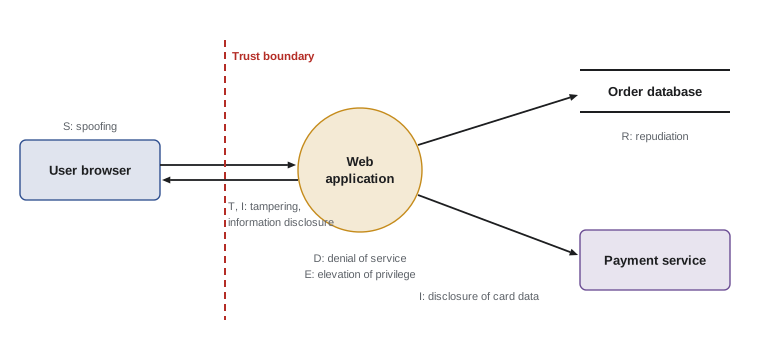
PASTA (Process for Attack Simulation and Threat Analysis) is a seven-stage, risk-centric methodology: define objectives, define the technical scope, decompose the application, analyze threats, analyze vulnerabilities, model attacks, and analyze risk and impact. Because it starts from business objectives, it links threat modeling to risk management. DREAD, also from Microsoft, rated threats by Damage, Reproducibility, Exploitability, Affected users and Discoverability; it is now rarely used because its ratings proved subjective, but it still appears in study materials. VAST (Visual, Agile and Simple Threat modeling) aims to scale threat modeling across large agile organizations. Attack trees represent an attacker's goal at the root and the ways to achieve it as branches, which helps find the cheapest path for an attacker. MITRE ATT&CK provides a knowledge base of real attacker tactics and techniques that teams use to check that their models reflect real behavior. LINDDUN applies a similar approach to privacy threats.
| Method | Focus | Typical use |
|---|---|---|
| STRIDE | Six threat categories mapped to security properties | Design reviews of applications and systems |
| PASTA | Seven risk-centric stages tied to business objectives | High-value applications needing risk analysis |
| DREAD | Scoring threats on five factors | Historic; largely replaced by other scoring |
| VAST | Scalable, agile-friendly modeling | Large organizations with many teams |
| Attack trees | Attacker goals broken into paths | Analyzing specific high-value targets |
| MITRE ATT&CK | Catalog of real attacker behavior | Validating models and detection coverage |
Worked problem
STRIDE on a password reset feature
A web application lets users reset their password by entering an email address and clicking a link sent to that address. Identify one threat for each STRIDE category and a mitigation.
Show solution
- Spoofing: an attacker requests a reset for someone else; mitigate with single-use, short-lived tokens sent only to the registered address.
- Tampering: the attacker alters the user ID in the reset link; mitigate by binding the token to the account on the server.
- Repudiation: a user claims they never reset their password; mitigate with logging and notification of resets.
- Information disclosure: the form reveals whether an email is registered; mitigate with a generic response.
- Denial of service: mass reset requests flood mailboxes; mitigate with rate limiting.
- Elevation of privilege: resetting an administrator account without extra checks; mitigate with step-up verification for privileged accounts.
Answer: Six threats and six mitigations. Applying STRIDE systematically finds issues that ad hoc review often misses, such as account enumeration.
Security awareness, education and training
People are both a common attack target and a powerful line of defense. Awareness, training and education differ in depth. Awareness aims to change attention and behavior across the whole workforce: recognizing phishing, reporting incidents, protecting passwords, following clean-desk rules. Training builds specific skills for particular roles: secure coding for developers, incident handling for responders, secure configuration for administrators. Education builds deeper understanding and judgment over time, such as degree programs and certifications like the CISSP.
Effective programs use varied methods: short, frequent modules rather than one long annual session; phishing simulations with immediate, supportive feedback; social engineering tests, such as pretext phone calls, conducted with management approval and care for employees' dignity; gamification, such as challenges and leaderboards; champions in each department; and messages tied to current events. Content should be tailored to roles and risks: finance staff need training on payment fraud and business email compromise; executives need training on targeted attacks and their own role in governance.
The outline stresses periodic content reviews that include emerging technologies and trends. Recent examples include generative AI, which makes phishing messages more convincing and enables voice and video deepfakes used to authorize fraudulent payments; QR-code phishing; multi-factor authentication fatigue attacks, in which attackers flood users with approval prompts; and rules for staff using AI tools with company data. Programs should be reviewed at least annually and after major incidents or changes.
In the United States, CISA's resources and the National Cybersecurity Alliance support awareness, and October is Cybersecurity Awareness Month. FISMA requires federal agencies to provide security awareness training to all users and role-based training to those with significant security responsibilities, guided by NIST SP 800-50. The HIPAA Security Rule, the GLBA Safeguards Rule and PCI DSS also require security awareness training for workforce members.
Measuring effectiveness
Completion rates alone show only that people clicked through modules. Better measures look at behavior: phishing simulation click rates and, more importantly, reporting rates; time from receiving a real phishing email to its first report; number of incidents caused by human error; results of social engineering tests; and survey measures of security culture. Programs should set targets, compare against baselines and adjust content where results are weak.
Worked problem
Measuring a phishing program
In January, 1,500 employees received a simulated phishing email: 270 clicked and 150 reported it. In June, after monthly micro-training, 1,500 received a comparable simulation: 105 clicked and 540 reported it. Calculate the changes.
Show solution
- January click rate: \( 270 / 1500 = 18\% \); June: \( 105 / 1500 = 7\% \).
- Relative reduction in clicks: \( (18 - 7) / 18 \approx 61\% \).
- January reporting rate: \( 150 / 1500 = 10\% \); June: \( 540 / 1500 = 36\% \).
- Interpretation: fewer clicks and far more reports. Reporting matters because one early report lets the security team block a real campaign for everyone.
Answer: Click rate fell from 18 to 7 percent (about 61 percent lower) and reporting rose from 10 to 36 percent. Check that the June simulation was of similar difficulty before claiming full credit.
Capstone: a risk assessment for Northfield Logistics
Northfield Logistics is a fictional company with 900 employees, warehouses in three locations, an online customer portal and a fleet of delivery trucks. It stores customer contact and delivery data, employee records and payment information processed through a card payment provider. Most systems run on one cloud provider; a managed service provider handles IT support. The board has asked the new CISO for a first enterprise security risk assessment.
Step 1, governance and scope: the CISO confirms that the board owns risk appetite, sets up a risk committee with operations, finance, legal and IT, and agrees scope (all business units) and criteria (a 1 to 5 likelihood and impact scale, with scores of 15 or above reported to the board). Step 2, obligations: legal counsel lists privacy and breach notification laws in each jurisdiction where Northfield operates, PCI DSS duties through the payment provider contract, transportation safety rules for fleet systems, and contractual security commitments to large customers.
Step 3, assets and BIA: the team identifies critical functions. Dispatch and route planning has an MTD of 8 hours and an RTO of 4 hours; the customer portal an MTD of 24 hours; payroll an MTD of 3 days. Step 4, threats and vulnerabilities: interviews, scans and threat intelligence identify ransomware, business email compromise, supplier compromise through the managed service provider, insider theft of customer data and a cloud region outage.
| Risk | Likelihood | Impact | Score | Proposed treatment |
|---|---|---|---|---|
| Ransomware stops dispatch | 4 | 5 | 20 | Mitigate: immutable backups, EDR, MFA, segmentation; test 4-hour recovery |
| Business email compromise diverts payments | 4 | 4 | 16 | Mitigate: payment call-back procedure, finance training, email authentication |
| MSP credentials abused | 3 | 5 | 15 | Mitigate and transfer: contract controls, MFA and just-in-time access; cyber insurance |
| Insider exports customer data | 2 | 4 | 8 | Mitigate: least privilege, data loss prevention, access reviews |
| Cloud region outage | 2 | 4 | 8 | Mitigate: replicate dispatch to a second region |
| Lost unencrypted laptop | 3 | 2 | 6 | Mitigate: enforce disk encryption standard |
Step 5, quantify the top risk: Northfield estimates that a ransomware incident stopping dispatch for five days would cost $3.2 million in lost revenue, recovery and penalties (SLE), and expects such an incident once every three years without new controls (ARO of one in three, about 0.33), giving an ALE of about $1.07 million. A package of controls costing $350,000 a year is expected to reduce the ARO to 0.05 and the impact to $1.2 million, for an ALE of $60,000. Its value is about \( 1{,}070{,}000 - 60{,}000 - 350{,}000 = 660{,}000 \) dollars a year, a strong case.
Step 6, people and suppliers: background checks for staff with access to customer data and finance systems, automated deprovisioning tied to HR, a supplier tiering exercise placing the cloud provider, MSP and payment provider in the critical tier, and an SBOM requirement for the customer portal's vendor. Step 7, awareness: role-based training for finance on payment fraud, phishing simulations measured by reporting rate, and a threat model of the customer portal using STRIDE before its next release. Step 8, report and monitor: the CISO presents the top five risks to the board in business terms, with decisions requested and residual risks for formal acceptance, and sets key risk indicators for quarterly reporting.
Observe how every Domain 1 sub-domain appears: ethics in honest reporting, the five pillars in the risks themselves, governance in the committee and board decisions, frameworks in the risk method, law and investigations in the obligations list, policy in the encryption standard, continuity in the BIA, personnel and supply chain controls, risk management throughout, threat modeling for the portal, and awareness for finance and all staff.
Common mistakes
MistakeThreat modeling only after a system is built.
InsteadModel early in design, when changes are cheapest, and revisit when the design changes.
MistakeConfusing awareness with training.
InsteadAwareness changes behavior broadly; training builds role-specific skills; education builds deep understanding.
MistakeMeasuring awareness only by completion rates.
InsteadMeasure behavior, such as phishing click and reporting rates.
MistakeShaming employees who fail phishing tests.
InsteadGive supportive feedback and reward reporting.
MistakePresenting a risk assessment as a technical report.
InsteadPresent top risks in business terms with decisions for leadership.
Summary and key terms
- Threat modeling asks what we are building, what can go wrong, what we will do and whether we did enough.
- Data flow diagrams and trust boundaries focus threat identification.
- STRIDE maps threats to security properties; PASTA is risk-centric; DREAD is historic; attack trees and ATT&CK support analysis.
- Awareness, training and education differ in audience and depth.
- Programs should use varied methods, tailor content and review it for emerging threats such as AI-enabled fraud.
- Measure behavior, especially reporting rates, not just completion.
- A full risk assessment combines governance, obligations, BIA, threats, quantification, people, suppliers, awareness and reporting.
- Threat modeling
- A structured process for identifying and addressing what could go wrong with a system.
- Trust boundary
- A point where data moves between areas with different levels of trust.
- Data flow diagram
- A diagram of processes, data stores, external entities and data flows.
- STRIDE
- Spoofing, tampering, repudiation, information disclosure, denial of service and elevation of privilege.
- PASTA
- A seven-stage, risk-centric threat modeling methodology.
- Attack tree
- A diagram of an attacker's goal and the paths to achieve it.
- Security awareness
- Activities that change attention and behavior across the workforce.
- Role-based training
- Skills training tailored to specific job responsibilities.
- Phishing simulation
- A controlled fake phishing email used to train and measure staff.
- Reporting rate
- The share of recipients who report a suspicious message.
Practice problems
Work each problem on paper first, then reveal the answer to check.
What are the four questions of threat modeling?
Show answer
What are we working on, what can go wrong, what will we do about it, and did we do a good enough job?
What does the E in STRIDE stand for?
Show answer
Elevation of privilege.
Which security property does repudiation threaten?
Show answer
Nonrepudiation.
Which methodology has seven risk-centric stages?
Show answer
PASTA.
Where do threats tend to cluster in a data flow diagram?
Show answer
At trust boundaries.
How does training differ from awareness?
Show answer
Training builds role-specific skills; awareness changes general behavior.
Why is the phishing reporting rate important?
Show answer
Early reports let the security team block real campaigns for everyone.
Name an emerging threat to include in awareness content.
Show answer
AI-enabled deepfake fraud, QR-code phishing or MFA fatigue attacks.
In the capstone, which risks went to the board?
Show answer
Those scoring 15 or above.
What should a CISO present to the board after a risk assessment?
Show answer
Top risks in business terms, decisions requested and residual risks for acceptance.
Lesson quiz · 5 questions
Score 60% or more to complete this lesson.
Create a free account to save your progress, take quizzes and earn a certificate.