
CISSP-110 · Lesson 2 of 12 · 27 min
Security governance: alignment, roles and due care
Governance is the system by which an organization is directed and controlled. Security governance applies that idea to protecting information: it sets direction, assigns authority and accountability, and checks that security activities support the organization's goals. Sub-domain 1.3 of the 2024 CISSP outline asks you to evaluate, apply and sustain security governance principles, including alignment with business strategy, organizational processes, roles and responsibilities, control frameworks and due care and due diligence. This lesson covers everything except the frameworks, which have a lesson of their own.
Governance and management are different
Governance decides what should be done and why; management decides how to do it and does it. A board of directors that approves the organization's risk appetite and asks for quarterly cyber risk reports is exercising governance. A chief information security officer (CISO) who builds the security program, hires staff and runs projects to meet that appetite is exercising management. COBIT, the governance framework published by ISACA, makes the same distinction: governance evaluates, directs and monitors; management plans, builds, runs and monitors.
The distinction matters because security failures are often governance failures. A breach caused by an unpatched server may look like a technical error, but the root cause may be that no one owned patching, that the budget was never approved, or that leaders accepted the risk without understanding it. Good governance makes risk decisions visible and assigns them to people with the authority to make them.
Aligning security with the business
Security strategy should flow from business strategy. If the organization plans to expand into the European Union, move its core systems to the cloud or acquire a competitor, each plan changes the risk picture and the security program must change with it. Alignment works in both directions: security leaders bring risk insight to strategic decisions, and business leaders set the priorities that security must support.
A useful way to express alignment is through layered plans. A strategic plan covers three to five years and links security goals to the mission, for example 'support the move to digital services while keeping customer trust'. A tactical plan covers about a year and lists initiatives such as deploying multi-factor authentication across all remote access. Operational plans cover weeks or months and describe the detailed tasks, owners and schedules. Each layer should trace upward to the one above it.
Measurement closes the loop. Boards and executives need a small number of meaningful indicators, not raw technical data. Key risk indicators show whether exposure is rising (for example, the number of critical vulnerabilities older than 30 days). Key performance indicators show whether the program is working (for example, the percentage of staff who completed training). Reporting should translate technical facts into business terms: likely impact, trends, and decisions required.
Organizational processes
The outline singles out organizational processes such as acquisitions, divestitures and governance committees, because these events change security risk sharply.
In an acquisition, the buyer inherits the target's systems, data, contracts, vulnerabilities and past breaches. Security should be part of due diligence before the deal closes: reviewing the target's security program, incident history, regulatory obligations and technical debt. After closing, integration should be planned so that networks are not connected until the acquired environment has been assessed. A well-known pattern is an acquired company bringing an undiscovered compromise into the parent's network.
In a divestiture, part of the organization is sold or spun off. Security must separate data, accounts, licenses and network connections cleanly, decide which records go with the divested unit, and ensure that departing staff and systems lose access to what they should no longer reach. Transitional service agreements often keep systems shared for months, which creates its own risks.
Governance committees, such as an information security steering committee or a risk committee, bring together business, IT, legal, privacy and risk leaders to set priorities, approve policies and resolve conflicts. They give the security program authority beyond the security team and help ensure that decisions reflect the whole organization's interests.
Roles and responsibilities
Clear roles prevent both gaps and duplication. The exact titles vary between organizations, but the CISSP expects you to recognize these functions.
| Role | Main responsibility |
|---|---|
| Board of directors | Sets risk appetite, oversees management, holds ultimate accountability |
| Senior management (CEO and executives) | Owns security outcomes, approves policy and resources |
| CISO or security officer | Leads the security program, advises leadership on risk |
| Data or system owner | Business manager accountable for a data set or system; classifies it and approves access |
| Data custodian | Implements and operates controls on behalf of the owner, such as backups and access settings |
| Users | Follow policy and use information appropriately |
| Auditors | Independently assess whether controls exist and work |
| Privacy officer | Oversees compliance with privacy law and privacy policy |
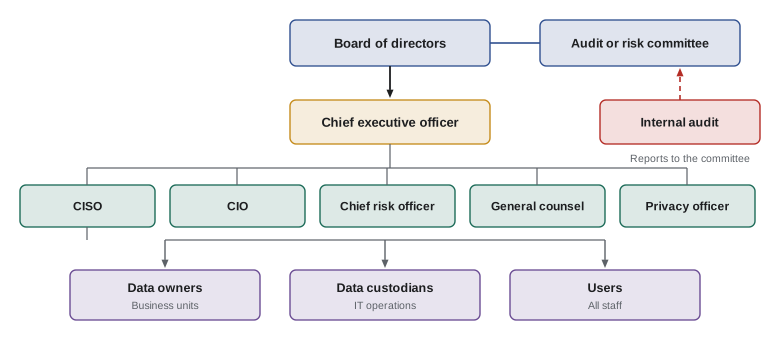
A principle that appears repeatedly on the exam is that senior management is ultimately accountable for security. Responsibilities can be delegated, but accountability cannot. If the CEO delegates security to the CISO and a preventable breach occurs, the board and executives still answer for it. Another recurring point is that data owners, not IT staff, decide classification and who may have access; custodians carry out those decisions.
Where the security function reports also matters. A CISO who reports to the chief information officer may face a conflict when security work competes with IT delivery deadlines. Many organizations have the CISO report to the CEO, the chief risk officer or general counsel, with a direct line to a board committee, so that security risks reach decision-makers without being filtered.
Due care and due diligence
Two terms with legal weight appear in sub-domain 1.3: due care and due diligence. Due diligence is the effort to understand risks and obligations: researching threats, assessing vendors, reviewing laws that apply, and checking that controls work. Due care is acting on that knowledge: implementing reasonable protections and operating them responsibly. A common memory aid is that due diligence is 'doing your homework' and due care is 'doing the right thing' with what you learned.
Both relate to the legal standard of the prudent person: what a reasonable person with similar responsibilities would do in the circumstances. An organization that fails to take reasonable precautions may be found negligent if harm results. Courts and regulators increasingly treat basic security measures, such as patching, multi-factor authentication for remote access and encryption of portable devices, as part of reasonable care.
In the United States, directors' duty of oversight was shaped by Delaware's Caremark decision (1996) and later cases such as Marchand v. Barnhill (2019), which held that boards must make a good-faith effort to oversee mission-critical risks. Regulators add specific duties: the FTC has treated unreasonable data security as an unfair practice under Section 5 of the FTC Act, and the SEC's 2023 cybersecurity disclosure rules require public companies to describe how the board oversees cyber risk.
Worked problem
Due diligence or due care?
Classify each activity: (a) reviewing a cloud provider's SOC 2 Type II report before signing; (b) enabling multi-factor authentication for all administrators; (c) researching which privacy laws apply to a new customer base; (d) applying critical patches within the timeframe set by policy; (e) running an annual control assessment.
Show solution
- (a) Investigating a vendor's controls before relying on them: due diligence.
- (b) Implementing a protection: due care.
- (c) Learning about obligations: due diligence.
- (d) Acting on known risk in a reasonable way: due care.
- (e) Checking that controls work: due diligence, which then informs further due care.
Answer: (a), (c) and (e) are due diligence; (b) and (d) are due care. The two work as a cycle.
Security program essentials
Pulling these ideas together, an effective security program usually has a charter approved by senior management, a governance committee, a policy framework (Lesson 8), a risk management process (Lesson 11), defined roles, a budget linked to risk, metrics reported to leadership and a cycle of review and improvement. Programs mature over time. Maturity models, such as the capability levels in COBIT or the CMMI scale, describe a path from ad hoc practices to defined, measured and continually improving ones, and can help leaders set realistic targets.
Worked problem
Translating a technical metric for the board
The security team reports that 340 servers have critical vulnerabilities older than 30 days, out of 2,000 servers. Last quarter the figure was 180. Rewrite this as a board-level message.
Show solution
- Convert to a percentage: \( 340 / 2000 = 17\% \), up from \( 180 / 2000 = 9\% \).
- State the trend: exposure has almost doubled in one quarter.
- State the business impact: unpatched critical flaws are a common route to ransomware, which could stop operations.
- State the cause and decision needed: patching was deferred during a system migration; leadership must decide whether to fund extra staff or accept the higher risk until the migration ends.
Answer: For example: "Critical vulnerabilities older than 30 days rose from 9 to 17 percent of servers this quarter because of the migration. This raises our ransomware risk. We recommend two temporary staff for 90 days, or a formal decision to accept the risk until migration ends."
Look at the pattern in that message: a trend, an impact in business terms, a cause and a decision. Boards do not need to understand vulnerability scanners, but they do need to know when risk exceeds appetite and what their choices are.
Culture and the tone at the top
Structures and documents matter, but culture decides whether they work. When executives use multi-factor authentication without complaint, ask about cyber risk in strategy meetings and fund remediation promptly, staff see that security is part of how the organization operates. When executives demand exceptions for themselves, or treat security as a compliance cost to be minimized, staff draw the opposite conclusion. Security leaders influence culture by explaining the reasons behind controls, celebrating good reports rather than punishing honest mistakes, and making the secure way the easy way. A healthy culture shows in behavior: people report suspicious emails, ask before sharing data and raise concerns early.
Governance also needs to cover security's relationships with other assurance functions. Risk management, compliance, privacy, internal audit and legal all have views on security risk. The three lines model, published by the Institute of Internal Auditors in 2020, describes one common arrangement: first-line management owns and manages risk, second-line functions such as risk and compliance provide expertise and challenge, and internal audit, the third line, gives independent assurance to the governing body. Clarifying these roles avoids gaps where everyone assumes someone else is checking.
Governance should be reviewed as the organization changes. A start-up with one IT generalist, a growing company with a small security team and a multinational with a global security function need different structures, but each needs clear ownership of risk decisions, a route for security concerns to reach leadership and a way to check that agreed actions are carried out.
Common mistakes
MistakeTreating governance and management as the same thing.
InsteadGovernance directs and oversees; management plans and executes.
MistakeBelieving delegation transfers accountability.
InsteadSenior management remains accountable even when tasks are delegated.
MistakeLetting IT decide data classification.
InsteadData owners classify data; custodians implement the controls.
MistakeLeaving security out of mergers until after closing.
InsteadInclude security in due diligence and plan integration before connecting networks.
MistakeReporting raw technical data to the board.
InsteadReport trends, business impact and decisions needed.
Summary and key terms
- Governance sets direction and oversight; management plans and executes.
- Security strategy must align with business strategy through strategic, tactical and operational plans.
- Acquisitions, divestitures and governance committees are key organizational processes affecting security.
- Senior management holds ultimate accountability; owners classify data and custodians implement controls.
- Reporting lines affect independence; internal audit reports to a board committee.
- Due diligence is understanding risk and obligations; due care is acting on that knowledge reasonably.
- Board reporting should translate technical facts into trends, impacts and decisions.
- Security governance
- The system that directs, controls and oversees security in line with business goals.
- Risk appetite
- The amount and type of risk an organization is willing to pursue or retain.
- Strategic plan
- A long-range plan, typically three to five years, linking security to the mission.
- Tactical plan
- A mid-range plan, about a year, listing initiatives.
- Data owner
- The business manager accountable for a data set, who classifies it and approves access.
- Data custodian
- The role that implements and operates controls on the owner's behalf.
- Due diligence
- Investigating risks and obligations and checking controls.
- Due care
- Implementing and operating reasonable protections.
- Prudent person rule
- The standard of what a reasonable person in the role would do.
- Key risk indicator
- A metric that signals changes in risk exposure.
Practice problems
Work each problem on paper first, then reveal the answer to check.
Who is ultimately accountable for security in an organization?
Show answer
Senior management and the board.
Who decides the classification of a customer database?
Show answer
The data owner.
Is reviewing a vendor's audit report due care or due diligence?
Show answer
Due diligence.
Why should internal audit report to a board committee?
Show answer
To stay independent of the functions it audits.
What is the typical horizon of a strategic security plan?
Show answer
Three to five years.
Give one security task during an acquisition.
Show answer
Assess the target's security posture and incident history before connecting networks.
What is a governance committee for?
Show answer
To set priorities, approve policy and resolve conflicts across functions.
What does COBIT say governance does?
Show answer
Evaluates, directs and monitors.
Name one risk of a CISO reporting to the CIO.
Show answer
Security concerns may be filtered or deprioritized against IT delivery goals.
What four elements make a good board risk message?
Show answer
Trend, business impact, cause and decision needed.
Lesson quiz · 5 questions
Score 60% or more to complete this lesson.
Create a free account to save your progress, take quizzes and earn a certificate.