
CISSP-115 · Lesson 6 of 12 · 33 min
Control testing and continuous control monitoring
Most of what an organization calls security is a set of controls: a rule that terminated employees lose access within one business day, a requirement that every production change has an approved ticket, a standard that laptops are encrypted. Each control is a claim about how things work. Control testing checks those claims with evidence. It is the quiet, repetitive core of Domain 6, and it is where internal auditors, external auditors, regulators and security managers spend much of their time.
This lesson explains how to test whether controls are well designed and whether they actually operate, how much evidence is enough, how to sample when you cannot check everything, and how automation is turning periodic testing into continuous control monitoring. Sub-domain 6.2 of the outline, conduct security control testing, is the exam anchor, together with 6.3 on collecting the process data that testing relies on.
Design effectiveness and operating effectiveness
Every control can fail in two different ways, and tests are built to detect each. A control fails in design if, even when performed perfectly, it would not achieve its objective. A quarterly access review that covers only Active Directory, when half the company's sensitive data sits in a SaaS system with its own accounts, has a design gap. A control fails in operation if it is designed well but is not performed as designed, consistently, by competent people, over the period being examined. A well-scoped quarterly review that was skipped in the third quarter has an operating failure.
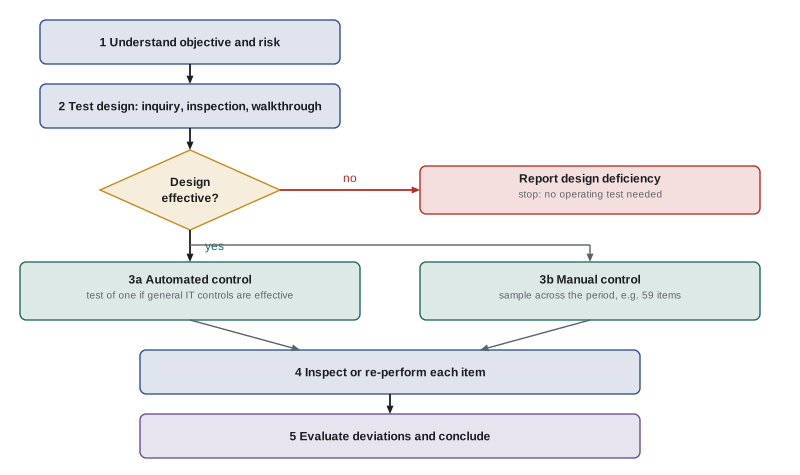
Design is tested first, because there is no point measuring how consistently a flawed control runs. Design testing relies on inquiry (asking the control owner how it works), inspection of documents (the policy, the procedure, the system configuration) and a walkthrough, in which the tester follows one real transaction or instance from start to finish to confirm that the control exists as described. Operating effectiveness is then tested over a period, usually by inspecting evidence for a sample of instances, observing the control being performed, or re-performing it independently and comparing results.
| Test technique | What the tester does | Strength of evidence | Typical use |
|---|---|---|---|
| Inquiry | Asks the control owner or staff how the control works | Weakest on its own | Starting point for every control; never sufficient alone |
| Observation | Watches the control being performed | Moderate, but only for the moment observed | Physical controls, badge checks, data center procedures |
| Inspection | Examines documents, records, logs and configurations | Moderate to strong, depending on source reliability | Approval records, review sign-offs, system settings |
| Re-performance | Independently executes the control and compares results | Strongest | Automated checks, reconciliations, access recertifications |
The exam expects you to know that inquiry alone never provides enough evidence. A system owner who says that every change is approved may believe it sincerely; only records show whether it is true. Evidence generated by a system, under controls the tester has confidence in, is generally more reliable than evidence prepared by the person whose control is being tested. Evidence the tester obtains directly, such as a configuration export run in the tester's presence, is stronger than a screenshot sent by email.
Manual and automated controls
Controls can be manual (a person performs them, such as a manager approving access), automated (a system enforces them, such as a password length setting) or hybrid (a system produces a report that a person reviews). The distinction changes how testing works. A manual control can fail on any given day, so testers sample many instances across the period. A properly configured automated control behaves the same way every time, so testers can often rely on a test of one: confirm the configuration is correct, confirm that it was in place throughout the period, and confirm that change management over that configuration is effective so that nobody could have altered it unnoticed.
That last point matters. Reliance on an automated control depends on the general IT controls around it: change management, logical access to the system and operations. If anyone with administrator rights could switch off the password rule for a week and switch it back, a single inspection proves little. Auditors therefore test the general IT controls first and then reduce the testing of automated application controls accordingly.
How much evidence is enough: sampling
Testing every instance of a control is often impossible or wasteful. A company that processes 4,000 access requests a year cannot inspect them all for every audit. Attribute sampling is the standard method for control testing: the tester selects a sample, checks each item for a single attribute (was the request approved by an authorized manager before access was granted?), counts deviations and draws a conclusion about the whole population.
Three choices drive the sample size. The confidence level is how sure the tester wants to be in the conclusion; 90 % or 95 % are common. The tolerable deviation rate is the highest rate of control failure the tester could accept and still conclude that the control works; 5 % or 10 % are common for important controls. The expected deviation rate is the tester's estimate of how often the control fails; for controls expected to work, it is usually zero. Higher confidence, lower tolerable rate and higher expected deviations all increase the sample.
For a large population with zero expected deviations, the sample size n is the smallest number that satisfies the condition that the probability of seeing no deviations, if the true rate were the tolerable rate, is no more than one minus the confidence level.
import math
# Attribute sampling, zero expected deviations, large population
def sample_size(confidence, tolerable):
    return math.ceil(math.log(1 - confidence) / math.log(1 - tolerable))
for c in (0.90, 0.95):
    for t in (0.10, 0.05, 0.03):
        print(f'confidence {c:.0%}  tolerable {t:4.0%}  ->  sample {sample_size(c, t)}')
# What a clean sample of 59 tells us: the chance of zero deviations
# in 59 items if the true failure rate were really 5 %
print(f'P(0 deviations in 59 | rate 5%) = {0.95**59:.3f}')confidence 90% tolerable 10% -> sample 22 confidence 90% tolerable 5% -> sample 45 confidence 90% tolerable 3% -> sample 76 confidence 95% tolerable 10% -> sample 29 confidence 95% tolerable 5% -> sample 59 confidence 95% tolerable 3% -> sample 99 P(0 deviations in 59 | rate 5%) = 0.048
The output shows the familiar audit figure: 95 % confidence and a 5 % tolerable deviation rate need a sample of 59 when no deviations are expected. If all 59 items pass, the tester can say with 95 % confidence that the true deviation rate is below 5 %, because a control failing 5 % of the time would produce a clean sample of 59 less than 5 % of the time. Many audit firms publish simplified tables for manual controls based on frequency, such as 25 to 40 items for a daily control and 2 for a quarterly control; these tables are judgment-based shortcuts built on the same logic.
| Control frequency | Approximate population per year | Common sample guidance (illustrative) |
|---|---|---|
| Annual | 1 | 1 |
| Quarterly | 4 | 2 |
| Monthly | 12 | 2 to 5 |
| Weekly | 52 | 5 to 15 |
| Daily | 250 to 365 | 20 to 40 |
| Many times a day | Hundreds or thousands | 25 to 60, or statistical sampling |
Samples must be selected so that every instance has a chance of being chosen; random selection or systematic selection with a random start are standard. Letting the control owner choose the sample defeats the purpose, as does taking all items from one convenient month. The sample should span the whole period under review.
Evaluating deviations
When a sampled item fails the test, the tester investigates. Is it a real deviation, or a documentation gap where the control was performed but the evidence was misfiled? What was the cause: a new manager who did not know the procedure, a system outage, deliberate circumvention? A single deviation in a sample designed for zero expected deviations usually means the tester cannot conclude that the control operated effectively at the planned confidence. The options are to expand the sample, to test a compensating control that would have caught the problem, or to report the control as not operating effectively.
Deviations are classified by severity. A control deficiency exists when a control does not allow management or staff to prevent or detect problems on a timely basis. A significant deficiency is serious enough to deserve the attention of those charged with governance. A material weakness, in the language of financial reporting audits, is a deficiency or combination of deficiencies that creates a reasonable possibility that a material misstatement will not be prevented or detected. Security managers use similar tiers, often mapped to the organization's risk rating scale.
Worked problem
One exception in a clean-looking test
An internal auditor tests 59 terminations for the control that access is removed within one business day. Fifty-eight pass. One contractor kept access for 23 days and logged in twice after leaving. How should the auditor proceed?
Show solution
- Confirm the deviation: obtain the termination date, the access removal record and the log entries showing the post-termination logins.
- Investigate the cause: the contractor was terminated through a procurement system that does not feed the identity system, so no ticket was created.
- Recognize that the cause is a design gap affecting all contractors, not a one-off slip, so expanding the sample of employees will not help.
- Assess impact: review what the contractor accessed after leaving and whether any data was affected.
- Report a design deficiency in contractor offboarding with a recommendation to connect procurement to the identity life cycle.
Answer: The single exception reveals a design gap for contractors; report it as a deficiency with root cause and impact rather than dismissing it as one error in 59.
Continuous control monitoring
Traditional control testing is periodic: an auditor examines a sample once a year, and the organization hopes nothing broke in between. Continuous control monitoring (CCM) uses automation to test controls frequently, often daily or in near real time, across the whole population rather than a sample. A CCM rule might compare the HR termination feed against active accounts every night, check every cloud storage bucket for public access every hour, or confirm that every production change in the deployment pipeline links to an approved ticket.
CCM changes the role of the tester. Instead of selecting samples, the assurance team validates the monitoring rules themselves (do they test the right thing, completely and accurately?), reviews exceptions and follows up on remediation. Auditors may rely on CCM results if they have tested the design of the monitoring and the integrity of its data sources. The result is earlier detection, less manual evidence gathering and a continuous picture of control health for management.
import random
random.seed(115)
# Continuous control monitoring: nightly comparison of HR leavers against
# active accounts over 30 days (synthetic data)
days, exceptions, total = 30, [], 0
for day in range(1, days + 1):
    leavers = random.randint(0, 4)
    total += leavers
    for n in range(leavers):
        # a small chance that an account is not disabled by the next run
        if random.random() < 0.08:
            exceptions.append((day, f'user{day:02d}{n}'))
print('Exceptions raised by the nightly rule:')
for day, user in exceptions:
    print(f'  day {day:2d}: {user} still active after termination')
print(f'{len(exceptions)} exceptions among {total} leavers in {days} days; each needs follow-up and closure evidence')Exceptions raised by the nightly rule: day 11: user110 still active after termination day 27: user272 still active after termination 2 exceptions among 57 leavers in 30 days; each needs follow-up and closure evidence
A sample-based annual test might have missed every one of those exceptions, or caught one. A nightly rule catches each within a day, which shrinks the window in which a former employee's account could be misused. The cost is that someone must own the exception queue: an alert nobody acts on is not a control.
| Aspect | Periodic sample testing | Continuous control monitoring |
|---|---|---|
| Coverage | Sample of the population | Whole population |
| Frequency | Annual or quarterly | Daily, hourly or event-driven |
| Detection delay | Up to a year | Hours to a day |
| Main effort | Gathering and inspecting evidence | Building rules, validating data, working exceptions |
| Main risk | Missing failures between tests | Trusting a broken rule or ignoring the exception queue |
Frameworks and control catalogs
Controls are usually tested against a catalog. NIST SP 800-53 Revision 5 provides the control catalog widely used in US government and beyond, and SP 800-53A Revision 5 provides matching assessment procedures that specify, for each control, assessment objectives and the methods (examine, interview, test) and objects to use. ISO/IEC 27001:2022 Annex A lists 93 controls in four themes, with guidance in ISO/IEC 27002:2022. The Center for Internet Security Critical Security Controls version 8.1 give a prioritized set with implementation groups for organizations of different sizes.
In the United States, federal agencies assess controls against NIST SP 800-53 using SP 800-53A procedures under the Risk Management Framework (SP 800-37), and the Federal Information Security Modernization Act requires annual independent evaluations by inspectors general. Public companies test internal control over financial reporting under the Sarbanes-Oxley Act, section 404, which brings IT general controls into scope. Sector rules add more: the HIPAA Security Rule for health data, the FFIEC handbooks for banks and the New York Department of Financial Services cybersecurity regulation, 23 NYCRR Part 500, which requires annual certification of compliance.
Worked problem
Testing an automated control with a test of one
A company configures its identity platform to require multifactor authentication for all users, enforced by a conditional access policy. The auditor wants assurance for the whole year. What evidence supports a test of one?
Show solution
- Inspect the current policy configuration and confirm it applies to all users with no broad exclusions.
- Obtain the change history for the policy for the year and confirm that no change weakened it, or that any change was approved and reversed promptly.
- Confirm that general IT controls over the identity platform, especially administrator access and change management, were effective.
- Re-perform: attempt a test sign-in without a second factor and confirm it is blocked.
- Review the exclusion list, such as break-glass accounts, and confirm those accounts have compensating controls and monitoring.
Answer: Configuration, change history, effective general IT controls and a re-performed sign-in together support relying on one test for the year.
Worked problem
Choosing the evidence
For the control that every production change is approved, the change manager offers a spreadsheet she maintains listing changes and approvers. The deployment tool also keeps a log of every deployment. Which should the tester use as the population?
Show solution
- The spreadsheet is prepared by the control owner and may be incomplete, so it is a weak population source.
- The deployment log is system-generated and records every actual change to production, so it is the complete population.
- Select the sample from the deployment log, then trace each sampled deployment to its approval record in the ticketing system.
- Also confirm that the deployment log itself cannot be edited by the people whose changes it records.
Answer: Sample from the system-generated deployment log and trace to approvals; do not rely on the owner-maintained spreadsheet as the population.
Common mistakes
MistakeRelying on inquiry because the control owner is trusted.
InsteadCorroborate inquiry with inspection, observation or re-performance.
MistakeTesting operating effectiveness before checking design.
InsteadTest design first; a badly designed control fails even when performed perfectly.
MistakeLetting the control owner pick the sample.
InsteadSelect samples randomly or systematically across the whole period.
MistakeTaking the population from a list the control owner prepared.
InsteadUse a complete, system-generated population where possible.
MistakeTesting an automated control once without checking change management.
InsteadRely on a test of one only when general IT controls over the system are effective.
MistakeTreating continuous monitoring alerts as the end of the job.
InsteadAssign owners to exceptions and track them to closure with evidence.
Summary and key terms
- Control testing checks with evidence that controls are well designed and operate as intended.
- Design is tested first through inquiry, inspection and a walkthrough; operation is tested over a period.
- Evidence strengthens from inquiry to observation, inspection and re-performance; inquiry alone is never enough.
- Automated controls can be tested with a test of one if general IT controls are effective.
- Attribute sampling at 95 % confidence and 5 % tolerable deviation needs 59 items when no deviations are expected.
- Deviations are investigated for cause and classified as deficiencies, significant deficiencies or material weaknesses.
- Continuous control monitoring tests whole populations frequently; its rules and exception handling must themselves be assured.
- Design effectiveness
- Whether a control, performed as designed, would achieve its objective.
- Operating effectiveness
- Whether a control was performed as designed, consistently, over the period.
- Walkthrough
- Following one transaction or instance end to end to confirm how a control works.
- Re-performance
- The tester independently executes a control and compares the result.
- Test of one
- Relying on a single test of a properly controlled automated control.
- General IT controls
- Controls over change management, access and operations that support application controls.
- Attribute sampling
- Sampling to estimate how often a control fails, by checking one attribute per item.
- Tolerable deviation rate
- The highest failure rate at which a tester would still rely on a control.
- Control deficiency
- A control that does not allow timely prevention or detection of problems.
- Continuous control monitoring
- Automated, frequent testing of controls across whole populations.
Practice problems
Work each problem on paper first, then reveal the answer to check.
What is the difference between a design failure and an operating failure?
Show answer
A design failure means the control would not work even if performed perfectly; an operating failure means it was not performed as designed.
Why is inquiry alone insufficient?
Show answer
It reflects what people believe or say, not evidence of what happened.
Which test technique gives the strongest evidence?
Show answer
Re-performance.
When can a tester rely on a test of one?
Show answer
For an automated control when general IT controls over the system are effective throughout the period.
What sample size is needed for 95 % confidence and 5 % tolerable deviation with no expected deviations?
Show answer
59.
Name two ways to select a sample properly.
Show answer
Random selection and systematic selection with a random start.
What should a tester do after finding one deviation in such a sample?
Show answer
Investigate cause, then expand the sample, test a compensating control or report the control as not operating effectively.
Why use a system-generated population?
Show answer
It is more complete and reliable than a list prepared by the control owner.
What does continuous control monitoring change about the tester's role?
Show answer
The tester validates the monitoring rules and data and reviews exceptions rather than sampling.
Which NIST publication gives assessment procedures for SP 800-53 controls?
Show answer
SP 800-53A.
Lesson quiz · 5 questions
Score 60% or more to complete this lesson.
Create a free account to save your progress, take quizzes and earn a certificate.