
CON-100 · Lesson 11 of 12 · 25 min
Careers and pathways in construction management
Construction management offers a wide range of careers: running projects for general contractors, leading crews on site, estimating and bidding, scheduling, safety, quality, owner's representation, cost consulting, development, facility management and entrepreneurship. Few industries offer such variety, such visible results or such a direct path from entry-level roles to senior leadership. This lesson describes the main career paths, the roles and skills involved, how people enter the field, professional designations and credentials, and how to build a career, including the two paths this degree is designed around: project management and site supervision.
Where construction managers work
Construction managers work for many kinds of employers:
- General contractors and construction management firms, from local builders to national and international companies.
- Specialty trade contractors, such as mechanical, electrical, concrete and steel contractors, which need project managers, estimators and superintendents of their own.
- Home builders and developers, managing land development, construction and sales.
- Owners, such as governments, school boards, hospitals, universities, utilities and large corporations, as project managers and owner's representatives.
- Consultants, such as project management firms, cost consultants and quantity surveyors, scheduling and claims consultants, and inspection and testing firms.
- Industrial and energy companies, managing capital projects and maintenance turnarounds.
- Facility management organizations, overseeing operation and renewal of buildings.
- Their own businesses, as contractors, renovators or consultants.
The two main career tracks
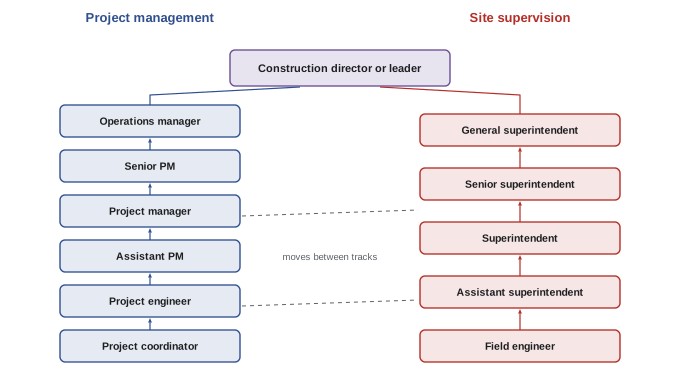
Within contracting firms, careers often follow two broad tracks, which correspond to the two majors of this degree:
| Track | Entry roles | Mid-career roles | Senior roles | Core strengths |
|---|---|---|---|---|
| Project management (office and trailer) | Project coordinator, project engineer, assistant estimator | Project manager, senior estimator, scheduler | Senior project manager, operations manager, vice-president, president | Contracts, cost, schedule, client relationships, commercial judgment |
| Site supervision (field) | Field engineer, assistant superintendent, foreperson | Superintendent, site manager | General superintendent, construction director, operations manager | Leadership of crews, sequencing, logistics, safety, quality, problem solving |
Both tracks are essential, and the best projects are run by project managers and superintendents who respect and support each other. Many people move between tracks or combine them, and senior leaders often have experience of both.
Specialist roles
Beyond the two main tracks, construction offers specialist careers:
- Estimator: quantifying and pricing work, preparing bids and conceptual estimates (CON-200, CON-300).
- Scheduler or planner: building and maintaining project schedules, analyzing delays (CON-210).
- Safety professional: developing safety programs, training, inspecting and investigating (HSE stream).
- Quality manager: quality systems, inspection and test plans, deficiency management (CON-345).
- Virtual design and construction (VDC) or BIM manager: model coordination, 4D and digital tools (CON-260).
- Preconstruction manager: leading early cost, schedule and constructability work.
- Cost consultant or quantity surveyor: advising owners on costs and controlling budgets.
- Claims and dispute consultant: analyzing delay and cost claims (CON-420).
- Sustainability manager: tracking carbon, waste and green building requirements (CON-430).
Skills employers look for
Construction managers combine technical knowledge with business and people skills. Employers consistently look for:
- Technical knowledge of construction methods, materials, drawings, codes and systems.
- Estimating, scheduling and cost control skills.
- Understanding of contracts, risk and documentation.
- Communication: clear writing, presentations, negotiation and listening.
- Leadership and teamwork, including working with trades, clients and designers.
- Problem solving and decision making under pressure.
- Safety leadership and attention to quality.
- Organization, time management and attention to detail.
- Comfort with technology, from scheduling software to field platforms.
- Integrity and professionalism (Lesson 12).
Technical knowledge can be learned in courses like this one, but judgment, leadership and relationships are built through experience, which is why co-op placements, internships and summer jobs on construction sites are so valuable.
Entering the field
People enter construction management through several routes: university degrees in construction management, civil engineering or architecture; college diplomas in construction technology or management; working up from the trades, often supplemented by part-time study; and moving from related fields such as engineering, surveying or real estate. Many firms hire graduates as project coordinators or field engineers and rotate them through estimating, site and project management roles. Co-op and internship programs give students paid experience and frequently lead to job offers. Joining student chapters of industry associations, attending industry events and competitions, and building a network of contacts help students find opportunities.
Professional designations and credentials
Construction management is not a licensed profession in the way engineering and architecture are, but several voluntary designations recognize education, experience and competence, and some roles have licensing or certification requirements.
In the United States, common credentials include the Construction Management Association of America's Certified Construction Manager (CCM); the American Institute of Constructors' Associate Constructor (AC) and Certified Professional Constructor (CPC); the Project Management Professional (PMP); AACE International cost and planning certifications; LEED professional credentials; and OSHA Outreach cards and safety certifications such as those of the Board of Certified Safety Professionals. Many states and localities require general contractors to be licensed, often with examinations on business, law and trade knowledge, and qualifying individuals must meet experience requirements.
Designations are most valuable when combined with experience; they demonstrate commitment and competence and are increasingly requested in public procurement.
Building a career
Successful construction careers usually involve deliberate growth:
- Seek variety early: different project types, sectors and roles build judgment.
- Find mentors: experienced project managers and superintendents are generous teachers.
- Keep learning: courses, designations, conferences and reading keep skills current.
- Build a reputation for reliability, honesty and safety, which travels quickly in a relationship-driven industry.
- Develop leadership deliberately, learning to lead people who may be older or more experienced.
- Manage wellbeing: construction can involve long hours, travel, stress and seasonal pressure, and the industry has high rates of mental health challenges, so building healthy habits and support networks matters.
Worked problem
Planning a five-year career path
A new graduate joins a general contractor as a project coordinator on a hospital project and wants to become a project manager within five years. What steps might a realistic plan include?
Show solution
- Years 1–2: master RFIs, submittals, change orders and documentation; learn the schedule and cost reports; spend time on site with the superintendent.
- Year 2–3: rotate into estimating for a bid cycle and into an assistant superintendent role for a phase of work, if possible.
- Year 3–4: become a project engineer or assistant project manager on a smaller project with responsibility for a scope of subcontracts and the monthly cost forecast.
- Year 4–5: pursue a designation such as Gold Seal (CA) or CCM or AC (US) or the PMP when eligible, and take responsibility as project manager on a small project with senior support.
Answer: A plan combining documentation mastery, rotation through estimating and site roles, growing responsibility for cost and subcontracts, mentorship and a professional designation.
Pay, conditions and outlook
Construction management offers competitive salaries, which rise significantly with experience and responsibility, and often bonuses tied to project and company performance; superintendents and project managers on large projects are among the better-paid roles in the industry. Working conditions vary: site roles involve early starts, outdoor work and sometimes travel or rotational schedules on remote projects; office roles involve deadlines and bid-day pressure. Employment outlooks in both countries are generally strong because of infrastructure renewal, housing demand, energy and industrial investment, and the retirement of experienced managers, although work in particular regions and sectors rises and falls with the cycle (Lesson 1).
A day in the life
It helps to picture the daily work of each track. A project manager's day might begin with emails and a review of the cost report, followed by a meeting with the owner's representative about a change order, a call with a subcontractor about a late submittal, a review of the monthly progress billing, time on site with the superintendent to walk through an upcoming sequence, and an afternoon preparing a schedule recovery plan. A superintendent's day often starts before 7 a.m. with a walk of the site, a crew huddle and safety talk, coordination with forepersons on the day's work, receiving deliveries and inspectors, solving problems as they arise, checking quality and safety, updating the daily report and planning tomorrow's work. Both jobs are fast-paced and varied, and both depend on good relationships.
Moving up and moving across
Advancement in construction usually comes through demonstrated performance on progressively larger and more complex projects. A project coordinator who shows initiative may become an assistant project manager in two or three years and a project manager a few years later; a field engineer may become an assistant superintendent and then a superintendent. Senior roles, such as operations manager, construction director or company leader, require business skills: financial management, business development, people leadership and strategy. Construction managers also move across: from contractor to owner, from building to civil, from estimating to project management, or into consulting and teaching. Each move broadens perspective and skills.
Entrepreneurship
Construction has relatively low barriers to starting a business compared with many industries, and many construction managers eventually start their own contracting, renovation, project management or consulting firms. Success requires more than construction knowledge: business planning, financial management and cash flow, estimating discipline, insurance and bonding, legal compliance, marketing, hiring and safety programs. Many construction businesses fail because of poor cash flow management or bidding work at unprofitable prices. The business courses in this degree, such as accounting, finance and contracts, provide a foundation for those who choose this path.
Lifelong learning
Construction changes constantly: codes are updated, new materials and methods appear, technology evolves and regulations tighten. Professional designations usually require continuing education to maintain them. Construction managers keep learning through courses, seminars, industry associations, trade publications, site visits and, above all, reflection on their own projects. Keeping a personal record of lessons learned, what went well, what went wrong and what you would do differently, turns experience into expertise.
Soft skills that make the difference
Experienced construction leaders often say that technical problems are rarely what sink a career; people problems are. The ability to listen, to explain clearly, to stay calm under pressure, to negotiate firmly but fairly, to give credit, to admit mistakes and to resolve conflict between trades or with clients distinguishes successful project managers and superintendents. These skills can be learned and practiced: by observing respected leaders, asking for feedback, taking on presentations and negotiations, and reflecting on what worked. CON-305 on site supervision and leadership develops them in depth.
Diversity in construction management careers
Construction management careers are open to people from every background, and firms increasingly seek diverse teams, recognizing that diverse perspectives improve problem solving and client relationships. Women, Indigenous people, newcomers and other under-represented groups are growing in number among construction management graduates and professionals, supported by mentorship programs, professional networks and scholarships offered by industry associations. Students should seek out these networks and mentors, and all construction managers can help by creating inclusive workplaces.
Preparing while you study
Students can begin building their careers before graduating. Useful steps include seeking summer and co-op jobs on construction sites or with contractors, even in general labor or administrative roles; joining student associations and competitions, such as estimating and construction management competitions run by industry associations; attending industry events and site tours; building a professional online profile; learning common software such as scheduling, estimating and project management platforms; and keeping a portfolio of course projects, such as estimates, schedules and site logistics plans, that demonstrate skills to employers. Employers value students who show curiosity about how things are built, reliability and a willingness to learn on site.
Interviews and first jobs
In interviews for entry-level roles, employers look for evidence of motivation, communication skills, teamwork, safety awareness and practical understanding of construction. Being able to discuss a project you studied or worked on, explain how you solved a problem, and ask informed questions about the firm's projects makes a strong impression. Once hired, new graduates succeed by being punctual, asking questions, taking notes, volunteering for tasks, spending time on site and learning from every role around them.
Common mistakes
MistakeSeeing only general contractors as employers.
InsteadConsider trades, owners, consultants and developers too.
MistakeNeglecting site experience in an office role.
InsteadSpend time in the field to understand the work.
MistakeRelying on technical knowledge alone.
InsteadDevelop communication, leadership and integrity.
MistakeCollecting designations without experience.
InsteadCombine credentials with real responsibility.
MistakeIgnoring wellbeing in a demanding industry.
InsteadBuild healthy habits and support networks.
Summary and key terms
- Construction managers work for contractors, trades, owners, consultants, developers and their own firms.
- Project management and site supervision are the two main career tracks.
- Specialist roles include estimating, scheduling, safety, quality, VDC and cost consulting.
- Employers value technical knowledge with communication, leadership and integrity.
- People enter through degrees, diplomas, the trades and related fields.
- Voluntary designations and licensing requirements differ between countries.
- Careers grow through variety, mentors, learning, reputation and wellbeing.
- Project coordinator
- Entry-level role supporting project documentation.
- Assistant superintendent
- Entry or mid-level field leadership role.
- Preconstruction
- Cost, schedule and constructability work before construction.
- VDC
- Virtual design and construction.
- Quantity surveyor
- Professional who measures and manages construction costs.
- Gold Seal
- Canadian Construction Association certification program.
- CCM
- Certified Construction Manager, CMAA credential.
- PMP
- Project Management Professional credential.
- Co-op placement
- Paid work term during studies.
- Owner's representative
- Manager of projects on behalf of an owner.
Practice problems
Work each problem on paper first, then reveal the answer to check.
Name four kinds of employers of construction managers.
Show answer
Contractors, trades, owners, consultants, developers.
Name entry roles on the project management track.
Show answer
Project coordinator, project engineer, assistant estimator.
Name entry roles on the site supervision track.
Show answer
Field engineer, assistant superintendent, foreperson.
What does a preconstruction manager do?
Show answer
Leads early cost, schedule and constructability work.
Name five skills employers seek.
Show answer
Technical, estimating, contracts, communication, leadership, safety.
Why are co-op placements valuable?
Show answer
They build experience and often lead to offers.
Name a designation in your country.
Show answer
Gold Seal, PQS (CA); CCM, AC, CPC (US); PMP.
Is construction management licensed like engineering?
Show answer
Generally no, though contractor licensing may apply.
Name two career-building habits.
Show answer
Seek variety, find mentors, keep learning, build reputation.
Why is the employment outlook strong?
Show answer
Infrastructure, housing, energy demand and retirements.
Lesson quiz · 5 questions
Score 60% or more to complete this lesson.
Create a free account to save your progress, take quizzes and earn a certificate.