
CON-100 · Lesson 9 of 12 · 25 min
The workforce: trades, apprenticeship and labor relations
Construction is built by people. Behind every building are electricians, carpenters, ironworkers, plumbers, pipefitters, operators, laborers, bricklayers, sheet metal workers, drywallers, painters, roofers and dozens of other trades, along with the supervisors, technicians and managers who organize their work. The availability, skill, safety and productivity of this workforce determine whether projects can be built at all. This lesson describes the construction workforce: the main trades and how they are trained, apprenticeship and certification systems, union and non-union sectors, workforce demographics and shortages, diversity and inclusion, and what these mean for construction managers.
The construction trades
Construction trades can be grouped into a few families:
| Group | Examples of trades | Typical work |
|---|---|---|
| Structural and civil | Carpenters, ironworkers, cement finishers, laborers, operating engineers | Formwork, rebar, structural steel, concrete, earthwork, equipment operation |
| Mechanical | Plumbers, steamfitters and pipefitters, sprinkler fitters, sheet metal workers, refrigeration mechanics | Piping, HVAC, fire protection, ductwork |
| Electrical | Construction electricians, industrial electricians, power line technicians, low voltage technicians | Power, lighting, controls, communications |
| Envelope and finishing | Bricklayers, roofers, glaziers, drywallers and lathers, painters, floor coverers, tile setters | Masonry, roofing, windows, interiors, finishes |
| Specialized | Elevator constructors, boilermakers, insulators, millwrights, crane operators | Elevators, boilers, insulation, machinery, lifting |
Each trade has its own skills, tools, safety hazards, training system and, in unionized work, its own union and collective agreement. Jurisdictional boundaries between trades, about which trade may perform which work, are sometimes contested and are resolved by agreements, assignment practices and labor boards.
Apprenticeship and certification
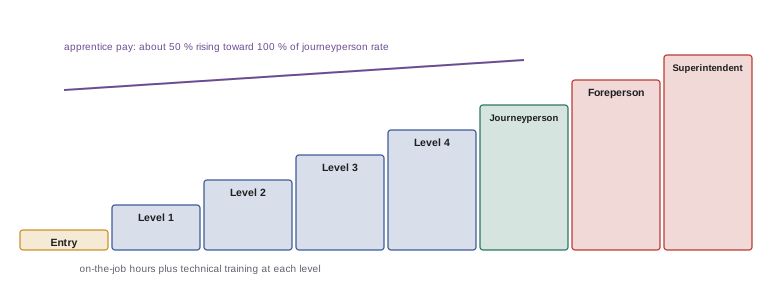
Most construction trades are learned through apprenticeship, which combines paid work on the job under the supervision of qualified tradespeople with periods of technical training at a college, union training center or other institution. Apprentices progress through levels or years, typically over three to five years, and usually earn a rising percentage of a journeyperson's wage.
In the United States, registered apprenticeship programs are approved by the Department of Labor's Office of Apprenticeship or by state apprenticeship agencies, and are run by union joint apprenticeship and training committees, contractor associations, employers and colleges. Licensing of trades is largely a state and local matter: electricians and plumbers are licensed by many states and cities, with journeyman and master levels, while other trades may need no license. Some credentials are national, such as EPA Section 608 certification for refrigerant handling, NCCER credentials and crane operator certification required under OSHA's crane standard.
Construction managers rarely hold trade certificates themselves, although many began their careers in the trades, but they must understand the skills, qualifications and constraints of each trade, plan work to make good use of them, and ensure that only qualified workers perform regulated work.
Union and non-union construction
Construction labor is organized in both union and non-union forms. In the unionized sector, building trades unions represent workers in each trade, negotiate collective agreements with contractor associations, and operate hiring halls and training centers; contractors signed to an agreement hire workers through the union and pay negotiated wages and benefits. The non-union or "open shop" sector consists of contractors who employ workers directly, set wages and benefits themselves, and run their own or association-based training. Some projects use project labor agreements that set uniform terms for all contractors on a large project.
In the United States, building trades unions are affiliated with North America's Building Trades Unions (NABTU), and union membership in construction is roughly a tenth of wage and salary workers, much higher in some metropolitan areas and on large public and industrial projects. Labor relations are governed by the National Labor Relations Act, with special construction provisions such as pre-hire agreements under Section 8(f). Associated Builders and Contractors represents many open shop contractors. Project labor agreements are used on some public and private megaprojects.
Construction managers on unionized projects must understand collective agreements, jurisdiction, hiring procedures, grievance processes and how to work effectively with union stewards and business representatives (CON-365).
Demographics and labor shortages
Both countries face persistent shortages of skilled construction workers. Large numbers of experienced workers are approaching retirement, while too few young people enter the trades to replace them, and demand for construction, from housing, infrastructure renewal, energy projects and data centers, remains high.
Industry associations such as Associated Builders and Contractors estimate that the US construction industry needs to attract several hundred thousand new workers each year on top of normal hiring to meet demand, and surveys by the AGC regularly find that most contractors have difficulty filling craft positions. Immigration plays a large role in the US construction workforce, and changes in immigration policy affect labor availability.
Shortages affect construction managers directly: they raise wages, lengthen schedules, increase overtime and turnover, and make experienced supervisors scarce. They also drive interest in productivity improvements, prefabrication and automation (Lesson 10), and in recruiting from groups historically under-represented in construction.
Worked problem
Estimating crew requirements
A project needs about 36,000 hours of drywall labor over a 20-week installation period. If each drywaller works 40 hours a week and the crew achieves 85 % productive time, how many drywallers are needed at peak, assuming even workload?
Show solution
- Productive hours per worker per week: \(40 \times 0.85 = 34\) hours.
- Productive hours per worker over 20 weeks: \(34 \times 20 = 680\) hours.
- Workers needed: \(36{,}000 / 680 \approx 52.9\), so about 53 drywallers on average.
- Because workload is rarely even, peak demand will be higher, perhaps 60 to 70, which may be difficult to staff in a tight labor market.
Answer: About 53 drywallers on average, with a higher peak, so the schedule and crew plan must be checked against labor availability.
Diversity, inclusion and respect
Construction has historically been one of the least diverse industries, dominated by men. Women make up only a small share of tradespeople in both countries, roughly one in twenty, and a larger but still minority share of construction management and professional roles. Indigenous people, racialized workers, newcomers and people with disabilities face barriers to entry and advancement, including harassment, isolation, lack of mentorship, poorly fitting PPE and inadequate site facilities. Increasing diversity is both a matter of fairness and a practical response to labor shortages. Construction managers play a central role: by setting expectations of respect, preventing harassment and hazing, providing proper washrooms and PPE for all workers, supporting mentorship and apprenticeship, meeting community benefit and inclusion commitments, and modeling inclusive leadership. Programs such as Canada's Building Trades Unions' Build Together and similar US initiatives support women and under-represented groups in the trades.
Productivity and the workforce
Construction labor productivity, output per hour worked, has grown slowly over decades compared with manufacturing and the wider economy, a pattern documented in studies by national statistical agencies and consultancies, although measurement is difficult. Causes include the one-off nature of projects, fragmentation, weather, poor planning, waiting for materials, information or other trades, rework and low adoption of new technology. Research on job sites has repeatedly found that craft workers spend a substantial share of their time on non-productive activities such as waiting, traveling and searching for materials and information. Construction managers improve productivity mainly by planning: ensuring that crews have the information, materials, tools, equipment, access and prerequisite work they need before they start, which is the focus of workface planning and lean construction (CON-335, CON-410).
Supervisors and the front line
Between the managers and the tradespeople are the forepersons and supervisors who lead crews each day. A foreperson is usually an experienced tradesperson who plans the crew's work, assigns tasks, checks quality, enforces safety and reports progress. Forepersons are the critical link between the plan and the work: they turn schedules and drawings into daily tasks, and they know what is really happening in their areas. Construction managers who build strong relationships with forepersons, listen to their concerns and involve them in planning get better results than those who rely only on schedules and reports. Many superintendents began as forepersons, and the site supervision major of this degree builds on that path.
Health, safety and wellbeing of the workforce
Construction work is physically demanding and hazardous. Falls from height, being struck by objects or vehicles, electrocution and being caught in or between equipment are leading causes of fatal injuries, and musculoskeletal injuries, hearing loss, silica exposure and heat stress cause long-term harm. Mental health is also a serious concern: studies in both countries have found elevated rates of suicide, substance use and opioid harm among construction workers, linked to injury, chronic pain, job insecurity, long hours and workplace culture. Industry organizations, unions and employers have developed mental health and substance use programs, peer support and awareness campaigns. Construction managers contribute by planning safe work, preventing fatigue, supporting injured workers and building workplaces where people can ask for help.
Training and upskilling
The workforce needs continuous training as methods, materials and technology change. Contractors and unions provide training in new products, digital tools, safety, supervision and leadership. Trades increasingly need skills in installing heat pumps, solar and battery systems, mass timber, prefabricated assemblies and building controls. Construction managers identify training needs on their projects, ensure that workers have the qualifications required for regulated tasks, and support apprentices with mentorship and suitable assignments, recognizing that today's apprentices are tomorrow's forepersons and superintendents.
Temporary and mobile workforces
Construction employment is project-based, so workers frequently move between employers and sites, and many travel long distances for major projects. Large industrial and remote projects use camps and rotational schedules, such as several weeks on and a week off, which bring challenges for fatigue, family life and community impacts. Labor mobility rules, such as recognition of trade certificates between provinces or states, affect how easily workers can move to where work is. Understanding these patterns helps construction managers plan recruitment, accommodation and retention for their projects.
Wages, benefits and labor costs
Labor costs include much more than hourly wages. Employers pay payroll taxes and statutory contributions, such as employment insurance, pension plans and workers' compensation premiums in Canada or Social Security, Medicare, unemployment insurance and workers' compensation in the United States, along with vacation and holiday pay, health and pension benefits, and training contributions under collective agreements. These additions, often called labor burden, can add a substantial percentage to the base wage. Estimators must use fully burdened labor rates when pricing work, and construction managers must understand how overtime premiums, shift differentials and travel allowances affect the cost of accelerating a schedule.
Subcontracting and the workforce
Because general contractors subcontract most trade work, the majority of the workforce on a building site is employed by subcontractors. The general contractor's influence over workers is therefore indirect, through subcontract terms, site rules, coordination and leadership. Effective construction managers set clear expectations for every company on site, from safety and conduct to cleanliness and quality, and hold all employers to them consistently, while respecting that each subcontractor directs its own workers.
Workforce planning for a project
Construction managers plan the workforce for each project much as they plan materials and equipment. A manpower or workforce histogram, built from the schedule and estimated labor hours, shows how many workers of each trade are needed in each period. Comparing the histogram with the expected availability of labor, from union halls, subcontractors or the local market, reveals periods when demand will exceed supply. Construction managers can then adjust the schedule, add shifts, increase prefabrication, bring in workers from other regions, or start recruitment and apprenticeship programs early. On large projects, accommodation, transportation and training for workers must also be planned.
Respectful workplaces and site culture
Site culture strongly affects safety, productivity and retention. Sites where workers are treated with respect, where concerns are heard, where facilities are clean and adequate, and where harassment and discrimination are not tolerated keep workers longer and attract new entrants to the trades. Construction managers shape culture through their own behavior, the expectations they set in orientations and contracts, how they respond to complaints, and whom they recognize and promote.
Common mistakes
MistakeIgnoring trade jurisdiction on union sites.
InsteadAssign work according to agreements and practice.
MistakeAssuming labor will always be available.
InsteadCheck crew needs against market availability.
MistakeLetting unqualified workers do regulated work.
InsteadVerify certifications and apprenticeship ratios.
MistakeTolerating harassment as "site culture".
InsteadSet and enforce standards of respect.
MistakeBlaming workers for low productivity.
InsteadRemove constraints through better planning.
Summary and key terms
- Construction relies on many trades grouped into structural, mechanical, electrical, finishing and specialized families.
- Most trades are learned through apprenticeship combining work and technical training.
- Certification and licensing systems differ between Canada and the United States.
- Union and open shop sectors coexist, with different hiring and bargaining.
- Retirements and strong demand create persistent labor shortages.
- Greater diversity and respect are essential and practical.
- Productivity depends largely on planning that removes constraints.
- Journeyperson
- Fully qualified tradesperson who has completed apprenticeship.
- Apprenticeship
- Training combining paid work and technical instruction.
- Compulsory trade
- Trade that only certified workers or apprentices may perform.
- Red Seal
- Interprovincial standard of excellence for Canadian trades.
- Registered apprenticeship
- Government-approved apprenticeship program in the US.
- Collective agreement
- Negotiated contract between union and employers.
- Open shop
- Non-union construction employment.
- Project labor agreement
- Uniform labor terms for all contractors on a project.
- Jurisdiction
- Which trade performs which work.
- Labor productivity
- Output per hour worked.
Practice problems
Work each problem on paper first, then reveal the answer to check.
Name three mechanical trades.
Show answer
Plumbers, pipefitters, sprinkler fitters, sheet metal workers.
What does apprenticeship combine?
Show answer
On-the-job work and technical training.
Typical length of apprenticeship?
Show answer
Three to five years.
What is a compulsory trade?
Show answer
One only certified workers or apprentices may perform.
What is an open shop?
Show answer
Non-union construction employment.
What is a project labor agreement?
Show answer
Uniform labor terms for all contractors on a project.
Name two causes of labor shortages.
Show answer
Retirements, too few entrants, high demand.
Workers for 20,000 hours over 10 weeks at 34 productive hours/week?
Show answer
About 59.
Name two ways managers support inclusion.
Show answer
Prevent harassment, proper facilities and PPE, mentorship.
How do managers improve productivity most?
Show answer
By planning to remove constraints before work starts.
Lesson quiz · 5 questions
Score 60% or more to complete this lesson.
Create a free account to save your progress, take quizzes and earn a certificate.