
CON-325 · Lesson 6 of 12 · 25 min
Lift planning and critical lifts
Most crane lifts on a building site are routine: a bundle of reinforcing steel to the deck, a stack of formwork, a lumber package to the floor below the framers. They follow standard rigging methods, use well-understood loads and happen many times a day. A few lifts are different. They are near the crane's capacity, pass over people, use two cranes, involve lifting workers, land loads where the operator cannot see, or take place during the erection and dismantling of the crane itself. These lifts need more planning, more review and more control. HSE-219 lesson 5 explained what goes into a lift plan and the roles on a lift. This lesson takes the superintendent's view: setting up a lift planning system for the project, deciding which lifts are critical, integrating them into the logistics plan and making sure the plan is followed on the day.
A lift planning system for the project
A lift planning system defines, for the whole project, how lifts are categorized, who plans and approves each category, what documents are needed, and how lifts are scheduled and supervised. It is usually based on the contractor's corporate crane policy, adjusted for the site and the cranes in use. Writing it down at the start avoids the common situation where every lift is treated as routine until something goes wrong, or where the definition of a critical lift depends on who is asked.
Thornbury's crane policy, applied to Larkspur Commons, has three categories.
| Category | Examples | Planning and approval |
|---|---|---|
| Ordinary lifts | Repetitive lifts of known loads within 75 percent of capacity, with the operator able to see the load or guided by a signal person | Daily crane schedule; standard rigging; qualified rigger and signal person |
| Critical lifts | Over 75 percent of capacity; over occupied areas or the public; tandem lifts; lifting personnel; crane erection, climbing and dismantling; lifts near power lines; unusual loads | Written lift plan by a qualified person; review by the superintendent and, where required, an engineer; pre-lift meeting; sign-off before the lift |
| Prohibited lifts | Over 90 percent of rated capacity; side loading; dragging loads; lifts outside the manufacturer's limits | Not permitted; the plan must change |
The percentages in the policy are company choices, not legal limits. Many contractors use 75 percent or 80 percent as the trigger for a critical lift and 90 percent or 95 percent as the upper limit, because load weights are often uncertain, rigging adds weight, wind adds load and dynamic effects add stress. Some regulations and owners set their own definitions. The important point is that the definitions are clear, written and applied consistently.
Classifying the lifts
At the start of each phase, Dana's team lists the lifts that may need special treatment and classifies them. The list for the wood-frame and roofing phase included the following.
# Classify planned lifts under Thornbury's crane policy (illustrative policy, not a regulation)
lifts = [
    # name, percent of rated capacity, flags
    ("Rebar bundle to podium deck", 48, set()),
    ("Lumber package from lane bay", 66, set()),
    ("Prefabricated wall panel, blind landing on L5", 52, {"blind"}),
    ("Rooftop unit by mobile crane over the street", 81, {"over public"}),
    ("Tower crane jib section during dismantling", 70, {"crane assembly"}),
    ("Steel canopy beam with two cranes", 60, {"tandem"}),
    ("Workers on a suspended personnel platform", 20, {"personnel"}),
]

def classify(pct, flags):
    reasons = []
    if pct > 90:
        return "Prohibited", ["over 90% of rated capacity"]
    if pct > 75:
        reasons.append("over 75% of capacity")
    for f in sorted(flags & {"over public", "tandem", "personnel", "crane assembly"}):
        reasons.append(f)
    if reasons:
        return "CRITICAL - written plan and pre-lift meeting", reasons
    if "blind" in flags:
        return "Ordinary - signal person and radio check", ["blind landing"]
    return "Ordinary - daily crane schedule", []

for name, pct, flags in lifts:
    cat, why = classify(pct, flags)
print(f"{name:<48} {pct:>3}% {cat}" + (f" ({', '.join(why)})" if why else ""))Rebar bundle to podium deck 48% Ordinary - daily crane schedule Lumber package from lane bay 66% Ordinary - daily crane schedule Prefabricated wall panel, blind landing on L5 52% Ordinary - signal person and radio check (blind landing) Rooftop unit by mobile crane over the street 81% CRITICAL - written plan and pre-lift meeting (over 75% of capacity, over public) Tower crane jib section during dismantling 70% CRITICAL - written plan and pre-lift meeting (crane assembly) Steel canopy beam with two cranes 60% CRITICAL - written plan and pre-lift meeting (tandem) Workers on a suspended personnel platform 20% CRITICAL - written plan and pre-lift meeting (personnel)
Two of the critical lifts are critical for reasons other than weight. The tower crane jib section during dismantling is only at 70 percent of the assist crane's capacity, but crane assembly and disassembly are always treated as critical because the consequences of error are so severe (lesson 4). The workers on a suspended personnel platform are at only 20 percent of capacity, but lifting people with a crane is permitted only when no safer means of access is practical, and it needs a dedicated plan, special equipment and trial lifts. On Larkspur Commons, the team avoided that lift entirely by using a mast climbing work platform to reach the facade anchor, which shows that classifying lifts early often leads to better methods, not just more paperwork.
The blind landing of the prefabricated wall panel is classed as ordinary but with conditions: a dedicated signal person on the landing floor, a radio check before the lift and a stop if communication is lost. Blind lifts are common on buildings because the operator in the cab often cannot see the landing area on the far side of the building.
What a critical lift plan contains
A critical lift plan describes the lift in enough detail that everyone involved understands it and a reviewer can check it. HSE-219 lesson 5 listed the typical contents; in summary, the plan shows:
- the load: weight, center of gravity, lifting points and how the weight was determined;
- the crane: model, configuration, position, radius at pick and set-down, rated capacity and percentage of capacity;
- the rigging: slings, shackles, spreader bars and below-the-hook devices, with their ratings, angles and inspection status;
- the ground and support: mats, outrigger loads, bearing pressures and any engineer's review;
- the site: obstructions, power lines, exclusion zones, traffic control and protection of the public;
- the people: lift director, operator, riggers, signal persons and their qualifications;
- the conditions: wind and weather limits, lighting and communication methods;
- the sequence: the steps of the lift and the stop criteria; and
- the approvals and signatures.
The superintendent's review focuses on the interfaces with the rest of the site, which a crane specialist may not see. Is the street closure permit in place for the date? Is the sidewalk below protected? Will a delivery or a concrete pour need the gate at the same time? Has the neighbor been told? Is the landing area clear and strong enough? Who will stop other trades from working under the load path?
Weights and centers of gravity
Most lifting incidents involving overloads begin with a wrong weight. Weights should come from reliable sources: the manufacturer's certified weight, a weighed load, or a calculation from drawings and material densities, with an allowance for items that are not on the drawings. Suppliers' estimates on a phone call, or a guess based on the size of the load, are not good enough for a critical lift. The center of gravity matters as much as the weight, because a load lifted off its center of gravity tilts, shifts its weight unevenly onto the slings and can slip out of its rigging.
The rooftop mechanical unit on Larkspur Commons is a good example. The mechanical subcontractor's submittal gave a shipping weight, but the unit as delivered included a curb adapter and an economizer section not in the submittal. The supplier's certified lift drawing showed an operating weight about 1,300 pounds heavier, with the center of gravity well off center toward the compressor end. The lift plan used the certified figures and a spreader bar with adjustable pick points to keep the unit level.
Lifting prefabricated components
Prefabrication (CON-315 lesson 8, CON-410 lesson 9) brings more and larger lifts to the site: wall panels, floor cassettes, bathroom pods, stair units, mechanical skids. Each prefabricated component needs designed lifting points and, often, below-the-hook lifting devices such as spreader beams or lifting frames. The lifting points are designed by the component manufacturer's engineer and must be used as designed; lifting a panel by a different point, or with slings at angles other than those shown, can overload the connections or the panel itself.
Below-the-hook lifting devices must be designed, marked with their rated load and inspected, following ASME B30.20 and the design standard ASME BTH-1, which OSHA and manufacturers commonly reference. Wall panels on Larkspur Commons are lifted with a spreader beam supplied by the panel fabricator, with the rated load marked on it, and the lifting inserts are inspected on each panel before it is lifted.
Delivery sequence is part of the lift plan for prefabricated components. Panels must arrive in the order they will be installed, oriented on the truck so that they can be lifted directly into position, with tag lines attached before the lift. A truck that arrives loaded in the wrong order can mean hours of re-handling or temporary storage on a site with no space. This is another reason the delivery booking and the crane schedule are managed together.
Lifts over the public and occupied areas
The safest rule is not to lift loads over people. On an urban site, this means arranging the crane's working zones so that loads stay over the site, closing or protecting sidewalks and streets when loads must pass over them, and stopping work in areas of the building under the load path. Overhead protection such as a covered way (lesson 10) protects against falling debris, but it is not designed to stop a falling crane load.
On Larkspur Commons, the crane's zoning system keeps loads out of the neighbors' airspace and over the site, except for one corridor over the street used for unloading at the street-side laydown. Lifts in that corridor happen only when the sidewalk below is closed with flaggers, under a permit that allows short closures at off-peak hours. The rooftop unit lift by mobile crane, after the tower crane has gone, needs a full closure of the street lane and sidewalk for half a day, which is booked months in advance.
Inside the building, work under crane loads is controlled by exclusion zones that move with the load. When a lumber package is flown to level 5, the area of level 5 where it will land is cleared, and no one works on the floors directly below the load path if there is any open edge or shaft through which a dropped item could fall. These controls depend on signal persons and foremen who know the day's crane plan, which is why the daily crane schedule is shared at the morning huddle.
Tandem lifts and multiple cranes
A tandem lift uses two cranes to lift one load. Tandem lifts are much more complex than single-crane lifts, because the load shares between the cranes change as the load moves, the cranes must move in coordination, and a failure of one crane can overload the other. They are always critical lifts, usually require an engineer's review, and should be avoided where a single crane can do the job.
On Larkspur Commons, the steel canopy beam along the retail frontage was originally planned as a tandem lift with the tower crane and a mobile crane, because the beam is long and heavy for the tower crane at that radius. The steel erector's engineer instead split the beam into two pieces with a bolted splice over an intermediate column, allowing single-crane lifts. Again, the planning process led to a simpler method.
Where several cranes work on one site, their working zones may overlap. Collision avoidance systems, zoning, different heights for the jibs, and communication protocols keep them apart. Even on a site with one tower crane, the boom trucks, concrete pump booms and mobile cranes that visit must be considered as additional cranes for collision planning.
The pre-lift meeting and the day of the lift
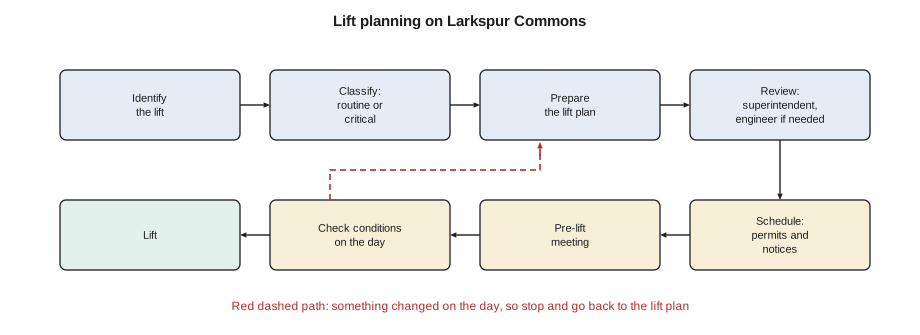
For every critical lift, the people involved meet before the lift to go through the plan: the operator, the lift director, the riggers, the signal persons, the superintendent or his or her delegate, and anyone controlling the area below. The meeting confirms the weight, the rigging, the path, the signals, the wind limits, the exclusion zones and the stop criteria, and asks each person whether anything has changed since the plan was written. HSE-219 lesson 5 described the meeting and the trial lift.
Many critical lift incidents happen because something changed on the day: a different crane configuration, a heavier load, a wind gust, a crew member replaced, a truck parked where the outrigger mat should go. The superintendent's role is to make it acceptable, even expected, to stop and replan when conditions differ from the plan. CON-305 discussed how leaders build the trust that makes people willing to speak up. A lift director who calls off a lift because the wind is gusting above the limit should be thanked, not questioned about the cost of the crane.
Records and learning
Lift plans, pre-lift meeting records, inspection records for rigging and equipment, and operator qualifications form part of the project's safety records. They also support learning: if a lift went differently from the plan, the team should find out why and update the plan for similar lifts. On Larkspur Commons, the first two prefabricated wall panels took twice as long to land as planned, because the tag lines were too short and the landing crew could not reach them safely. The plan was revised to use longer tag lines and a landing crew of three, and later panels landed on time.
Near misses deserve the same attention. A load that swung into a scaffold, a sling that slipped, an operator who lost sight of the signal person: each is a free lesson about what could go wrong in a more serious way. CON-355 and the incident investigation courses cover the methods; the logistics point is that lift planning improves only if the site reports and discusses what actually happens.
Common mistakes
MistakeDefining a critical lift only by percentage of capacity.
InsteadInclude lifts over the public, tandem lifts, personnel lifts, crane assembly and dismantling, blind and unusual lifts.
MistakeUsing a supplier's estimated weight for a critical lift.
InsteadUse certified or weighed weights and the center of gravity, with allowances for added components.
MistakeLifting prefabricated panels by any convenient point.
InsteadUse the designed lifting points and rated below-the-hook devices exactly as specified.
MistakeRelying on a covered way to protect the public from crane loads.
InsteadKeep loads away from people; close or protect areas under load paths.
MistakeProceeding with a critical lift when conditions differ from the plan.
InsteadStop and replan; make stopping expected and supported.
Summary and key terms
- A project lift planning system defines lift categories, responsibilities, documents, scheduling and supervision.
- Critical lifts include those near capacity, over people, tandem, personnel and crane assembly or dismantling lifts.
- Percentage triggers are company choices; they must be written and applied consistently.
- Classifying lifts early often leads to safer methods, such as avoiding personnel lifts or tandem lifts.
- Lift plans must use reliable weights and centers of gravity.
- Prefabricated components need designed lifting points, rated devices and correct delivery sequence.
- Loads should not pass over the public or workers; areas under load paths are closed or controlled.
- Pre-lift meetings confirm the plan, and changes on the day must lead to replanning.
- Lift planning system
- A project procedure defining how lifts are categorized, planned, approved and supervised.
- Critical lift
- A lift that needs a written plan and extra review because of its risk.
- Lift director
- The person who directs a lift and has authority to stop it.
- Blind lift
- A lift in which the operator cannot see the load or landing and relies on a signal person.
- Tandem lift
- A lift using two or more cranes to lift one load.
- Below-the-hook lifting device
- A device such as a spreader beam or lifting frame used between the hook and the load.
- Center of gravity
- The point at which a load's weight acts; the hook must be above it for a level lift.
- Pre-lift meeting
- A meeting of the lift team before a critical lift to confirm the plan and conditions.
Practice problems
Work each problem on paper first, then reveal the answer to check.
Name the three categories in Thornbury's crane policy.
Show answer
Ordinary, critical and prohibited lifts.
Why is a crane dismantling lift critical even at 70 percent of capacity?
Show answer
Crane assembly and disassembly have severe consequences and are always treated as critical.
How did the team avoid the personnel platform lift?
Show answer
By using a mast climbing work platform to reach the facade anchor.
Why did the rooftop unit lift plan change after the certified drawing arrived?
Show answer
The unit was about 1,300 pounds heavier with an off-center center of gravity, so a spreader with adjustable pick points was used.
How was the tandem lift of the canopy beam avoided?
Show answer
The beam was split into two pieces with a bolted splice over an intermediate column.
What protects the public under the street lifting corridor?
Show answer
Lifts only when the sidewalk below is closed with flaggers under a permit.
Name three things the superintendent checks in a lift plan that a crane specialist may miss.
Show answer
Any three of: permits, protection below, competing deliveries or pours, neighbor notice, landing area readiness, control of trades under the load path.
What changed after the first two wall panels?
Show answer
Longer tag lines and a landing crew of three.
Lesson quiz · 5 questions
Score 60% or more to complete this lesson.
Create a free account to save your progress, take quizzes and earn a certificate.