
CON-345 · Lesson 10 of 12 · 23 min
Nonconformances and corrective action
Even with good plans, careful first work and regular inspection, some work will not conform. A bar will be misplaced, a cylinder will break low, a window will leak, a base plate will not fit. What separates a strong quality program from a weak one is not whether nonconformances happen but what happens next: whether they are found quickly, recorded honestly, resolved with the right people's approval and, above all, prevented from happening again. This lesson follows the nonconformance process on Larkspur Commons from the moment a problem is found to the point where its cause has been removed.
What counts as a nonconformance
A nonconformance is any work, material or document that does not meet a specified requirement. It may be found by the installer, the contractor, a consultant, an inspector or a test. Not every small defect needs the formal process. Thornbury distinguishes three levels.
| Level | Example | How it is handled |
|---|---|---|
| Defect corrected in the normal course of work | A missing nail plate found by the plumber before calling for inspection | Fixed immediately by the installer; no record needed beyond the installer's own checklist |
| Deficiency | A scuffed door, a missing outlet cover, a paint touch-up | Recorded on a deficiency list and closed by the responsible trade (lesson 11) |
| Nonconformance | Low concrete strength, misplaced reinforcing, a failed water test, a component that does not fit | Recorded on a nonconformance report (NCR); dispositioned with the appropriate approvals; root cause analyzed if significant |
The line between a deficiency and a nonconformance is drawn by consequence: does the problem affect structure, safety, durability, code compliance or the function of a system, or does it need a decision by the design team? If so, it is a nonconformance. When in doubt, Mei writes an NCR, because an NCR that turns out to be minor costs a few minutes, while a serious problem handled informally can cost a great deal.
The nonconformance process
Thornbury's procedure has seven steps, each with an owner and a record.
| Step | What happens | Who |
|---|---|---|
| 1. Identify | Describe the nonconformance precisely: location, requirement, what was found, evidence | Whoever finds it; recorded by the field engineer |
| 2. Control | Mark or tag the work, stop further work that would cover or depend on it, and notify the affected trades | Field engineer, superintendent |
| 3. Notify | Inform the consultant or engineer whose design is affected, and the owner where the contract requires | Field engineer, project manager |
| 4. Disposition | Decide what to do: use as is, repair, rework or reject and replace | Contractor proposes; designer approves where the design is affected |
| 5. Correct | Carry out the approved disposition | Responsible trade |
| 6. Verify | Inspect or test the corrected work and close the NCR | Field engineer; consultant where required |
| 7. Prevent | For significant or repeated NCRs, find the root cause and take corrective action to stop recurrence | Field engineer, quality manager, trade |
Step 2 is the one most often skipped under schedule pressure. If a reinforcing problem is found an hour before a pour, the temptation is to let the pour proceed and sort it out afterwards. Once the concrete is placed, many dispositions are no longer possible, and the remaining ones are usually more expensive. On Larkspur Commons, Mei has the authority to stop work affected by a nonconformance, and Dana backs her when she uses it.
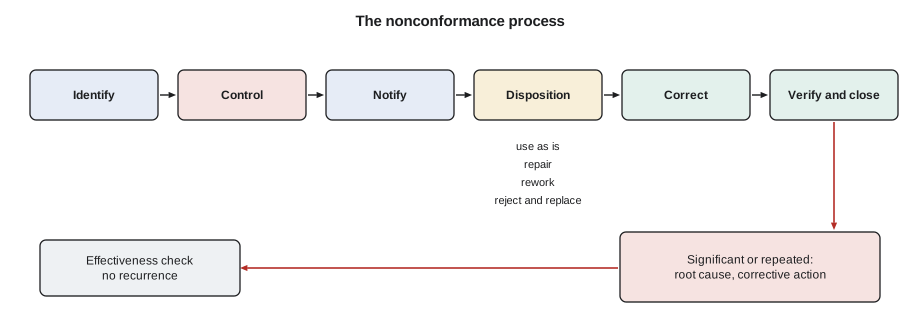
Dispositions
The disposition is the decision about what to do with the nonconforming work. There are four standard options.
| Disposition | Meaning | Who must approve | Example |
|---|---|---|---|
| Use as is | Accept the work without change because it still meets the design intent | The designer responsible, in writing; the owner where the contract requires | The low three-test average in lesson 6, accepted by the engineer after review |
| Repair | Bring the work to an acceptable condition that may differ from the original requirement | The designer responsible, with an approved repair method | Additional nails on shear wall W2 (lesson 5); protective coating on podium wall W-7 (lesson 6) |
| Rework | Redo the work so that it meets the original requirement | Contractor; verified by inspection | Rebuilding the mock-up sill (lesson 4); recompacting fill (lesson 7) |
| Reject and replace | Remove the work or material and replace it | Contractor; verified by inspection | Rejecting a load of concrete; replacing a damaged window |
Use-as-is and repair dispositions change what the owner receives, so they need the approval of the designer whose design is affected, and often the owner's acceptance. An engineer's approval of a repair is technical; the owner may still be entitled to a credit if the repaired work is of lower value, for example a visible patch in exposed concrete. Thornbury's NCR form has a line for the owner's acceptance whenever the disposition is use as is or repair.
A worked nonconformance: NCR-034
NCR-034 is a good example of the whole process. When the steel erector set the stair 2 stringers at the podium, the base plate did not fit over its anchor bolts. The anchor bolts had been cast in the slab six weeks earlier, exactly where the structural drawings showed them. The base plate, as fabricated, was 1 5/8 in off, because the stair shop drawings had moved it to clear a revised door frame and nobody had told the field.
Step by step, the team identified the problem with measurements and photographs; controlled it by stopping the stair erection and tagging the base plate; notified the structural engineer and the architect; and asked the engineer to choose between options proposed by the steel fabricator. The options were to cut off and relocate the anchor bolts with post-installed anchors, to slot and add plate washers within limits the engineer would set, or to fabricate a new base plate matching the cast-in bolts and shift the door frame back. The engineer chose post-installed anchors at the new location, with a specified epoxy anchor system, special inspection of the installation and pull tests on two anchors. The fabricator installed them, the testing agency witnessed the pull tests, the engineer reviewed the results and the NCR was closed eleven days after it was opened.
The root cause analysis took longer, and it was more valuable. The question was not who made the mistake, but why the system allowed a shop drawing to move a structural connection without the field knowing.
Root cause analysis
Root cause analysis asks why a problem happened, repeatedly, until it reaches a cause that, if removed, would prevent the problem from recurring. PMP-131 introduced the 5 whys and the cause-and-effect or fishbone diagram. Both are used on site. For NCR-034, Mei led a short session with the fabricator's detailer, the steel erector, the architect's representative and Omar.
| Why? | Answer |
|---|---|
| Why did the base plate not fit? | It was fabricated 1 5/8 in from the anchor bolt location. |
| Why was it fabricated there? | The stair shop drawing moved it to clear the revised door frame. |
| Why did the shop drawing move it without the field knowing? | The change was shown on the shop drawing but not identified as a deviation from the structural drawings. |
| Why was it not identified as a deviation? | The detailer saw it as a minor coordination change, and Thornbury's review did not compare the shop drawing with the anchor bolt layout. |
| Why did the review not compare them? | The submittal checklist for miscellaneous steel had no step for checking embedded items already installed. |
The root cause was in Thornbury's own process: the submittal review checklist. The corrective action was to add a step to the checklist requiring every steel, stair and equipment shop drawing to be compared with the as-built locations of embedded items, and to require detailers to cloud and list every change from the structural or architectural drawings. Lesson 4's principle, that hidden deviations are not approved, applied exactly. The same check later caught a mismatch between the elevator rail bracket embeds and the elevator supplier's shop drawings before the elevator steel was fabricated.
Corrective and preventive action
Corrective action removes the cause of a nonconformance that has happened so it does not recur. Preventive action removes the cause of a potential nonconformance that has not happened yet, often found by looking at near misses, trends or problems on other projects. In ISO 9001's current language the separate term preventive action has largely been folded into risk-based thinking, but the distinction is still useful on site.
A corrective action is only finished when it has been shown to work. Mei checks effectiveness by looking for recurrence over a set period. For the submittal checklist change, she reviewed the next twelve steel and equipment submittals and confirmed that each had been compared with the as-built embeds. For the shear wall nailer change in lesson 5, the evidence was that the follow-up inspections on the next four floors found no recurrence. An action that has not been checked is a hope, not a correction.
The NCR log
All NCRs are kept in a log that shows their status, age, disposition, cause and cost. Lena reviews it at the monthly quality meeting, looking for three things: NCRs that have been open too long, causes that keep recurring, and trades whose NCR rates are rising.
# NCR log summary at the end of month 10 (illustrative)
from collections import Counter
ncrs = [  # (id, trade, cause, disposition, days open, closed, cost in thousand dollars)
    ("NCR-021", "concrete", "method/skill", "repair", 9, True, 14.2),
    ("NCR-024", "earthworks", "method/skill", "rework", 3, True, 2.1),
    ("NCR-026", "waterproofing", "coordination", "rework", 14, True, 22.4),
    ("NCR-027", "rebar", "supervision/checking", "repair", 21, True, 31.5),
    ("NCR-029", "storefront", "information", "rework", 12, True, 18.4),
    ("NCR-031", "framing", "method/skill", "repair", 6, True, 3.9),
    ("NCR-032", "windows", "method/skill", "rework", 8, True, 11.6),
    ("NCR-033", "PT", "supervision/checking", "use as is", 5, True, 0.8),
    ("NCR-034", "misc. steel", "information", "repair", 11, True, 9.7),
    ("NCR-035", "fireproofing", "coordination", "repair", 4, True, 1.2),
    ("NCR-036", "air barrier", "material", "rework", 0, False, 0.0),
    ("NCR-037", "framing", "coordination", "repair", 0, False, 0.0),
]
closed = [n for n in ncrs if n[5]]
print(f"NCRs: {len(ncrs)}, closed {len(closed)}, open {len(ncrs) - len(closed)}")
print(f"average days to close: {sum(n[4] for n in closed) / len(closed):.1f}")
print(f"cost of closed NCRs: {sum(n[6] for n in closed):.1f} thousand dollars")
print("by cause:", dict(Counter(n[2] for n in ncrs).most_common()))
print("by disposition:", dict(Counter(n[3] for n in ncrs).most_common()))NCRs: 12, closed 10, open 2
average days to close: 9.3
cost of closed NCRs: 115.8 thousand dollars
by cause: {'method/skill': 4, 'coordination': 3, 'supervision/checking': 2, 'information': 2, 'material': 1}
by disposition: {'repair': 6, 'rework': 5, 'use as is': 1}Method and skill problems were the most common cause in this period, followed by coordination, information and checking problems, with one material problem. That points the improvement effort toward preparatory phases and preinstallation meetings for method and skill, and toward submittal and coordination checks for the others. The single most expensive NCR, the reinforcing cover problem at wall W-7 (NCR-027), was a checking failure: the initial phase had been a quick look. A small number of expensive NCRs often teaches more than a large number of cheap ones.
Costs and back-charges
When a subcontractor's work does not conform, the subcontract normally makes it responsible for correcting the work at its own cost, and for the cost of related damage and delay. When the subcontractor corrects the work itself, the cost stays where it falls. When the general contractor has to correct it, or pays others to, it may recover the cost by a back-charge, a deduction from amounts owed to the subcontractor. Back-charges are a frequent source of disputes, so the procedure matters.
- Give notice. The subcontract usually requires written notice of the defect and an opportunity for the subcontractor to correct it before the contractor does the work and charges for it.
- Record the facts. The NCR, photographs, test results and the designer's disposition are the evidence.
- Track the costs separately. Labor, materials, equipment and third-party costs should be recorded against the NCR as they are incurred, not estimated afterwards.
- Charge promptly. A back-charge raised months later, after the subcontractor's crew has left, is harder to support and harder to resolve.
Under the AIA A201 general conditions and subcontracts such as the AIA A401, the owner's remedies against the general contractor for defective work, such as requiring correction or, after notice, correcting it and deducting the cost, flow down to the subcontractors through the subcontract terms, together with the notice provisions in those terms.
# Back-charge for NCR-026 (garage waterproofing leak at wall-to-deck transition), illustrative
crew_hours = 64
crew_rate = 92.0            # blended hourly rate including burden
materials = 3_850.0
equipment = 1_200.0           # lift rental and pressure washer
third_party = 9_400.0         # concrete repair contractor
markup = 0.10                 # subcontract markup on contractor-performed corrective work
direct = crew_hours * crew_rate + materials + equipment + third_party
total = direct * (1 + markup)
print(f"crew time {crew_hours * crew_rate:,.0f}, materials {materials:,.0f}, equipment {equipment:,.0f}, third party {third_party:,.0f}")
print(f"direct cost {direct:,.0f}; with {markup:.0%} markup {total:,.0f}")crew time 5,888, materials 3,850, equipment 1,200, third party 9,400 direct cost 20,338; with 10% markup 22,372
In this case the waterproofing subcontractor accepted the charge without dispute because it had been given written notice and the chance to make the repair itself, had declined because its crew was on another job, and had seen the cost records as they were kept. The figure became part of the internal failure cost in Lena's cost-of-quality report.
A culture that reports nonconformances
The nonconformance process only works if people report problems. A culture in which reporting a problem leads to blame produces a short NCR log and a building full of hidden defects. Thornbury's approach on Larkspur Commons treats a self-reported nonconformance as good news: a foreman who reports a problem in his own crew's work gets help to fix it, and the NCR records the finding as self-reported. Over the project, about 60 percent of NCRs were self-reported by the installing trade or Thornbury, and the rest were found by consultants, inspectors or tests. Lena watches that ratio. A falling share of self-reported NCRs suggests either that the trades have stopped looking or that they have stopped telling.
Lesson 12 returns to quality culture. The point here is that the nonconformance process is as much about learning as about fixing, and learning needs honest information.
Common mistakes
MistakeLetting work proceed over a nonconformance to save time.
InsteadControl the work first: tag it and stop anything that would cover or depend on it until the disposition is decided.
MistakeChoosing a use-as-is or repair disposition without the designer's approval.
InsteadGet written approval from the designer whose design is affected, and the owner's acceptance where the contract requires.
MistakeStopping the root cause analysis at the person who made the error.
InsteadKeep asking why until you reach a process cause that can be changed.
MistakeClosing a corrective action without checking whether it worked.
InsteadVerify effectiveness by checking for recurrence over a defined period.
MistakeRaising back-charges late and without notice.
InsteadGive written notice and an opportunity to correct, record costs against the NCR as incurred, and charge promptly.
Summary and key terms
- A nonconformance is work, material or a document that does not meet a requirement; consequence decides whether it needs the formal process.
- The process is identify, control, notify, disposition, correct, verify and prevent.
- Controlling the work, by tagging it and stopping dependent work, is the step most often skipped under pressure.
- Dispositions are use as is, repair, rework, and reject and replace; use as is and repair need the designer's approval.
- Root cause analysis keeps asking why until it reaches a process cause; NCR-034's root cause was a gap in the submittal checklist.
- Corrective action removes the cause of an actual problem and must be checked for effectiveness.
- The NCR log shows open items, recurring causes and trade trends; a few expensive NCRs often teach the most.
- Back-charges require notice, records and prompt action; a culture that rewards self-reporting keeps the log honest.
- Nonconformance
- Work, material or a document that does not meet a specified requirement.
- Nonconformance report
- The record of a nonconformance, its disposition, correction and closure.
- Disposition
- The decision about what to do with nonconforming work.
- Use as is
- A disposition accepting nonconforming work without change because it still meets the design intent.
- Repair
- A disposition bringing work to an acceptable condition that may differ from the original requirement.
- Root cause
- The underlying cause which, if removed, would prevent a problem from recurring.
- Corrective action
- Action to remove the cause of a nonconformance and prevent recurrence.
- Back-charge
- A deduction from amounts owed to a subcontractor to recover the cost of correcting its work.
Practice problems
Work each problem on paper first, then reveal the answer to check.
Is a scuffed door a deficiency or a nonconformance? What about a low cylinder strength?
Show answer
The scuffed door is a deficiency; the low strength is a nonconformance because it may affect structure and needs the engineer's decision.
Why does step 2, control, matter so much?
Show answer
Once the work is covered or built on, many dispositions are no longer possible and the rest cost more.
Which disposition did the engineer choose for NCR-034, and what verification followed?
Show answer
Post-installed epoxy anchors at the new location, with special inspection and pull tests on two anchors.
What was the root cause of NCR-034, and what was the corrective action?
Show answer
The submittal checklist had no step to compare shop drawings with installed embeds; the checklist was changed and detailers must cloud every change.
From the NCR log, what was the most common cause and the most expensive NCR?
Show answer
Method and skill; NCR-027, the reinforcing cover problem, caused by a checking failure.
What was the back-charge for NCR-026 including markup?
Show answer
About 22,372 dollars: a direct cost of 20,338 plus 10 percent.
Lesson quiz · 5 questions
Score 60% or more to complete this lesson.
Create a free account to save your progress, take quizzes and earn a certificate.