
CON-345 · Lesson 5 of 12 · 24 min
First-work inspections and three-phase control
A large share of defects on repetitive work are set in the first few days. If the first shear wall, the first window or the first suite is built wrong, the crew learns the wrong method and repeats it until someone notices. If the first one is built right and checked carefully, the crew has a model and a standard, and the inspections that follow can be lighter. This lesson describes how to control the start of each new activity, using two closely related methods: the first-work inspection, used on most building projects, and the three-phase control process used on US federal work and adopted by many contractors on private projects because it is simple and effective.
Definable features of work
Both methods work on units called definable features of work. A definable feature is a task that is separate and distinct from other tasks, has its own control requirements and is usually carried out by one crew or trade: placing reinforcing, installing post-tensioning, framing shear walls, installing windows, applying the air barrier, installing firestopping, hanging drywall, installing roofing. On Larkspur Commons, Lena's quality plan lists 46 definable features, each linked to its ITP. A new definable feature also arises when the same work is done by a new crew, with a new material, or in a substantially different condition, for example the first window installed in the retail storefront rather than in a residential wall.
The three phases of control
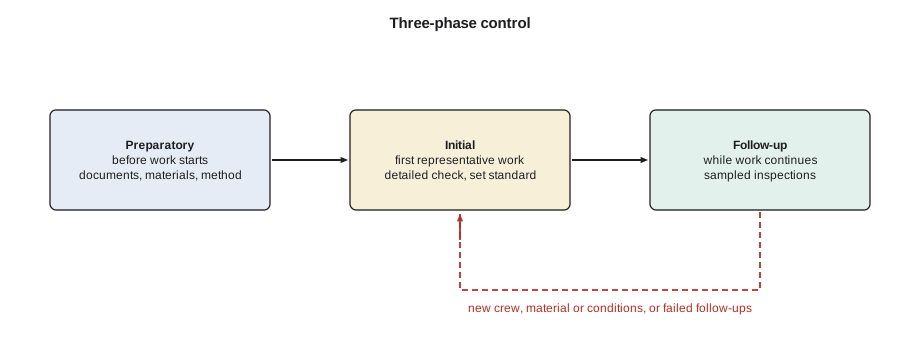
The three-phase process divides control of each definable feature into a preparatory phase, an initial phase and a follow-up phase. Its value is that it forces the team to prepare deliberately before work begins and to check the first work carefully, rather than relying only on inspections after the fact.
| Phase | When | What happens |
|---|---|---|
| Preparatory | Before the feature starts | Meeting with the crew foreman and the quality team; review drawings, specifications, approved submittals and the ITP; check materials on site against submittals; confirm prerequisite work is complete and accepted; review methods, tests and safety; agree what the initial phase will look at |
| Initial | As soon as a representative portion of the work is done | Inspect the first work in detail against the requirements; confirm workmanship standard; resolve differences in interpretation; record the results; set the standard for the rest of the feature |
| Follow-up | Daily or regularly while the feature continues | Continued inspection to confirm the standard is maintained; record results; return to the initial phase if the crew, material or conditions change, or if quality slips |
The preparatory phase is similar to the preinstallation meeting in lesson 4, but more focused on the crew doing the work. A preinstallation meeting brings together several trades and the consultants to settle interfaces; the preparatory phase brings the crew foreman and the people who will check the work together to confirm that the crew has everything it needs to do the work right. On Larkspur Commons the two are often combined for small features and held separately for large ones.
The initial phase is the heart of the method. It is not a quick look. The inspector, usually the field engineer or a dedicated quality person, works through the ITP checklist in detail on the first representative portion of the work, with the crew foreman present, and both sign the record. Disagreements about what the specification means are settled here, with the consultant if needed, rather than discovered later across a whole floor.
First-work inspections
A first-work inspection, sometimes called a first-in-place or benchmark inspection, is the initial phase by another name. Most building contracts that use the term require the contractor to notify the consultant when the first installation of a particular item is complete, so that the consultant can inspect it and confirm the standard before the work proceeds. On Larkspur Commons, the specification requires first-work inspections for windows, air barrier, firestopping, roofing, cladding, drywall finishing, and each finish item in the suites.
The level 3 finishes suite described in lesson 4 was the first-work inspection for the suite finishes. Each finishing trade completed its work in suite 301 first, the architect and Thornbury walked it with each trade, and once approved it was locked as the standard. Inspectors in later suites compared directly: 'Is this baseboard joint as tight as in 301? Is the caulking line as clean?' That comparison is far easier to apply consistently than a written description of workmanship.
An initial phase on the shear walls
The wood-frame floors of Larkspur Commons rely on plywood shear walls to resist wind and earthquake loads. Their strength depends on details that are easy to get wrong and hard to see once the walls are covered: the panel thickness and grade, the nail size and type, the nail spacing at panel edges and in the field of the panel, the edge distance of the nails, nails driven too deep, the blocking behind panel edges, and the hold-down connectors at the ends of each wall. The structural drawings show several shear wall types with different nailing schedules.
Before framing started on level 3, Mei ran the preparatory phase with Ridgeline Framing's foreman and two lead hands. They reviewed the shear wall schedule and the hold-down details, checked that the nails delivered matched the specified size and type, confirmed that the pneumatic nailers would be set to drive nails flush, and agreed that each shear wall would be marked on the floor plate with its type before sheathing. The initial phase was held on the first four shear walls framed on level 3 west.
# Initial-phase check of shear wall edge nailing, level 3 west (illustrative)
# Wall type SW2 requires edge nails at 4 in on center; tolerance +3/8 in on any space
required, tol = 4.0, 0.375
walls = {  # measured edge nail spaces in inches along one panel edge (sample)
    "W1": [3.9, 4.0, 3.9, 4.1, 3.8, 4.0, 4.0, 3.9],
    "W2": [4.1, 4.4, 3.9, 4.7, 4.0, 4.3, 4.5, 3.9],
    "W3": [3.9, 4.0, 4.0, 3.9, 4.0, 4.0, 3.8, 4.0],
    "W4": [4.0, 3.9, 4.1, 4.0, 3.9, 4.0, 4.0, 3.9],
}
overdriven = {"W1": 0, "W2": 6, "W3": 1, "W4": 0}   # nails counted as overdriven in the sample
for w, sp in walls.items():
    over = [s for s in sp if s > required + tol]
    mean = sum(sp) / len(sp)
    ok = not over and overdriven[w] <= 1
print(f"{w}: mean space {mean:4.2f} in, spaces over limit {len(over)}, overdriven {overdriven[w]} -> {'conforms' if ok else 'NONCONFORMING'}")W1: mean space 3.95 in, spaces over limit 0, overdriven 0 -> conforms W2: mean space 4.22 in, spaces over limit 3, overdriven 6 -> NONCONFORMING W3: mean space 3.95 in, spaces over limit 0, overdriven 1 -> conforms W4: mean space 3.98 in, spaces over limit 0, overdriven 0 -> conforms
Wall W2 failed on both counts: several spaces were well over the limit and six nails in the sample were overdriven, breaking through the face ply. The cause was simple. W2 had been sheathed by a newer worker using a nailer whose depth setting had not been adjusted, and the worker was spacing nails by eye rather than following the line marked on the panel. The tolerance and the limit on overdriven nails here are illustrative project values; on a real project they come from the engineer, the specification or the reference standards. The engineer of record reviewed W2 and required additional nails between the existing ones along the affected edges, a standard repair, before the wall was accepted.
The more important result was what changed afterwards. Ridgeline marked nail lines on every panel edge, set and locked the depth on every nailer at the start of each shift, and paired the newer worker with a lead hand for the rest of the week. The follow-up inspections on level 3 east found no further spacing problems. Had the initial phase been skipped, the same problem would probably have been found by the engineer's field review weeks later, after many more walls had been sheathed.
Follow-up inspections
Once the initial phase has set the standard, follow-up inspections confirm that it is maintained. They are lighter and more frequent: the field engineer or foreman walks the work daily or at set intervals, checks a sample against the ITP and records the result. Follow-up is where the subcontractor's own quality control does most of the work, with the contractor sampling and the consultants making periodic reviews.
Inspection effort can be adjusted to performance. A useful idea, borrowed from sampling inspection in manufacturing, is to tighten inspection when results are poor and relax it when they are consistently good. Mei uses a simple rule for repetitive features on Larkspur Commons: start at normal sampling after the initial phase; move to tightened sampling after any failed inspection; return to normal after three consecutive passes at tightened; and move to reduced sampling after ten consecutive passes at normal. Any change in crew, material or conditions sends the feature back to the initial phase.
# Switching between normal, tightened and reduced follow-up sampling (illustrative rule)
rates = {"tightened": 0.40, "normal": 0.20, "reduced": 0.10}
results = ["pass"] * 4 + ["fail"] + ["pass"] * 3 + ["pass"] * 10 + ["pass"] * 3 + ["fail", "pass"]
state, run = "normal", 0
for i, r in enumerate(results, 1):
    used = state
    if r == "fail":
        state, run = "tightened", 0
    else:
        run += 1
        if state == "tightened" and run >= 3:
            state, run = "normal", 0
        elif state == "normal" and run >= 10:
            state, run = "reduced", 0
print(f"inspection {i:2d}: sampled at {used:9s} ({rates[used]:.0%}) result {r:4s} -> next {state}")inspection 1: sampled at normal (20%) result pass -> next normal inspection 2: sampled at normal (20%) result pass -> next normal inspection 3: sampled at normal (20%) result pass -> next normal inspection 4: sampled at normal (20%) result pass -> next normal inspection 5: sampled at normal (20%) result fail -> next tightened inspection 6: sampled at tightened (40%) result pass -> next tightened inspection 7: sampled at tightened (40%) result pass -> next tightened inspection 8: sampled at tightened (40%) result pass -> next normal inspection 9: sampled at normal (20%) result pass -> next normal inspection 10: sampled at normal (20%) result pass -> next normal inspection 11: sampled at normal (20%) result pass -> next normal inspection 12: sampled at normal (20%) result pass -> next normal inspection 13: sampled at normal (20%) result pass -> next normal inspection 14: sampled at normal (20%) result pass -> next normal inspection 15: sampled at normal (20%) result pass -> next normal inspection 16: sampled at normal (20%) result pass -> next normal inspection 17: sampled at normal (20%) result pass -> next normal inspection 18: sampled at normal (20%) result pass -> next reduced inspection 19: sampled at reduced (10%) result pass -> next reduced inspection 20: sampled at reduced (10%) result pass -> next reduced inspection 21: sampled at reduced (10%) result pass -> next reduced inspection 22: sampled at reduced (10%) result fail -> next tightened inspection 23: sampled at tightened (40%) result pass -> next tightened
The rule makes inspection effort follow the evidence. A crew that keeps passing earns less inspection; a crew that fails gets more until it shows the problem is fixed. It also makes the decision transparent: the foreman can see why the field engineer is suddenly checking twice as many items, and how to earn the reduction back.
Who does the inspecting
An inspection is only as good as the inspector. Thornbury's procedure requires that the person carrying out an initial-phase inspection be competent in the work being inspected and be someone other than the person who did the work. On Larkspur Commons, initial phases are run by Mei or Omar for most features, by Lena for the most critical ones, and with the consultant present where the ITP shows a hold or witness point. Subcontractors' quality control people carry out most follow-up inspections of their own work, and their records are spot-checked.
On US federal projects using contractor quality control, the specifications typically require a quality control manager who is not the superintendent and who has the authority to stop work, along with specialized quality control staff for some features. Larkspur Commons is privately owned and has no such requirement, but Thornbury's practice is to give a named person on each project the authority to stop work for quality reasons, which Dana has delegated to Mei.
Independence matters most when schedule pressure is high. A superintendent who is behind schedule has a natural incentive to accept marginal work; a quality person reporting to the project manager or the quality manager can say no without having to weigh the schedule. Dana is comfortable with this. He would rather hear about a problem from Mei on the day it happens than from the engineer three weeks later.
Daily quality reports
Three-phase control is supported by a daily quality record. On US federal projects this is a formal daily quality control report, signed by the quality control manager. On Larkspur Commons it is a short section of the daily site report: which preparatory meetings and initial phases were held, which follow-up inspections were done and their results, any tests performed, any nonconformances opened or closed, and any instructions given. The record takes ten minutes to complete with the inspection application, and it is the first place Lena looks when she reviews the project.
| Item | Example entry, 12 March |
|---|---|
| Preparatory meetings | Window installation, retail storefront, with Clearline Glazing foreman |
| Initial phases | Air barrier at L3W windows 1 to 3, envelope consultant present; conforms |
| Follow-up inspections | Shear walls L3E: 6 walls sampled, all conform; firestopping L3W: 62 of 304, 2 failed and redone |
| Tests | Transfer slab pour 2: 4 sets of cylinders, slump and air in range, concrete temperature in range |
| Nonconformances | NCR-034 opened: stair 2 base plate does not fit its anchor bolts; NCR-031 closed |
| Instructions | Nailers depth-checked at start of each shift (Ridgeline); window sill turn-up sketch rev B issued to crews |
When to return to the initial phase
The initial phase is not a one-time event per feature. It should be repeated when something changes that could affect quality: a new crew or foreman, a new supplier or product, a new location with different conditions, a long break in the work, or a run of failed follow-up inspections. On Larkspur Commons the framing contractor brought in a second crew for levels 5 and 6 to recover schedule (CON-335). That crew went through its own preparatory and initial phases, even though the work was identical, because the crew had never built these walls.
Similarly, when winter conditions arrived, the air barrier installer switched to a low-temperature version of the membrane primer. The change was approved as a minor substitution, and the air barrier went back to an initial phase on the next floor to confirm adhesion with the new primer in cold conditions. Both decisions cost a few hours of inspection; both protected against defects that would have been expensive to find later.
Three-phase control and the trade train
On repetitive floors, three-phase control fits neatly into the trade train from CON-335. The preparatory and initial phases happen in the first zone, and the follow-up phase runs through the remaining zones. That means the first zone carries more inspection and some extra time, which should be built into the takt plan: the first wagon of a new trade in zone L3W often needs a day longer than the takt time while the initial phase is completed and any corrections are made. Mei and Omar include this 'learning day' in the look-ahead rather than squeezing it into the normal takt and then being surprised by the delay.
The cost of that day is small compared with the alternative. On the podium, where the team had been less disciplined, the reinforcing cover problem at the podium walls mentioned in lesson 1 was found by the engineer's review after three walls had been formed and two of them poured. The repair, which involved additional cover by a specified coating system and engineering review of each wall, cost far more than a careful initial phase on the first wall would have.
Common mistakes
MistakeTreating the initial phase as a quick look at the first work.
InsteadInspect the first representative portion in detail against the ITP with the foreman present, record the results and settle interpretations.
MistakeSkipping the preparatory phase because the crew is experienced.
InsteadHold a short preparatory meeting to confirm documents, materials, prerequisites and methods for this project's specific requirements.
MistakeKeeping the same inspection frequency whatever the results.
InsteadTighten sampling after failures and relax it after sustained passes, using a transparent rule.
MistakeAssuming a new crew on identical work needs no initial phase.
InsteadReturn to the initial phase whenever the crew, material, conditions or results change.
MistakeLeaving no time in the plan for initial phases.
InsteadAllow a learning day for the first zone of each new trade in the look-ahead.
Summary and key terms
- Definable features of work are distinct tasks with their own control requirements, each linked to an ITP.
- Three-phase control uses a preparatory phase before work, an initial phase on the first representative portion and follow-up inspections while work continues.
- First-work inspections are the initial phase on most building contracts; approved first work becomes the standard for comparison.
- The initial phase on the shear walls found incorrect spacing and overdriven nails on one wall and led to process changes that prevented repeats.
- Follow-up sampling can be tightened after failures and reduced after sustained passes.
- Inspectors must be competent and independent of the work; someone on site should have authority to stop work for quality.
- A daily quality record summarizes preparatory meetings, initial phases, follow-ups, tests, nonconformances and instructions.
- Return to the initial phase when the crew, material, conditions or results change, and allow a learning day in the plan.
- Definable feature of work
- A task separate from others, with its own control requirements, usually done by one crew or trade.
- Three-phase control
- A control process with preparatory, initial and follow-up phases for each definable feature.
- Preparatory phase
- A meeting before work starts to confirm documents, materials, prerequisites, methods and inspections.
- Initial phase
- Detailed inspection of the first representative portion of the work to set the standard.
- Follow-up phase
- Continued inspection while the work proceeds to confirm the standard is maintained.
- First-work inspection
- Inspection of the first installation of an item, usually with the consultant, before the work proceeds.
- Tightened inspection
- Increased sampling applied after a failed inspection until performance is shown to have recovered.
- Daily quality report
- A daily record of quality activities, inspections, tests and nonconformances.
Practice problems
Work each problem on paper first, then reveal the answer to check.
Name three things that make a new definable feature even when the work is the same.
Show answer
A new crew, a new material or supplier, or substantially different conditions or location.
How does the preparatory phase differ from a preinstallation meeting?
Show answer
The preparatory phase focuses on the crew doing the work; the preinstallation meeting brings several trades and consultants together on interfaces.
Why did wall W2 fail, and what process changes followed?
Show answer
Nail spaces over the limit and overdriven nails by a newer worker with an unadjusted nailer; Ridgeline marked nail lines, locked nailer depth each shift and paired the worker with a lead hand.
Under Mei's switching rule, what happens after a failed inspection?
Show answer
Sampling moves to tightened until three consecutive passes, then returns to normal.
Why should someone other than the superintendent have authority to stop work for quality?
Show answer
Schedule pressure gives the superintendent an incentive to accept marginal work; an independent person can say no.
What is a learning day and where does it go?
Show answer
Extra time for the first zone of a new trade to complete the initial phase and corrections; it goes into the look-ahead.
Lesson quiz · 5 questions
Score 60% or more to complete this lesson.
Create a free account to save your progress, take quizzes and earn a certificate.