
CRE-101 · Lesson 4 of 12 · 26 min
How recommendation systems shape reach
On today's platforms, most views do not come from followers choosing to watch a creator; they come from recommendation systems deciding what to show each user next, in the For You feed, the home page, the "up next" column and search results. Creators often talk about "the algorithm" as if it were a mysterious force that rewards or punishes them. In reality, recommendation systems follow understandable principles: they predict what each person is likely to watch, enjoy and return for, based on signals from billions of interactions. This lesson explains how these systems work in general terms, which signals matter, how new content is tested, why reach varies so much from one post to the next, how search differs from recommendation, and how creators can work with recommendation systems without chasing every rumor.
The recommendation problem
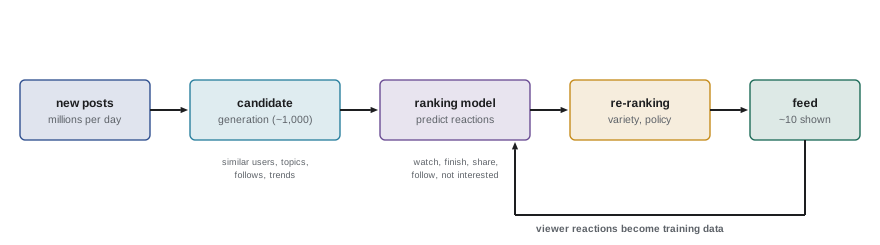
A platform has millions of new videos or posts every day and must choose, for each user at each moment, a handful to show. It cannot ask people what they want, so it learns from what they do. Recommendation systems typically work in stages:
- Candidate generation: from the huge pool of content, quickly select a few hundred or thousand candidates likely to interest this user, based on what similar users watched, topics the user has engaged with, accounts they follow, and recent popular content.
- Ranking: a machine learning model scores each candidate by predicting outcomes such as the probability of watching, watching to the end, liking, sharing, commenting, following, or reporting the content as unwanted, and combines these predictions into a single score.
- Re-ranking and policy: the top candidates are adjusted for variety (not too many videos from the same creator or topic in a row), freshness, and platform rules, such as reducing the spread of borderline or misleading content and excluding content that violates policies.
The models learn from enormous amounts of data and are retrained continually, so platforms themselves describe what their systems optimize for rather than giving exact formulas. Several platforms publish general explanations of their recommendation systems, partly in response to regulation such as the European Union's Digital Services Act, which requires large platforms to explain the main parameters of their recommender systems.
What the systems try to predict
Platforms have moved over time from simple measures toward measures of satisfaction. YouTube, for example, ranked largely by clicks in its early years, which rewarded misleading thumbnails; around 2012 it shifted to watch time, and later added surveys and other signals of whether viewers were satisfied with what they watched. Short-form feeds weigh signals such as whether a viewer watches a clip to the end, rewatches it, shares it or swipes away quickly. Common signals include:
| Signal | What it suggests | Notes |
|---|---|---|
| Click-through rate (CTR) | the title and thumbnail made people want to watch | high CTR with low retention suggests clickbait |
| Watch time and retention | people actually watched | often the strongest signal for video |
| Completion and rewatches | short content held attention fully | especially important for short-form |
| Shares and saves | people valued it enough to send or keep it | strong signals of value |
| Comments and replies | it sparked conversation | quality matters more than volume |
| Follows after viewing | people want more from the creator | signals long-term value |
| Negative feedback | not interested, skips, reports, hiding | reduces future distribution |
| Satisfaction surveys | people say they were glad they watched | used by some platforms to correct for clickbait |
These signals are judged relative to context: a 40% retention rate may be excellent for a 20-minute documentary and poor for a 15-second clip, and a video's performance is compared with what other content shown to similar viewers achieves. This is why advice like "videos must be at least 8 minutes" or "post exactly at 5 p.m." is unreliable: what matters is whether the content satisfies the people it is shown to better than the alternatives.
How new content is tested
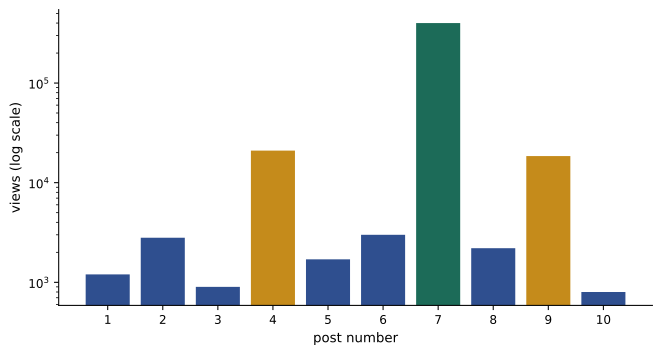
On most recommendation-driven platforms, a new post is first shown to a small group of viewers, typically a mix of followers and people likely to be interested. If they respond well, compared with similar content, the system shows it to a larger group, and so on, in expanding waves. If the response is weak at any stage, distribution slows. This explains several common observations:
- Views come in bursts, and a video can suddenly take off days or even months after publication when it starts being recommended alongside a popular related video.
- Small accounts can reach large audiences on short-form platforms, because distribution depends on performance, not follower count.
- A creator's results vary enormously from post to post, even when the creator thinks the quality was similar.
Worked problem
Expanding test waves
Suppose a platform shows a new clip to 500 people. If at least 60% watch most of it, it is shown to 5,000 more; if at least 55% of those do, to 50,000 more; then 500,000. Clip A achieves 62%, 57% and 50% in successive waves. Clip B achieves 58% in the first wave. How many views does each get?
Show solution
- Clip A: passes wave 1 (62%) and wave 2 (57%), fails wave 3 (50%): views \(500 + 5{,}000 + 50{,}000 = 55{,}500\).
- Clip B: fails wave 1: views 500.
Answer: A small difference in early retention (62% versus 58%) produces a hundredfold difference in views. Real systems are smoother and more complex than these thresholds, but the compounding effect is real, which is why small improvements to hooks and pacing (Lesson 2) can change reach dramatically.
Search and suggested content
Not all discovery comes from feeds. Search on YouTube, Pinterest, TikTok and Google sends viewers looking for specific answers, and content that answers common questions can earn views for years. Search ranking considers relevance (does the title, description, spoken words and captions match the query?), quality signals such as retention and satisfaction, and freshness for time-sensitive topics. Practical steps:
- Research what people actually search for in your topic, using platform search suggestions and keyword tools.
- Use clear, specific titles that match how people phrase questions, rather than vague or clever ones that no one searches for.
- Add accurate descriptions, chapters and captions, which platforms read to understand content, and which also help viewers who are deaf or hard of hearing or watching without sound.
- Make content that remains useful: evergreen tutorials, reviews and explainers accumulate views long after trending topics fade.
Suggested videos, the recommendations beside or after a video, work by association: a video is suggested to people watching related content, so videos that complement popular ones, or that form series, can earn steady traffic.
Working with recommendation systems
Since the systems try to predict satisfaction, the most reliable strategy is to make content that the intended audience genuinely values and to remove obstacles to it being found and watched:
- Package honestly and compellingly: a thumbnail and title that create curiosity and accurately represent the content earn clicks without the negative signals clickbait causes.
- Hook and pace: open with the value, cut slow sections, and keep promises made in the title (Lesson 2).
- Be consistent in topic: a channel with a coherent audience gives the system clear signals about who to show new content to; abrupt changes of topic can confuse it and disappoint existing followers.
- Publish regularly enough to give the system material to test, without sacrificing quality.
- Learn from analytics (Lesson 10): which videos brought new viewers, where retention dropped, which traffic sources worked.
- Avoid manipulation: buying views or followers, engagement pods, misleading thumbnails and spam violate platform rules, can lead to penalties, and corrupt the creator's own data.
Worked problem
CTR, retention and impressions together
Two videos each receive 100,000 impressions (times their thumbnail was shown). Video A has 9% CTR and 25% average viewed of a 12-minute video. Video B has 5% CTR and 55% average viewed of a 12-minute video. Which earned more watch time, and which is the system more likely to keep recommending?
Show solution
- A: 9,000 views × \(0.25 \times 12 = 3\) minutes = 27,000 minutes.
- B: 5,000 views × \(0.55 \times 12 = 6.6\) minutes = 33,000 minutes.
Answer: B earned more watch time from fewer clicks, and its high retention suggests viewers were satisfied. A's high CTR with low retention may indicate packaging that overpromised. Platforms look at both, so the best result combines a strong CTR with strong retention; improving A's content to match its packaging, or B's packaging to match its content, would both help.
Myths and realities
Creators trade many theories about algorithms. A few common ones, and what the evidence suggests:
- "Shadowbanning" (secret suppression of an account): platforms do restrict distribution of content that breaks rules or is borderline, and some now notify creators; but most drops in reach come from ordinary variation, changing audience interest or competition, not secret bans.
- "The algorithm hates links or hashtags": some platforms reduce distribution of posts that send people off-platform, and hashtags matter far less than they once did; effects vary by platform and change over time.
- "You must post every day": consistency helps, but quality and audience satisfaction matter more than frequency; burnout from unsustainable schedules is a serious risk (Lesson 7).
- "Deleting and reposting a video helps": usually it loses accumulated data and can look like spam.
When a platform officially changes how recommendations work, it usually announces the general direction. Creators who focus on what audiences value adapt best to these changes; those who optimize narrowly for one quirk are hurt most when it changes.
Recommendation systems and society
Recommendation systems shape not just creators' livelihoods but what billions of people see. Concerns include filter bubbles (people seeing only content that confirms their views), the amplification of sensational, divisive or misleading content because it provokes engagement, effects on young people's wellbeing, and the concentration of power in a few companies whose systems are opaque. Research on these questions is active and findings are mixed: some studies find recommendation systems push users toward more extreme content, others find that user choice and existing interests explain most of what people watch. Regulators are responding: the EU Digital Services Act requires risk assessments and a non-personalized feed option on very large platforms, and governments in Canada, the US and elsewhere are debating online harms and youth safety rules (Lesson 12). For creators, the practical lesson is that platforms change their systems in response to these pressures, and that content that is honest and genuinely valuable is the most durable strategy.
Common mistakes
MistakeBelieving reach depends mainly on follower count.
InsteadDistribution depends on how well content performs with the viewers it is tested on.
MistakeUsing clickbait to raise click-through rate.
InsteadPackage honestly; low retention after a misleading click hurts distribution.
MistakeFollowing rigid rules about length or posting time.
InsteadJudge by audience satisfaction and test in your own context.
MistakeAssuming every drop in views is a shadowban.
InsteadCheck analytics for normal variation, topic interest and competition first.
MistakeBuying views or followers to boost signals.
InsteadAvoid manipulation; it breaks rules and corrupts your data.
Summary and key terms
- Recommendation systems generate candidates, rank them by predicted engagement and satisfaction, and re-rank for variety and policy.
- Signals include click-through, watch time, completion, shares, saves, comments, follows, negative feedback and surveys.
- New posts are tested on small audiences and expanded in waves; small differences compound into large differences in reach.
- Search rewards relevance and lasting usefulness; titles, descriptions, chapters and captions help.
- Working with algorithms means honest packaging, strong hooks, consistent topics and learning from analytics.
- Many algorithm myths reflect ordinary variation; manipulation backfires.
- Recommendation systems raise societal concerns and are increasingly regulated, which changes how they work.
- Recommendation system
- Software that selects content for each user based on predicted interest.
- Candidate generation
- The first stage selecting possible content for ranking.
- Ranking model
- A model that scores candidates by predicted outcomes.
- Impression
- A time a thumbnail or post is shown to a user.
- Click-through rate
- Views divided by impressions.
- Average percentage viewed
- The average share of a video that viewers watch.
- Test wave
- An initial limited audience used to judge new content.
- Evergreen content
- Content that stays useful and searched for over a long time.
- Shadowban
- A claimed secret restriction of an account's reach.
- Filter bubble
- A situation where users see mainly content matching their existing views.
Practice problems
Work each problem on paper first, then reveal the answer to check.
Name the three stages of a recommendation system.
Show answer
Candidate generation, ranking, re-ranking.
Why did platforms move away from ranking by clicks alone?
Show answer
Clicks rewarded misleading packaging; watch time and satisfaction better reflect value.
Views from 40,000 impressions at 6% CTR?
Show answer
2,400.
Watch time from 2,400 views at 40% of a 10-minute video?
Show answer
9,600 minutes.
What does high CTR with low retention suggest?
Show answer
Packaging that overpromises (clickbait).
Why can a small account go viral on short-form platforms?
Show answer
Distribution depends on performance in test waves, not follower count.
Name two ways to improve search discovery.
Show answer
Clear searchable titles, descriptions, chapters, captions, evergreen topics.
What does a coherent channel topic help the system do?
Show answer
Identify who to show new content to.
Why avoid deleting and reposting videos?
Show answer
It loses accumulated data and can look like spam.
What does the EU Digital Services Act require of very large platforms?
Show answer
Explanations of recommender parameters, risk assessments and a non-personalized option.
Lesson quiz · 5 questions
Score 60% or more to complete this lesson.
Create a free account to save your progress, take quizzes and earn a certificate.