
CRE-220 · Lesson 6 of 12 · 25 min
Body language, gesture and energy
Viewers read bodies as much as words. Posture, facial expression, gestures and movement communicate confidence, warmth, nervousness or boredom, often before a word is spoken. On camera, body language is magnified: a close-up shows every glance and tension in the jaw, while a wide shot reveals posture and fidgeting. This lesson covers what research does and does not say about nonverbal communication, posture and grounding, facial expression and smiling, gestures and hands, movement within the frame, energy and rhythm, adapting body language to framing, cultural differences, and practicing body awareness.
What research says about nonverbal communication
Nonverbal communication is powerful, but some popular claims about it are exaggerated. A widely repeated statistic says that communication is 7 % words, 38 % tone of voice and 55 % body language. It comes from experiments by psychologist Albert Mehrabian in the 1960s, which studied how people judged feelings and attitudes when a single word's meaning conflicted with tone or facial expression. Mehrabian himself has said the figures do not apply to communication in general; words obviously carry most of the information in a tutorial or explanation. What the research does support is that when words and body language conflict, such as saying "I'm excited" with a flat face, people tend to trust the nonverbal signal. Similarly, the idea that adopting "power poses" for two minutes transforms hormones and behavior, popularized in the 2010s, did not hold up well in later replication studies, though some research suggests that posture can affect how confident people feel. The practical lesson for creators is congruence: body language should match and support what you are saying.
Posture and grounding
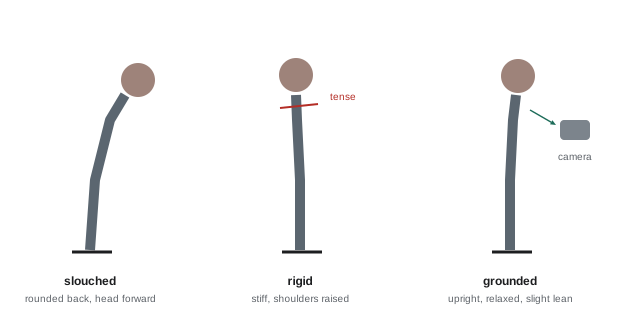
Good posture on camera looks upright, open and relaxed, not rigid. Standing, plant your feet about hip-width apart with weight evenly distributed, knees soft rather than locked, shoulders relaxed and down, and head balanced over the spine. This grounded stance prevents swaying and shifting, which are distracting on camera and especially obvious in medium shots. Sitting, sit toward the front of a stable chair rather than slouching into a soft sofa, keep both feet on the floor, lean very slightly toward the camera to convey engagement, and avoid swivel chairs, which encourage rocking. Many presenters find it helpful to roll their shoulders, shake out their hands and take a few slow breaths before each take to release tension.
Facial expression and smiling
In close-ups, the face carries most of the nonverbal message. Expressive faces engage viewers; blank faces, which often appear when people concentrate on remembering lines, look bored or anxious. Expression should follow content: interest when posing a question, concern when discussing a problem, delight at a result. Genuine smiles, which involve the muscles around the eyes as well as the mouth, read as warm and trustworthy; forced smiles, which involve only the mouth, can look insincere, especially if held too long. Thinking about something genuinely pleasant, or about the person you are speaking to, helps produce natural smiles. Raised eyebrows signal interest and openness; a furrowed brow can signal concentration but also worry. Watching yourself with the sound off reveals what your face is communicating independently of your words.
Gestures and hands
Gestures help viewers understand and remember ideas. Research on speech and gesture suggests that gestures can support the speaker's own thinking and fluency as well as the listener's comprehension. Types of gesture include illustrative gestures that show size, shape, direction or movement ("a box this big"); emphatic gestures that underline key points, such as a hand chop or open palm; enumerating gestures that count points on fingers; and deictic gestures that point to objects, screens or graphics. On camera, gestures should stay within the frame: in a medium close-up, gestures near the chest are visible, while those at waist level disappear. Open palms tend to read as honest and inviting; pointing at the lens can feel aggressive. Avoid repetitive gestures, such as the same chop on every sentence, and self-soothing gestures such as touching the face, rubbing hands or playing with hair, which signal nervousness. When not gesturing, rest hands in a neutral position, lightly together or on a table, rather than hiding them.
| Gesture type | Purpose | Example |
|---|---|---|
| Illustrative | Shows size, shape, movement | Hands apart to show length |
| Emphatic | Underlines key points | Open palm on the main idea |
| Enumerating | Counts points | Fingers for first, second, third |
| Deictic (pointing) | Directs attention | Pointing to a product or graphic |
| Self-soothing | Signals nervousness (avoid) | Touching face, rubbing hands |
Movement within the frame
Movement can add energy, but it must be purposeful. In standing presentations, stepping toward the camera for an important point, or moving to a new position to mark a new section, can work well, as long as focus and framing allow. Aimless wandering, rocking and swaying distract. In seated videos, leaning in for emphasis, shifting position to mark a transition and turning to show an object add variety. Remember that the camera's framing defines what movement is visible: a small movement in a tight close-up can be dramatic, while the same movement in a wide shot barely registers. Coordinate movement with the camera operator or set a fixed frame and stay within it; marking your position on the floor with tape helps you return to the same spot between takes.
Energy and rhythm
Energy on camera is not the same as speed or volume. It is a sense of engagement and intention that comes from the whole body: an alert posture, expressive face, purposeful gestures and a voice with variety. Rhythm matters too: alternating moments of high energy, such as an exciting reveal, with calmer moments, such as a careful explanation, keeps viewers engaged and prevents fatigue, much as music alternates loud and quiet passages. Some creators physically warm up before recording, with stretching, jumping, shaking out the body or even dancing to music, to raise their energy; others meditate or breathe slowly to calm nerves. The aim is to arrive at the camera relaxed but alert.
Worked problem
Matching body language to a segment
A creator's video has three segments: an energetic opening teasing a surprising result, a careful step-by-step explanation, and an emotional story about why the project mattered. How should body language change across them?
Show solution
- Opening: upright, slightly forward lean, bright expression, an emphatic gesture on the key line, quicker rhythm.
- Explanation: steady posture, clear illustrative and enumerating gestures within the frame, calmer pace and neutral resting hands between steps.
- Story: slower movement, softer expression, fewer gestures, more stillness and sustained eye contact to let the emotion land.
- Check each segment on playback with the sound off to confirm body language matches the content.
Answer: Bright and forward for the opening, steady and illustrative for the explanation, still and soft for the story, checked with the sound off.
Adapting to framing
Body language must suit the shot. In close-ups, the face does almost all the work; gestures are invisible or appear as sudden intrusions at the edge of the frame, so keep them small and high if used. In medium shots, the typical talking-head framing, hands and upper body are visible, so gestures near the chest work well and posture matters. In wide shots, the whole body is visible, so stance, movement and overall energy dominate, and facial expression must be slightly larger to read. Vertical short-form framing (CRE-130) is usually closer and centered on the face, favoring expressive faces and compact gestures. Discussing framing with your camera operator, or checking it yourself before recording, lets you calibrate.
Cultural and individual differences
Body language is not universal. Gestures that are friendly in one culture can be rude in another: the thumbs-up and the "OK" sign, for example, have offensive meanings in some countries, and pointing with a finger is impolite in many places. Norms for eye contact, smiling, personal space and expressiveness also vary across cultures. Creators with international audiences should be aware of these differences and avoid gestures with potentially offensive meanings. Individual differences matter too: some people are naturally expressive and others more reserved, and some disabled and neurodivergent creators communicate in ways that differ from typical norms. There is no single correct body language; effective presenters develop a style that is authentic to them and clear to their audience (Lessons 7 and 12).
Practicing body awareness
Most people are unaware of their habitual body language until they see it. Useful practice methods include recording yourself and watching with the sound off; asking a trusted friend to note distracting habits; practicing in front of a mirror; studying presenters you admire, noting how they use posture, expression and gesture; and exercises from acting and public speaking, such as delivering a passage with exaggerated gestures and then reducing them to a natural level. Address one habit at a time, such as swaying or face touching, and practice until the new behavior becomes automatic. Body language improves with experience: comfort on camera grows with repetition, and as comfort grows, natural body language returns.
Props, objects and demonstrations
Many creators present with objects: products, tools, ingredients, instruments, books. Handling objects well is a body language skill. Hold objects steady and close to the camera when showing details, angled toward the lens and kept within the frame; move them slowly so the camera can focus; and pause while viewers look. Practice demonstrations in advance so that hands move confidently, since fumbling signals inexperience. Objects also give nervous hands something to do, which can make presenters more relaxed, but avoid fiddling with props when not using them. Point to features with an open hand or a finger near the object, rather than across the frame.
Seated, standing and walking delivery
Each position communicates differently. Seated delivery feels conversational and intimate, suiting podcasts, interviews and reflective content; it is also easier to maintain consistent framing. Standing delivery conveys more energy and authority, allows fuller gestures and suits tutorials, presentations and comedy; many presenters find their voice is stronger standing. Walking delivery, in walk-and-talk shots, conveys movement and momentum, suiting travel, explainers on location and documentary styles, but requires careful rehearsal of pace and path. Choosing the position deliberately for each format, and practicing each, widens your range.
Body language when listening
On-camera presence includes how you look when others are speaking, in interviews, co-hosted shows and live streams with guests. Active listening body language includes facing the speaker, nodding occasionally, reacting with natural expressions and keeping still rather than fidgeting or checking notes. Editors use reaction shots to cut conversations together, and viewers notice disengaged listeners. Lessons 10 and 11 cover listening in interviews and collaborations.
Dressing for the camera
Clothing affects body language and presence. Comfortable clothes that fit well let you move naturally and feel confident. Solid colors and simple patterns usually work best; very fine stripes and small checks can cause moiré on camera, and clothing that blends into the background makes presenters look less distinct. Consider how clothing interacts with lavalier microphones, since stiff or rustling fabrics cause noise, and how jewelry may clink or catch light. Dress to suit your brand and audience, and keep notes of outfits for continuity in series and multi-day shoots.
Body language in group shots
In group or two-shot framing, body language also communicates relationships. Turning slightly toward a co-host signals connection; turning away signals distance. Leaning in shows interest, and mirroring a partner's posture can suggest rapport. Viewers watch how presenters react to each other as closely as they watch the speaker, so stay engaged even when you are not speaking. In panels, avoid crossing arms or slumping while others talk, which can read as disagreement or boredom even when it is not intended.
Common mistakes
MistakeBelieving body language is 55 % of all communication.
InsteadAim for congruence between words and nonverbal signals.
MistakeSwaying or rocking while speaking.
InsteadGround your stance or use a stable chair.
MistakeGesturing below the frame.
InsteadKeep gestures within the shot, near the chest.
MistakeRepeating the same gesture constantly.
InsteadVary gestures and rest hands between them.
MistakeUsing gestures that may offend international viewers.
InsteadLearn cultural meanings of common gestures.
Summary and key terms
- Nonverbal signals matter most when they conflict with words; aim for congruence.
- Grounded, upright, relaxed posture prevents distraction.
- Expression should follow content; genuine smiles involve the eyes.
- Gestures illustrate, emphasize, count and point, and must stay in frame.
- Movement should be purposeful and suit the framing.
- Energy comes from the whole body; vary rhythm across a video.
- Body language varies by culture and person; practice awareness.
- Nonverbal communication
- Communication through body, face and voice beyond words.
- Congruence
- Agreement between words and body language.
- Grounded stance
- Stable, balanced standing posture.
- Genuine smile
- Smile involving the eyes as well as the mouth.
- Illustrative gesture
- Gesture showing size, shape or movement.
- Emphatic gesture
- Gesture underlining a point.
- Deictic gesture
- Pointing gesture.
- Self-soothing gesture
- Nervous touching of face, hands or hair.
- Rhythm
- Alternation of energy levels across a piece.
- Framing
- How much of the presenter the shot shows.
Practice problems
Work each problem on paper first, then reveal the answer to check.
What did Mehrabian actually study?
Show answer
Judgments of feeling when words conflicted with tone or expression.
What is the practical lesson about body language?
Show answer
Congruence with what you say.
Describe a grounded standing stance.
Show answer
Feet hip-width, soft knees, relaxed shoulders, balanced head.
Why avoid swivel chairs?
Show answer
They encourage rocking.
What distinguishes a genuine smile?
Show answer
It involves the eyes.
Name four gesture types.
Show answer
Illustrative, emphatic, enumerating, deictic.
Where should gestures be in a medium close-up?
Show answer
Near the chest, within frame.
How does framing change body language?
Show answer
Close-ups rely on the face; wide shots show stance and movement.
Name a gesture with different cultural meanings.
Show answer
Thumbs-up, OK sign, pointing.
How can you check body language?
Show answer
Watch recordings with the sound off.
Lesson quiz · 5 questions
Score 60% or more to complete this lesson.
Create a free account to save your progress, take quizzes and earn a certificate.