
CRE-250 · Lesson 8 of 12 · 27 min
Collaborations, raids, co-streams and live events
Live streaming is social. Streamers grow by sharing audiences, playing and talking together, and creating events that are bigger than any single channel. Raids at the end of a stream, co-streams with friends, guest appearances, community tournaments and charity marathons all introduce viewers to new creators and give existing communities memorable moments. They also bring logistical and interpersonal challenges: coordinating schedules, sharing revenue and credit, handling different community cultures and keeping everyone safe. This lesson covers raids and hosts, finding collaborators, co-streaming and shared sessions, guest appearances, community events and tournaments, charity streams, brand and in-person events, managing collaborations, and learning from them. CRE-220 covered on-camera chemistry and co-hosting; this lesson focuses on the mechanics and strategy of live collaboration.
Raids and hosts
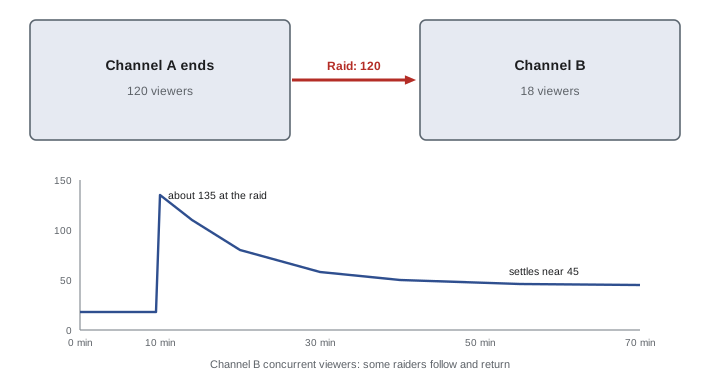
A raid sends a streamer's viewers to another live channel at the end of a stream; the receiving streamer sees an alert and gains a wave of new viewers who may follow and return. Hosting, where available, displays another channel's stream on your own page. Raids are one of the most effective growth tools on platforms with directory-based discovery, because they bring real viewers rather than impressions. Good raid etiquette includes raiding streamers whose content and community would welcome your viewers; announcing the raid and why you chose the channel; checking that the target streamer is not in a sensitive moment; thanking incoming raiders warmly, recapping your stream for them and giving a shout-out to the raider; and never raiding to harass. Some platforms let streamers block raids from unknown channels, a defense against hate raids (Lesson 9).
Finding collaborators
Good collaborators share a compatible audience, content and values, and similar commitment, though not necessarily similar size. Ways to find them include joining communities for streamers in your category, participating in others' chats genuinely before asking for anything, attending online and in-person events, and building small networks of streamers who raid and support each other. Reaching out with a specific idea, such as "a co-op run of this game next Thursday" or "a guest segment on your art stream about color palettes", works better than a vague request to collaborate. Larger streamers receive many requests, so start with peers.
Co-streaming and shared sessions
Co-streaming means two or more streamers broadcasting together, each on their own channel, playing the same game, chatting, or hosting a joint show. Some platforms offer shared-chat or joint-stream features in which viewers of all participants see each other's messages, combined viewer counts and shared alerts; feature names and availability change, so check current tools. Practical considerations include sharing voice through a call tool with headphones to avoid echo (Lesson 6), agreeing on audio levels, deciding whose game or camera view each channel shows, coordinating start and end times, and agreeing how to handle raids and shout-outs. Co-streams also merge chats with different norms, so moderators from each channel should coordinate rules.
Guest appearances
Guest appearances, in which one creator joins another's stream, introduce each to the other's audience. A good guest segment has a clear purpose, such as an interview, a challenge or teaching a skill; a planned duration; technical preparation, including a test call; promotion before the stream on both channels; and a clear call to action, such as following the guest's channel. Hosts should give guests time to speak, credit them visibly with a name label and links, and protect them from hostile chat. Guests should respect the host's community rules and avoid using the appearance to promote themselves excessively.
Community events and tournaments
Community events bring many participants together: tournaments in a game, viewer game nights, creative challenges, community watch parties where permitted, game jams and marathons. Planning includes clear rules and formats, sign-up and selection processes, schedules accounting for time zones, prize policies (Lesson 12 covers contest law), moderation of voice and text, and fallback plans for technical problems. Tournament tools manage brackets and results; overlays show scores. Events for younger communities need extra care with personal information and voice chat.
Worked problem
Planning a community tournament
A streamer wants to run a 16-player community tournament in an online game, streamed live, with a small prize. What should be planned?
Show solution
- Format: single elimination, best of three in early rounds and best of five in the final, about 3 hours total.
- Sign-ups: open form with eligibility rules (age, region, platform), random draw if oversubscribed.
- Rules: published game settings, conduct rules, disconnection policy and dispute process.
- Prize: describe clearly; check contest rules in your jurisdiction and the platform's policies; skill-testing question if required in Canada (Lesson 12).
- Production: bracket overlay, casters or co-hosts, moderators for each match lobby, backup plan for no-shows.
Answer: A clear format, fair sign-ups, published rules, a legally compliant prize, and production and moderation plans for each match.
Charity streams
Charity streams raise money for causes, often through marathons, challenges and incentives. Tools such as Tiltify and platform-native charity features connect donations directly to registered charities, which is safer and more transparent than collecting money personally and passing it on. Good practice includes choosing a registered charity and getting permission to use its name and branding; being transparent about where money goes and whether any portion supports the streamer; avoiding pressure tactics; publishing totals afterward; and following platform rules for charity streams. Charitable fundraising may have tax and regulatory implications, which differ between Canada and the United States, and receipts for donors are issued by charities, not streamers. Charity streams build goodwill and community pride, and some, such as Games Done Quick speedrunning marathons, have raised tens of millions of dollars over the years.
Brand events and in-person streaming
Brands hire streamers for launches, sponsored streams and live appearances at conventions and trade shows. Event streaming from venues brings challenges: unreliable venue internet (bring bonded cellular or a dedicated line), noise (use close microphones and noise suppression), lighting (bring portable lights), crowds and safety, and coordination with event staff. Sponsored events require disclosure (Lesson 10) and clear agreements about content, schedule and rights to the footage. In-person community meetups require planning for safety and privacy, and many streamers meet audiences only at organized events with security rather than announcing locations publicly.
Managing collaborations
Collaborations go best with clear agreements, even informal ones between friends:
- Who is involved, when and for how long.
- Each person's role and responsibilities.
- Branding, titles and credit on each channel.
- How income is handled, such as whether donations or sponsorships are shared.
- Rules for content, language and behavior, and how to handle problems.
- Who owns recordings and can use clips.
For paid or sponsored collaborations, written contracts are essential (CRE-330). When conflicts arise, address them privately and calmly; public disputes between streamers often escalate into community conflicts that harm everyone.
| Collaboration type | Main benefit | Key planning point |
|---|---|---|
| Raid | Sends real viewers to a peer | Choose a compatible channel; announce and explain |
| Co-stream | Shared audiences and energy | Audio routing, timing, shared moderation |
| Guest appearance | Introduces a new voice | Purpose, duration, credit and protection |
| Community tournament | Participation and excitement | Rules, fair selection, legal prizes |
| Charity stream | Purpose and goodwill | Registered charity, transparency |
Learning from collaborations
After a collaboration, review what happened: viewer numbers and new followers for each channel, chat reactions, technical problems and how each participant felt. Some collaborations bring many new viewers, others mainly strengthen friendships and enjoyment. Both are valuable. Long-term collaborative networks, in which streamers regularly raid, appear on each other's streams and run joint events, are among the most reliable ways for small and mid-sized streamers to grow.
Measuring the effect of a raid
A raid brings a spike in viewers, but what matters is how many stay, follow and come back. A simple retention calculation helps compare raids.
Worked problem
Calculating raid retention
A channel had 18 viewers before receiving a raid of 120 viewers. Thirty minutes later it has 45 viewers, and it gained 14 followers during the raid period. What share of raiders stayed, and what was the follow rate?
Show solution
- Extra viewers after 30 minutes: 45 - 18 = 27.
- Retention: 27 / 120 x 100 % = 22.5 %.
- Follow rate: 14 / 120 x 100 % = about 11.7 %.
- A warm welcome and quick recap usually improves both numbers.
Answer: About 22.5 % of raiders stayed after 30 minutes, and about 11.7 % followed.
Welcoming a raid
The first two minutes after a raid matter most. Thank the raider by name, say something genuine about their channel, recap what your stream is about and what is happening right now, invite raiders to say hello, and continue the content rather than stopping for a long time. Many streamers have a short "raid welcome" scene or sound and a chat command with a link to the raider's channel. If the raiding channel has a very different tone or language, adjust your welcome so the newcomers understand the community norms.
Time zones and international collaborations
Collaborations across countries and continents need careful scheduling. Use a shared calendar or a time zone tool, state times with the zone in announcements (for example 7 p.m. ET / 4 p.m. PT / 11 p.m. UTC), and consider rotating start times so that no collaborator always streams at an inconvenient hour. Language differences also matter: agree which language the shared stream will use and how to include viewers who speak others, for example with bilingual moderators or translated chat commands.
| Location | Local start time | Notes |
|---|---|---|
| Vancouver (PT) | 4 p.m. | Afternoon |
| Toronto (ET) | 7 p.m. | Evening prime time |
| Halifax (AT) | 8 p.m. | Evening |
| London (UK) | Midnight | Very late; consider rotating |
| Sydney (AEDT) | 11 a.m. next day | Late morning |
Handling problems during a collaboration
Problems happen: a collaborator arrives late, a guest says something hurtful, the call drops or chats clash. Agree in advance who decides when to pause or end a segment, how to communicate privately during the stream (for example a separate text chat), and how each channel will handle harmful comments from the other community. If a collaborator behaves in a way that harms your community, it is acceptable to end the collaboration politely and address it with your community briefly and calmly afterwards.
Collaboration and long-term growth
Collaboration networks compound over time. Streamers who regularly raid, appear on each other's streams and run joint events build a group of communities that share viewers, cross-promote and support each other through difficult periods. The most valuable collaborations often come from genuine friendships that began in each other's chats.
Collaboration as a smaller streamer
Smaller streamers sometimes feel they have nothing to offer in a collaboration, but that is rarely true. A small channel can offer a different skill, a fresh audience, a willingness to prepare carefully and reliability. Some of the most successful collaborative groups began as several small streamers who met in each other's chats, raided each other consistently and grew together over years. When approaching someone, explain what the collaboration offers their viewers, keep the request short, suggest a date and format, and accept a no gracefully. Following through on what you promised, arriving on time, testing audio in advance and promoting the collaboration on your own channels builds a reputation that leads to more invitations.
Shared income and credit
When a collaboration earns money, such as a joint sponsored stream or a charity event with incentives, agree in advance how income is shared and who reports it for tax purposes. Splitting equally is simple but may not reflect different roles; some groups split by hours, by audience size or by role. Credit matters too: name every participant in titles, descriptions and clips, and link to their channels. Disputes about credit and money are among the most common reasons collaborations end, and a short written agreement prevents most of them.
Collaborations also teach skills. Working with others reveals new production ideas, different ways of talking to chat and new tools, and it gives each streamer honest feedback from someone who understands the work. Many streamers say that their style improved most quickly in the months when they collaborated regularly, because they saw their own habits from the outside.
Common mistakes
MistakeEnding streams without a raid.
InsteadRaid a compatible channel and explain why.
MistakeVague collaboration requests to large streamers.
InsteadApproach peers with specific ideas.
MistakeIgnoring audio routing in co-streams.
InsteadUse headphones and agree levels and views.
MistakeCollecting charity money personally.
InsteadUse charity platforms that pay registered charities directly.
MistakeNo agreements with collaborators.
InsteadAgree roles, credit, income and conduct.
Summary and key terms
- Raids send real viewers to peers and are a strong growth tool.
- Find collaborators among peers with compatible audiences and values.
- Co-streams need audio routing, timing and shared moderation.
- Guest segments need purpose, preparation, credit and protection.
- Community events need clear rules, fair selection and legal prizes.
- Charity streams should use transparent tools and registered charities.
- Agreements and reviews make collaborations sustainable.
- Raid
- Sending viewers to another live channel.
- Host
- Displaying another channel's stream on your page.
- Shout-out
- Publicly recommending another creator.
- Co-stream
- Streamers broadcasting together on their own channels.
- Shared chat
- Combined chat across collaborating channels.
- Hate raid
- Raid used to flood a channel with abuse.
- Bracket
- Structure of tournament matches.
- Charity stream
- Stream raising money for a cause.
- Bonded cellular
- Combining mobile networks for reliability.
- Collaboration agreement
- Terms agreed among collaborators.
Practice problems
Work each problem on paper first, then reveal the answer to check.
Why are raids effective for growth?
Show answer
They bring real viewers, not just impressions.
Name two parts of raid etiquette.
Show answer
Choose compatible channels, announce, thank raiders, never harass.
How should you approach a potential collaborator?
Show answer
With a specific idea, starting with peers.
What must co-streamers coordinate?
Show answer
Audio, views, timing, raids and moderation.
What makes a good guest segment?
Show answer
Purpose, duration, test call, promotion, credit, protection.
Name three tournament planning items.
Show answer
Format, sign-ups, rules, prizes, moderation, backups.
Why use charity platforms?
Show answer
They pay registered charities directly and transparently.
Who issues tax receipts for charity donations?
Show answer
The charity, not the streamer.
What is a hate raid?
Show answer
A raid used to flood a channel with abuse.
Name three things a collaboration agreement covers.
Show answer
Roles, credit, income, conduct, recordings.
Lesson quiz · 5 questions
Score 60% or more to complete this lesson.
Create a free account to save your progress, take quizzes and earn a certificate.