
CRE-301 · Lesson 7 of 12 · 25 min
Building owned channels and email lists
Email is the most durable owned channel most creators will ever build. It is decades old, works on every device, is not controlled by any single company, and lets you reach people directly in a space they check every day. A creator with a healthy email list can launch a product, announce a tour, recover from an account suspension or move to a new platform, and still reach the people who care. This lesson covers why email remains valuable, choosing an email service, growing a list with consent, the anti-spam laws in Canada and the United States, deliverability and the sender requirements of major mailbox providers, writing newsletters people open, segmentation and automation, list economics and lifetime value, and list hygiene.
Why email still matters
Social platforms decide how many of your followers see each post, and organic reach for many accounts is a small fraction of followers. Email is different: every subscriber receives the message in their inbox, unless it is filtered as spam or promotional. Open rates are imperfect measures, especially since privacy features such as Apple Mail Privacy Protection, introduced in 2021, preload images and inflate opens, but click rates, replies and purchases show that email remains among the highest-converting channels for creators. Email lists are also portable: you can export your list and move it between services. Finally, email supports long-form, thoughtful communication that suits creators who teach, write or build deeper relationships.
Choosing an email service
Creators send email through an email service provider (ESP), which manages sign-up forms, subscriber lists, sending, unsubscribes and analytics. Options include creator-focused newsletter platforms such as Substack, Beehiiv, Ghost and Kit (formerly ConvertKit), and general marketing tools such as Mailchimp. Consider:
- Pricing: free tiers, fees that rise with list size, or a share of paid subscription revenue.
- Ownership and export: whether you can export subscriber emails and content easily.
- Monetization: paid subscriptions, sponsorship marketplaces, referral programs.
- Discovery: some platforms recommend newsletters to each other's readers, which can drive growth.
- Automation and segmentation: welcome sequences, tags and conditional emails.
- Compliance features: consent records, unsubscribe handling, sender address fields.
Platforms that combine publishing, discovery and payments are convenient but may take a share of revenue or encourage dependence; check export options before committing.
Growing a list with consent
Healthy lists are built by inviting people who want to hear from you. Good practices include:
- Offering a clear benefit: what subscribers will get, how often, and why it is worth their attention.
- Placing sign-ups where interested people already are: your website, link page, video descriptions, podcast notes, community spaces and the end of articles (Lesson 6).
- Mentioning the newsletter in your main content, with a specific reason to join, such as an extra resource or behind-the-scenes notes.
- Using lead magnets, such as checklists, templates or mini-courses, related to the newsletter's purpose.
- Cross-promoting with other newsletters (Lesson 4).
- Using double opt-in, where subscribers confirm by clicking a link, which reduces fake sign-ups and provides a record of consent.
Never buy or rent email lists, add people who did not sign up, or scrape addresses from the web or platforms. Besides breaking anti-spam laws, these practices damage your sender reputation and fill your list with people who will never engage.
Anti-spam law in Canada and the United States
In the United States, the CAN-SPAM Act of 2003 governs commercial email. Unlike Canada's opt-in law, CAN-SPAM is largely an opt-out law: you may send commercial email without prior consent, but you must follow its rules. Messages must not use false or misleading header information or deceptive subject lines, must identify the message as an advertisement where applicable, must include your valid physical postal address (a street address, post office box or registered private mailbox), and must tell recipients how to opt out. Opt-out requests must be honored within 10 business days, and you may not sell or transfer the addresses of people who opted out. You remain responsible for compliance even if you hire someone else to send your email. The Federal Trade Commission enforces CAN-SPAM, with civil penalties of more than $53,000 per violating email, adjusted annually for inflation. Despite the opt-out framework, best practice and mailbox provider rules strongly favor explicit opt-in. Messages sent to Canadian recipients must also comply with CASL, which is stricter.
Because many creators have international audiences, a practical approach is to follow the strictest rules that apply: obtain express opt-in consent, record it, identify yourself clearly, include a mailing address, and make unsubscribing easy and immediate. Text messages face further rules, including telemarketing laws, so seek specific advice before running an SMS program.
| Requirement | CASL (Canada) | CAN-SPAM (US) |
|---|---|---|
| Consent before sending | Required (express or implied) | Not required, but opt-out must be honored |
| Sender identification | Required | Required; no misleading headers |
| Mailing address | Required, valid 60 days | Valid physical postal address required |
| Unsubscribe | Free, honored within 10 business days | Honored within 10 business days |
| Maximum penalties | Up to $10M per violation (organizations) | Over $53,000 per email |
Deliverability and mailbox provider rules
Deliverability is the likelihood that your email reaches the inbox rather than spam. Mailbox providers such as Gmail, Yahoo and Outlook judge senders by authentication, reputation and recipient behavior. Since February 2024, Gmail and Yahoo have required bulk senders, those sending around 5,000 or more messages a day to their users, to authenticate email with SPF, DKIM and DMARC, to offer one-click unsubscribe processed within two days, and to keep reported spam rates below 0.3 %, with a target below 0.1 %. Microsoft announced similar requirements for Outlook consumer addresses in 2025. Even smaller senders benefit from following these rules. Most ESPs guide you through authenticating a custom sending domain; sending from your own domain rather than a free webmail address improves trust. Behavior also matters: engaged subscribers who open, click and reply improve your reputation, while sending to inactive or purchased addresses harms it.
Writing newsletters people open
A newsletter succeeds when subscribers look forward to it. Principles include:
- A clear promise and consistent schedule: what each issue offers and when it arrives.
- Specific subject lines that tell readers why to open, without clickbait that disappoints.
- A personal voice: newsletters feel like letters, and many creators write as if to one reader.
- Value in the email itself, not only links elsewhere: ideas, stories, recommendations, behind-the-scenes notes.
- One main call to action per issue, so that readers know what you would like them to do.
- Readable formatting on phones: short paragraphs, descriptive links, alt text for images, and a plain-text version.
- Invitations to reply, which build relationships and improve deliverability.
Segmentation and automation
Segmentation divides a list into groups by interest, behavior or source, so that people receive relevant messages. A creator might tag subscribers by the topics they chose at sign-up, the lead magnet they downloaded, or whether they bought a product. Automation sends emails triggered by events: a welcome sequence introducing new subscribers to your best work over a week or two, a follow-up after a purchase, or a re-engagement email to inactive subscribers. A thoughtful welcome sequence is one of the highest-value emails you can write, because new subscribers are most interested immediately after joining.
List economics and lifetime value
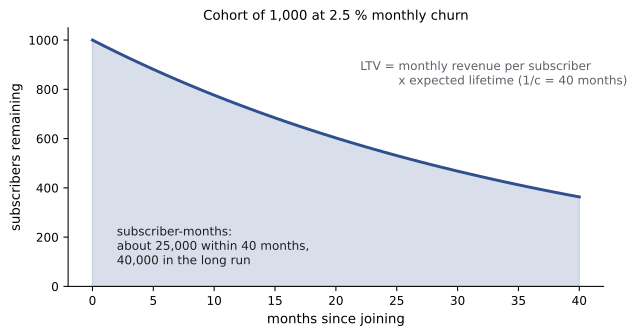
Email lists can be valued by the revenue they help generate. Revenue per subscriber is total revenue attributed to email over a period divided by the average number of subscribers. Subscriber lifetime value estimates the revenue a typical subscriber brings over their time on the list. If a subscriber brings average monthly revenue \(m\) and the monthly unsubscribe and churn rate is \(c\), the expected lifetime is about \(1/c\) months, so:
Comparing lifetime value with the cost of acquiring a subscriber, whether through paid promotion, lead magnets or time, shows whether a growth tactic pays.
Worked problem
Is a paid newsletter recommendation worth it?
A creator's list of 10,000 subscribers generates $3,000 a month from sponsorships and product sales. Monthly churn is 2.5 %. A newsletter recommendation network charges $2.00 per new subscriber. Is it worth paying?
Show solution
- Monthly revenue per subscriber: $3,000 / 10,000 = $0.30.
- Expected lifetime: 1 / 0.025 = 40 months.
- Lifetime value: $0.30 / 0.025 = $12.00.
- Cost per subscriber: $2.00, so LTV is 6 times acquisition cost.
- Caution: paid subscribers often engage less than organic ones; if their revenue is half as much, LTV is $6.00, still above cost.
Answer: Yes on these numbers: each subscriber is worth about $12 against a $2 cost, but track the cohort to confirm that paid subscribers engage.
Lifetime value estimates rest on assumptions, so revisit them with real cohort data (Lesson 2) and avoid letting revenue goals push you into sending more promotions than subscribers want.
List hygiene
List hygiene keeps a list healthy. Remove addresses that hard bounce, honor unsubscribes instantly, and periodically send a re-engagement campaign to subscribers who have not opened or clicked in several months, removing those who do not respond. A smaller, engaged list delivers better, costs less on size-based pricing and gives more accurate metrics than a large list full of inactive addresses. Avoid relying on open rates alone given privacy features; consider clicks, replies and purchases when judging engagement.
Paid newsletters
Some creators charge for their newsletter directly, offering paid subscriptions for full access, extra issues or community features while keeping some issues free. Platforms such as Substack, Beehiiv and Ghost support paid subscriptions, each with different fee structures: some take a percentage of subscription revenue plus payment processing, while others charge a flat monthly fee. Paid newsletters work best when the writer offers expertise, analysis, reporting or community that readers cannot easily find elsewhere, and when free issues show the quality of paid work. Conversion from free to paid subscribers is often in the low single digits as a percentage of the free list, so a large, engaged free list is usually the foundation of a successful paid newsletter. Sales taxes may apply to digital subscriptions in both countries, depending on where subscribers live and the platform's role in collecting them.
Measuring newsletter performance
Useful newsletter measures include list growth (new subscribers minus unsubscribes), click rate (the share of delivered emails in which a reader clicks a link), reply rate, unsubscribe rate per issue, spam complaint rate, and revenue per issue or per subscriber. Because privacy features inflate open rates, treat opens as a rough guide to trends rather than an exact count. Compare issues to see which topics, formats and subject lines produce the most clicks and replies, and watch for rising unsubscribes after particular types of content, which can show what subscribers do not want.
Moving between email services
Because email lists are portable, creators can move between services as their needs change. When moving, export your subscribers with their consent records, tags and sign-up dates, import them into the new service, set up authentication on your sending domain again, and warm up sending gradually if your volume is large, since a sudden spike from a new service can look suspicious to mailbox providers. Redirect old sign-up forms and update links on your website, link page and video descriptions. Keep the old account until you have confirmed that everything works, and remove inactive subscribers before importing so that you start with a clean, engaged list.
Respecting subscribers' attention
Every email asks for a moment of a subscriber's attention. Respect it by sending only when you have something worth reading, keeping to the schedule you promised, making unsubscribing easy, and letting subscribers choose how often or on which topics they hear from you. Subscribers who feel respected stay longer, click more and recommend your newsletter to others.
Common mistakes
MistakeBuying or scraping email addresses.
InsteadGrow with clear, consent-based sign-ups.
MistakeAssuming US rules apply to Canadian subscribers.
InsteadFollow CASL's opt-in rules and keep consent records.
MistakeSending from a free webmail address without authentication.
InsteadAuthenticate a custom domain with SPF, DKIM and DMARC.
MistakeNewsletters that are only lists of links.
InsteadDeliver value in the email and one clear call to action.
MistakeKeeping thousands of inactive addresses.
InsteadRun re-engagement campaigns and prune the list.
Summary and key terms
- Email reaches subscribers directly and is portable across services.
- Choose an ESP by pricing, export, monetization, discovery and automation.
- Grow lists with clear benefits, consent and double opt-in.
- CASL requires consent; CAN-SPAM requires honest messages and opt-outs.
- Authentication, low spam rates and engagement drive deliverability.
- LTV is roughly monthly revenue per subscriber divided by churn.
- Segmentation, welcome sequences and list hygiene keep lists healthy.
- ESP
- Email service provider that manages lists and sending.
- Double opt-in
- Sign-up confirmed by clicking a link.
- CASL
- Canada's Anti-Spam Legislation.
- CAN-SPAM
- US law governing commercial email.
- CEM
- Commercial electronic message under CASL.
- Deliverability
- Likelihood of email reaching the inbox.
- SPF, DKIM and DMARC
- Email authentication standards.
- Welcome sequence
- Automated emails sent to new subscribers.
- LTV
- Lifetime value: expected revenue from a subscriber.
- List hygiene
- Removing bounces and inactive subscribers.
Practice problems
Work each problem on paper first, then reveal the answer to check.
Why are open rates less reliable since 2021?
Show answer
Privacy features preload images and inflate opens.
Name three factors in choosing an ESP.
Show answer
Pricing, export, monetization, discovery, automation, compliance.
What is double opt-in?
Show answer
Subscribers confirm their sign-up by clicking a link.
Is consent required before commercial email under CASL?
Show answer
Yes, express or implied.
How quickly must opt-outs be honored under both laws?
Show answer
Within 10 business days.
What spam rate do Gmail and Yahoo require bulk senders to stay below?
Show answer
0.3 %.
LTV for $0.20 per month and 4 % churn?
Show answer
$5.00.
Expected lifetime at 5 % monthly churn?
Show answer
20 months.
Why is a welcome sequence valuable?
Show answer
New subscribers are most interested right after joining.
What does list hygiene involve?
Show answer
Removing bounces, honoring unsubscribes, re-engaging or pruning inactive subscribers.
Lesson quiz · 5 questions
Score 60% or more to complete this lesson.
Create a free account to save your progress, take quizzes and earn a certificate.