
CRE-302 · Lesson 6 of 12 · 29 min
Memberships and subscriptions
Memberships and subscriptions turn an audience's loyalty into recurring revenue: members pay a fixed amount each month or year for access, perks or simply to support the creator. Recurring revenue is valuable because it is predictable, it grows steadily as members accumulate, and it depends on the creator's relationship with fans rather than on advertising rates or algorithms. But it also brings ongoing obligations: members expect value every month, and if they stop finding it, they cancel. This lesson covers membership models and platforms, pricing and tiers, the key metrics of monthly recurring revenue (MRR), churn and lifetime value (LTV), how to deliver value sustainably, and the consumer protection rules for subscriptions in Canada and the United States. CRE-301 discussed community spaces and member privacy; this lesson focuses on the business of memberships.
Membership models
Memberships come in several models:
- Patronage: members pay to support the creator's work, with small thank-you perks such as credits or badges. The main value is the satisfaction of supporting something the member cares about.
- Premium content: members get extra content, such as bonus episodes, ad-free versions, early access, extended cuts or a premium newsletter.
- Community access: members join a private community, such as a Discord server, forum or members-only live stream.
- Learning and access: members get regular lessons, critiques, office hours or direct contact with the creator.
- Product subscriptions: members receive regular physical or digital goods, such as patterns, presets or a monthly box.
Many memberships combine elements of several models across different tiers.
Platforms and fees
Memberships can be run on the platform where the audience already is, on a dedicated membership platform, or on the creator's own site:
- In-platform memberships: YouTube channel memberships, Twitch subscriptions, Instagram and Facebook subscriptions, and TikTok subscriptions. They are convenient for fans but the platform takes a share; at the time of writing, YouTube pays creators 70 % of net membership revenue, and app store fees can reduce net revenue for purchases made in mobile apps.
- Dedicated platforms: Patreon, Ko-fi memberships, Buy Me a Coffee, Memberful and similar services. At the time of writing, Patreon charges creators who launched after 4 August 2025 a 10 % platform fee, plus payment processing fees; older accounts may be on earlier plans. Substack takes 10 % of paid newsletter subscriptions plus payment processing.
- Own website: membership plugins and payment processors such as Stripe give the most control and lowest fees but require more setup, customer support and compliance work.
The trade-off is between convenience and discovery on one side and control, fees and ownership of the customer relationship on the other. A dedicated platform or own site usually gives the creator members' email addresses, which an in-platform membership does not.
| Option | Typical creator share | Owns member contact | Main advantage |
|---|---|---|---|
| In-platform (e.g. YouTube) | About 70 % of net | No | Convenience for fans |
| Patreon (new accounts) | About 90 % before processing | Yes, email | Tools and recognition |
| Substack paid newsletter | About 90 % before processing | Yes, email | Built-in publishing |
| Own site with Stripe | About 97 % before tools | Yes, full | Control and low fees |
Pricing and tiers
Most memberships offer two to four tiers, for example $5, $10 and $25 a month, each adding perks. A low entry tier lets many fans join; higher tiers capture more value from the most devoted members. Common findings are that most members choose the lowest or middle tier, that a small number at the top tier can contribute a large share of revenue, and that perks requiring the creator's personal time, such as one-to-one calls, should be limited to high tiers with capped numbers. Annual plans, often discounted by about 15 to 20 %, improve cash flow and reduce churn. Price increases should be announced in advance; many creators keep existing members at their original price.
Average revenue per member (ARPM) shows how the tier mix translates into revenue. Raising ARPM through a well-designed higher tier can be as effective as recruiting more members.
MRR, churn and growth
Monthly recurring revenue (MRR) is the total revenue from active subscriptions in a month, with annual plans counted as one-twelfth of their price. Churn rate is the share of members who cancel each month.
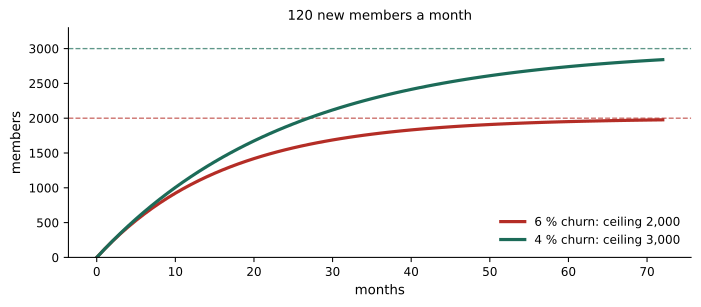
Membership growth depends on the balance between new members and churn. If a creator gains \(N\) new members a month and loses a fraction \(c\) of existing members, membership tends toward a steady state where gains equal losses.
Worked problem
Membership growth and its ceiling
A creator gains 120 new members a month, and 6 % of members cancel each month. ARPM is $8. What membership size and MRR will the program approach?
Show solution
- Steady state: \(M = N / c = 120 / 0.06 = 2{,}000\) members.
- MRR at steady state: 2,000 × $8 = $16,000.
- If churn fell to 4 %, the ceiling would rise to 120 / 0.04 = 3,000 members and $24,000 MRR.
Answer: About 2,000 members and $16,000 MRR; cutting churn from 6 % to 4 % raises the ceiling by half.
Lifetime value
Lifetime value (LTV) estimates the total revenue a member brings over their membership. With a constant monthly churn rate \(c\), the average membership lasts about \(1/c\) months.
Worked problem
Lifetime value after fees
A membership has ARPM of $10, platform and processing fees of 13 % and monthly churn of 5 %. What is the LTV per member?
Show solution
- Net revenue per month: $10 × (1 − 0.13) = $8.70.
- Average lifetime: 1 / 0.05 = 20 months.
- LTV: $8.70 × 20 = $174.
Answer: About $174 per member, which tells the creator how much effort or promotion spending per new member is worthwhile.
LTV helps decide how much to spend on attracting members, for example through free trials, promotional content or ads, and shows the value of reducing churn.
Reducing churn
Members cancel for predictable reasons: they no longer use the perks, they forget why they joined, money is tight, the creator's schedule slipped, or the community changed. Practical ways to reduce churn include delivering perks on a reliable schedule, welcoming new members personally or with an onboarding sequence, making the value visible each month with a short update, offering annual plans, providing a pause option rather than only cancellation, and asking departing members why they are leaving. Some churn is unavoidable and healthy; a membership that makes cancellation hard does not reduce churn, it just converts it into resentment and legal risk.
Sustainable perks
The biggest risk in a membership is promising more than the creator can deliver. Perks that require weekly bespoke content can become a second job. Sustainable perk design favors perks that scale, such as early access to content already being made, ad-free versions, behind-the-scenes clips captured during normal production, monthly live sessions and community access, over perks that require one-to-one work for every member. A simple test is whether the creator could still deliver every promised perk during a busy or difficult month.
Consumer protection for subscriptions
Subscriptions that renew automatically are subject to consumer protection rules in both countries. Common principles are that the price, billing frequency and renewal terms must be disclosed clearly before purchase; the customer must agree to the recurring charge; cancellation must be reasonably easy; and price increases require notice. Creators using established platforms benefit from the platform's checkout and cancellation flows, but those running memberships on their own sites are responsible for compliance themselves.
In the United States, the Restore Online Shoppers' Confidence Act (ROSCA) requires clear disclosure of material terms, express informed consent before charging, and a simple way to stop recurring charges for online negative option offers. The FTC's 2024 amendments to the Negative Option Rule, known as the "click to cancel" rule, were vacated by the Eighth Circuit in July 2025; at the time of writing the FTC has restarted the rulemaking process, but ROSCA and the FTC Act remain in force. Many states, including California and New York, have automatic renewal laws requiring clear disclosure, affirmative consent, reminders for some renewals and easy online cancellation.
Integrating memberships with other streams
Memberships work best when they grow naturally from the creator's content and community. Free content attracts the audience; a membership offers a deeper relationship to those who want it. Members are also the most likely buyers of products, courses and merchandise, and their feedback helps shape new offerings. Mentioning the membership regularly but briefly in content, as a call to action rather than a hard sell, keeps new members arriving. A membership with a few hundred engaged members can provide a stable base that makes the creator less dependent on volatile ad and sponsorship income.
Free trials and promotions
Free trials and introductory discounts can attract members who are unsure whether a membership is worth it, but they bring their own costs. Trial members churn at higher rates, and a trial that converts automatically into a paid subscription must follow the disclosure and consent rules described above, including clear notice of when charges begin. Many creators prefer occasional promotions, such as a discounted first month around a milestone or a sale on annual plans during a holiday period, over permanent free trials. The value of a promotion can be estimated by comparing the LTV of members who join through it with its cost in discounts and extra churn.
Worked problem
Is an annual plan worth the discount?
A monthly membership costs $10 with 6 % monthly churn. An annual plan costs $100, and the creator expects 60 % of annual members to renew each year. Ignoring fees, compare the expected revenue from a monthly member and an annual member over their lifetime.
Show solution
- Monthly member: $10 / 0.06 ≈ $167.
- Annual member: expected number of years is 1 / (1 − 0.60) = 2.5; revenue: $100 × 2.5 = $250.
Answer: The annual member is worth about $250 against $167, despite the lower monthly equivalent price, because annual commitment reduces churn.
Cohort analysis
Average churn can hide important patterns. Cohort analysis groups members by the month they joined and tracks what share remain after one, three, six and twelve months. It often shows that churn is highest in the first month or two and falls for members who stay longer, so improving the first-month experience has the largest effect. It can also reveal that members who joined through a particular promotion or platform behave differently. Most membership platforms provide data that can be exported into a spreadsheet for this kind of analysis.
Membership privacy and community health
Memberships often involve private communities, direct messages and personal information such as names, email addresses and payment details. Creators should protect members' data, follow the privacy rules discussed in CRE-301, and set clear community guidelines. A membership community that becomes hostile, or where the creator is never present, loses members quickly. Moderators, clear expectations about how often the creator will participate, and regular events help keep the community healthy.
When a membership is not the right fit
Not every creator should run a membership. Audiences that come for occasional entertainment, rather than an ongoing relationship, may not see value in paying every month, and creators who already struggle to keep a publishing schedule may find perk obligations overwhelming. In such cases, tips, one-off products or an occasional crowdfunding campaign may suit better. A simple test is to ask the audience directly what they would value, then launch with a small set of perks that can be expanded if demand is strong.
Membership income should also be planned with fees and taxes in mind. Platform fees, payment processing, currency conversion for members paying in other currencies, and sales taxes where they apply all reduce what reaches the creator. Some platforms collect sales tax or VAT on memberships on the creator's behalf, while others leave it to the creator. Checking these details before choosing a platform avoids unpleasant surprises when the first payouts arrive, and makes MRR forecasts realistic.
Common mistakes
MistakePromising perks that require weekly bespoke work.
InsteadDesign perks that scale with normal production.
MistakeFocusing only on new member sign-ups.
InsteadMeasure and reduce churn, which sets the ceiling.
MistakeMaking cancellation difficult.
InsteadMake it easy; offer pause options and ask why.
MistakeComparing platforms by fee alone.
InsteadWeigh fees, convenience and ownership of member contact.
MistakeRaising prices without notice.
InsteadAnnounce changes in advance and follow renewal rules.
Summary and key terms
- Memberships provide recurring revenue from loyal fans.
- Models include patronage, premium content, community and learning access.
- Platforms trade convenience against fees and member ownership.
- MRR sums active subscriptions; churn is the monthly cancellation rate.
- Membership approaches a ceiling of new members divided by churn.
- LTV equals net monthly revenue per member divided by churn.
- Subscriptions must follow disclosure, consent and cancellation rules.
- Membership
- A recurring payment for access or perks.
- Tier
- A membership level with its own price and perks.
- MRR
- Monthly recurring revenue.
- Churn rate
- Share of members canceling each month.
- ARPM
- Average revenue per member.
- LTV
- Total revenue expected from a member.
- Steady state
- Size at which new members equal cancellations.
- Annual plan
- A yearly subscription, often discounted.
- Negative option
- An offer that renews unless the customer cancels.
- ROSCA
- US law on online recurring charges.
Practice problems
Work each problem on paper first, then reveal the answer to check.
Name four membership models.
Show answer
Patronage, premium content, community, learning, product subscriptions.
MRR for 300 at $5 and 50 at $20?
Show answer
$2,500.
ARPM for $2,500 MRR from 350 members?
Show answer
About $7.14.
Churn if 40 of 800 members cancel?
Show answer
5 %.
Steady state for 100 new a month at 5 % churn?
Show answer
2,000 members.
LTV for $9 net per month at 3 % churn?
Show answer
$300.
Name two ways to reduce churn.
Show answer
Reliable perks, onboarding, annual plans, pause option, exit surveys.
What happened to the FTC click-to-cancel rule?
Show answer
Vacated by the Eighth Circuit in July 2025.
What US federal law still governs online recurring charges?
Show answer
ROSCA.
Why prefer scalable perks?
Show answer
They can be delivered even in busy months.
Lesson quiz · 5 questions
Score 60% or more to complete this lesson.
Create a free account to save your progress, take quizzes and earn a certificate.