
CRE-302 · Lesson 8 of 12 · 29 min
Digital products
Digital products are among the most attractive revenue streams for creators: once made, they can be sold any number of times at almost no extra cost, they need no warehouse or shipping, and they let creators package their expertise or style into something an audience can use. Templates, presets, e-books, guides, sound packs, fonts, printables, stock footage, digital art, software tools and patterns are all examples. The high margins come with their own challenges: making a product people will pay for, pricing it well, marketing it to an audience accustomed to free content, handling piracy and refunds, and complying with sales tax rules on digital goods in many jurisdictions. Courses are a large category of digital product with their own considerations, covered separately in Lesson 9. This lesson covers types of digital products, validation, pricing and margins, break-even analysis, sales platforms and launch strategy, and the tax and consumer rules that apply.
Types of digital product
Common digital products include:
- Templates: spreadsheets, budgets, planners, Notion workspaces, design templates, video editing templates, résumé templates.
- Presets and packs: photo and video color-grading presets, LUTs, sound effects, music loops, sample packs, brushes, fonts.
- Written products: e-books, guides, checklists, recipe collections, travel itineraries, study notes.
- Patterns and plans: sewing, knitting and crochet patterns, woodworking plans, 3D printing files.
- Digital art and assets: wallpapers, illustrations, stock photos and footage, overlays and graphics for streamers.
- Software and tools: plug-ins, apps, scripts, calculators.
The best digital products grow directly out of the creator's content: a photographer's presets, a cook's recipe book, a finance creator's budget template, a woodworker's plans. Viewers who have watched the creator use the tool already understand its value.
Validating demand
Before investing weeks in a product, creators can test whether people will buy it. Signals of demand include repeated questions in comments, requests for the files or tools the creator uses, strong performance of content on the topic, and responses to a direct question in a poll or newsletter. Stronger tests ask for commitment: a waiting list with email sign-ups, pre-orders at a discount, or a small minimum version sold to a few people first. A product that sells to the first 20 buyers and earns good feedback is far more likely to succeed at scale than one built on assumption. Validation also shapes the product, since early buyers' questions show what to include.
Pricing and margins
Because the marginal cost of a digital product is close to zero, its gross margin is very high, but it is not 100 %. Payment processing, platform fees, sales taxes the creator must remit, refunds and affiliate commissions all reduce what the creator keeps. Gross margin per sale is the share of the price left after these variable costs.
Prices for digital products should be based on the value to the buyer, not the cost of making them. A template that saves a small business owner hours of work each month may be worth $40 or more, while a set of phone wallpapers might sell for a few dollars. Useful pricing approaches include comparing similar products, offering a basic and a premium version, bundling related products at a discount, and testing prices with small launches. Charm prices such as $19 or $29 are common, and launch discounts can reward early buyers. Underpricing is a more common error than overpricing: a price that feels too low can suggest low quality and leaves no room for promotions or affiliates.
| Variable cost | Typical size | Notes |
|---|---|---|
| Payment processing | About 3 % plus a fixed fee | Higher on small transactions |
| Sales platform fee | 0–10 %, or a monthly plan | Varies by platform and plan |
| Marketplace fee | Often 5–30 % | Marketplaces bring traffic |
| Affiliate commission | Often 20–50 % | Only on affiliate-referred sales |
| Refunds | A few percent of sales | Depends on policy and quality |
Worked problem
Margin on a template
A budget template sells for $29. Payment processing is 2.9 % plus $0.30; the sales platform takes 5 %; refunds average 3 % of sales. What is the contribution per sale and the gross margin?
Show solution
- Processing: $29 × 0.029 + $0.30 = $1.14.
- Platform fee: $29 × 0.05 = $1.45; refund allowance: $29 × 0.03 = $0.87.
- Variable costs: $1.14 + $1.45 + $0.87 = $3.46; contribution: $29 − $3.46 = $25.54.
- Gross margin: $25.54 / $29 ≈ 88 %.
Answer: About $25.54 per sale, an 88 % gross margin.
Break-even for a digital product
Digital products have fixed costs, mainly the creator's time and any design, editing, software or testing paid for, plus marketing. The break-even point is the number of sales needed to recover those fixed costs.
Worked problem
Break-even for a preset pack
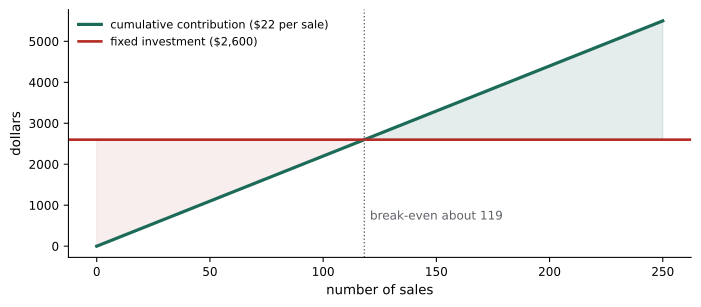
A creator spends 40 hours making a preset pack, valuing their time at $50 an hour, and pays $600 for testing and product images. The pack sells for $25 with a contribution of $22 per sale. How many sales are needed to break even, counting their time?
Show solution
- Fixed costs: 40 × $50 + $600 = $2,600.
- Break-even: $2,600 / $22 ≈ 118.2, so 119 sales.
- If 0.5 % of a 30,000-person email list and audience buy at launch, that is about 150 sales.
Answer: About 119 sales; a launch to 30,000 people at 0.5 % would pass break-even.
Counting the creator's time as a cost is important. A product that "made $2,000" but took 100 hours paid $20 an hour, which may be worse than other uses of the same time. Digital products become very profitable after break-even, because every later sale contributes almost the full price, and evergreen products can keep selling for years.
Where to sell
Creators can sell digital products through several kinds of platform:
- Creator storefronts such as Gumroad, Payhip, Stan, Shopify with digital download apps, Sellfy and Lemon Squeezy, which handle payments and file delivery for a percentage or monthly fee.
- Marketplaces such as Etsy for printables and patterns, Creative Market for design assets, and asset stores for plug-ins and game assets, which bring their own traffic in exchange for higher fees and more competition.
- Platform shops built into membership platforms (Patreon, Ko-fi) or social platforms.
- The creator's own website with an e-commerce plug-in.
An important difference between platforms is how they handle sales tax. Some act as the merchant of record, meaning they are legally the seller and calculate, collect and remit sales taxes worldwide; others leave tax compliance to the creator. For a creator selling to customers in many provinces, states and countries, a merchant-of-record platform can remove a large compliance burden, often for a slightly higher fee.
Sales tax on digital products
Digital products are taxed differently from physical goods, and the rules vary by jurisdiction. Generally, the tax depends on where the buyer is located, not where the creator lives.
In the United States, there is no federal sales tax; each state decides whether and how to tax digital products, and many states tax some digital goods while others exempt them. After South Dakota v. Wayfair (2018), states can require out-of-state sellers to collect sales tax once sales into the state exceed an economic nexus threshold, commonly $100,000 a year, and sometimes a number of transactions. Marketplace facilitator laws in every state with a sales tax require marketplaces such as Etsy to collect and remit tax on sales they facilitate. CRE-330 covers nexus and registration.
International sales add value-added tax (VAT) rules in places such as the European Union and the United Kingdom, which apply to digital products sold to consumers there from the first sale. This is a strong argument for merchant-of-record platforms for creators with global audiences.
Licenses, piracy and refunds
Digital products should state what buyers may do with them. A license might allow personal use only, commercial use in the buyer's own projects, or redistribution under specific conditions; presets, fonts, music loops and stock assets especially need clear licenses. Piracy is inevitable for popular products, but it rarely costs as many sales as creators fear, because people who pirate are often not likely buyers; reasonable measures include watermarking, license keys for software and personalized download links, without punishing legitimate buyers. Refund policies should be clear and fair; consumer protection laws may override a "no refunds" policy in some cases, for example if the product is defective or not as described.
Launching and marketing digital products
Content is the marketing for most creator products. Showing the product in use, sharing results, offering a free sample or lite version, and mentioning the product in relevant videos all help. Launches to an email list (CRE-301) often produce a large share of first-year sales; a launch discount with a clear deadline encourages early purchase. Evergreen sales continue through product pages linked from descriptions, pinned comments, a website and search. Bundles and upgrades increase average order value: a buyer of a starter pack may later buy the premium pack. Affiliate programs for the creator's own products, in which other creators earn commission for referring buyers, can extend reach.
Product page essentials
A product page has to answer the buyer's questions quickly. Effective pages explain what the product is, who it is for, what problem it solves, what exactly is included (file formats, number of items, compatibility with software versions), how it will be delivered, the license, the refund policy and how to get help. Before-and-after images, short demonstration videos and examples of results show value better than descriptions. Testimonials from real buyers help, but they must be genuine and representative. A clear, specific page also reduces support requests and refunds, because buyers know what they are getting.
Customer support and updates
Digital products are not entirely hands-off. Buyers ask for help installing presets, opening templates in different software versions, or finding download links. Software and templates may need updating when the tools they depend on change. A small set of help articles, a frequently asked questions section and a support email address handle most questions. Updating products and notifying past buyers of improvements builds goodwill and encourages future purchases.
Worked problem
Pricing tiers for a template pack
A creator offers a basic template pack at $19 and a premium pack, with extra templates and video walkthroughs, at $49. Contribution is about 88 % of price for both. Of 400 buyers, 70 % choose basic and 30 % premium. What is total contribution and average contribution per buyer?
Show solution
- Basic: 280 × $19 × 0.88 = $4,681.60.
- Premium: 120 × $49 × 0.88 = $5,174.40.
- Total: $9,856; average per buyer: $9,856 / 400 = $24.64.
Answer: About $9,856 in total, $24.64 per buyer; the premium tier, chosen by under a third of buyers, contributes more than half.
Bundles and price anchoring
Offering a premium option alongside a basic one does more than capture extra revenue from enthusiasts. A higher-priced option makes the middle option look more reasonable, an effect known as price anchoring, and bundles of related products can increase average order value while giving buyers a better deal. Bundles should combine products that genuinely belong together, such as a starter preset pack with a matching LUT pack, rather than padding a bundle with unrelated items.
Accessibility and file formats
Digital products should work for as many buyers as possible. E-books and guides can be offered in accessible formats with proper headings and alternative text for images; templates should state which software versions they work with; video walkthroughs benefit from captions. Choosing widely supported file formats, and explaining any requirements clearly, prevents frustration and refund requests.
Finally, digital products benefit from a long-term catalog strategy. Rather than launching unrelated products, creators can build a family of products that serve the same audience at different levels, such as a free sample, a starter pack, a complete pack and a professional bundle. Each product can link to the next, and buyers who are satisfied with one product are the most likely to buy another. Over time, a well-organized catalog can produce steady sales with relatively little new work.
Common mistakes
MistakeBuilding a product before validating demand.
InsteadTest with waiting lists, pre-orders or a small version.
MistakePricing by production cost.
InsteadPrice by value to the buyer.
MistakeIgnoring time when calculating profit.
InsteadCount your hours as a fixed cost.
MistakeAssuming digital sales are tax-free.
InsteadCheck GST/HST, QST, state and VAT rules.
MistakeSelling assets without a clear license.
InsteadState permitted personal and commercial uses.
Summary and key terms
- Digital products can be sold repeatedly at near-zero marginal cost.
- The best products grow out of the creator's content.
- Validate demand before building.
- Price by value; account for fees, processing and refunds.
- Break-even sales equal fixed costs divided by contribution per sale.
- Sales taxes on digital products depend on the buyer's location.
- Merchant-of-record platforms can handle tax compliance.
- Digital product
- A product delivered electronically, such as a template.
- Marginal cost
- The cost of selling one more unit.
- Gross margin
- Share of price left after variable costs.
- Break-even point
- Sales needed to recover fixed costs.
- Validation
- Testing demand before building a product.
- Merchant of record
- The legal seller responsible for tax and payments.
- Marketplace facilitator
- A marketplace required to collect sales tax.
- Economic nexus
- State tax obligation triggered by sales volume.
- Small supplier
- Canadian business under the $30,000 GST/HST threshold.
- License
- Terms stating how a buyer may use a product.
Practice problems
Work each problem on paper first, then reveal the answer to check.
Name four types of digital product.
Show answer
Templates, presets, e-books, patterns, assets, software.
Name two ways to validate demand.
Show answer
Waiting list, pre-orders, small version, polls.
Gross margin for a $40 product with $4 variable costs?
Show answer
90 %.
Break-even for $3,000 fixed costs and $25 contribution?
Show answer
120 sales.
Why count your time as a cost?
Show answer
To see the true hourly return.
What is a merchant of record?
Show answer
The legal seller handling tax and payments.
What is the Canadian small supplier threshold?
Show answer
$30,000 over four consecutive quarters.
What did Wayfair allow states to do?
Show answer
Require out-of-state sellers to collect sales tax.
Why do presets and fonts need licenses?
Show answer
To define personal and commercial uses.
Which channel often drives launch sales?
Show answer
The email list.
Lesson quiz · 5 questions
Score 60% or more to complete this lesson.
Create a free account to save your progress, take quizzes and earn a certificate.