
CRE-340 · Lesson 12 of 12 · 34 min
Capstone: campaign plan and post-campaign report
This capstone brings the course together. You will follow a complete campaign for a fictional brand from brief to final report, applying each lesson's tools in order. The worked examples show one reasonable set of choices; your own capstone project should apply the same steps to a brand and product of your choice, with your own reasoning and numbers. The brand, creators and figures below are invented for teaching.
The scenario
Ridgeline Bars is a small company that makes high-protein snack bars aimed at hikers, climbers and trail runners. The bars are sold through the company's website and in about 300 outdoor and grocery stores. Ridgeline is launching a new plant-based flavor in the spring and has a creator budget of $90,000 for a ten-week campaign. Its gross margin on website sales is 45 %, the average website order is $48, and the company estimates that a new website customer generates $95 of gross profit over their lifetime, including the first order. Last year's small creator test produced a cost per acquisition of about $38 on tracked website orders.
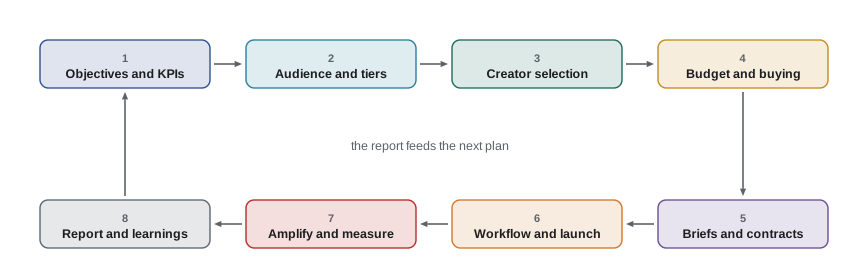
Step 1: objectives and KPIs
Ridgeline's business objective is to make the new flavor one of its top two sellers within six months. The creator program cannot do that alone, so the team defines two campaign objectives: drive 1,200 new website customers during the campaign window at a CPA no higher than $45, and raise awareness of the new flavor among outdoor enthusiasts in the target regions, measured by a brand-lift survey. A secondary objective is to obtain at least 25 licensed short videos for use in paid social over the following year.
| Level | Measure | Target | Source |
|---|---|---|---|
| Primary KPI | New website customers from creator activity | 1,200 at CPA ≤ $45 | Affiliate links, codes, web analytics |
| Primary KPI | Aided awareness lift among target audience | +4 percentage points | Platform brand-lift study |
| Secondary | Incremental orders in test regions | Positive and significant | Regional holdout |
| Secondary | Licensed videos delivered | 25 or more | Content tracker |
| Diagnostic | Reach, completion rate, CTR, engagement by reach, disclosure rate | Benchmarked to past campaign | Creator analytics, ad accounts |
Worked problem
Checking the conversion objective is realistic
Last year's creator posts produced a click-through rate of 0.9 % of impressions and a website conversion rate of 3.5 % of clicks. How many impressions are needed for 1,200 new customers, assuming 80 % of buyers are new?
Show solution
- Orders needed: 1,200 ÷ 0.80 = 1,500.
- Orders per impression: 0.009 × 0.035 = 0.000315.
- Impressions needed: 1,500 ÷ 0.000315 ≈ 4.76 million.
Answer: About 4.8 million impressions, a figure the team must check against the budget in Step 4.
Step 2: audience and creator tiers
The target audience is adults aged 22 to 45 who hike, climb or trail run at least twice a month, care about ingredients and performance, research gear through short video and long-form reviews, and are skeptical of overly polished ads. Secondary audiences include plant-based eaters who are active but not specialists. The team chooses a pyramid: two mid-tier outdoor creators for credibility and reach, 14 micro creators across hiking, climbing, trail running and plant-based cooking, and 30 nano creators who are existing customers, recruited through tagged posts and an application form.
Because Ridgeline sells nationally in the US, the line-up includes creators in mountain, Pacific and northeastern regions where most of its retail stores are, plus two bilingual Spanish-English creators.
Step 3: selecting creators
The team builds a long list of 220 creators from platform marketplaces, a discovery tool, tagged posts and referrals. A basic screen for country, niche, platform and size leaves 95. A performance screen using median reach and engagement by reach over the last 90 days leaves 60. Authenticity checks, content audits covering two years and disclosure-history checks leave 52, from which the team selects the 46 needed using a weighted scorecard: audience fit 35 %, content quality 25 %, performance 20 %, authenticity 10 % and cost efficiency 10 %, with brand safety as a gate.
Worked problem
Adjusting a candidate for audience quality
One mid-tier candidate has 310,000 followers, an estimated 12 % suspicious followers and 55 % of real followers in the target market and countries. Another has 240,000 followers, 4 % suspicious and 70 % fit. Which has the larger useful audience?
Show solution
- Candidate 1: 310,000 × 0.88 × 0.55 ≈ 150,040.
- Candidate 2: 240,000 × 0.96 × 0.70 ≈ 161,280.
Answer: Candidate 2 has the larger useful audience despite 70,000 fewer followers.
Step 4: budget and buying models
The team allocates the $90,000 budget across creator fees, usage, amplification, product and shipping, software, measurement and contingency. Mid-tier creators receive flat fees with 90 days of paid usage. Micro creators receive hybrid deals: a flat fee plus 10 % commission on tracked sales. Nano creators receive product, a modest flat fee of $150 for one video with disclosure, and an affiliate link.
| Line | Calculation | Amount |
|---|---|---|
| Mid-tier fees (2) | 2 × $7,500 | $15,000 |
| Mid-tier paid usage, 90 days | 2 × 30 % × $7,500 (priced at 30 % of base for 90 days) | $4,500 |
| Micro fees (14) | 14 × $1,400 | $19,600 |
| Micro usage, organic reposting | 14 × $200 | $2,800 |
| Nano fees (30) | 30 × $150 | $4,500 |
| Commissions (estimate) | 10 % of expected tracked sales from micro creators | $3,000 |
| Paid amplification | Media budget | $28,000 |
| Product and shipping | 46 kits including cross-border shipping | $3,200 |
| Software and payments | Discovery and payment tools for the quarter | $3,400 |
| Measurement | Brand-lift study minimum and analyst time | $1,500 |
| Contingency | About 5 % | $4,500 |
| Total | $90,000 |
Worked problem
Will the plan deliver enough impressions?
Organic delivery is forecast at 260,000 impressions per mid-tier post with two posts each, 28,000 per micro post with two posts each, and 4,000 per nano post with one post each. Amplification buys impressions at an expected $11 CPM. Does the plan reach 4.8 million impressions?
Show solution
- Mid-tier organic: 2 creators × 2 posts × 260,000 = 1,040,000.
- Micro organic: 14 × 2 × 28,000 = 784,000.
- Nano organic: 30 × 4,000 = 120,000.
- Organic total: 1,944,000.
- Paid: 28,000 ÷ 11 × 1,000 ≈ 2,545,000.
- Total: about 4,489,000 impressions, roughly 6 % short of 4.76 million.
Answer: The plan falls slightly short; the team decides to shift $3,000 of contingency to amplification, adding about 273,000 impressions, and to improve the landing page to lift conversion.
Step 5: briefs, contracts and compliance
Each creator receives a two-page brief with the objective, audience, one key message ("real trail fuel, now plant-based"), mandatories (product name, link or code, disclosure at the start of each post), approved claims with substantiation (protein content per bar, ingredient list, plant-based status) and prohibited claims (no weight-loss or medical claims). Contracts use the brand's master agreement with campaign statements of work covering deliverables, one revision round, usage terms, authorization for paid amplification, 30-day category exclusivity for mid-tier creators, an authenticity warranty, analytics requirements at 7 and 30 days, payment within 30 days of delivery and a balanced morals clause.
The disclosure guide follows the FTC's Endorsement Guides and its guidance for influencers, and the team confirms that no reviews or testimonials in the campaign could breach the FTC's Consumer Reviews and Testimonials Rule.
Step 6: workflow and launch
Working back from a launch date in week 8, recruitment runs in weeks 2 to 4, kits ship in week 5, drafts are due at the end of week 6 and approvals finish in week 7. The program lead estimates 4 hours per micro or mid-tier creator and 2 hours per nano creator, or 16 × 4 + 30 × 2 = 124 hours over ten weeks, and assigns a coordinator for 15 hours a week to support the lead.
Step 7: amplification and measurement
After 48 hours of organic posting, the paid team tests the eight strongest videos by completion rate and click-through rate and scales the best three. To measure incrementality, Ridgeline concentrates amplification in test regions and holds back matched control regions with similar historical sales. A platform brand-lift study runs on the amplified content.
The post-campaign report
Results after 30 days are shown below, and the worked examples analyze them.
| Result | Value |
|---|---|
| Total spend (including commissions paid) | $90,600 |
| Total impressions | 4,910,000 |
| Tracked website orders | 1,720 |
| New customers among tracked orders | 1,310 |
| Tracked revenue | $82,560 |
| Awareness lift (aided) | +5.1 points |
| Test-region conversion rate / control | 1.84 % / 1.50 % among 600,000 target customers in test regions |
| Licensed videos delivered and approved | 31 |
| Posts with clear disclosure on first check | 58 of 62 (all fixed within 24 hours) |
Worked problem
Cost per new customer and ROAS
Using the results, calculate CPA per new customer, ROAS on tracked revenue and ROI on first orders.
Show solution
- CPA per new customer: 90,600 ÷ 1,310 ≈ $69.16.
- Compare with the target: $69.16 is well above the $45 target set for tracked orders.
- ROAS: 82,560 ÷ 90,600 ≈ 0.91.
- Gross profit on tracked revenue: 82,560 × 0.45 = $37,152; ROI: (37,152 − 90,600) ÷ 90,600 ≈ −59 %.
Answer: On tracked first orders alone the campaign lost money, with a CPA of about $69 per new customer against a $45 target.
Worked problem
Incremental results from the holdout
Calculate incremental orders and incremental revenue from the regional test, and compare with tracked orders.
Show solution
- Lift: 1.84 % − 1.50 % = 0.34 points = 0.0034.
- Incremental orders in test regions: 0.0034 × 600,000 = 2,040.
- Incremental revenue: 2,040 × $48 = $97,920, including store and website sales captured in the regional data.
- Incremental orders exceed tracked orders (1,720), suggesting many buyers did not use links or codes, especially in stores.
Answer: About 2,040 incremental orders and $97,920 of incremental revenue, an iROAS of about 1.08.
Worked problem
Lifetime view and content value
Assume 75 % of incremental orders are from new customers, each worth $95 of lifetime gross profit, and value the 31 licensed videos at $1,200 each as cost avoided, counting only the 15 the brand plans to use in ads. What is the lifetime ROI including content value?
Show solution
- New customers: 0.75 × 2,040 = 1,530.
- Lifetime gross profit: 1,530 × $95 = $145,350.
- Content value: 15 × $1,200 = $18,000.
- Lifetime ROI including content: (145,350 + 18,000 − 90,600) ÷ 90,600 ≈ 0.80, or 80 %.
Answer: About 80 % lifetime ROI, or about 60 % without counting content value: the campaign pays back over time, though not on first orders.
The first example deserves comment. Honest reports note when a target was missed, as here, and then explain the fuller picture with clearly labeled additional analysis. The CPA target of $45 was set on tracked orders and was missed. Incrementality and lifetime value show the campaign was still worthwhile, but the report should say plainly that tracked CPA was above target and recommend how to improve it: the landing page converted below forecast, and three micro creators delivered most tracked sales.
Writing the recommendations
Ridgeline's report ends with recommendations. Convert the three micro creators with the lowest CPA into six-month ambassadors on hybrid deals. Keep one mid-tier creator for awareness in the autumn and drop the other, whose reach was high but whose audience fit proved weaker than expected. Rebuild the landing page and retest. Continue regional holdouts each quarter, because tracked sales captured only about 84 % of measured incremental orders. Use the 31 licensed videos in paid social and track whether they lower the brand's CPA compared with studio content. Tighten disclosure training, since four posts needed fixes.
Your capstone project
For your own capstone, choose a real or fictional brand and product and prepare: a one-page measurement plan with objectives, KPIs, definitions and targets; an audience description and creator tier strategy; a selection process and scorecard; a complete budget with buying models; a brief and a contract term sheet; a timeline worked back from launch with staffing estimates; an amplification and incrementality plan; a risk register; and a mock post-campaign report with invented but internally consistent results, an honest assessment against targets and recommendations. Check every calculation, state every assumption and make sure the plan would be legal and fair in your country.
Common mistakes
MistakeBuilding the plan around a favorite creator rather than the objective.
InsteadStart with objectives and audience, then select creators.
MistakeForgetting to check that the budget can deliver the required impressions.
InsteadWork back from the objective and reconcile with the budget before launch.
MistakeReporting only the most flattering metric.
InsteadReport results against every agreed target, including misses.
MistakeCounting content value as revenue.
InsteadReport content value separately as cost avoided.
MistakeEnding the report without recommendations.
InsteadTurn results into specific decisions for the next campaign.
Summary and key terms
- A complete plan links business objective, campaign objectives, KPIs and targets.
- Audience and tier strategy determine the creator pyramid.
- Staged selection and weighted scorecards produce a defensible roster.
- Budgets must cover all costs and be reconciled with the impressions or conversions needed.
- Briefs, contracts and disclosure guides build compliance in from the start.
- Holdouts and lifetime value reveal effects that tracked first orders miss.
- Honest reports state misses, explain the fuller picture and recommend next steps.
- Capstone
- A project that applies the whole course to one case.
- Measurement plan
- An agreed document of objectives, KPIs, targets and methods.
- Creator pyramid
- A tier mix with few large and many small creators.
- Term sheet
- A summary of key contract terms.
- Regional holdout
- Regions deliberately excluded from a campaign for comparison.
- iROAS
- Incremental revenue divided by spend.
- Lifetime ROI
- Return including expected future gross profit from customers.
- Cost avoided
- Spending the brand did not need because of an asset it obtained.
- Recommendation
- A specific action proposed on the basis of results.
- Assumption
- A stated input taken as true for planning.
Practice problems
Work each problem on paper first, then reveal the answer to check.
1,000 new customers needed, 75 % of buyers new. Orders needed?
Show answer
About 1,333.
CTR 1 %, conversion 4 %, 2,000 orders. Impressions?
Show answer
5,000,000.
$22,000 amplification at $10 CPM. Impressions?
Show answer
2,200,000.
Spend $60,000, 1,000 new customers. CPA?
Show answer
$60.
Test 2.2 %, control 1.8 %, 500,000 in test. Incremental orders?
Show answer
2,000.
2,000 incremental orders at $40. Incremental revenue?
Show answer
$80,000.
1,200 new customers × $80 lifetime gross profit, spend $60,000. Lifetime ROI?
Show answer
60 %.
Why might incremental orders exceed tracked orders?
Show answer
Many buyers do not use links or codes, especially in stores.
Name four parts of a capstone campaign plan.
Show answer
Measurement plan, audience and tiers, budget, brief, timeline, amplification, risk register.
What should a report do when a target is missed?
Show answer
State it plainly, explain the fuller picture and recommend improvements.
Lesson quiz · 5 questions
Score 60% or more to complete this lesson.
Create a free account to save your progress, take quizzes and earn a certificate.