
CRE-340 · Lesson 2 of 12 · 27 min
Campaign objectives, KPIs and benchmarks
A campaign without a clear objective cannot succeed, because there is nothing to succeed at. It can only produce numbers, and numbers without a target invite whichever interpretation suits the person presenting them. This lesson shows how to turn a business problem into a campaign objective, choose key performance indicators (KPIs) that genuinely measure that objective, set targets using benchmarks and history, and agree all of this before any money is spent.
From business problem to campaign objective
Campaigns exist to solve business problems, so planning starts with the problem rather than the tactic. Typical problems include low awareness of a new product, weak consideration among a particular group, poor conversion from site visits to sales, falling repeat purchases, a damaged reputation or a shortage of fresh content for advertising. A useful planning question is: if this campaign works perfectly, what will be different for the business in six months? The answer is the business objective. The campaign objective is the part of that change the creator program is expected to deliver.
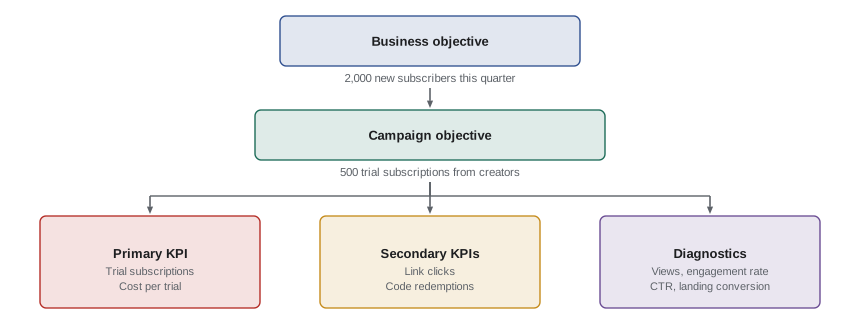
Suppose a regional coffee roaster is launching an online subscription. The business objective is 2,000 new subscribers in the first quarter. Creator marketing will not deliver all of them; email, search ads and the roaster's own social accounts will contribute too. The campaign objective might be to drive 500 trial subscriptions from creator content and to produce 40 short videos the brand can reuse in ads. Separating the two keeps expectations realistic and makes the creator team accountable for something it can actually influence.
SMART objectives
A widely used test for objectives is SMART: specific, measurable, achievable, relevant and time-bound. Specific means it names the audience, product and change. Measurable means there is a number and a way to track it. Achievable means it is grounded in past results or benchmarks rather than hope. Relevant means it connects to the business objective. Time-bound means it has a deadline. "Get people talking about our brand" fails every test. "Reach 1.2 million Canadian women aged 25 to 44 interested in running at least once with creator content between 1 March and 30 April, and raise aided awareness in that group by 5 percentage points" passes them all.
SMART is a checklist, not a guarantee. An objective can be perfectly SMART and still wrong, for example if it measures what is easy to count instead of what matters. The rest of this lesson is about choosing the right things to count.
Choosing KPIs that fit the objective
A KPI is a metric chosen because it indicates progress toward an objective. Metrics are anything you can count; KPIs are the few that matter. Good creator programs use a small hierarchy: one primary KPI that defines success, two or three secondary KPIs that explain it, and diagnostic metrics that help the team optimize during the campaign.
| Objective | Primary KPI | Secondary KPIs | Diagnostic metrics |
|---|---|---|---|
| Awareness | Reach in target audience; awareness lift | Impressions, video views, CPM | Completion rate, frequency |
| Consideration | Engaged views; site visits | Saves, shares, comments, CPE | Watch time, sentiment |
| Conversion | Purchases or sign-ups; CPA | Revenue, ROAS, code redemptions | CTR, landing-page conversion |
| Content production | Usable assets delivered; cost per asset | Ad performance of reused assets | Approval rounds, delivery time |
| Loyalty and advocacy | Repeat purchase rate; referrals | Community growth, reviews | Ambassador posting frequency |
Several metrics deserve careful definitions because they are calculated differently by different platforms and vendors. Impressions count every time content is displayed, including repeat views by the same person. Reach counts unique people. Views have platform-specific definitions: one platform may count a view after a couple of seconds, another after longer, so comparing view counts across platforms is unreliable. Engagements usually include likes, comments, shares and saves, and sometimes clicks; say which. Engagement rate may be calculated by followers, by reach or by impressions, and the three give very different numbers for the same post.
Whatever definitions you choose, write them into the campaign brief and the reporting template so that creators, agencies and the brand team calculate the same thing. Mismatched definitions are a common source of disputes when a creator's screenshot shows a different number from the brand's dashboard.
North-star metrics and vanity metrics
Some brands use a single north-star metric across all their marketing, such as weekly active users for an app or subscribers for a subscription business. When a north-star exists, the creator program's primary KPI should ladder up to it as directly as possible. Vanity metrics are numbers that look impressive but do not connect to the objective: total followers gained by the brand account, raw likes, or impressions bought cheaply in irrelevant markets. They are not useless as diagnostics, but they should never be the headline in a report.
A useful test is to ask whether a metric could rise while the business gets worse. Likes can rise while sales fall; impressions can rise while the target audience is missed. If the answer is yes, the metric is a diagnostic, not a KPI.
Setting targets with benchmarks and history
Once the KPIs are chosen, each needs a target. There are three main sources. The best is your own history: the median results of your past creator campaigns with similar creators, platforms and objectives. The second is creator-level history: each creator's median reach, views and engagement on recent posts, especially sponsored posts. The third is industry benchmarks from analytics vendors, agencies and platforms, which are useful when you have no history but vary widely and are often based on averages that viral posts inflate.
Published benchmarks for 2026 illustrate the variation. One industry roundup put median engagement around 4 % on TikTok, a little over 1 % on Instagram Reels, and around 0.5 % on YouTube and Instagram feed posts, with average creator CPMs ranging from under US$5 on TikTok to around US$15 on YouTube. Other sources report different numbers for the same platforms. Use benchmarks as a sense check, not a target: if a plan forecasts engagement five times the benchmark, it needs a very good reason.
Worked problem
Setting a reach target from creator history
A brand plans to hire 12 micro creators. Their median recent reach per post is 9,500 people, and each will publish two posts. The brand assumes 20 % of the people reached by the second post already saw the first. What reach target is reasonable?
Show solution
- Reach per creator for post 1: 9,500.
- Reach for post 2 excluding repeat viewers: 9,500 × (1 − 0.20) = 7,600.
- Reach per creator over two posts: 9,500 + 7,600 = 17,100.
- Total across 12 creators: 12 × 17,100 = 205,200, assuming little audience overlap between creators.
Answer: A target of about 200,000 people reached is reasonable, with a note that audience overlap between creators would reduce it.
Worked problem
Working back from a conversion objective
A skincare brand wants 600 first orders from a creator campaign. Past campaigns delivered a click-through rate of 0.8 % of impressions and a landing-page conversion rate of 3 %. How many impressions does the campaign need?
Show solution
- Orders per impression: 0.008 × 0.03 = 0.00024.
- Impressions needed: 600 ÷ 0.00024 = 2,500,000.
- If the creators being considered average 60,000 impressions per post, about 2,500,000 ÷ 60,000 ≈ 42 posts are needed.
Answer: About 2.5 million impressions, or roughly 42 posts at 60,000 impressions each; if the budget cannot buy that, the objective or the funnel assumptions must change.
Working backwards like this is one of the most valuable planning habits. It exposes unrealistic objectives before money is spent and shows which assumption matters most. In the second example, doubling the landing-page conversion rate halves the number of posts needed, which might make fixing the landing page a better investment than hiring more creators.
Leading and lagging indicators
Some effects of creator marketing appear immediately and some take weeks or months. Leading indicators move first: views, engagement, clicks and site visits. Lagging indicators move later: awareness, branded search volume, retail sales, repeat purchases and long-term revenue. A good measurement plan tracks both, sets an evaluation date for each, and resists judging a campaign on lagging indicators the day after it ends. Lesson 9 covers methods, such as holdout tests and marketing mix models, that estimate lagging effects more reliably.
Agreeing objectives with stakeholders
Objectives and KPIs should be written down and agreed by everyone who will judge the campaign before it starts. A one-page measurement plan usually covers the business objective, the campaign objective, the primary and secondary KPIs with definitions and targets, the tracking method for each, the reporting dates and who receives the report. When the finance director asks at the end why sales did not double, a signed measurement plan that said the primary KPI was awareness lift is far more persuasive than a retrospective explanation.
Measurement plans that involve collecting personal information, such as survey responses or customer data matched to campaign exposure, also need to respect privacy law. In the US there is no single federal privacy law for most businesses, but around twenty states, including California under the CCPA as amended by the CPRA, now have comprehensive consumer privacy laws. Lesson 9 returns to privacy in tracking.
Common objective traps
Several traps recur. One is setting too many objectives, so that every result can be framed as a success. Another is choosing KPIs the brand cannot actually measure, such as in-store sales when it has no access to retail data. A third is copying another brand's targets without considering differences in product, price and audience. A fourth is ignoring cost: a campaign that delivers its reach target at three times the planned CPM has not really succeeded. A fifth is changing the objective mid-campaign without recording why, which makes the final report impossible to interpret. Keeping the plan short, specific and agreed avoids most of them.
Targets for content and qualitative goals
Not every objective is a number of people or purchases. Campaigns that aim to produce content for advertising need targets such as the number of usable assets delivered, the share approved on the first round and the cost per asset compared with studio production. Campaigns that aim to shift perception need qualitative measures too: the themes that appear in comments, whether audiences repeat the key message in their own words and how sentiment changes over the campaign. These can be tracked systematically by sampling comments and coding them against a short list of themes, which turns impressions of the conversation into evidence.
Qualitative goals deserve the same discipline as quantitative ones. Decide in advance what you will look for, how many comments or posts you will sample and who will code them. Two people coding the same sample and comparing results is a simple way to check consistency. A report that says forty percent of sampled comments mentioned taste, compared with ten percent before the campaign, is far more persuasive than one that says the audience seemed to love it.
Reviewing targets during the campaign
Targets set before launch are forecasts, and early results will show whether they were realistic. Agree in the measurement plan when and how targets may be reviewed, for example after the first wave of posts, and who can approve changes. Reallocating budget from weak creators to strong ones in response to early data is good management. Quietly lowering targets so that the campaign appears to succeed is not. Record any change, the reason for it and the date, so that the final report can show both the original and revised targets.
Common mistakes
MistakeStarting with tactics, such as "do a TikTok campaign", instead of the business problem.
InsteadDefine the business objective, then the share the creator program must deliver.
MistakeReporting likes and follower growth as the headline result.
InsteadLead with the primary KPI and use vanity metrics only as diagnostics.
MistakeUsing different engagement-rate definitions across creators and reports.
InsteadDefine every metric in the brief and the reporting template.
MistakeCopying industry benchmarks as targets.
InsteadBase targets on your own and the creators' history, and use benchmarks as a sense check.
MistakeJudging lagging effects the day after a campaign ends.
InsteadSet evaluation dates for leading and lagging indicators.
Summary and key terms
- Start from the business problem, then define the campaign objective the creator program can influence.
- SMART objectives are specific, measurable, achievable, relevant and time-bound.
- Use one primary KPI, a few secondary KPIs and diagnostic metrics.
- Define impressions, reach, views, engagements and engagement rate explicitly.
- Set targets from your history first, creator history second and benchmarks third.
- Working backwards from an objective exposes unrealistic plans and key assumptions.
- Agree a written measurement plan with stakeholders before launch.
- KPI
- A metric chosen to indicate progress toward an objective.
- SMART
- Specific, measurable, achievable, relevant and time-bound.
- Impressions
- The number of times content is displayed.
- Reach
- The number of unique people who saw content.
- Engagement rate
- Engagements divided by followers, reach or impressions.
- CPM
- Cost per thousand impressions.
- CPA
- Cost per acquisition or conversion.
- North-star metric
- A single metric that best reflects a business's core value.
- Vanity metric
- A number that looks good but does not indicate progress.
- Leading indicator
- A metric that moves early and predicts later results.
Practice problems
Work each problem on paper first, then reveal the answer to check.
Rewrite "make our brand famous" as a SMART objective.
Show answer
For example: raise aided awareness among Canadian gamers aged 18 to 30 from 12 % to 18 % by 30 June.
What is the difference between reach and impressions?
Show answer
Reach counts unique people; impressions count displays.
Cost $4,000, impressions 250,000. CPM?
Show answer
$16.
Cost $4,000, engagements 10,000. CPE?
Show answer
$0.40.
Cost $4,000, conversions 160. CPA?
Show answer
$25.
Engagements 2,400, reach 60,000. Engagement rate by reach?
Show answer
4 %.
Give one test that identifies a vanity metric.
Show answer
It could rise while the business gets worse.
400 orders needed, CTR 1 %, conversion 4 %. Impressions needed?
Show answer
400 ÷ 0.0004 = 1,000,000.
Name two lagging indicators.
Show answer
Awareness, branded search, retail sales, repeat purchases.
What does a one-page measurement plan include?
Show answer
Objectives, KPIs with definitions and targets, tracking methods, reporting dates and recipients.
Lesson quiz · 5 questions
Score 60% or more to complete this lesson.
Create a free account to save your progress, take quizzes and earn a certificate.