
CRE-450 · Lesson 3 of 12 · 28 min
Child influencer laws, Coogan accounts and COPPA in the US
Lesson 2 set out the ethics of featuring children in content. This lesson turns to the law. Since 2024 a growing number of US states have passed laws written specifically for child influencers, requiring family vloggers to set aside part of a child's earnings and, in some states, giving children the right to have content deleted. These sit alongside older Coogan laws for child performers, federal children's privacy law (COPPA) and general privacy and child labor law. The area is changing quickly, so check for new state laws before relying on this summary.
The new state child influencer laws
The new laws share a common structure. They apply when a minor appears in a significant share of a creator's paid content, usually at least 30 % within a 30-day period, and they require the creator to keep records and set aside part of the earnings in a trust the child can access at adulthood. Some add the right to request deletion and limits on young children's work. The main laws in force are summarized below.
| Law | In force | Key requirements |
|---|---|---|
| Illinois (SB 1782) | July 1, 2024 | Minors under 16 in at least 30 % of paid vlog content in 30 days; set aside half the percentage of time featured; records; child may sue |
| California (SB 764 and AB 1880) | January 1, 2025 | SB 764 covers family content featuring minors and requires a trust set-aside (reported as 65 % of the minor's share); AB 1880 extends Coogan protections to child content creators under contract |
| Minnesota (HF 3488) | July 1, 2025 | Children under 14 may not work in content creation; trust and records for minors in at least 30 % of paid content; deletion on request from age 13 |
| Utah (HB 322) | Passed 2025 | Trust protections and a right to request removal of content after 18; check the final enacted terms |
How the Illinois formula works
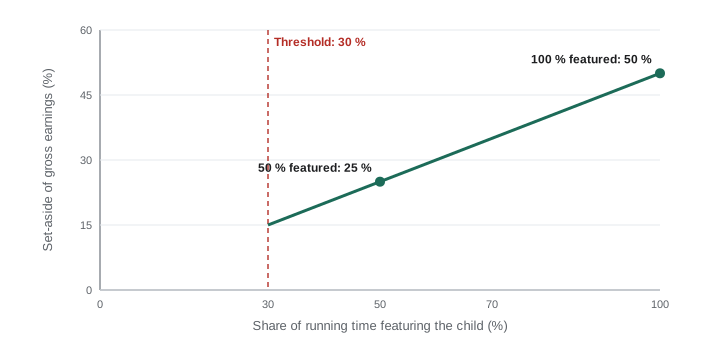
Illinois was the first state to act. Its law covers minors under 16 who appear in at least 30 % of a vlogger's compensated video content in a 30-day period, measured by how much of the running time shows them or includes them in spoken narration. For qualifying content, the vlogger must place a share of gross earnings in a trust equal to half the percentage of time the minor is featured. A child featured in all of the content is owed at least 50 % of gross earnings from it; a child featured in half is owed at least 25 %. The vlogger must keep records of qualifying content, earnings and deposits, and the child can sue if the vlogger knowingly or recklessly fails to comply.
Worked problem
Calculating an Illinois set-aside
An Illinois family vlogger earns $12,000 in gross compensation in a month from videos that qualify under the law. Their 10-year-old appears in 60 % of the running time of those videos. How much must be set aside?
Show solution
- Set-aside percentage: half of 60 % = 30 %.
- Amount: \( 0.30 \times 12{,}000 = 3{,}600 \).
- The vlogger must deposit $3,600 into a qualifying trust and record the content, earnings and deposit.
Answer: $3,600 for that month. If two children each appear in the same content, each child's share is calculated from their own featured time, and the law sets rules for dividing it.
California: SB 764 and the Coogan law
California, which has had the original Coogan law since 1939, added two laws in force from January 1, 2025. AB 1880 extends Coogan protections to minors who do contractual work as online content creators, such as influencers hired by brands. Under the Coogan law, the employer must deposit at least 15 % of the minor's gross earnings into a blocked trust account, known as a Coogan account, that the child can access at adulthood. SB 764, the Child Content Creator Rights Act, covers family content where a minor appears in at least 30 % of the creator's content, even with no contract. Summaries of the law describe a set-aside of 65 % of the minor's proportional share of earnings, together with record-keeping and proof that the trust exists. Check the statute for the exact calculation.
Brands that hire child creators directly in California should verify that a Coogan account exists and be ready to deposit 15 % of the child's earnings into it. Several other states, including New York, Illinois, Louisiana and New Mexico, have their own Coogan-style rules for child performers, and these can apply when a brand hires a child under contract.
Minnesota and other states
Minnesota's law, in force from July 1, 2025, goes furthest. It prohibits children under 14 from engaging in the work of content creation, requires creators to set aside earnings in a trust for minors who appear in at least 30 % of their paid video content in a 30-day period, requires records, and lets a minor ask for content featuring them to be deleted after they turn 13. Utah passed HB 322 in 2025 with trust protections and a right to request removal of content after age 18, and further states have introduced similar bills. The overall direction is clear: more states are treating family content featuring children as work that earns the child money and gives the child some control.
Worked problem
Coogan deposit on a brand deal
A California brand hires a 13-year-old creator for a sponsored video series paying $4,000. What must the brand deposit, and where?
Show solution
- AB 1880 brings child content creators under contract within the Coogan law.
- Deposit: at least 15 % of gross earnings, \( 0.15 \times 4{,}000 = 600 \).
- The brand deposits $600 directly into the minor's Coogan trust account, after verifying it exists.
Answer: At least $600 into the child's Coogan account. Agencies and brands increasingly ask for proof of the account before signing.
COPPA: children's privacy online
The Children's Online Privacy Protection Act (COPPA) applies to operators of websites and online services directed to children under 13, and to operators who know they collect personal information from children under 13. It requires verifiable parental consent before collecting such information. In 2019 the FTC and New York reached a $170 million settlement with Google and YouTube over children's data, which led YouTube to require creators to mark content as made for kids, as lesson 4 explains. The FTC can treat a creator as an operator, and creators of child-directed content can face penalties. Amendments to the COPPA Rule took effect in June 2025, with most compliance required by April 22, 2026, including separate parental consent for disclosing children's data to third parties for targeted advertising and written data retention policies.
Separately, federal law prohibits child sexual abuse material, and creators who find their content misused can report to the National Center for Missing and Exploited Children's CyberTipline. NCMEC's Take It Down service helps young people get sexual images of themselves removed, and the federal TAKE IT DOWN Act, in force from May 2026 for platforms, requires removal of non-consensual intimate images within 48 hours of a valid request.
Practical compliance steps
- Work out whether a child appears in 30 % or more of your paid content in any 30-day period, and track it monthly.
- If you are in a state with a child influencer law, set up a qualifying trust, record content and deposits, and keep records accessible to the child.
- If you hire child creators, verify Coogan accounts and deposit the required percentage.
- Mark child-directed content as made for kids and review COPPA obligations.
- Commit in writing to remove content when a child asks, and report any misuse of children's images to the national tipline.
How the laws define covered content
The state laws use similar definitions, and the details matter. They generally cover a creator or family that receives compensation from online video content, such as ad revenue, sponsorships or platform payments, and a minor whose name, image or likeness appears in a set share of that content. Minors creating their own content are often treated differently, and minors who appear only incidentally, such as in the background at a public event, are usually excluded. Illinois measures appearance by the share of running time in which the minor is shown or discussed, and its law applies only to content that reaches a compensation threshold set by the platform or pays at least ten cents per view. Because the definitions differ, a family that moves between states, or whose videos feature children of relatives in other states, should get legal advice about which law applies.
Enforcement mainly happens through private lawsuits brought by the child, often years later when they reach adulthood, rather than through a government agency. That makes record-keeping especially important: a parent who cannot show what content featured a child, what it earned and what was deposited may struggle to defend a later claim. Keeping a simple monthly spreadsheet of videos, the child's share of running time, gross earnings and deposits is the most practical protection, and it doubles as the record the child is entitled to see. Families should also keep the trust account separate from household and business accounts, and avoid withdrawing from it, since the funds belong to the child.
Worked problem
Building the record a child can inspect
An Illinois vlogger posts 12 qualifying videos in a month earning $9,000 in total. The child appears for 45 % of the total running time. What should the monthly record show?
Show solution
- Number and titles of qualifying videos: 12.
- Child's share of running time: 45 %; set-aside rate: 22.5 %.
- Gross earnings: $9,000; deposit: \( 0.225 \times 9{,}000 = 2{,}025 \).
- Date and account of the deposit.
Answer: A record listing the 12 videos, the 45 % share, $9,000 gross and a $2,025 deposit, with the date. Records like this protect both the child and the parent.
Finally, remember that federal and state child labor laws were written for traditional workplaces. The federal Fair Labor Standards Act generally exempts children employed by their parents in non-hazardous work, which is one reason family content fell through the gaps before the new state laws. State child performer rules, such as entertainment work permits in California and New York, may still apply when a brand or production company hires a child, so check the state's labor department guidance before any sponsored shoot.
Common mistakes
MistakeAssuming state laws only apply to big channels.
InsteadThe laws turn on the share of paid content featuring a minor, not channel size.
MistakeCalculating set-asides on net profit instead of gross earnings.
InsteadUse gross compensation from qualifying content, as the laws specify.
MistakeForgetting record-keeping.
InsteadRecord qualifying content, earnings and trust deposits and keep them accessible to the child.
MistakeTreating a child's earnings as household income with no set-aside.
InsteadDeposit the required share into a qualifying trust or Coogan account.
MistakeIgnoring misuse of children's images.
InsteadReport to NCMEC's CyberTipline and remove the content.
Summary and key terms
- Since 2024 several states require family vloggers to set aside part of a child's earnings.
- Illinois requires a set-aside equal to half the percentage of time a minor is featured.
- California's SB 764 covers family content and AB 1880 extends the Coogan law to child creators under contract.
- Minnesota bans content-creation work by children under 14 and allows deletion requests from age 13.
- Coogan accounts hold at least 15 % of a child performer's gross earnings in trust.
- COPPA requires parental consent for collecting data from children under 13, with amended rules from 2025.
- Voluntary set-asides, consent records and removal commitments are good practice everywhere.
- PIPEDA
- Canada's federal private-sector privacy law.
- Law 25
- Quebec law that modernized its privacy rules between 2022 and 2024.
- Coogan account
- A blocked trust account holding part of a child performer's earnings until adulthood.
- Set-aside
- The share of earnings that must be saved for a child.
- COPPA
- The US Children's Online Privacy Protection Act.
- Verifiable parental consent
- Consent from a parent obtained in a way that reasonably confirms it is the parent.
- Child performer
- A minor engaged to perform in entertainment, often protected by specific laws.
- Qualifying content
- Paid content that meets a child influencer law's threshold.
- Cybertip.ca
- Canada's national tipline for reporting online sexual exploitation of children.
- CyberTipline
- The US national reporting system for child sexual exploitation, run by NCMEC.
Practice problems
Work each problem on paper first, then reveal the answer to check.
Which state passed the first child influencer law?
Show answer
Illinois, in force July 1, 2024.
Illinois: a minor is featured 80 % of the time. What share must be set aside?
Show answer
40 %.
What percentage does the Coogan law require?
Show answer
At least 15 % of gross earnings.
From what age does Minnesota let minors request deletion?
Show answer
13.
An Illinois vlogger earns $8,000; a child appears 50 %. Set-aside?
Show answer
Half of 50 % = 25 %; $2,000.
Which law extended Coogan protections to child content creators in California?
Show answer
AB 1880.
Where can misuse of children's images be reported in the US?
Show answer
NCMEC's CyberTipline.
What age does COPPA protect?
Show answer
Children under 13.
What threshold of content triggers most state laws?
Show answer
A minor in at least 30 % of paid content in a 30-day period.
Name one good practice that applies everywhere.
Show answer
Voluntary set-asides, written consent, removal commitments or reporting misuse.
Lesson quiz · 5 questions
Score 60% or more to complete this lesson.
Create a free account to save your progress, take quizzes and earn a certificate.