
CRE-450 · Lesson 8 of 12 · 28 min
Grief, trauma, violence and disasters
Creators are often among the first to film or comment on accidents, crimes, disasters and public tragedies, and many make content about grief, violence or true crime. This content can inform, comfort and build understanding. It can also exploit people at the worst moments of their lives, retraumatize survivors and spread distressing images to viewers who did not choose to see them. Journalists have developed ethical practices for this work over many decades, and creators can learn from them. This lesson covers consent and dignity for people in distress, trauma-informed practice, graphic content, true crime, disasters, fundraising and the creator's own wellbeing.
The core principle: people are not content
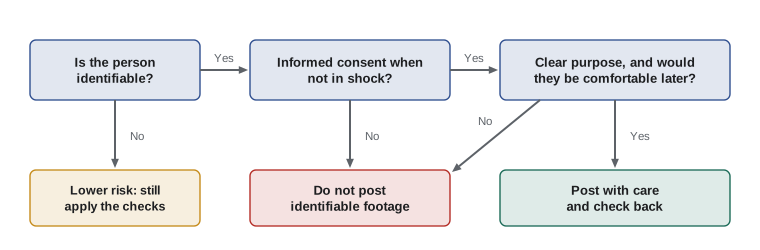
A useful starting point is the principle that people's suffering is not raw material. Before filming or posting anything involving people in distress, ask whose story this is, what they would want, and what purpose sharing serves. Content that helps viewers understand an issue, find resources or support those affected can be valuable. Content that mainly harvests views from someone's pain, sometimes called trauma exploitation or, more bluntly, trauma porn, harms both the people shown and the creator's credibility.
- Whose story is it? A person grieving a loss, the survivor of an attack or a family whose home burned owns their story.
- Did they agree, knowing what that means? People in shock cannot give meaningful consent to being filmed for a public channel.
- What purpose does sharing serve? Informing, helping or remembering, or simply attention?
- Could it cause harm? To the people shown, to their families, to survivors watching, or to an investigation?
Consent in moments of distress
Consent given in a moment of shock, grief or injury is fragile. Someone who agrees to be filmed at the scene of a car crash may feel very differently the next day. Trauma-informed practice treats consent as ongoing: asking again later, explaining clearly where the content will appear, offering to show the final version, and honoring requests to withdraw. The Dart Center for Journalism and Trauma, based at Columbia University, publishes widely used guidance on interviewing survivors and covering tragedy, emphasizing respect, choice and avoiding further harm.
| Situation | Good practice |
|---|---|
| Filming at an accident or emergency | Do not film injured or dying people; never obstruct responders; if you filmed, do not post identifiable victims |
| Interviewing a bereaved person | Ask permission away from the camera first, let them set limits, check back before publishing |
| Talking to a survivor of violence | Let them control what is shared; avoid pressing for details; offer to omit identifying information |
| Featuring a loved one who has died | Consider the wishes of close family; avoid images of the person in their final illness without consent |
Trauma-informed practice
Trauma-informed practice is an approach used in health care, social services and journalism that recognizes how trauma affects people and aims to avoid causing further harm. For creators, it means a few concrete habits.
- Offer choices. Let people decide whether to appear, how they are shown and what details are included.
- Avoid pressing for graphic details. Survivors may not want to describe the worst moments, and viewers do not need them.
- Do not ambush. Approaching grieving people unannounced with a camera can deepen their distress.
- Think about survivors watching. Content about a mass shooting or disaster will be seen by people who lived through it.
- Use care with anniversaries and follow-ups, which can bring back intense feelings.
Graphic and violent content
Footage of violence, serious injury or death spreads quickly online. Platforms have policies on graphic content: most remove content that glorifies violence or shows extreme gore for shock value, and age-restrict or add warnings to graphic material with documentary or news value. Creators should not share graphic footage of identifiable victims, should blur or cut graphic moments, and should add warnings when describing violence in detail. Where footage shows a crime, consider whether sharing it could interfere with an investigation, identify witnesses or spread the attacker's message. Researchers and police have urged media not to name or show perpetrators of mass shootings prominently, to avoid giving them the notoriety some seek.
US law gives media wide freedom to publish information about crimes, protected by the First Amendment, and publication bans of the Canadian kind are rare. But other limits apply: privacy torts such as public disclosure of private facts, defamation if you wrongly suggest someone is involved, and specific state laws, such as California's 2020 law making it a crime for first responders to take unauthorized photos of deceased people at a scene. Many US newsrooms voluntarily avoid naming sexual assault victims and juvenile suspects, and responsible creators can follow the same standards.
True crime
True crime is one of the most popular genres in podcasts and video. It can raise awareness of injustice and help solve cases, but it has also been criticized for treating real victims as entertainment, harassing families, spreading speculation and naming innocent people. Ethical true crime creators keep the focus on victims as people, consult or at least consider families, check facts rigorously, avoid speculation about suspects, and never encourage audiences to investigate or contact people involved.
Worked problem
Scoring a true crime episode for harm
A creator uses a five-point check, one point per concern: (1) victim's family not consulted or considered, (2) graphic details beyond what the story needs, (3) speculation naming an uncharged person, (4) encouraging audience investigation, (5) monetizing a very recent case. A planned episode about a case from three months ago names a neighbor as a likely suspect, includes autopsy details and invites listeners to find the neighbor's social media. What is its score?
Show solution
- Family not considered: 1 (no contact made).
- Graphic details: 1 (autopsy details).
- Speculation naming an uncharged person: 1.
- Encouraging investigation: 1.
- Very recent case: 1.
- Score: 5.
Answer: Score 5, the maximum. Besides being harmful, naming an uncharged person as a suspect is a serious defamation risk, as CRE-430 explained. The episode should be reworked or dropped.
Disasters and breaking events
During wildfires, floods, storms and other disasters, creators can share useful information quickly, such as evacuation routes and shelter locations from official sources. They can also spread rumors, show identifiable people losing their homes and attract sightseers who get in the way of emergency crews. Good practice is to amplify official sources, avoid filming people in distress without consent, never enter evacuation zones or interfere with responders, and wait before turning the event into content.
Worked problem
Applying a waiting period
A creator adopts a rule: wait at least 72 hours after a disaster before posting commentary, unless sharing official safety information. A flood begins on a Monday at 6 p.m. When is the earliest time for a commentary video, and why might the rule help?
Show solution
- 72 hours after Monday 6 p.m. is Thursday 6 p.m.
- In the first days, facts change quickly, casualty figures are uncertain and families may not yet have been notified.
- Waiting reduces the risk of spreading false information and of identifying victims before families know.
Answer: Thursday at 6 p.m. at the earliest. The waiting period trades a little speed for accuracy and respect.
Fundraising for those affected
Creators often raise money for people affected by tragedy. This can do real good, but it requires care. Get the consent of the people you are raising money for, use reputable platforms, be transparent about fees and where money goes, and do not keep any share without clear disclosure. Fake fundraisers commonly appear after disasters, so verify before sharing others' campaigns.
Worked problem
Estimating how much reaches the beneficiary
A creator raises $20,000 for a family whose home burned, using a platform that charges no platform fee but deducts payment processing of 2.9 % plus $0.30 per donation. There were 800 donations. How much reaches the family?
Show solution
- Percentage fees: \( 0.029 \times 20{,}000 = 580 \).
- Per-donation fees: \( 800 \times 0.30 = 240 \).
- Amount to the family: \( 20{,}000 - 580 - 240 = 19{,}180 \).
Answer: About $19,180. Publishing this calculation is part of being transparent. Fee structures vary by platform and country, so check current terms.
Your own grief and trauma
Many creators share their own losses, and audiences often respond with deep support. Sharing grief publicly can also be exhausting and can expose you to cruel comments. It is reasonable to take time away, to share only what you choose, and to involve family members in decisions about content that concerns them. If you have witnessed something traumatic while filming, talk to someone; reactions such as intrusive memories, poor sleep and irritability are common after trauma, and support can help. CRE-350 discussed support networks and professional help.
Covering tragedies affecting children
Tragedies involving children, such as school shootings, child deaths and abuse cases, require the greatest care. Do not show or name child victims or witnesses unless their families have chosen to make their names public, and even then avoid images of them in distress. Avoid interviewing children who witnessed violence; if their perspective matters, a trusted adult can speak for them. Think about the child viewers in your own audience: young children may be frightened by graphic descriptions and need reassurance rather than detail. For parents in your audience, practical guidance on talking with children about frightening news, drawn from child psychologists and organizations such as children's hospitals, is often more useful than commentary.
Reviewing content after the event
Content made in the immediate aftermath of a tragedy often looks different weeks later. A short review after the event, asking whether any facts turned out to be wrong, whether anyone shown has asked to be removed and whether the video still serves a purpose, helps keep a channel accurate and respectful. Correct or update videos where needed, as lesson 9 describes, and consider making private any content that no longer serves its original purpose but continues to cause distress to those affected.
Throughout this work, it helps to ask how you would feel if the person on screen, or their family, watched the final video. If the honest answer is that they would feel exploited or exposed, rethink the content, even if it is newsworthy or legal to publish.
Responsible coverage of hard events is a skill that grows with experience, reflection and feedback from the people affected.
Common mistakes
MistakeFilming or posting injured, dying or grieving people for views.
InsteadDo not post identifiable people in distress; ask whose story it is and what purpose sharing serves.
MistakeTreating consent given in shock as final.
InsteadTreat consent as ongoing: ask again later, show the final version and honor withdrawals.
MistakeAssuming the First Amendment means there are no limits.
InsteadRemember privacy torts, defamation and specific state laws still apply.
MistakeSpeculating about suspects in true crime.
InsteadStick to established facts and never name uncharged people as suspects.
MistakeRaising money for victims without their consent or transparency.
InsteadGet consent, use reputable platforms and publish fees and where money goes.
Summary and key terms
- People's suffering is not raw material; ask whose story it is and what sharing achieves.
- Consent given in distress is fragile and should be treated as ongoing.
- Trauma-informed practice offers choices, avoids graphic details and considers survivors watching.
- Graphic content should be blurred, cut or warned, and perpetrators should not be glorified.
- US law allows wide publication but privacy, defamation and specific state laws still apply.
- Ethical true crime centers victims, checks facts and avoids speculation and audience investigation.
- In disasters, amplify official sources, wait before commentary and fundraise transparently.
- Trauma-informed practice
- An approach that recognizes trauma's effects and avoids causing further harm.
- Ongoing consent
- Consent that is checked again over time and can be withdrawn.
- Trauma exploitation
- Using people's suffering mainly to attract attention.
- Publication ban
- A court order prohibiting publication of certain information.
- Graphic content
- Images or descriptions of violence, injury or death.
- Dart Center
- A center at Columbia University offering guidance on journalism and trauma.
- True crime
- Content about real crimes, often investigative or narrative.
- Waiting period
- A self-imposed delay before making content about a tragedy.
- Official source
- An authority such as emergency services or government agencies.
- Beneficiary
- The person or group a fundraiser is for.
Practice problems
Work each problem on paper first, then reveal the answer to check.
Name the four questions to ask before posting people in distress.
Show answer
Whose story is it, did they meaningfully agree, what purpose does it serve, could it cause harm?
Why is consent given at an accident scene fragile?
Show answer
People in shock cannot fully understand or may later feel differently.
Name two trauma-informed habits.
Show answer
Offer choices, avoid pressing for graphic details, do not ambush, consider survivors watching.
Name one US legal limit on crime content.
Show answer
Privacy torts, defamation or specific state laws such as California's first responder photo law.
A true crime episode has 3 of the 5 concerns. What is its score?
Show answer
3.
A disaster starts Friday 9 a.m. With a 72-hour rule, earliest commentary?
Show answer
Monday 9 a.m.
$10,000 raised from 400 donations at 2.9 % plus $0.30. Amount to beneficiary?
Show answer
10,000 − 290 − 120 = $9,590.
Why avoid naming mass shooting perpetrators prominently?
Show answer
To avoid giving them notoriety some seek.
What should creators do during a disaster?
Show answer
Amplify official sources, avoid interfering, avoid filming people in distress without consent.
Name one reaction common after witnessing trauma.
Show answer
Intrusive memories, poor sleep or irritability.
Lesson quiz · 5 questions
Score 60% or more to complete this lesson.
Create a free account to save your progress, take quizzes and earn a certificate.