
ENGG-130 · Lesson 2 of 5 · 40 min
Equilibrium of a particle
A crane hook holding a pallet, the ring where three slings meet above a load, a traffic light hanging from two cables, a pulley riding on a zip line: in each case, several forces act through a single point, and that point is not moving. These are particle equilibrium problems, the simplest kind in statics and the foundation for everything that follows.
This chapter sets out the equilibrium condition, then spends real time on the free-body diagram, the drawing that turns a physical situation into equations. You will model cables, pulleys, springs and smooth surfaces, see why tight cables carry surprisingly large forces, find the largest load a system can safely carry, and extend the method to three dimensions.
The equilibrium condition
Newton's first law says that a particle with no net force on it stays at rest (or moves at constant velocity). So a particle is in equilibrium when the vector sum of all forces on it is zero:
In two dimensions this is two scalar equations; in three dimensions, three:
Two equations can solve for two unknowns, three for three. Unknowns are typically cable tensions, an unknown angle, or the weight a system can carry. If a problem has more unknowns than equations, you need more information, such as a spring stiffness or a geometric relationship, before it can be solved.
The free-body diagram
The free-body diagram (FBD) is a sketch of the particle by itself, cut free from everything around it, with every external force drawn as an arrow. It is the single most important step in a statics problem. Almost every wrong answer in this course can be traced to a wrong free-body diagram, not a wrong equation.
Draw one in four steps:
- Isolate the particle. Imagine cutting every cable, rope and contact that touches it, and draw the particle on its own.
- Add the weight (if it is not negligible) acting straight down.
- At every cut, add the force that the removed object exerted. A cable becomes a tension along the cable; a smooth surface becomes a normal force perpendicular to it.
- Label each force with its known value or an unknown symbol, mark the angles and slopes, and choose x and y axes.
Forces between parts of the particle (internal forces) never appear. Forces the particle exerts on other things do not appear either: only forces acting on it.
Modeling the connections
Each kind of connection exerts a particular kind of force. Learning these is like learning vocabulary; you will use them for the rest of your career.
- Cables, ropes and chains can only pull. The tension acts along the cable, away from the particle. An ideal cable is weightless and inextensible.
- A frictionless pulley changes the direction of a cable without changing its tension. The tension is the same on both sides.
- A linear spring exerts a force proportional to its change in length: \(F = ks\), where \(k\) is the stiffness (N/m) and \(s = L - L_0\) is the stretch from the unstretched length \(L_0\). A stretched spring pulls; a compressed spring pushes.
- A smooth surface pushes perpendicular to itself (a normal force) and cannot pull. "Smooth" means no friction, so there is no force along the surface.
- Weight acts at the center of gravity, vertically downward, with magnitude \(mg\).
Solving two-dimensional problems
With the free-body diagram drawn, the rest is algebra. Resolve every force into x and y components, write the two equilibrium equations, and solve.
Worked problem
Crate held by two cables
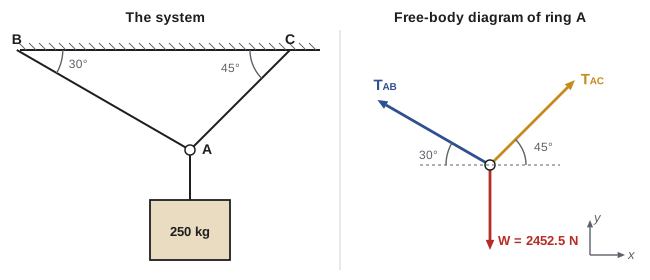
A 250 kg crate hangs from ring A. Cable AB rises to the left at 30° above horizontal and cable AC rises to the right at 45° above horizontal. Find the tension in each cable.
Show solution
- Weight: \(W = 250 \times 9.81 = 2452.5\) N.
- Free-body diagram of A: \(T_{AB}\) at 30° up-left, \(T_{AC}\) at 45° up-right, \(W\) down.
- \[\sum F_x = 0: \quad -T_{AB}\cos 30^\circ + T_{AC}\cos 45^\circ = 0\]
- \[\sum F_y = 0: \quad T_{AB}\sin 30^\circ + T_{AC}\sin 45^\circ - 2452.5 = 0\]
- From the first equation, \(T_{AC} = 1.2247\,T_{AB}\). Substitute: \(0.5\,T_{AB} + 0.7071(1.2247\,T_{AB}) = 2452.5\), so \(1.3660\,T_{AB} = 2452.5\).
Answer: T_AB = 1795 N and T_AC = 2199 N. The steeper cable carries more. Both are less than the weight here, but only because both cables are fairly steep
Two checks are worth building into your habits. First, both tensions are positive: a negative tension would mean a cable pushing, which is impossible, so the assumed geometry would be wrong. Second, the steeper cable carries more load, which matches intuition: the more nearly vertical a cable, the more directly it opposes the weight.
The force triangle and Lami's theorem
When exactly three forces hold a particle in equilibrium, they must form a closed triangle when drawn tip to tail. That gives an alternative to components. Lami's theorem states that each force is proportional to the sine of the angle between the other two:
where \(\alpha_1\) is the angle between \(F_2\) and \(F_3\), and so on. For the crate, the angle between \(T_{AC}\) and \(W\) is 135°, between \(W\) and \(T_{AB}\) is 120°, and between the two cables is 105°. Then \(T_{AB} = 2452.5 \sin 135^\circ / \sin 105^\circ = 1795\) N, matching the component method. Lami's theorem is quick for three forces but does not extend to four or more, so components remain the general tool.
Why tight cables are dangerous
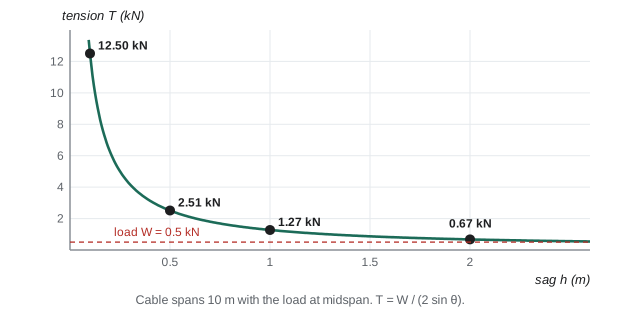
Look at what happens as a cable flattens. A load \(W\) hangs from the middle of a cable with each half at angle \(\theta\) below horizontal. By symmetry the tensions are equal, and vertical equilibrium gives
As \(\theta\) goes to zero, \(\sin\theta\) goes to zero and the tension grows without limit. A perfectly straight horizontal cable cannot support any load at all.
Worked problem
A taut line
A cable spans 10 m between two posts at the same height. A 500 N load hangs at midspan. Find the tension when the sag is (a) 0.5 m and (b) 0.1 m.
Show solution
- Each half spans 5 m horizontally. For sag \(h\), \(\sin\theta = h/\sqrt{25 + h^2}\).
- (a) \(\sin\theta = 0.5/\sqrt{25.25} = 0.0995\). \(T = 500/(2 \times 0.0995) = 2512\) N.
- (b) \(\sin\theta = 0.1/\sqrt{25.01} = 0.0200\). \(T = 500/(2 \times 0.0200) = 12\,500\) N.
Answer: (a) 2.51 kN; (b) 12.5 kN, twenty-five times the load
This is why riggers never tighten a lifting sling until it is nearly flat, why a "slackline" anchored between two trees can pull them over, and why overhead power lines are strung with a deliberate sag. Rigging handbooks give sling capacity as a function of the sling angle, and capacity drops sharply below about 45°. The same geometry appears in the nearly flat members of a shallow truss, which carry large forces for the same reason.
Pulleys and springs
Worked problem
A pulley on a cable
A cable 10 m long is fixed to two supports at the same height, 8 m apart. A 40 kg load hangs from a frictionless pulley that rolls freely on the cable. Find the tension.
Show solution
- The pulley is frictionless, so the tension is the same on both sides. Horizontal equilibrium then forces the two halves to make equal angles with the horizontal, so the pulley settles at midspan.
- Each side is 5 m long and spans 4 m horizontally, so it drops 3 m: \(\sin\theta = 3/5\).
- \[2T\left(\tfrac{3}{5}\right) = 40 \times 9.81 = 392.4 \;\Rightarrow\; T = 327 \text{ N}\]
Answer: 327 N. The 3-4-5 geometry comes from the cable length, not from the load: any mass would hang at the same point
Worked problem
Spring and cable
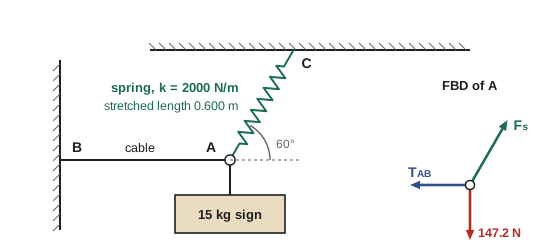
A 15 kg sign hangs from ring A. Cable AB runs horizontally to a wall, and spring AC rises at 60° above horizontal to the ceiling. The spring has stiffness \(k = 2000\) N/m and its stretched length is 0.600 m. Find the forces and the spring's unstretched length.
Show solution
- Weight: \(15 \times 9.81 = 147.2\) N.
- \(\sum F_y = 0\): \(F_s\sin 60^\circ = 147.2\), so \(F_s = 169.9\) N.
- \(\sum F_x = 0\): \(T_{AB} = F_s\cos 60^\circ = 85.0\) N.
- Stretch: \(s = F_s/k = 169.9/2000 = 0.0850\) m. Unstretched length \(L_0 = 0.600 - 0.085 = 0.515\) m.
Answer: Spring force 170 N, cable tension 85.0 N, unstretched length 515 mm
Smooth surfaces and inclines
On an incline, choose axes along and perpendicular to the surface. The normal force then lies along one axis, which removes it from the other equation.
Worked problem
Holding a crate on a smooth ramp
A 50 kg crate rests on a smooth 30° ramp. A worker holds it in place by pushing horizontally. Find the push \(P\) and the normal force \(N\).
Show solution
- \(W = 490.5\) N. Axes along the slope (x, up the slope) and perpendicular (y).
- Along the slope, the push contributes \(P\cos 30^\circ\) up the slope and the weight \(W\sin 30^\circ\) down it: \(P\cos 30^\circ = W\sin 30^\circ\), so \(P = W\tan 30^\circ = 283.2\) N.
- Perpendicular: \(N = W\cos 30^\circ + P\sin 30^\circ = 424.8 + 141.6 = 566.4\) N.
Answer: P = 283 N and N = 566 N. The normal force is larger than the weight because the horizontal push also presses the crate into the ramp
Design: the largest safe load
In practice the question is often reversed. Each cable has a rated working load, and you need the largest mass the system can carry. Solve for every tension in terms of the load, find which member reaches its limit first, and size the load to that member.
Worked problem
Maximum load on two cables
In the crate example, each cable has a working load limit of 5.0 kN. What is the largest mass that can be hung from ring A?
Show solution
- From the earlier solution, per unit of weight: \(T_{AB} = 0.7321W\) and \(T_{AC} = 0.8966W\).
- AC carries more, so it governs: \(0.8966W = 5000\), giving \(W = 5577\) N.
- Check AB: \(0.7321 \times 5577 = 4083\) N, under its limit.
- Mass: \(5577/9.81 = 568\) kg.
Answer: 568 kg, limited by cable AC
Note the method: you cannot just set both tensions to 5 kN and solve, because then you would have three equations (two equilibrium plus a ratio) and only one free variable. Solve generally first, then let the governing member set the load.
Particles in three dimensions
In 3D, write each force as a Cartesian vector, usually using the position-vector method from the last lesson, and set the sum of each component to zero. Three equations solve for three unknowns, such as the tensions in three cables holding a load.
Worked problem
Load hung from three cables
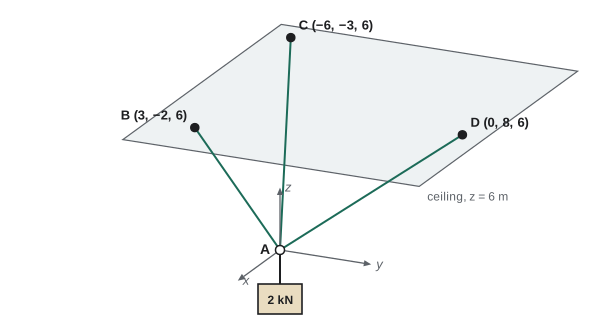
Ring A at the origin carries a 2.00 kN load. Cables run from A to ceiling anchors at B(3, −2, 6), C(−6, −3, 6) and D(0, 8, 6) m. Find the three tensions.
Show solution
- Unit vectors (lengths 7, 9 and 10 m): \(\mathbf{u}_{AB} = (3, -2, 6)/7\), \(\mathbf{u}_{AC} = (-6, -3, 6)/9\), \(\mathbf{u}_{AD} = (0, 8, 6)/10\).
- \(\sum F_x = 0\): \(\tfrac{3}{7}T_B - \tfrac{6}{9}T_C = 0\).
- \(\sum F_y = 0\): \(-\tfrac{2}{7}T_B - \tfrac{3}{9}T_C + \tfrac{8}{10}T_D = 0\).
- \(\sum F_z = 0\): \(\tfrac{6}{7}T_B + \tfrac{6}{9}T_C + \tfrac{6}{10}T_D - 2000 = 0\).
- From x: \(T_C = 0.6429\,T_B\). From y: \(T_D = (0.2857 + 0.2143)T_B/0.8 = 0.6250\,T_B\).
- Substitute into z: \((0.8571 + 0.4286 + 0.3750)T_B = 2000\), so \(T_B = 1204\) N.
Answer: T_B = 1204 N, T_C = 774 N, T_D = 753 N. Check the z equation: 1032 + 516 + 452 = 2000 N
In 3D, solving by substitution is fine for three equations, but a calculator or a few lines of Python with a matrix solver is faster and avoids arithmetic slips. You will write exactly that program in ENCM-100. Whichever way you solve, substitute the answers back into all three equations as a check.
Common mistakes
MistakeLeaving a force off the free-body diagram, most often the weight or the force from a second cable.
InsteadGo round the boundary of the isolated particle and add one force at every cut, plus the weight.
MistakeDrawing a cable tension pointing toward the particle.
InsteadCables pull. Draw tension away from the particle, along the cable.
MistakeUsing different tensions on the two sides of a frictionless pulley.
InsteadAn ideal pulley only redirects a cable. The tension is the same throughout one continuous cable.
MistakeUsing the spring's total length in F = ks.
Insteads is the change in length from the unstretched length: s = L − L₀.
MistakeAssuming the normal force equals the weight.
InsteadFind N from the equation perpendicular to the surface; other forces often press into or lift off the surface.
MistakeSetting every cable to its limit to find the maximum load.
InsteadSolve for each tension in terms of the load, then let the most heavily loaded member govern.
Summary and key terms
- A particle is in equilibrium when ΣF = 0: two scalar equations in 2D, three in 3D.
- The free-body diagram isolates the particle and shows every external force acting on it; it is the most important step.
- Cables pull along their length; ideal pulleys keep tension constant; springs obey F = ks; smooth surfaces push perpendicular to themselves.
- For three forces, the force triangle or Lami's theorem gives a quick solution.
- Tension rises as W/(2 sin θ) as a cable flattens, which is why taut cables and flat slings carry large forces.
- To find a maximum load, express each force in terms of the load and let the governing member set the limit.
- In 3D, write forces with unit vectors from position vectors and solve three equations; check by substitution.
- Particle
- A body whose forces all act through one point, so rotation does not matter.
- Equilibrium
- The state of zero net force (and, for rigid bodies, zero net moment).
- Free-body diagram
- A sketch of an isolated body showing every external force on it.
- Tension
- The pulling force in a cable, rope or chain, acting along it.
- Normal force
- A contact force perpendicular to a surface.
- Spring stiffness
- k, the force per unit stretch of a linear spring, in N/m.
- Lami's theorem
- For three concurrent forces in equilibrium, each force divided by the sine of the angle between the other two is the same.
- Working load limit
- The largest load a rigging component is rated to carry in service.
Practice problems
Work each problem on paper first, then reveal the answer to check.
A 30 kg traffic light hangs from two cables, one at 20° and one at 35° above horizontal on opposite sides. Find the tensions.
Show answer
W = 294.3 N. T₁ cos 20° = T₂ cos 35°, so T₂ = 1.1472T₁. T₁ sin 20° + 1.1472T₁ sin 35° = 294.3 gives 1.000T₁ = 294.3. T₁ = 294 N, T₂ = 338 N.
A 10 kg mass hangs at the middle of a 4.0 m clothesline with a sag of 0.20 m. Find the tension.
Show answer
sin θ = 0.2/√(4 + 0.04) = 0.0995. T = 98.1/(2 × 0.0995) = 493 N.
A 200 kg engine is lifted by two slings from one hook, each sling 30° from vertical. Find the sling tension. What would it be at 60° from vertical?
Show answer
2T cos 30° = 1962, T = 1133 N. At 60° from vertical, 2T cos 60° = 1962, T = 1962 N, the full weight in each sling.
A 25 kg box is held on a smooth 40° incline by a rope parallel to the incline. Find the rope tension and the normal force.
Show answer
T = mg sin 40° = 245.25 × 0.6428 = 157.6 N. N = mg cos 40° = 187.9 N.
A spring with k = 800 N/m and unstretched length 0.30 m is stretched to 0.42 m. What force does it exert?
Show answer
s = 0.12 m. F = 800 × 0.12 = 96 N, pulling.
In the spring-and-cable example, what spring stiffness would make the spring's stretched length 0.560 m, with the same unstretched length?
Show answer
s = 0.560 − 0.515 = 0.045 m. k = 169.9/0.045 = 3780 N/m.
Two cables hold a ring: AB at 50° above horizontal to the left (limit 4 kN) and AC at 25° above horizontal to the right (limit 3 kN). Find the maximum weight.
Show answer
TAB cos 50° = TAC cos 25°, TAC = 0.7092TAB. W = TAB sin 50° + 0.7092TAB sin 25° = 1.0657TAB. If TAB = 4 kN, TAC = 2.84 kN (OK). W = 4.26 kN. AB governs.
A rope passes over a frictionless pulley at A and supports a 50 kg mass on one end. The other end is pulled at 40° below horizontal. What pull is needed, and what is the force on the pulley's axle?
Show answer
Pull = 490.5 N (same tension). Axle force = resultant of 490.5 N down and 490.5 N at 40° below horizontal: components (375.7, −805.8), magnitude 889 N.
Using Lami's theorem, find the tensions when a 600 N load hangs from two cables at 60° and 30° above horizontal on opposite sides.
Show answer
Angle between cables is 90°; T₁ (at 60°) = 600 sin 120°/sin 90° = 520 N; T₂ (at 30°) = 600 sin 150°/sin 90° = 300 N.
In the three-cable example, if each cable can take 1.5 kN, what is the largest load?
Show answer
T_B = 0.602W is largest (1204/2000). 0.602W = 1500 gives W = 2.49 kN.
Lesson quiz · 5 questions
Score 60% or more to complete this lesson.
Create a free account to save your progress, take quizzes and earn a certificate.