
ENGG-401 · Lesson 11 of 12 · 26 min
Replacement analysis and economic service life
Every asset eventually needs replacing. Pumps wear out, vehicles become expensive to maintain, computers become obsolete, and new technologies offer better performance at lower operating cost. Deciding when to replace equipment is one of the most frequent engineering economic decisions, and also one of the most frequently mishandled, because people tend to keep old assets too long out of attachment to what they already paid, or replace them too soon because new equipment is exciting. This lesson covers the reasons for replacement, the defender and challenger framework, the outsider viewpoint and the treatment of sunk costs, economic service life, the replacement decision procedure, one-year-later analysis, retirement without replacement, and practical considerations such as technology change, reliability and taxes.
Why assets are replaced
Assets are replaced for several reasons:
- Physical deterioration: wear, corrosion and fatigue raise operating and maintenance costs and reduce reliability and output.
- Obsolescence: newer technology performs better or costs less to run, even if the old asset still works, as with lighting, motors, computers and vehicles.
- Inadequacy: the asset can no longer meet demand, such as a pump too small for increased flow.
- Changed requirements: regulations, safety standards, environmental rules or product changes make the old asset unsuitable.
- Leasing or outsourcing alternatives may become cheaper than continued ownership.
Replacement analysis compares the cost of keeping the existing asset with the cost of replacing it, at the MARR, from today forward.
Defender and challenger
The existing asset is called the defender and the proposed replacement the challenger. The key question is not whether the challenger is better than the defender was when new, but whether replacing the defender now is cheaper than keeping it for some further period. Because the defender and challenger usually have different remaining lives, and because the costs of an aging defender change each year, annual worth methods are the natural tool.
The outsider viewpoint and sunk costs
The correct way to value the defender is the outsider viewpoint: imagine an outsider deciding whether to buy the defender at its current market value or to buy the challenger at its price. The defender's "first cost" in the analysis is its current market value, the cash the owner gives up by keeping it rather than selling it, an opportunity cost. Its original purchase price, its book value and any loss on sale are irrelevant: they are sunk costs. A common error is to refuse to replace an asset because "we would lose money selling it for less than its book value"; but the book value has no effect on future cash flows, except through taxes in an after-tax analysis. Equally, the trade-in value offered for the defender as part of a challenger purchase should be examined critically, since dealers often inflate trade-in values while raising the challenger's price; the true market value of the defender and the true net price of the challenger should be used.
Economic service life
An asset's economic service life (ESL) is the number of years of use that minimizes its equivalent uniform annual cost. Two opposing effects create a minimum. Capital recovery cost falls as the first cost is spread over more years and the market value declines more slowly; operating and maintenance costs rise as the asset ages. Their sum, the total EUAC, typically falls, reaches a minimum and then rises.
Worked problem
Finding the economic service life
A delivery vehicle costs $50,000. Its estimated market values at the end of years 1 to 7 are $35,000, $26,000, $19,000, $14,000, $10,000, $7,000 and $5,000, and its annual operating and maintenance costs in years 1 to 7 are $6,000, $7,500, $9,000, $11,000, $13,500, $16,500 and $20,000. At a MARR of 10 %, what is its economic service life?
Show solution
- For each \(n\), compute capital recovery with \(MV_n\) and the equivalent annual O&M.
- \(n = 1\): \(20{,}000 + 6{,}000 = 26{,}000\); \(n = 3\): \(14{,}366 + 7{,}405 = 21{,}770\); \(n = 5\): \(11{,}552 + 9{,}051 = 20{,}603\).
- \(n = 6\): \(10{,}573 + 10{,}016 = 20{,}590\); \(n = 7\): \(9{,}743 + 11{,}069 = 20{,}812\).
- The minimum EUAC occurs at 6 years, though 5 and 6 years differ by only $13 a year.
Answer: Economic service life about 6 years, with a minimum EUAC of about $20,590; the curve is flat near the minimum.
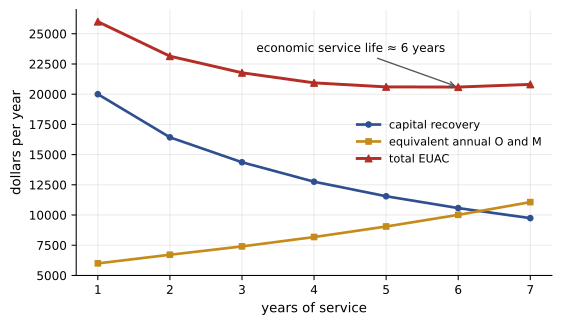
The flatness of the EUAC curve near its minimum is typical and has practical value: there is usually a window of several years in which replacement is nearly equally economic, allowing replacement to be timed for budgets, production schedules or technology releases without significant cost.
The replacement decision procedure
A standard procedure for replacement decisions is:
- 1. Determine the economic service life and minimum EUAC of the challenger, \(EUAC_C^*\).
- 2. Determine the economic service life and minimum EUAC of the defender over its possible remaining lives, using its current market value as the first cost, \(EUAC_D^*\).
- 3. If \(EUAC_D^* > EUAC_C^*\), replace now with the challenger.
- 4. If \(EUAC_D^* \le EUAC_C^*\), keep the defender for now, and re-examine next year with updated estimates.
Often the defender's costs simply rise each year, so its minimum EUAC is for keeping it just one more year, and the decision reduces to comparing the cost of keeping the defender one more year with the challenger's minimum EUAC.
One-year-later analysis
When the defender's costs increase steadily, the marginal cost of keeping it one more year is:
This is the interest forgone on its current market value, plus the loss in market value over the year, plus the next year's operating cost. If \(MC_D\) is below the challenger's minimum EUAC, keep the defender for another year; otherwise, replace it.
Worked problem
Keep or replace this year?
An existing vehicle could be sold today for $18,000 or next year for $14,000. Its operating costs next year are estimated at $12,000. A new vehicle like the one above has a minimum EUAC of $20,590. At 10 %, should the old vehicle be replaced now?
Show solution
- \(MC_D = 18{,}000 \times 1.10 - 14{,}000 + 12{,}000 = 19{,}800 - 14{,}000 + 12{,}000 = 17{,}800\).
- Compare with the challenger: \(17{,}800 < 20{,}590\).
- Keeping the defender for one more year is cheaper.
- Repeat the analysis next year with updated market values and costs.
Answer: Keep the old vehicle another year; re-evaluate next year.
| Year kept | Market value at start | Market value at end | O&M | Marginal cost at 10 % |
|---|---|---|---|---|
| Next year | $18,000 | $14,000 | $12,000 | $17,800 |
| Year after | $14,000 | $11,000 | $15,000 | $19,400 |
| Third year | $11,000 | $9,000 | $19,000 | $22,100 |
In this illustration, the defender should be kept for two more years and replaced when its marginal cost exceeds the challenger's minimum EUAC in the third year. Because estimates change, the decision is revisited each year.
Retirement without replacement and abandonment
Sometimes the question is whether to retire an asset without replacing it, because the service is no longer needed or can be obtained another way. The analysis compares the defender's marginal costs with the value of the service it provides. Abandonment analysis applies the same logic to whole projects: a project should be abandoned when the present worth of continuing is less than the value received by stopping, such as salvage value, regardless of how much has already been invested. Recognizing when to stop is a valuable skill, because sunk cost thinking and reputational concerns often lead organizations to continue failing projects too long.
Practical considerations
Real replacement decisions involve more than EUAC calculations:
- Technological change: if challengers improve rapidly, waiting for the next generation may be better than replacing now, even if the current challenger is cheaper than the defender. Including expected future challengers in the analysis, or using shorter study periods, addresses this.
- Reliability and downtime: aging equipment fails more often, causing production losses, safety risks and emergency repair costs that should be included in operating costs.
- Capacity and quality: challengers may offer higher output, better quality or lower emissions, which should be monetized where possible.
- Taxes: in after-tax analysis, disposal triggers recapture or losses (Lesson 9), and the challenger generates new depreciation tax shields, which can change the decision.
- Budget and timing: replacements may be bundled with planned shutdowns to minimize disruption.
- Asset management systems: organizations with large fleets of assets, such as utilities, municipalities and transportation agencies, use asset management frameworks, such as those based on ISO 55000, with condition data, risk models and life-cycle cost analysis to plan replacements across thousands of assets.
Replacement with technological improvement
When challengers improve each year, the replacement decision should consider not only today's challenger but the likely challengers of the next few years. A simple approach estimates the rate at which challenger costs fall, or performance rises, and asks whether keeping the defender for one more year and then buying an improved challenger is cheaper than replacing now. For fast-improving technologies, such as computing hardware, LED lighting a decade ago or battery systems today, this often favors shorter ownership periods and leasing. For mature technologies, the challenger is unlikely to change much, and standard defender-challenger analysis is adequate.
After-tax replacement analysis
Taxes can change replacement decisions. Selling the defender may trigger tax on recapture or generate a deductible loss; buying the challenger provides new depreciation deductions, potentially including immediate expensing under current incentives in both countries. In an after-tax analysis, the defender's first cost is its market value adjusted for the tax effect of selling it, the after-tax amount forgone by keeping it, and the challenger's cash flows include its depreciation tax shields. Because immediate expensing can make the challenger's after-tax cost much lower than its price, incentives can accelerate replacement of older equipment, which is one of their policy goals.
Fleet replacement in practice
Organizations with fleets of vehicles or equipment, such as municipalities, utilities and construction firms, set replacement policies based on age, kilometers or hours, and cost history, informed by economic life studies. Fleet management software records maintenance costs per unit, flags units whose costs are rising faster than the fleet average, and supports decisions to replace, refurbish or redeploy them. Replacement budgets are often smoothed over years to avoid large spikes, accepting small departures from the theoretical economic life.
Overhaul versus replace
A frequent variant of replacement analysis asks whether to overhaul or refurbish an existing asset, extending its life, or to replace it. The overhaul option is treated as a modified defender: its first cost is the defender's market value plus the cost of the overhaul, and its operating costs and market values reflect the improved condition. The challenger is the new asset as before. Comparing the minimum EUACs of the overhauled defender and the challenger shows which is cheaper; in many cases, a well-timed overhaul provides several more years of economic service at lower cost than replacement, especially for heavy equipment and infrastructure.
Replacement and sustainability
Replacing equipment early to gain energy efficiency must be weighed against the embodied energy and emissions of manufacturing the new equipment and disposing of the old. Life-cycle assessment complements economic analysis by quantifying these environmental effects, and some organizations include a carbon price in replacement studies.
Common mistakes
MistakeUsing the defender's original cost or book value.
InsteadUse its current market value (outsider viewpoint).
MistakeRefusing to replace to avoid a book loss.
InsteadIgnore sunk costs; book losses matter only through taxes.
MistakeComparing the challenger with the defender as new.
InsteadCompare from today forward.
MistakeUsing the challenger's full physical life instead of its ESL.
InsteadUse the minimum EUAC at its economic service life.
MistakeAccepting inflated trade-in offers at face value.
InsteadUse true market value and true net price.
Summary and key terms
- Assets are replaced because of deterioration, obsolescence, inadequacy or changed requirements.
- The defender is the existing asset; the challenger is the proposed replacement.
- Value the defender at its current market value; original cost and book value are sunk.
- Economic service life minimizes total EUAC of capital recovery and O&M.
- Replace when the defender's minimum EUAC exceeds the challenger's.
- Marginal cost of keeping one more year = MV₀(1 + i) − MV₁ + OM₁.
- Consider technology change, reliability, taxes, timing and asset management.
- Defender
- Existing asset under consideration for replacement.
- Challenger
- Proposed replacement asset.
- Outsider viewpoint
- Valuing the defender at its current market value.
- Economic service life
- Life that minimizes EUAC.
- Physical life
- Time until an asset can no longer function.
- Marginal cost
- Cost of keeping an asset one more year.
- Obsolescence
- Loss of value due to better alternatives.
- Abandonment
- Stopping a project or retiring an asset.
- Trade-in value
- Allowance for the defender in a purchase deal.
- Asset management
- Systematic life-cycle management of assets.
Practice problems
Work each problem on paper first, then reveal the answer to check.
Name three reasons for replacement.
Show answer
Deterioration, obsolescence, inadequacy, changed requirements.
What first cost is used for the defender?
Show answer
Its current market value.
Why is book value irrelevant before tax?
Show answer
It is a sunk accounting figure that does not affect future cash flows.
What creates a minimum EUAC?
Show answer
Falling capital recovery and rising O&M.
Why is a flat EUAC curve useful?
Show answer
Replacement timing can be flexible.
Marginal cost if MV₀ = $10,000, MV₁ = $8,000, OM₁ = $5,000 at 8 %?
Show answer
$7,800.
Decision if MC_D is below the challenger's minimum EUAC?
Show answer
Keep the defender another year.
What is abandonment analysis?
Show answer
Comparing the PW of continuing with the value of stopping.
How can rapid technological change affect replacement?
Show answer
Waiting for a better challenger may be preferable.
Name an asset management standard.
Show answer
ISO 55000.
Lesson quiz · 5 questions
Score 60% or more to complete this lesson.
Create a free account to save your progress, take quizzes and earn a certificate.