
FILM-101 · Lesson 2 of 12 · 29 min
Film form and narrative
Most films we watch tell stories, and much of our pleasure comes from following them: wanting to know what happens next, guessing, being surprised. But a film never simply presents a story. It selects events, arranges them in an order, gives us some information and withholds other information, and lets us see through some characters' eyes more than others. This lesson introduces the core concepts of narrative form: the difference between story and plot, cause and effect, the many ways films handle time, the range and depth of narration, and point of view. These concepts apply to a ninety-second advertisement as much as to a three-hour epic, and they underpin everything you will analyze in later lessons.
Story and plot
Film scholars distinguish between story and plot. The story is all the events of the narrative, both those shown and those the viewer infers, arranged in chronological order. The plot is everything the film actually presents to us, in the order and manner it presents it, including material that is not strictly part of the story world, such as opening credits or non-diegetic music. (Some writers use the Russian formalist terms fabula for story and syuzhet for plot.)
Imagine a mystery film. The story begins years earlier, when a crime is planned and committed. The plot may begin with a detective arriving at the scene, so the crime itself is revealed only near the end in a flashback. The viewer's job is to reconstruct the story from the plot. Much of the tension and pleasure of a mystery comes from the gap between the two.
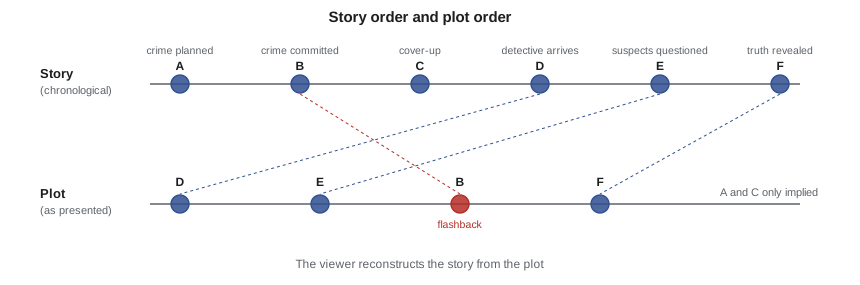
The distinction matters because many of a film's effects come from how the plot arranges the story. A film that shows the ending first, as some crime dramas do, trades suspense about what happens for curiosity about how and why it happened.
Cause and effect
Most narratives, especially in mainstream fiction film, are built on chains of cause and effect. Characters want things; their desires lead to actions; actions meet obstacles; obstacles produce new actions and consequences. Viewers constantly form hypotheses about causes ("why is he lying?") and effects ("what will happen when she finds out?").
In classical Hollywood narrative, the dominant style of American studio filmmaking from roughly the 1910s to the 1960s and still influential today, causes are usually personal: individual characters with clear goals drive the action. The plot often has two lines of action, frequently a romance and a work or adventure plot, and ends with a high degree of closure, meaning the main questions are answered.
Other traditions loosen these chains. European art cinema of the 1950s and 1960s often featured characters without clear goals, drifting plots and ambiguous endings. Some films emphasize social or natural causes rather than individual will. Recognizing how tightly a film links cause and effect is one of the first steps in describing its narrative form.
Time: order, duration and frequency
Because the plot can rearrange the story, films manipulate time in three main ways.
- Order: events can be shown chronologically or out of order. A flashback shows an earlier event; a flash-forward shows a later one. Some films are built almost entirely on rearranged order, such as a crime thriller told backwards so that each scene precedes the one before it.
- Duration: the plot can compress years into minutes or expand an instant into a long sequence. Story duration is the total time of the events; plot duration is the time span the film covers; screen duration is the running time of the film or scene.
- Frequency: an event usually appears once, but a film can show the same event several times, perhaps from different characters' perspectives. A famous Japanese film of 1950 tells the same incident through four contradictory testimonies, leaving the truth uncertain.
| Kind | Definition | Example for a described film |
|---|---|---|
| Story duration | Total time span of all events, including those only implied | Forty years, from a couple's childhood to old age |
| Plot duration | Time span of the events the film actually shows | Three days at a family reunion, with brief flashbacks |
| Screen duration | Running time | 110 minutes |
Screen duration can also be stretched or squeezed within a scene. Slow motion and repeated overlapping shots expand a moment; ellipsis, a cut that skips time, compresses it. A montage sequence may cover months of training in a minute of screen time.
Worked problem
Calculating story, plot and screen duration
A described film runs 96 minutes. Its scenes take place across one week in 2019, but repeated flashbacks show a car accident in 2004 that set the story in motion. What are the story, plot and screen durations?
Show solution
- Story duration runs from the earliest event implied or shown (the 2004 accident) to the last event (the end of the week in 2019): about 15 years.
- Plot duration covers the time spans the film actually presents: the week in 2019 plus the flashback moments of the accident. The main span is one week.
- Screen duration is the running time: 96 minutes.
Answer: Story duration is about 15 years, plot duration is about one week plus brief flashbacks, and screen duration is 96 minutes.
Screenplay timing: a page a minute
Screenwriters and producers use a rough rule that one page of a properly formatted screenplay equals about one minute of screen time. It is only an average; a page of rapid dialogue may run less than a minute, and a page describing a battle may run several. Still, the rule lets you estimate structure. Many screenwriting manuals describe a three-act structure in which the first act (setup) takes roughly the first quarter, the second act (confrontation) roughly the middle half, and the third act (resolution) the final quarter, with turning points at the act breaks.
Worked problem
Estimating act breaks from page count
A feature screenplay is 108 pages long. Using the page-a-minute rule and a quarter, half, quarter three-act model, estimate the screen times of the two main turning points.
Show solution
- Estimate the running time: 108 pages ≈ 108 minutes.
- First act ≈ one quarter: \( 108 \times 0.25 = 27 \) minutes, so the first turning point falls near minute 27.
- Second act ≈ one half: \( 108 \times 0.5 = 54 \) minutes, so it ends near \( 27 + 54 = 81 \) minutes.
- Third act runs from about minute 81 to minute 108.
Answer: Expect the first turning point near minute 27 and the second near minute 81, remembering that the rule gives only a rough guide.
Not every film follows three acts, and many scholars argue that a four-part or episodic structure describes some films better. The value of the exercise is that it makes you look for where the film shifts direction.
Narration: range and depth
Narration is the process by which the plot gives us story information. Two dimensions help describe it.
- Range: how much we know compared with the characters. Unrestricted (omniscient) narration lets us know more than any single character, moving between locations and people. Restricted narration limits us to what one character knows, so we discover things as they do. Many detective films use restricted narration to keep us in the investigator's position.
- Depth: how far we get inside characters' minds. Objective narration shows only what characters say and do from the outside. Subjective narration takes us into perceptions (point-of-view shots, distorted sound when a character is dazed) or into mental states (dreams, memories, imagined scenes).
The director Alfred Hitchcock famously explained the difference between surprise and suspense: if a bomb under a table suddenly explodes, the audience is surprised for a moment; if the audience is shown the bomb first and the characters chat unaware, the audience feels suspense for the whole scene. That is a choice about range: unrestricted narration that lets us know more than the characters creates suspense.
Point of view and narrators
Point of view in film can mean the literal optical view of a character, shown through a point-of-view (POV) shot, usually framed by a shot of the character looking and a shot of their reaction. More broadly, it means whose experience the film aligns us with. Some films use a narrator: a character narrator who appears in the story and tells it (often in voice-over), or a non-character narrator, an outside voice. Voice-over narrators can be unreliable, describing events in ways the images contradict, which invites the viewer to question them.
Point of view also shapes sympathy. Spending time with a character, seeing their reactions in close-up and sharing their knowledge tends to make us care about them, even when they do bad things. This alignment is one of cinema's most powerful moral tools.
Beginnings, endings and patterns of development
The opening of a film establishes the world, the characters, the tone and often the main question. Pay close attention to the first and last shots of a film; filmmakers frequently compose them as a pair, so that a change between them expresses the story's arc. Patterns of development across the middle include journeys, investigations, repetition with variation, and parallels between characters or plot lines.
Endings range from closed, where conflicts are resolved and fates settled, to open, where key questions remain. An open ending is not a failure; it may deliberately leave the viewer thinking. Analysis asks whether the ending fits the system the film has set up.
American cinema offers many examples of unconventional structure. Christopher Nolan's Memento (2000) presents the color scenes of its plot in reverse order, putting the viewer in the position of a hero with no short-term memory. Orson Welles's Citizen Kane (1941) assembles its central character's life from several witnesses' flashbacks, which overlap and contradict one another.
Applying narrative analysis
When you analyze narrative, work through a short checklist: How does the plot order the story? What is withheld and when is it revealed? Whose knowledge do we share? How deep do we go into characters' minds? What is the cause-and-effect logic, and how strong is closure at the end? Answering these questions in specific terms, with timings and scene references, turns plot summary into analysis.
Worked problem
Range of narration in a described scene
In a described thriller, the audience watches a burglar hide a key under a doormat while the homeowner sleeps. The next morning the homeowner leaves for work, unaware. What kind of narrative range is used, and what effect does it produce?
Show solution
- Compare viewer knowledge with character knowledge: we know about the hidden key; the homeowner does not.
- This is unrestricted narration, because we know more than at least one character.
- Apply Hitchcock's distinction: shared knowledge of a threat produces suspense rather than surprise.
Answer: The scene uses unrestricted range, giving the audience knowledge the homeowner lacks, so every later scene in the house carries suspense about when the burglar will return.
Common mistakes
MistakeConfusing story with plot
InsteadRemember that the story is all events in chronological order while the plot is what the film shows and in what order
MistakeTreating screen duration as the same as story duration
InsteadDistinguish the running time from the span of time the events cover
MistakeCalling every open ending a weakness
InsteadJudge the ending against the system the film sets up; ambiguity can be deliberate
MistakeEquating subjective narration with first-person voice-over only
InsteadRecognize that POV shots, distorted sound, dreams and memories are also subjective narration
MistakeRetelling the plot instead of analyzing it
InsteadExplain how the plot organizes information, time and point of view, with specific scene references
Summary and key terms
- The story is all events in chronological order; the plot is what the film presents and how.
- Most narratives rely on cause and effect, with classical Hollywood favoring goal-driven characters and strong closure.
- Films manipulate order, duration and frequency, and distinguish story, plot and screen duration.
- A screenplay page runs roughly a minute, which allows rough estimates of structure and act breaks.
- Narration varies in range, from restricted to unrestricted, and in depth, from objective to subjective.
- Point-of-view shots, narrators and alignment shape what we know and whom we sympathize with.
- Openings, endings and patterns of development reveal a film's narrative design.
- Story
- All the events of a narrative, shown or inferred, in chronological order
- Plot
- The events the film presents, in the order and manner it presents them
- Flashback
- A shot or scene showing events that happened earlier in the story
- Ellipsis
- An omission of story time, usually by a cut that skips over events
- Restricted narration
- Narration that limits the viewer to what one character knows
- Unrestricted narration
- Narration that gives the viewer more information than any single character has
- Subjective narration
- Narration that conveys a character's perceptions or mental states
- Point-of-view shot
- A shot taken from roughly where a character's eyes are, showing what they see
- Closure
- The degree to which a narrative resolves its questions and conflicts by the end
- Classical Hollywood narrative
- A storytelling model built on goal-driven characters, clear causality and strong closure
Practice problems
Work each problem on paper first, then reveal the answer to check.
Define story and plot in one sentence each.
Show answer
The story is all events in chronological order; the plot is what the film shows and how it arranges them.
What are the three ways films manipulate time?
Show answer
Order, duration and frequency.
A film runs 120 minutes and covers one night. What is its plot duration?
Show answer
About one night.
Using the page-a-minute rule, how long will a 92-page script run?
Show answer
About 92 minutes.
What is the difference between surprise and suspense according to Hitchcock?
Show answer
Surprise comes from sudden unknown events; suspense comes from the audience knowing a threat that characters do not.
Give an example of subjective narration.
Show answer
A dream sequence, a point-of-view shot or blurred sound when a character is dazed.
What kind of range keeps us in a detective's position?
Show answer
Restricted narration.
What is an unreliable narrator?
Show answer
A narrator whose account the film's images or later events contradict.
Why compare the first and last shots of a film?
Show answer
They are often designed as a pair, and the change between them expresses the story's arc.
Name two features of classical Hollywood narrative.
Show answer
Goal-driven characters and strong closure, often with a romance plot line.
Lesson quiz · 5 questions
Score 60% or more to complete this lesson.
Create a free account to save your progress, take quizzes and earn a certificate.