
FILM-101 · Lesson 9 of 12 · 27 min
Genre and style
When people choose a film to watch, they often choose by genre: a comedy for a light evening, a horror film for a scare, a documentary for something real. Genres are shared categories that shape how films are made, marketed and understood. Alongside genre, film studies looks at style and authorship: the patterns that make a director's films recognizable, and the debate over whether one person can be considered the author of a collaborative work. This lesson introduces genre conventions, how genres change, hybrid genres, the idea of the auteur and how to describe a director's style. FILM-430 explores the theory behind these ideas in more depth.
What is a genre?
A genre is a group of films that share recognizable conventions. Those conventions can include:
- Subject matter and themes: crime and punishment, love and marriage, survival, coming of age.
- Settings: the frontier town of the Western, the haunted house, the spaceship, the big-city newsroom.
- Character types: the gunfighter, the detective, the final survivor of a horror film, the mismatched romantic couple.
- Plot patterns: the investigation, the heist, the courtship with obstacles, the monster's rampage and defeat.
- Iconography: recurring images and objects that signal the genre, such as six-shooters and horses, fedoras and rain-slicked streets, spacesuits and control panels.
- Style: typical lighting, music, editing and camera choices, such as low-key lighting in horror or bright color and lively cutting in musicals.
Genres are not fixed boxes with clear borders. They are flexible categories shared by filmmakers, studios, critics and audiences, and their meanings change over time. A film may belong to several genres at once.
Major genres and their conventions
| Genre | Typical settings and iconography | Typical plot and themes | Typical style |
|---|---|---|---|
| Western | Frontier towns, deserts, horses, guns | Civilization versus wilderness, law, revenge | Wide landscapes, long shots |
| Horror | Isolated houses, woods, darkness | Threat, survival, the monstrous, fear of the body or the other | Low-key lighting, jump scares, unsettling sound |
| Musical | Stages, cities, dream spaces | Romance, community, performance | Song and dance numbers, bright color |
| Romantic comedy | Cities, workplaces, weddings | Courtship, obstacles, union | High-key lighting, witty dialogue |
| Science fiction | Futures, spaceships, laboratories | Technology, identity, society, the unknown | Visual effects, designed worlds |
| Crime and gangster | Cities, nightclubs, police stations | Ambition, law, corruption, loyalty | Urban settings, often low-key lighting |
| War | Battlefields, camps, home fronts | Sacrifice, comradeship, trauma | Chaotic action, documentary textures |
Genres also serve industrial purposes. Studios use them to plan production, reuse sets and costumes, build stars and target marketing. Audiences use them to predict the pleasures a film will offer. Critics use them to compare films and trace cultural change.
Genre change and hybrid genres
Genres change because filmmakers, audiences and societies change. Scholars often describe a rough life cycle: a genre's conventions form, become classic, are parodied and questioned, and are revised. The Western, for instance, moved from early heroic tales of settlers to later films that questioned violence and the treatment of Indigenous peoples, and today often appears in revisionist or hybrid forms.
Hybrid genres combine conventions: the horror comedy, the science-fiction Western, the musical biopic, the romantic thriller. Subgenres narrow a genre: within horror, slasher, supernatural, folk horror and body horror films each have their own conventions. Genres also travel between countries and change as they do; the Italian "spaghetti Westerns" of the 1960s and Hong Kong action cinema reshaped genres later borrowed by Hollywood.
Worked problem
Identifying genre conventions in a described film
A described film is set in a remote northern mining town. A newly arrived nurse investigates a series of disappearances, discovering a creature in the abandoned mine; the film includes romance with a local mechanic and ends with the town working together to seal the mine. Identify the genres and their conventions.
Show solution
- Horror conventions: isolated setting, disappearances, a monster in a dark underground space, survival.
- Mystery or detective conventions: an outsider investigates clues to uncover the truth.
- Romance conventions: a subplot of attraction between the nurse and the mechanic.
- Community resolution: the town uniting suggests a theme of collective survival, a variation on the lone hero.
Answer: The film is a hybrid of horror and mystery with a romantic subplot, using conventions of isolation, investigation and a monstrous threat, and its communal ending varies the genre's usual lone survivor.
Genre and culture
Genres can reveal social concerns. Science-fiction invasion films of the 1950s are often read as expressing Cold War anxieties; horror films frequently dramatize fears about bodies, families, technology or outsiders; disaster films respond to environmental worries. This is symptomatic meaning, introduced in Lesson 1. Such readings are most convincing when supported by evidence from the films and from their historical context, not just loose analogy.
Genres also carry assumptions about who gets to be the hero, the victim or the villain. Recent films often rework genre conventions to tell stories from perspectives historically excluded, such as Indigenous, Black, queer and women filmmakers using horror, Westerns or science fiction to address their own histories.
American cinema built many of the genres the world knows best, including the Western, the musical, the gangster film and the superhero blockbuster. Contemporary filmmakers continue to rework them: Jordan Peele's horror film Get Out (2017), for instance, used genre conventions to examine racism, and it won the Academy Award for Best Original Screenplay.
Authorship and the auteur
Films are made by many people, yet critics often discuss them as the work of their directors. This idea comes largely from French critics writing in the magazine Cahiers du cinéma in the 1950s, who argued that some directors working within the Hollywood studio system, such as Alfred Hitchcock and Howard Hawks, expressed a consistent personal vision across many films despite commercial constraints. They called this the "politique des auteurs." The American critic Andrew Sarris popularized it in English in the early 1960s as "the auteur theory."
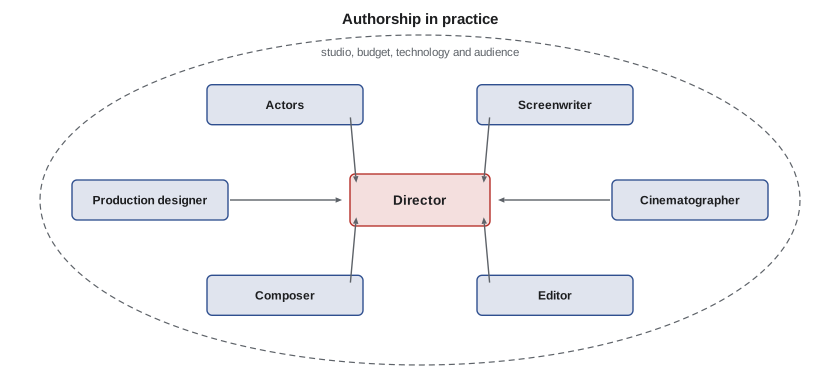
An auteur, in this view, is a director whose films show recognizable recurring themes and stylistic signatures. The idea encouraged serious study of popular films and remains influential in criticism, festival programming and marketing ("a film by..."). But it is also criticized for downplaying collaborators, such as screenwriters, cinematographers, editors, composers, production designers and actors, and for focusing on individual genius rather than industry, culture and audience.
Describing a director's style
Whether or not you accept auteur theory, you can describe a director's style by looking for patterns across several films.
- Recurring themes: identity, guilt, family, faith, power, memory.
- Characteristic mise-en-scène: symmetrical sets, natural locations, particular color palettes.
- Camera habits: long takes, handheld intimacy, frequent close-ups, specific lenses.
- Editing rhythms: fast intensified continuity, slow contemplative pacing, crosscutting.
- Sound and music: a recurring composer, silence, popular songs.
- Collaborators: a regular cinematographer, editor or actor who shapes the look and feel.
Worked problem
Building a style profile
You have watched three films by the same described director. All three feature isolated women in large houses, static symmetrical framings, slow pacing with average shot lengths above 12 seconds, near-silent soundtracks with sudden loud sounds, and the same cinematographer. Write a one-sentence style profile and note one caution.
Show solution
- Group themes: isolation of women in domestic spaces.
- Group style: static symmetrical composition, long shots in duration, sparse sound with sudden shocks.
- Note collaboration: the shared cinematographer likely contributes to the visual style.
- Caution: three films is a small sample, and later work may change.
Answer: This director's films explore women's isolation in domestic spaces through static, symmetrical framing, slow pacing and near silence broken by sudden sound, a style shaped in part by a long collaboration with one cinematographer; three films is a small sample, so the profile should be tested against other work.
Genre, authorship and the viewer
Genre and authorship both set up expectations. A viewer who knows a director's previous films or a genre's conventions watches differently, noticing variations and surprises. Analysis often examines how a film meets, varies or subverts those expectations. That play between expectation and surprise is one of the central pleasures of watching films.
Genre, stars and marketing
Genres work closely with stars and marketing. Certain actors become associated with particular genres, so casting a comic actor in a serious drama or an action star in a romance plays against audience expectations. Trailers, posters and streaming thumbnails signal genre within seconds through color, typography, music and imagery: dark blues and a lone figure suggest a thriller, bright colors and a smiling couple suggest a romantic comedy. Studios and streaming services use genre labels and algorithms to recommend films, which in turn shape what audiences expect and what gets made.
For analysis, ask how a film's marketing positioned it and whether the film itself delivers on or departs from those promises. Some of the most interesting films mislead audiences about their genre, beginning as a romance and turning into a thriller, for example, so that the shift itself becomes part of the experience.
Style beyond the director
Style can also belong to a studio, a period or a national cinema rather than a single director. Studio-era Hollywood studios had recognizable house styles shaped by their contracted cinematographers, designers and composers. Movements such as Italian Neorealism, which favored location shooting, non-professional actors and stories of ordinary postwar life, or the French New Wave, with its jump cuts and handheld freedom, share styles across many filmmakers. National cinemas develop recognizable tendencies too. Describing style at these levels helps you avoid attributing every choice to one individual and places a film within larger traditions.
A practical exercise is to compare two films from the same genre made decades apart. Note what has stayed the same, such as settings, character types and plot patterns, and what has changed, such as editing pace, attitudes toward violence, the roles given to women, or the inclusion of characters from communities once shown only as stereotypes. The comparison reveals both the stability of genre conventions and how they respond to social change.
Genre and national cinema
Genres take on local meanings when they are made in different countries. A crime film made in Montreal, Mexico City or Seoul may share conventions with Hollywood crime films while addressing local politics, languages and histories. Some genres are strongly associated with particular national cinemas, such as Bollywood musicals in India or wuxia martial-arts films in Chinese-language cinema. Watching genre films from many countries reveals both the global reach of genre conventions and the ways filmmakers adapt them to tell their own stories. In Canada, a long-running debate asks whether English Canadian cinema should compete with Hollywood genres or develop distinct forms, a question discussed further in FILM-120.
Common mistakes
MistakeTreating genres as fixed boxes with strict rules
InsteadDescribe genres as flexible, changing sets of conventions shared by makers and audiences
MistakeAssigning a film to only one genre
InsteadRecognize hybrids and subgenres and identify which conventions come from where
MistakeMaking symptomatic readings from loose analogy
InsteadSupport cultural readings with evidence from the films and their historical context
MistakeCrediting the director with every choice
InsteadAcknowledge collaborators and industrial constraints when discussing authorship
MistakeBuilding a style profile from a single film
InsteadLook for patterns across several films before describing a director's style
Summary and key terms
- A genre is a flexible group of films sharing conventions of subject, setting, character, plot, iconography and style.
- Genres serve industry, audiences and critics, and help predict a film's pleasures.
- Genres change over time through cycles of formation, classic use, parody and revision.
- Hybrid genres and subgenres combine and narrow conventions, and genres travel between countries.
- Genres can express social anxieties, but such readings need evidence.
- Auteur theory treats some directors as authors with recognizable themes and styles, but downplays collaborators.
- A director's style is described by patterns across several films in theme, mise-en-scène, camera, editing and sound.
- Genre
- A category of films sharing recognizable conventions
- Convention
- A familiar element or pattern that audiences expect in a genre
- Iconography
- Recurring images and objects that signal a genre
- Subgenre
- A narrower category within a genre, such as the slasher within horror
- Hybrid genre
- A film or category that combines conventions from more than one genre
- Revisionist genre film
- A film that questions or reworks a genre's traditional values
- Auteur
- A director regarded as the author of films with recognizable themes and style
- Auteur theory
- The critical approach treating some directors as the primary authors of their films
- Cahiers du cinéma
- The French film magazine where critics developed the politique des auteurs in the 1950s
- Body horror
- A horror subgenre centered on disturbing bodily transformation
Practice problems
Work each problem on paper first, then reveal the answer to check.
List four kinds of genre conventions.
Show answer
Subject matter, settings, character types, plot patterns, iconography or style.
What is iconography in genre terms?
Show answer
Recurring images and objects that signal a genre.
Give an example of a hybrid genre.
Show answer
A horror comedy or a science-fiction Western.
Why do studios value genres?
Show answer
They help plan production, reuse resources, build stars and target marketing.
How are 1950s invasion films often read?
Show answer
As expressing Cold War anxieties.
Where did the politique des auteurs develop?
Show answer
In the French magazine Cahiers du cinéma in the 1950s.
Who popularized auteur theory in English?
Show answer
The American critic Andrew Sarris.
Name one criticism of auteur theory.
Show answer
It downplays collaborators such as writers, cinematographers and editors.
Name three things to examine when describing a director's style.
Show answer
Themes, mise-en-scène, camera habits, editing, sound or collaborators.
What is body horror?
Show answer
A horror subgenre in which bodily transformation expresses anxieties.
Lesson quiz · 5 questions
Score 60% or more to complete this lesson.
Create a free account to save your progress, take quizzes and earn a certificate.