
FILM-220 · Lesson 5 of 12 · 30 min
Rhythm, pacing and timing
Audiences rarely talk about rhythm, yet they feel it immediately. A scene that drags makes them restless; a sequence that rushes leaves them confused; a film that varies its pace well carries them along without effort. Rhythm in editing comes from the length of shots, the placement of cuts against movement, sound and dialogue, and the larger pattern of fast and slow sections across a film. Pacing is the audience's experience of how quickly story and emotion unfold. This lesson gives you tools to measure rhythm, including average shot length and cut rates, and ways to shape pacing, from trimming individual frames to restructuring a whole act. Numbers help you diagnose; your feeling at full speed remains the final judge.
Rhythm, pace and tempo
These three words overlap, but it helps to separate them. Rhythm is the pattern of cuts and movements in time, like a beat. Pace is how fast story information and emotion arrive. Tempo is the overall speed of a scene or film. A scene can have many cuts yet feel slow if nothing new happens; a scene can be one long take yet feel fast if events tumble over each other. Editors therefore watch not only how often they cut but how much changes at each cut.
- Rhythm: the pattern of shot lengths and cut placements.
- Pace: the rate at which story and emotional information reach the audience.
- Tempo: the overall speed of a scene, sequence or film.
- Internal rhythm: movement and timing within a shot, created by actors and camera.
Measuring rhythm: average shot length
Average shot length, usually shortened to ASL, is the running time of a sequence divided by its number of shots. It is the most common measure film scholars use to compare editing styles. A related measure is cuts per minute. Neither tells you whether a sequence works, but both help you compare versions and spot drift: a scene that feels slow may turn out to have an ASL twice as long as its neighbors.
Worked problem
Calculating ASL and cuts per minute
A 3-minute 20-second dialogue scene contains 52 shots. What is its ASL and how many cuts per minute does it have?
Show solution
- Running time: \( 3 \times 60 + 20 = 200 \) seconds.
- ASL: \( 200 / 52 \approx 3.85 \) seconds.
- Cuts: with 52 shots there are 51 cuts. Cuts per minute: \( 51 / (200/60) = 51 / 3.33 \approx 15.3 \).
Answer: ASL about 3.8 seconds and about 15 cuts per minute. For quick comparisons many people simply use shots per minute, here about 15.6, since the difference of one cut rarely matters.
Film researchers have measured ASL across thousands of films. Commonly cited findings suggest that mainstream American features in the studio era often averaged roughly 8 to 11 seconds per shot, while many films after 2000 averaged roughly 3 to 6 seconds, with action films often shorter still. The scholar David Bordwell called this trend intensified continuity: faster cutting, more close-ups and more camera movement, still within the continuity system. These are averages across large samples; individual films vary enormously, and some contemporary directors deliberately use very long shots.
| Material | Typical ASL range (illustrative) | Notes |
|---|---|---|
| Slow-cinema art film | 15 seconds or more | Long takes, contemplative tempo |
| Classical studio drama | About 8 to 11 seconds | Commonly cited historical averages |
| Contemporary drama | About 4 to 7 seconds | Varies widely by director |
| Contemporary action sequence | About 1.5 to 3 seconds | Very fast cutting in set pieces |
| Music video, trailer | About 1 to 2 seconds | Cut to musical beats |
The shape of a sequence
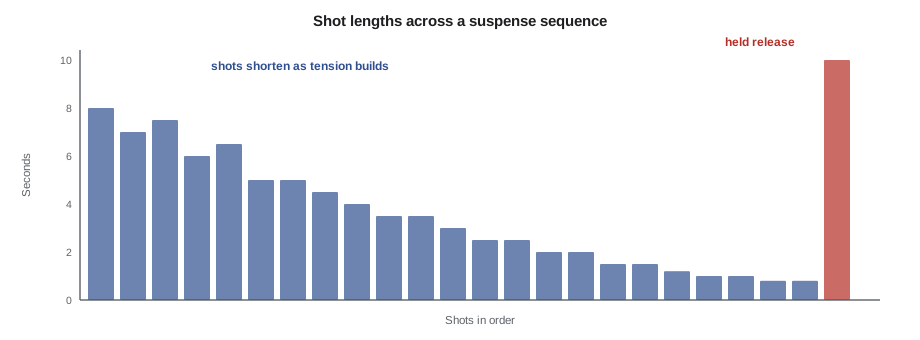
ASL is an average, and averages hide shape. A sequence with an ASL of 4 seconds could be steady four-second shots, or long shots punctuated by bursts of rapid cuts. Plotting each shot's length in order reveals the rhythm. Many effective sequences accelerate as tension builds, with shots getting shorter, then release with a long held shot.
Worked problem
Planning an accelerating sequence
You must cut a 60-second chase climax. You want the first 30 seconds at an ASL of 3 seconds, the next 24 seconds at an ASL of 1.5 seconds, and a final 6-second held shot. How many shots will the sequence contain?
Show solution
- First section: \( 30 / 3 = 10 \) shots.
- Second section: \( 24 / 1.5 = 16 \) shots.
- Final section: 1 shot.
- Total: \( 10 + 16 + 1 = 27 \) shots, so the overall ASL is \( 60 / 27 \approx 2.2 \) seconds.
Answer: 27 shots. The average of 2.2 seconds hides a clear acceleration and release, which is exactly what the audience feels.
Timing within the cut
At the level of a single cut, timing is a matter of frames. Cutting a reaction a few frames earlier can make a character seem quick-witted; holding it a few frames longer can make them seem stunned or thoughtful. In comedy, timing is everything: a reaction shot held a beat too long can kill a joke or, when intended, make it funnier. Editors learn to feel how long the audience needs to absorb a shot. Information-heavy shots, such as a wide establishing view or a page of text, need longer; simple close-ups with a single idea can be very short.
- Hold a shot until the audience has absorbed its information, then cut.
- Shorten a shot when its point is made, even if more action follows.
- Leave air, a brief pause, after an important line so it can land.
- Remove air in scenes that need urgency, overlapping lines where possible.
- Use the actors' internal rhythm; a performance with natural pauses often guides cut points.
Pacing a whole film
Beyond individual scenes, editors manage the pace of the whole film. A film that is fast all the time becomes numbing; a film that is slow all the time becomes tiring. Most effective features alternate intense and reflective passages so that each makes the other stronger. Editors look at the film as a series of sections and ask where the audience needs to breathe and where it needs to be pushed.
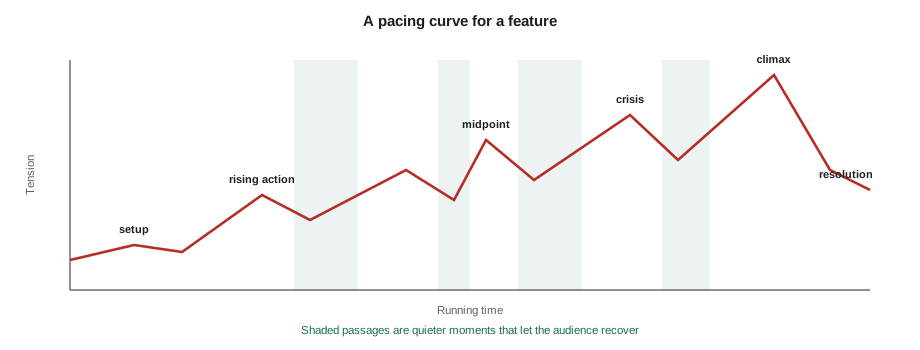
Pacing problems in long-form work are often structural rather than rhythmic. If the middle of a film drags, trimming frames from every shot may help only slightly. Removing or moving a scene, combining two scenes that make the same point, or entering scenes later and leaving them earlier usually helps more. Editors talk of coming into a scene late and leaving early: start after the greetings, end before the goodbyes.
Worked problem
Hitting a target running time
An assembly runs 128 minutes. The distributor wants a final cut of no more than 105 minutes. If the editor removes three whole scenes totaling 9 minutes, how much more must be trimmed, and what percentage is that of the remaining material?
Show solution
- Total reduction required: \( 128 - 105 = 23 \) minutes.
- After removing scenes: \( 128 - 9 = 119 \) minutes, so a further \( 119 - 105 = 14 \) minutes must go.
- Percentage of remaining material: \( 14 / 119 \approx 0.118 \), about 12 percent.
Answer: A further 14 minutes, roughly 12 percent of what remains. Trimming 12 percent evenly from every scene would be clumsy; usually some scenes lose a little while others are restructured or cut hard.
Tightening without losing rhythm
Tightening means removing material that slows a scene without adding value. Common targets include entrances and exits, repeated information, pauses before lines, and redundant reaction shots. But not every pause is waste. Tension often lives in silence, and a scene that is tightened too far can feel breathless and shallow. A useful check is to tighten aggressively, watch the result, and then restore the moments you miss.
| Target | How to tighten | Risk |
|---|---|---|
| Entrances and exits | Start after the character enters, end before they leave | Losing orientation in new locations |
| Pauses before lines | Trim pauses or overlap dialogue | Flattening performances |
| Repeated information | Cut lines or scenes that repeat what we know | Losing emphasis the audience needs |
| Establishing shots | Shorten or remove | Confusing geography |
| Reaction shots | Keep only those that add meaning | Losing the listener's perspective |
Measuring your own cuts
Most editing systems can list the events in a sequence, and from that list you can calculate shot counts and ASL quickly. Some editors keep a simple log of each scene's running time across versions to track how a cut is evolving. Numbers do not replace judgment, but they can reveal patterns: perhaps every scene in the second act grew longer in the last revision, or the climax is cut more slowly than the opening.
Worked problem
Comparing two versions
Version 3 of a scene runs 2:48 with 41 shots. Version 4 runs 2:15 with 40 shots. What changed?
Show solution
- Version 3 ASL: \( 168 / 41 \approx 4.1 \) seconds.
- Version 4 ASL: \( 135 / 40 \approx 3.4 \) seconds.
- The shot count barely changed, but 33 seconds were removed, so the editor trimmed within shots rather than removing shots.
Answer: Version 4 is tighter by about 20 percent, achieved mainly by trimming the heads and tails of shots. If the scene now feels rushed, restore pauses at key moments rather than adding shots.
Pacing for the platform
Where a film will be seen affects how it is paced. A feature designed for cinema can hold quiet passages because the audience has chosen to sit in the dark without distractions. A series episode on a streaming platform must hold viewers who can stop at any moment, so many editors open episodes with a strong hook and avoid long slow stretches early. Short-form content for social platforms often front-loads the most striking image in the first seconds. These are tendencies, not rules: some of the most admired streaming series move slowly and deliberately. But knowing the viewing context helps editors judge how much patience they can ask of the audience.
Measuring pacing across a feature
Some editors build a simple chart of scene running times across the whole film, marking each scene by type: dialogue, action, montage, transition. Seeing several long dialogue scenes in a row, or a run of short transitional scenes with no dramatic weight, often explains why a section feels slow or scattered. The chart does not replace watching, but it gives the editor and director a shared picture of the film's shape, which can make structural discussions faster and less subjective. It is also a useful record of how the cut has evolved over the months of editing.
Common mistakes
MistakeEquating more cuts with faster pacing
InsteadJudge pace by how quickly story and emotion arrive, not cut count alone
MistakeTrimming frames evenly to hit a running time
InsteadRestructure, remove redundant scenes, and enter late and leave early
MistakeRemoving every pause
InsteadKeep pauses that carry tension or let important lines land
MistakeRelying on ASL alone
InsteadPlot shot lengths to see the shape of a sequence and watch at full speed
MistakeCutting every scene at the same tempo
InsteadVary tempo across the film so intense and quiet passages strengthen each other
Summary and key terms
- Rhythm is the pattern of cuts; pace is the rate of story and emotion; tempo is overall speed.
- ASL is running time divided by number of shots; cuts per minute is a related measure.
- Commonly cited research shows mainstream ASLs shortening from roughly 8 to 11 seconds to roughly 3 to 6 seconds.
- The shape of shot lengths over time reveals acceleration and release.
- Timing within a cut is measured in frames and judged by feel.
- Long-form pacing problems are often structural and solved by moving or removing scenes.
- Tighten boldly, then restore the moments that matter.
- Rhythm
- The pattern of shot lengths and cuts in time
- Pace
- How quickly story and emotional information reach the audience
- Tempo
- The overall speed of a scene or film
- Average shot length
- Running time divided by number of shots
- Cuts per minute
- The number of cuts in each minute of running time
- Intensified continuity
- Bordwell's term for faster cutting within the continuity system
- Internal rhythm
- Timing and movement within a single shot
- Air
- A brief pause left to let a moment land
- Tightening
- Removing material that slows a scene without adding value
- Enter late, leave early
- Starting scenes after setup and ending before wind-down
Practice problems
Work each problem on paper first, then reveal the answer to check.
A 90-second sequence has 36 shots. What is the ASL?
Show answer
90 divided by 36 is 2.5 seconds.
How many shots does a 2-minute scene need for an ASL of 4 seconds?
Show answer
120 divided by 4 is 30 shots.
A scene of 4:30 has 60 shots. What is the ASL?
Show answer
270 divided by 60 is 4.5 seconds.
A 112-minute cut must become 98 minutes. What percentage must be removed?
Show answer
14 divided by 112 is 12.5 percent.
What did Bordwell call the trend to faster cutting within continuity?
Show answer
Intensified continuity.
Why can a scene with many cuts still feel slow?
Show answer
If little new information or emotion arrives at each cut.
What does entering late and leaving early mean?
Show answer
Starting after setup material and ending before wind-down.
How many cuts per minute does a 3-minute scene of 46 shots have, roughly?
Show answer
45 cuts divided by 3 minutes is 15.
Name one risk of removing establishing shots.
Show answer
The audience may lose track of geography.
Why plot shot lengths instead of using only ASL?
Show answer
The plot shows acceleration and release that an average hides.
Lesson quiz · 5 questions
Score 60% or more to complete this lesson.
Create a free account to save your progress, take quizzes and earn a certificate.