
FILM-220 · Lesson 7 of 12 · 28 min
Montage, parallel action and non-linear structure
Continuity editing builds scenes that feel like unbroken time. But much of a film's power comes from editing that compresses time, connects distant places and rearranges the order of events. This lesson covers three of those techniques. The montage sequence compresses days, months or years into a minute of screen time. Parallel action, or cross-cutting, alternates between two or more lines of action to build tension or draw comparisons. Non-linear structure rearranges the order in which the audience learns events, through flashbacks, flash-forwards and more radical reorderings. All three put the editor in charge not just of rhythm but of the architecture of the story.
The montage sequence
In Hollywood usage, a montage sequence is a short series of shots, usually set to music, that condenses a process or a passage of time: a team training for a big game, a couple falling in love over a summer, a city rebuilding after a disaster. The term borrows from Soviet montage theory but the practice is different: the Hollywood montage aims for clarity and emotional uplift rather than intellectual collision.
- Define what the montage must communicate: progress, passage of time, a relationship deepening, a decline.
- Gather shots that show stages of change, not just activity.
- Build a shape: beginning state, development, end state.
- Cut to the music's structure, using phrases and accents for key changes.
- Use visual links, such as graphic matches or repeated actions, to tie shots together.
Worked problem
Fitting a montage to a music cue
A montage uses a 32-second section of a song at 96 beats per minute in 4/4. The director wants cuts every two beats for the first half and every beat for the second half. How many shots are needed?
Show solution
- One beat lasts \( 60 / 96 = 0.625 \) seconds.
- First half, 16 seconds at two beats per shot: each shot lasts \( 2 \times 0.625 = 1.25 \) seconds, giving \( 16 / 1.25 = 12.8 \), so about 13 shots.
- Second half, 16 seconds at one beat per shot: \( 16 / 0.625 = 25.6 \), so about 26 shots.
- Total: about 39 shots, with an overall ASL near \( 32 / 39 \approx 0.82 \) seconds.
Answer: About 39 shots. Editors then vary the pattern slightly, holding a key image across a musical phrase so the sequence does not become mechanical.
Montages can be overused. Because they skip over the process of change, they can feel like a shortcut. Many editors try to give montages a dramatic arc of their own, with a setback in the middle or a final image that turns the mood, so they function as miniature scenes rather than filler.
Parallel action and cross-cutting
Cross-cutting alternates between two or more lines of action happening in different places. The audience infers that they are related, usually simultaneous, and often converging. Early American filmmakers, particularly D. W. Griffith, developed cross-cutting into a powerful tool for suspense, most famously in the last-minute rescue, where shots of a victim in danger alternate with shots of rescuers racing to help. Editors still use the structure in thrillers, heist films and action climaxes.
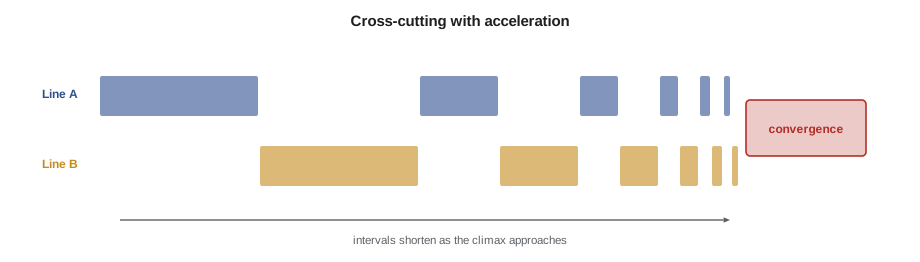
A key tool in cross-cutting is the interval between switches. Early in a sequence, editors stay with each line long enough to establish it. As the climax approaches, intervals shorten, accelerating the rhythm and the audience's anxiety. When the lines converge, the cross-cutting usually ends and continuous editing resumes.
Worked problem
Planning an accelerating cross-cut
A 2-minute climax cross-cuts between a bomb disposal technician and her partner racing to reach her. You plan segments that halve in length: two segments of 24 seconds, then two of 12, then two of 6, then two of 3, and so on until the convergence. How much time do the first eight segments use, and how much remains for the final rapid exchange and convergence?
Show solution
- Pairs of segments: \( 2 \times 24 + 2 \times 12 + 2 \times 6 + 2 \times 3 = 48 + 24 + 12 + 6 = 90 \) seconds.
- Remaining time: \( 120 - 90 = 30 \) seconds.
- The remaining 30 seconds can hold a burst of 1- to 2-second alternations and a held convergence shot.
Answer: The first eight segments use 90 seconds, leaving 30 seconds for the climax. In practice the pattern is never mathematically exact, but planning it this way helps the acceleration feel deliberate.
Parallel editing for meaning
Not all parallel editing is about simultaneity. Editors also cross-cut between events in different times or places to draw comparisons. A celebrated example from a well-known gangster saga intercuts a religious ceremony, a baptism, with a series of violent killings carried out on the godfather's orders. The contrast between the sacred ritual and the violence comments on the character's moral position without a word of dialogue. This is parallel editing working as thematic juxtaposition, close in spirit to Eisenstein's intellectual montage.
| Kind | Relationship between lines | Typical effect |
|---|---|---|
| Simultaneous action | Same time, different places | Suspense, convergence |
| Thematic contrast | Any time, linked by idea | Irony, moral comment |
| Past and present | Different times, same characters | Cause and effect, memory |
| Multiple storylines | Several characters' arcs | Ensemble structure, comparison |
Flashbacks and flash-forwards
A flashback shows events from earlier in the story; a flash-forward shows events from later. Editors must make the change of time clear enough that the audience follows, without being heavy-handed. Common cues include a dissolve or sound bridge, a change in color treatment agreed with the colorist (grading itself is covered in CINE-310), a change in costume or setting, or a character's look into space followed by a cut. Many modern films use hard cuts into flashbacks, trusting the audience to read the change from context.
- Give the audience a clear cue the first time a flashback device is used; later uses can be quicker.
- Keep the visual treatment of each time period consistent.
- Make sure each flashback answers a question the audience is already asking.
- Avoid flashbacks that repeat what the audience already knows unless the repetition adds a new perspective.
Story order and plot order
Narrative theorists distinguish story order, the chronological sequence of events in the fictional world, from plot order, the order in which the film presents them. Editors work directly with plot order. In many films, especially documentaries and complex dramas, the structure changes significantly in the edit. Scenes are moved, removed, split and recombined until the plot order works.
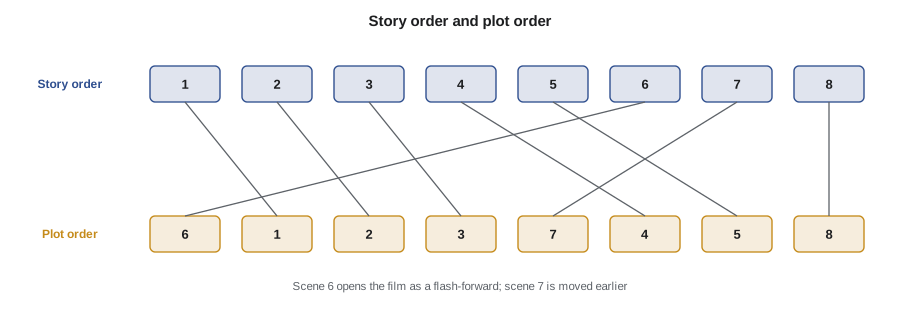
One well-known thriller tells most of its story in reverse chronological order, so each scene ends where the previous one began, putting the audience in the position of a protagonist who cannot form new memories. Another widely discussed crime film presents its interlocking stories out of order, so a character who dies in one section appears alive in a later one. These are extreme examples, designed largely at the script stage, but they show how plot order shapes meaning.
Restructuring in the cutting room
Even conventionally structured films are often reordered in editing. Editors and directors commonly use scene cards, index cards or a digital board with one card per scene, to see the whole film at a glance and test new orders. Moving a revelation earlier can create suspense; moving it later can create surprise. Removing a scene can make the next one more powerful because the audience has to infer what happened.
Worked problem
Counting possible orders
A director wants to test different orders for a sequence of five scenes in the second act, keeping the first and last scenes of the act fixed and rearranging the three middle scenes. How many orders are possible? What if all five are free to move?
Show solution
- Three scenes can be arranged in \( 3! = 3 \times 2 \times 1 = 6 \) orders.
- Five scenes can be arranged in \( 5! = 120 \) orders.
Answer: 6 orders with the ends fixed, 120 with all five free. Editors do not test every permutation; they use story logic to reduce the options to a few promising structures and test those at full speed.
| Move | Purpose | Risk |
|---|---|---|
| Move a scene earlier | Set up information or create suspense | Losing surprise |
| Move a scene later | Delay a revelation | Confusion if information is missing |
| Remove a scene | Tighten pace, force inference | Losing motivation or clarity |
| Split a scene and intercut it | Create parallel tension | Fragmenting performances |
| Combine two scenes | Remove redundancy | Overloading one scene |
| Open with a flash-forward | Hook the audience | Undermining suspense later |
Keeping the audience oriented
The more the editing rearranges time and place, the more the audience needs anchors. Editors provide them through consistent visual treatments for each timeline, recurring locations, title cards with dates or places, sound motifs and clear character introductions. Test screenings, discussed in lesson 12, are the best way to find out whether a complex structure is clear or simply confusing.
- Use consistent visual and sound cues for each timeline.
- Introduce characters clearly before cutting away from them.
- Use titles or dialogue for dates and places when the change is large.
- Watch the film fresh, or ask someone new to watch, to check clarity.
Cold opens and framing devices
Many films and series begin with a cold open: a scene, often from later in the story or from a separate incident, placed before the titles to hook the audience. Editors frequently create or reshape cold opens in post-production, pulling a dramatic moment forward to give the opening energy. Framing devices, such as a narrator recalling events or a present-day interview that bookends a story, are also often strengthened or simplified in the edit. Both techniques change plot order, so editors check that the moment pulled forward does not spoil a later surprise, and that the audience understands when the story returns to its main timeline.
Voice-over and structure
Voice-over narration can rescue a confusing structure by telling the audience what they need to know, but it can also become a crutch that explains what the pictures should show. Editors often record a temporary voice-over themselves or with an assistant to test whether narration is needed and where it belongs. If a temporary line makes a sequence work, the director and writer can then craft the final words. If the sequence plays without it, the voice-over is cut. This kind of experiment is common in documentary and in dramas with complex structures, and it shows how writing continues in the cutting room.
Testing structural changes
Because structural changes affect the whole film, editors usually test them on a duplicate of the current cut rather than the main version. They watch the changed section in context, ideally with at least the scenes before and after, so they judge how the change affects the flow. Keeping careful version names makes it easy to compare structures side by side and to return to an earlier version if the experiment fails.
Common mistakes
MistakeTreating a montage as filler
InsteadGive the montage a shape with a beginning, development and end state
MistakeCross-cutting at a constant interval
InsteadShorten intervals as tension builds and resolve on convergence
MistakeIntroducing flashbacks without cues
InsteadGive a clear cue the first time and keep each timeline's treatment consistent
MistakeAssuming structure is fixed by the script
InsteadTest new orders with scene cards and full-speed viewings
MistakeTrying every possible permutation
InsteadUse story logic to narrow options to a few strong structures
Summary and key terms
- Montage sequences compress time and process, usually to music.
- Cross-cutting alternates lines of action to build suspense or draw comparisons.
- Shortening intervals between switches accelerates tension.
- Parallel editing can create thematic meaning, as in intercutting ritual and violence.
- Flashbacks and flash-forwards need clear, consistent cues.
- Story order and plot order differ; editors shape plot order.
- Restructuring with scene cards is a normal part of editing.
- Montage sequence
- A short series of shots condensing time or process, often to music
- Cross-cutting
- Alternating between lines of action in different places
- Parallel editing
- Editing that links separate lines of action by time or idea
- Last-minute rescue
- A cross-cut structure where rescuers race to reach someone in danger
- Convergence
- The point where cross-cut lines of action meet
- Flashback
- A scene showing events from earlier in the story
- Flash-forward
- A scene showing events from later in the story
- Story order
- The chronological order of events in the fictional world
- Plot order
- The order in which the film presents events
- Scene cards
- Cards representing scenes, used to test structure
Practice problems
Work each problem on paper first, then reveal the answer to check.
A song is at 120 beats per minute. How long is one beat?
Show answer
0.5 seconds.
How many one-beat shots fit in 20 seconds at 120 beats per minute?
Show answer
40 shots.
How many orders are possible for four scenes?
Show answer
\( 4! = 24 \).
Name one cue for a flashback.
Show answer
A dissolve, a sound bridge, a change in color treatment or a look into space.
What is the difference between story order and plot order?
Show answer
Story order is chronological; plot order is the order of presentation.
Segments of 20, 20, 10, 10, 5 and 5 seconds total how much?
Show answer
70 seconds.
Why shorten cross-cutting intervals?
Show answer
To accelerate rhythm and raise tension before convergence.
What is one risk of moving a revelation earlier?
Show answer
Losing the surprise.
What did Griffith popularize in early American cinema?
Show answer
Cross-cutting for suspense, such as the last-minute rescue.
Why give montages an arc?
Show answer
So they work as miniature scenes, not filler.
Lesson quiz · 5 questions
Score 60% or more to complete this lesson.
Create a free account to save your progress, take quizzes and earn a certificate.