
HSE-103 · Lesson 1 of 12 · 26 min
Hazards, risk and why assessment matters
Most workplace injuries and illnesses are predictable. The ladder with a cracked rail, the guard removed from a machine to clear a jam, the solvent used in a small room without ventilation, the worker alone at night handling cash: in investigation after investigation, the hazard was there to be seen before anyone was hurt. Hazard recognition and risk assessment are the disciplined ways of seeing those hazards in advance, judging how serious they are, and choosing controls that actually work. They sit at the center of every modern occupational health and safety system, from the smallest shop to a refinery. This course explains the concepts and methods at an awareness level, for workers, supervisors, committee members and anyone who takes part in assessing hazards. This first lesson defines hazards and risk, explains why assessment matters, introduces the basic assessment process and sets out what the rest of the course covers.
This is an awareness-level course. It gives you a solid general understanding of hazard recognition and risk assessment and can support an employer's safety and health program under OSHA, state plans and recognized consensus standards. It does not replace the site-specific hazard assessments your employer must carry out, the training required by specific OSHA standards for your work and equipment, or specialized training required for particular hazards and methods. Always follow federal, state and local law and your employer's procedures.
Hazards
A hazard is anything with the potential to cause harm: injury, illness, damage to property or the environment, or a combination. Hazards can be objects (an unguarded saw blade), substances (a corrosive cleaner), energy (electricity, pressure, heat, gravity acting on a person at height), conditions (an icy parking lot, poor lighting), activities (lifting heavy boxes, working alone) or organizational factors (excessive overtime, unclear procedures, harassment). The defining feature of a hazard is potential: a hazard exists whether or not anyone is currently exposed to it. A drum of flammable liquid in a locked storeroom is still a hazard; it becomes dangerous when people, ignition sources or other conditions come together with it.
It helps to describe hazards precisely. "The warehouse" is not a hazard; "forklifts reversing through a pedestrian aisle with no separation" is. "Chemicals" is not a hazard; "splashing of 30 % sodium hydroxide during manual transfer from a drum" is. Precise hazard descriptions lead naturally to precise controls.
Risk
Risk combines two ideas: how likely it is that harm will occur, and how severe that harm would be. A frayed extension cord in a damp outdoor work area presents a high likelihood of shock with potentially fatal severity, so the risk is high. A paper cut from handling envelopes is likely but minor, so the risk is low. A meteor strike on the office is catastrophic but vanishingly unlikely. Risk is often expressed with a simple model:
Likelihood itself depends on exposure, meaning how many people are exposed, how often and for how long, and on the probability that the hazardous event happens during exposure. Severity depends on the energy or toxicity involved and on how many people could be affected. Existing controls change both: a guard reduces the likelihood of contact; a seat belt reduces the severity of a crash. Lesson 6 explains how risk is rated in practice and the pitfalls of simple numerical scores.
| Term | Meaning | Example |
|---|---|---|
| Hazard | A source of potential harm | Unguarded rotating shaft |
| Exposure | Contact or proximity to a hazard | Operator works 30 cm from the shaft for 6 hours |
| Hazardous event | The occurrence that causes harm | Sleeve caught on the shaft |
| Consequence | The harm that results | Arm entanglement and fracture |
| Risk | Likelihood and severity of harm combined | High: likely contact, serious injury |
| Control | A measure that eliminates or reduces risk | Fixed guard over the shaft |
From hazard to harm
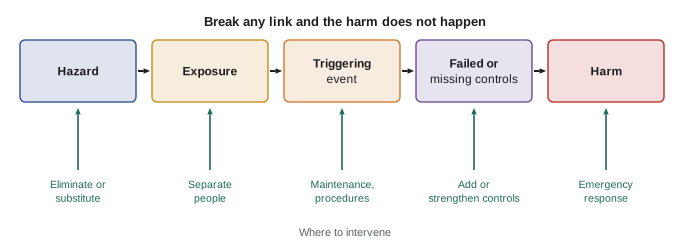
Harm rarely happens because of a single failure. A useful way to think about incidents is as a chain: a hazard exists; a person, process or asset is exposed to it; a triggering event or condition occurs; the controls that should prevent or limit the event fail or are absent; and harm results. Every link in the chain is a place to intervene. Removing the hazard breaks the chain at its source; separating people from the hazard breaks it at exposure; good maintenance and procedures make triggering events less likely; and protective measures such as guards, emergency stops, ventilation and personal protective equipment limit the harm if the event happens anyway. The "Swiss cheese" model, developed by psychologist James Reason, pictures each layer of protection as a slice with holes; harm occurs when the holes in several layers line up. Effective risk assessment looks at every slice.
Why assessment matters
Hazard and risk assessment matter for several reasons:
- Prevention: most injuries and occupational diseases can be prevented if hazards are identified and controlled before work begins, rather than after someone is hurt.
- The law: occupational health and safety law in both Canada and the United States requires employers to identify and control workplace hazards, either through explicit hazard assessment duties or through general duties to protect workers (Lesson 2).
- Prioritization: no organization can fix everything at once. Assessment shows which hazards present the greatest risk, so that time and money go where they protect the most people.
- Better decisions: assessment brings evidence and structure to decisions about equipment, procedures, staffing and design, instead of relying on habit or assumptions.
- Worker involvement: done well, assessment draws on the knowledge of the people who do the work, who often know where the real hazards are.
- Cost: injuries, illnesses, property damage and downtime are expensive. Workers' compensation premiums, lost production, investigation and legal costs, and damage to reputation all follow serious incidents.
- Continuous improvement: assessment is the starting point for measuring and improving safety performance over time.
Hazard assessment and risk assessment
The terms are often used interchangeably, but they emphasize different steps. Hazard identification, or hazard recognition, asks what could cause harm. Hazard assessment, as the term is used in many Canadian laws, combines identifying hazards with deciding how each will be eliminated or controlled. Risk assessment, as defined in standards such as ISO 31000 and ISO 45001, includes risk identification, risk analysis (understanding likelihood and consequence) and risk evaluation (comparing risk with criteria to decide what action is needed). Risk management is the whole cycle: assessing risk, treating it with controls, monitoring, reviewing, communicating and improving. In practice, all of these terms describe the same basic logic: find the hazards, understand the risk, control it, and check that the controls work.
The basic assessment process
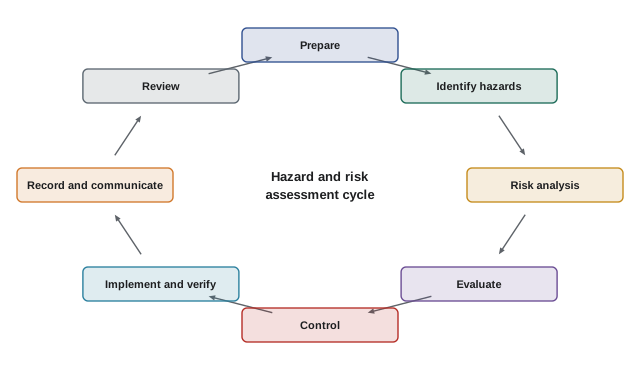
Whatever method is used, hazard and risk assessment follows a common sequence:
- 1. Prepare: define the scope (a task, a work area, a piece of equipment, a project), gather information such as procedures, manuals, safety data sheets, inspection and incident records, and assemble people who know the work.
- 2. Identify hazards: break the work into tasks or areas and look for everything that could cause harm, including non-routine work such as maintenance, cleaning, start-up, shutdown and emergencies.
- 3. Analyze risk: for each hazard, consider who could be harmed and how, the existing controls, and the likelihood and severity of harm.
- 4. Evaluate: decide whether the risk is acceptable or needs further control, and set priorities.
- 5. Control: choose controls using the hierarchy of controls, starting with elimination and substitution (Lesson 7).
- 6. Implement and verify: put controls in place, train people, and check that the controls work and do not create new hazards (Lesson 8).
- 7. Record and communicate: document the assessment and inform the people affected.
- 8. Review: revisit the assessment regularly and whenever something changes (Lessons 10 and 12).
Worked problem
From a vague concern to a precise hazard
A supervisor at a food distribution center says, "The loading dock is dangerous." How could this concern be turned into hazard descriptions that can be assessed and controlled?
Show solution
- Walk the dock with workers and observe the tasks: loading trucks, moving pallets, opening dock doors and checking trailers.
- Describe specific hazards: trailer creep or early departure while a forklift is inside; falls from the open dock edge when no trailer is present; pedestrians crossing forklift routes; cold stress in winter; manual lifting of mixed cases.
- For each hazard, note who is exposed, how often, and existing controls, such as wheel chocks and dock locks.
- Rate the risk and choose controls, for example vehicle restraints interlocked with dock doors, edge barriers and marked pedestrian walkways.
Answer: Replace "the dock is dangerous" with specific hazards, such as trailer creep, open dock edges and forklift-pedestrian conflict, each with its own exposure, rating and controls.
Who takes part
Employers are responsible for ensuring hazard assessments are done, but good assessments involve many people. Supervisors know the work and are responsible for day-to-day control. Workers bring detailed knowledge of how tasks are really done, including shortcuts and problems not shown in procedures. Health and safety committees and representatives review assessments and raise concerns. Specialists such as safety professionals, industrial hygienists, ergonomists and engineers help with complex hazards, measurement and design. Contractors and suppliers contribute information about their equipment and work. Lesson 11 discusses participation in more detail.
Common barriers to good assessment
Assessments often fail not because the method is wrong but because of how they are done. Common barriers include treating the assessment as paperwork to be filed rather than a tool for decisions; copying generic assessments that do not match the actual work; doing assessments in an office without seeing the task; missing non-routine work, such as maintenance and cleaning, where many serious incidents occur; normalization of deviance, the gradual acceptance of risky practices because nothing bad has happened yet; over-reliance on personal protective equipment and rules instead of better design; and never reviewing assessments after changes or incidents. Recognizing these barriers is the first step to overcoming them.
Course overview
Lesson 2 explains the legal framework for hazard assessment. Lesson 3 surveys the main types of hazards. Lesson 4 covers recognizing hazards through inspections, observation and reporting. Lesson 5 explains job hazard analysis. Lesson 6 covers rating risk. Lessons 7 and 8 cover the hierarchy of controls and how to select and verify controls. Lesson 9 introduces specialized methods such as what-if analysis, HAZOP, FMEA and bow-tie analysis. Lesson 10 covers management of change. Lesson 11 covers worker participation and communication. Lesson 12 covers reviewing and updating assessments and the capstone project.
The cost of not assessing
Unassessed hazards cost far more than the time it takes to assess them. Each serious injury brings direct costs, such as medical care, wage replacement and compensation premiums, and indirect costs that are often several times larger: lost production, overtime to cover the injured worker, damaged equipment and product, investigation time, hiring and training replacements, regulatory penalties, legal fees, and harm to reputation and morale. The human costs, including pain, disability, lost income, strain on families and, in the worst cases, death, cannot be measured in money at all. Workers who see that hazards are taken seriously are more likely to report problems, stay with the employer and recommend it to others.
Assessment also pays off in ways that have nothing to do with injuries. Looking closely at how a task is done often reveals wasted motion, poor layouts, unreliable equipment and unclear procedures. Fixing these improves quality and productivity as well as safety. Organizations that treat hazard assessment as part of how work is planned, rather than as paperwork done for the regulator, generally find that safety and operational performance improve together.
Assessment as a habit
Formal assessments are written down, reviewed and signed, but the skill behind them is a habit that every worker can use every day: pausing before a task to ask what could go wrong, how bad it could be and what will prevent it. Many organizations formalize this habit with short field-level or point-of-work assessments, sometimes called "take five" or "stop and think" cards. These do not replace the detailed assessments described later in this course, but they catch changes in conditions, such as rain, a missing tool, a new worker on the crew or a blocked exit, that a document written weeks ago could not anticipate.
Common mistakes
MistakeDescribing hazards vaguely, such as "the warehouse".
InsteadDescribe the specific source, task and way harm could occur.
MistakeTreating assessment as paperwork.
InsteadUse the assessment to make and track real decisions.
MistakeAssessing tasks from the office.
InsteadObserve the work and talk to the people who do it.
MistakeIgnoring maintenance, cleaning and emergencies.
InsteadInclude non-routine work in every assessment.
MistakeTreating awareness training as enough.
InsteadComplete your employer's site-specific assessments and training.
Summary and key terms
- A hazard is anything with the potential to cause harm.
- Risk combines the likelihood and severity of harm.
- Harm follows a chain from hazard to consequence, with many points to intervene.
- Assessment prevents harm, meets legal duties and sets priorities.
- Assessment follows a cycle: prepare, identify, analyze, evaluate, control, verify, record, review.
- Good assessments involve workers, supervisors, committees and specialists.
- Hazard
- Anything with the potential to cause harm.
- Risk
- The combination of likelihood and severity of harm.
- Exposure
- Contact with or proximity to a hazard.
- Hazardous event
- An occurrence that can cause harm.
- Control
- A measure that eliminates or reduces risk.
- Hazard identification
- Finding what could cause harm.
- Risk assessment
- Identifying, analyzing and evaluating risk.
- Risk management
- The full cycle of assessing, treating and reviewing risk.
- Swiss cheese model
- Model of incidents as aligned failures in layers of protection.
- Normalization of deviance
- Gradual acceptance of unsafe practices.
Practice problems
Work each problem on paper first, then reveal the answer to check.
Define a hazard.
Show answer
Anything with the potential to cause harm.
What two factors make up risk?
Show answer
Likelihood and severity.
Rewrite "chemicals" as a precise hazard.
Show answer
For example, splashing of corrosive liquid during manual transfer.
What does exposure depend on?
Show answer
How many people, how often and for how long.
Name the links in the chain from hazard to harm.
Show answer
Hazard, exposure, trigger, failed controls, harm.
Who developed the Swiss cheese model?
Show answer
James Reason.
Give three reasons assessment matters.
Show answer
Prevention, legal duties, prioritization, better decisions, cost.
List the steps of the assessment cycle.
Show answer
Prepare, identify, analyze, evaluate, control, verify, record, review.
Why include non-routine work?
Show answer
Many serious incidents occur during maintenance, cleaning and emergencies.
What is normalization of deviance?
Show answer
Gradually accepting risky practices because nothing has gone wrong yet.
Lesson quiz · 5 questions
Score 60% or more to complete this lesson.
Create a free account to save your progress, take quizzes and earn a certificate.