
HSE-103 · Lesson 11 of 12 · 25 min
Worker participation, committees and communication
The people who do the work know things about its hazards that no one else does: which tool slips, which valve sticks, which customer becomes aggressive, which shortcut everyone takes when the line falls behind. Hazard assessments that leave workers out miss this knowledge and produce controls that do not fit the work. Participation is also a legal right in both countries and one of the strongest predictors of effective safety programs. This lesson covers why participation matters, the legal framework for committees and representatives, ways workers can participate in hazard assessment, communicating hazards and controls, psychological safety and speaking up, and including contractors, temporary workers and workers with diverse needs.
Why participation matters
Worker participation improves hazard assessment in several ways. Workers identify hazards that managers and specialists miss, especially in non-routine tasks and workarounds. They help design controls that are practical, which makes them more likely to be used. Participation builds understanding and commitment: people are more likely to follow procedures they helped create. It creates channels for reporting hazards and near misses early. And it reflects the principle, built into occupational health and safety law in both countries, that workers have a right to participate in decisions that affect their health and safety. Studies of safety programs consistently find that meaningful worker involvement is associated with better performance, while programs imposed without involvement tend to produce paperwork without change.
Safety committees and worker involvement
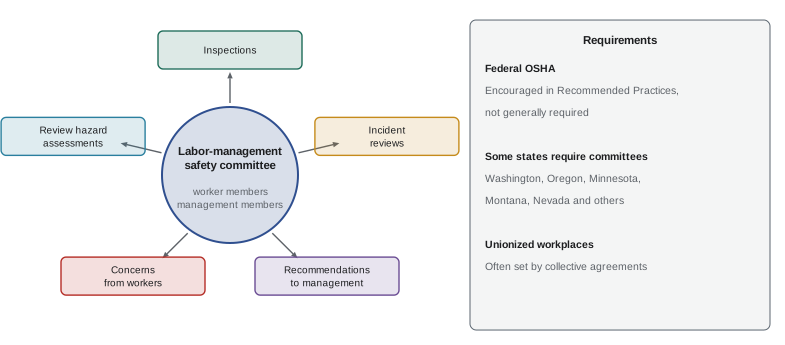
Federal OSHA does not require safety committees in general industry, although OSHA's Recommended Practices for Safety and Health Programs identify worker participation as a core element and encourage joint labor-management committees. Several states require safety committees for some employers. Washington requires safety committees or crew safety meetings for most employers; Oregon requires committees for employers with more than 10 employees and safety meetings for smaller employers; Minnesota, Montana, Nevada, Nebraska and others require committees for certain employers, often based on size or injury rates. Unionized workplaces commonly have joint committees under collective agreements. Where committees exist, they typically review hazards and incidents, take part in inspections, and make recommendations to management. The National Labor Relations Act also affects how committees can be structured in non-union workplaces, so employers usually seek advice when setting them up.
Ways workers can participate
Participation goes beyond committees. Workers can take part in hazard assessment by:
- Reporting hazards, near misses and concerns through simple, trusted channels (Lesson 4).
- Joining inspections and walk-throughs.
- Contributing to job hazard analyses and procedure writing for their own tasks (Lesson 5).
- Testing and evaluating controls and PPE before they are adopted.
- Taking part in specialized studies such as HAZOPs and design reviews (Lesson 9).
- Participating in incident investigations to identify causes and solutions.
- Leading toolbox talks and pre-job briefings.
- Completing field-level hazard assessments and stopping work when conditions are unsafe.
Meaningful participation requires time during working hours, information, training and a response: if workers raise concerns and nothing happens, participation will fade.
Communicating hazards and controls
Assessment results are useful only if the people affected know about them. Workers must be informed of the hazards of their work and the controls in place, and they must understand them. Effective communication uses several methods: orientation and job-specific training; written procedures and JHAs at the workplace; pre-job briefings and toolbox talks; signs, labels and visual cues; postings of inspection results and committee minutes; and one-on-one coaching by supervisors. Communication should be two-way, inviting questions, and checked for understanding, for example by asking workers to explain the hazards and controls in their own words or demonstrate a procedure.
| Method | Strengths | Watch out for |
|---|---|---|
| Toolbox talks | Frequent, specific, two-way | Becoming routine readings with no discussion |
| Written procedures and JHAs | Detailed, consistent reference | Too long, not at the workplace |
| Signs and labels | Reminders at the point of hazard | Ignored when overused or faded |
| Training | Builds knowledge and skill | Attendance without competence |
| Supervisor coaching | Personal, immediate | Depends on supervisor skill and time |
| Digital tools | Accessible on phones and tablets | Not everyone has access or skill |
Worked problem
Running an effective toolbox talk
A site supervisor has 10 minutes before a crew begins installing rooftop units with a crane lift. How can the talk communicate the hazard assessment effectively?
Show solution
- Start with the specific task and the critical hazards: suspended load, falls at the roof edge, pinch points during landing, wind.
- Explain the critical controls: the lift plan, the exclusion zone, tag lines, guardrails or fall arrest at the edge, wind speed limits and who can stop the lift.
- Ask the crew what has changed today and what concerns they have, and listen; adjust the plan if needed.
- Check understanding by asking a crew member to describe the exclusion zone and the stop-work signal.
- Record attendance and any changes to the plan.
Answer: Keep it specific, focus on critical controls, invite concerns, check understanding and record changes.
Psychological safety and speaking up
Participation depends on people feeling safe to speak up. Psychological safety, a term popularized by researcher Amy Edmondson, describes a shared belief that a team is safe for interpersonal risk-taking: that people will not be punished or humiliated for raising concerns, admitting mistakes or asking questions. In workplaces with low psychological safety, workers stay silent about hazards, near misses go unreported, and incidents repeat. Leaders build psychological safety by inviting input, responding constructively to bad news, thanking people for raising concerns, admitting their own mistakes, and following through. A just culture approach distinguishes honest errors, which call for learning and system improvement, from at-risk behaviors, which call for coaching, and reckless behavior, which may warrant discipline, so that people are treated fairly and the focus stays on fixing the system. Stop work authority, the clear right and expectation that anyone can stop work they believe is unsafe without reprisal, is a practical expression of these principles and complements the legal right to refuse dangerous work.
Contractors, temporary workers and diverse workforces
Hazard assessment must include everyone exposed, not only permanent employees. Contractors and temporary agency workers often face higher injury rates because they are new to the site, may not know its hazards, and may hesitate to raise concerns. Host employers and contractors should share hazard information, coordinate assessments, include contractors in briefings and committees where appropriate, and make sure temporary workers receive site-specific training. Communication should also reach workers who have limited English or French, low literacy, hearing or vision impairments, or different cultural expectations about speaking up, using plain language, translation, pictures, demonstrations and trusted co-workers. Young and new workers need particular attention, encouragement to ask questions and close supervision during their first months.
Committee inspections and recommendations
Where committees exist under state rules, their duties are usually spelled out. Washington requires safety committee meetings at set intervals, with minutes kept and posted, and requires committees to review safety inspections, accident investigations and the employer's accident prevention program. Oregon requires committees to meet regularly, to have equal numbers of employer and employee representatives in many cases, to inspect the workplace at set intervals, to make written recommendations and to receive timely written responses from management. Even where no rule applies, committees that meet regularly, review hazard reports and inspection findings, take part in investigations and track recommendations to completion can contribute greatly to hazard assessment. OSHA's Recommended Practices also call for employers to give workers access to information such as safety data sheets, injury logs, inspection results and hazard assessments.
Workers in the United States also have rights that support participation, including the right to report injuries and hazards without retaliation under section 11(c) of the OSH Act, the right to request an OSHA inspection, the right for a representative to accompany an OSHA inspector, and the right to see their own exposure and medical records.
Making committees effective
Committees are most effective when members are chosen by workers rather than appointed by management, receive good training in hazard recognition, assessment and investigation, have time during working hours to do their work, and are given the information they need. Effective committees set clear agendas, focus on the most serious hazards rather than minor housekeeping items, track their recommendations and the employer's responses, report back to the workforce, and evaluate their own performance. Signs of a struggling committee include meetings that are often canceled, minutes that repeat the same issues month after month, recommendations without responses, members who do not know their roles, and workers who do not know who their representatives are. Management members should be people with the authority to make decisions, so that the committee can resolve issues rather than merely list them.
The right to refuse
In both countries, workers have some form of right to refuse dangerous work. In Canada, the right is written into every jurisdiction's OHS law, with procedures for reporting, investigating and resolving refusals, often involving a committee member or representative. In the United States, the right is narrower and arises from OSHA regulations and case law: a worker may refuse when there is a reasonable belief of imminent danger of death or serious injury, there is not enough time to have the hazard corrected through normal channels, and the worker has asked the employer to fix it where possible. Hazard assessment and good communication should make refusals rare, because hazards are found and controlled before work starts, but every worker should know the right exists and how to use it.
Communication that reaches everyone
A message is not communicated until it is understood. Supervisors should check that workers who missed a toolbox talk because of shift schedules, leave or late arrival receive the information, and that night and weekend crews hear about changes as promptly as day staff. Visual communication, such as photographs of correct and incorrect setups, color coding of isolation points and short videos, helps workers with varied languages and reading levels. Peer-to-peer communication, where experienced workers explain hazards to new colleagues, is often more persuasive than formal training. Feedback channels should make it easy for workers to say when they do not understand, or when a control does not work as described.
Participation in small workplaces
Small workplaces may not be required to have a committee, but participation is just as important. In a business with a handful of workers, participation can be as simple as regular conversations about hazards, involving everyone in inspections and JHAs, posting a hazard report sheet, and discussing safety at staff meetings. Owners and managers in small businesses often work alongside their staff, which makes informal communication easier, but they should still record what hazards were discussed and what was done.
Measuring participation
Organizations can track participation with simple measures: the number of hazard reports submitted and the percentage closed with feedback to the reporter, attendance at committee meetings and toolbox talks, the proportion of JHAs and inspections that include front-line workers, the time taken to respond to committee recommendations, and results of periodic surveys asking workers whether they feel able to raise concerns and whether their concerns are acted on. Falling numbers of hazard reports are not necessarily good news; they may mean that workers have stopped reporting because nothing happens. Discussing these measures openly with workers and committees, and acting on what they reveal, shows that participation is valued.
Strong participation does not happen by accident. It grows when leaders ask for input, workers see their ideas adopted, and committees or worker teams are treated as partners rather than critics. In workplaces without any formal committee requirement, employers can still create worker safety teams, rotate front-line workers through inspection duties and hold regular open meetings where anyone can raise hazards, which together achieve many of the same benefits.
Common mistakes
MistakeWriting assessments without workers.
InsteadInvolve the people who do the work.
MistakeTreating committees as a formality.
InsteadGive committees information, time and responses.
MistakeReading procedures aloud as a toolbox talk.
InsteadMake talks specific, two-way and checked for understanding.
MistakePunishing people for reporting mistakes.
InsteadBuild psychological safety and a just culture.
MistakeLeaving contractors and temporary workers out.
InsteadInclude everyone exposed in assessment and communication.
Summary and key terms
- Workers know hazards that others miss and help design practical controls.
- Federal OSHA encourages committees; several states require them.
- Workers can participate in reporting, inspections, JHAs, investigations and briefings.
- Communication must be two-way and checked for understanding.
- Psychological safety allows people to speak up about hazards and mistakes.
- Stop work authority and a just culture support participation.
- Contractors, temporary and diverse workers must be included.
- Health and safety committee
- Group of worker and employer members that addresses health and safety.
- Health and safety representative
- Worker representative in smaller workplaces.
- Worker participation
- Involvement of workers in safety decisions.
- Toolbox talk
- Short safety discussion before work.
- Psychological safety
- Belief that it is safe to speak up.
- Just culture
- Fair approach distinguishing error, at-risk and reckless behavior.
- Stop work authority
- Right to stop unsafe work without reprisal.
- Host employer
- Employer at whose site contractors or temporary workers work.
- Two-way communication
- Communication that invites questions and feedback.
- Recommendation
- Committee advice to which the employer must respond.
Practice problems
Work each problem on paper first, then reveal the answer to check.
Give two reasons worker participation improves assessments.
Show answer
Finds hidden hazards and produces practical controls.
Name two states that require safety committees for some employers.
Show answer
Washington, Oregon, Minnesota, Montana, Nevada.
Does federal OSHA require safety committees in general industry?
Show answer
No, but it encourages them.
Name four ways workers participate.
Show answer
Reporting, inspections, JHAs, testing controls, investigations, briefings.
How can understanding be checked?
Show answer
Ask workers to explain or demonstrate.
What is a pitfall of toolbox talks?
Show answer
Becoming routine readings without discussion.
Who popularized the term psychological safety?
Show answer
Amy Edmondson.
What are the three behaviors in a just culture?
Show answer
Human error, at-risk behavior, reckless behavior.
What is stop work authority?
Show answer
The right to stop unsafe work without reprisal.
Why are temporary workers at higher risk?
Show answer
New to the site, unfamiliar with hazards, hesitant to speak up.
Lesson quiz · 5 questions
Score 60% or more to complete this lesson.
Create a free account to save your progress, take quizzes and earn a certificate.