
HSE-381 · Lesson 6 of 12 · 17 min
Thawing, cooking, cooling and reheating
▶ Video coming soon A video version of this lesson is on the way.
Between the walk-in and the plate, food goes through the steps where most temperature mistakes happen. Frozen food has to thaw without warming up on the outside while the center is still frozen. Raw food has to be cooked hot enough, for long enough, to kill the pathogens in it. Cooked food that will not be served right away has to cool quickly enough that spores cannot wake up and grow. And food that was cooked and cooled earlier has to be reheated fast and hot. Each step has limits, and the kitchen has to meet them on a Saturday night as well as on a quiet Tuesday.
Thawing
Frozen food thaws from the outside in. If a frozen turkey breast is left on the counter, its surface reaches room temperature and spends hours in the danger zone while the middle is still frozen solid. Bacteria on the surface, which survived freezing, start to grow long before the food is ready to cook. That is why thawing at room temperature is never allowed. There are four safe methods.
- In the cooler, at 41 °F or colder. This is the safest method but the slowest; a large roast or a case of chicken can take a day or two, so it needs planning. Thaw on a tray on the bottom shelf, below ready-to-eat food.
- Completely submerged under running water at 70 °F or colder, with enough flow to carry away loose particles. Under the Food Code, no part of the food may rise above 41 °F for more than four hours in total, counting the thawing time and any time it was out of temperature before.
- In a microwave, but only if the food will be cooked immediately afterwards, because microwaves thaw unevenly and leave warm spots.
- As part of cooking, such as frozen fries going straight into the fryer or frozen burger patties going straight onto the griddle, as long as the food reaches its full cooking temperature.
Vacuum-packed frozen fish needs extra care. Clostridium botulinum type E, which is found in fish, can grow and make toxin at cooler temperatures than most pathogens and grows without air. The 2022 Food Code keeps the rule that reduced oxygen packaged fish labeled to be kept frozen must be removed from the package before thawing in the cooler or immediately after thawing under running water.
Cooking
Cooking is the step that kills the pathogens that came in with raw food, and it is one of the few steps where a single number decides whether food is safe. The right number depends on the food: poultry, which often carries Salmonella and Campylobacter throughout, needs a higher temperature than a whole steak, whose inside is normally sterile and whose bacteria are on the surface. Ground meat is in between, because grinding spreads surface bacteria through the whole batch.
| Food | Minimum internal temperature and time |
|---|---|
| Poultry; stuffing; stuffed meat, fish or pasta | 165 °F for under 1 second |
| Ground beef, pork and other ground or mechanically tenderized meats; eggs for hot holding | 155 °F for 17 seconds |
| Steaks, chops, fish, shellfish, eggs cooked to order | 145 °F for 15 seconds |
| Whole roasts of beef, pork, veal and lamb | 145 °F for 4 minutes (or a lower temperature for a longer time) |
| Fruits, vegetables, grains and legumes for hot holding | 135 °F |
| Animal foods cooked in a microwave | 165 °F, then covered and left to stand for 2 minutes |
Juniper's line cooks probe every chicken dish, every burger and every egg dish that is held, and record a sample of readings on the cooking log at each service. Steaks and fish cooked to order are usually judged by experienced cooks by touch, but a probe settles any doubt. Color is not a reliable sign of doneness: ground beef can turn brown before it is safe, and poultry juices can run clear while the meat is still too cool.
Why time matters as well as temperature
Heat kills bacteria gradually, not all at once. At any given temperature, a fixed share of the bacteria die every second, and the hotter the food, the faster they die. That is why cooking standards sometimes pair a temperature with a time, and why a whole roast can be made safe at a lower temperature if it is held there long enough. Food scientists describe the goal as a log reduction: a 7-log reduction of Salmonella in poultry, for example, means that only one cell in ten million survives. The single numbers in the table are set high enough that the reduction happens almost instantly, which is why a cook only needs to see the probe reach the number.
Sous vide cooking, in which vacuum-sealed food is cooked for a long time in a precisely controlled water bath, uses the same principle to cook chicken safely at temperatures well below the usual standard. It is a legitimate technique, but it combines low cooking temperatures with packaging that removes air, which favors Clostridium botulinum, so restaurants need a written process with time and temperature tables, fast chilling and strict storage limits, approved by the health authority. Juniper does not cook sous vide; if it ever starts, the process will go into the food safety plan first, as Lesson 11 describes.
Partial cooking
Some kitchens partly cook foods in advance to save time during service: blanching fries, par-roasting chicken wings or searing burger patties to finish later. Partial cooking is risky because it warms the food into the danger zone without killing everything in it. It is allowed only under a written procedure: the initial heating lasts no longer than an hour, the food is cooled immediately using the two-stage limits, it is stored cold and labeled as partly cooked, and it is cooked to its full temperature before it is served. Juniper's wings are fully cooked, cooled and then reheated and crisped to order, which is simpler to control.
Undercooked foods on the menu
Many guests want a rare steak, a soft-poached egg or a tuna tartare, and restaurants can serve them with care. The Food Code allows raw or undercooked animal foods to be served when the guest orders them that way or when they are on the menu, as long as the restaurant gives a consumer advisory: a disclosure that identifies the dishes, often with an asterisk, and a reminder that eating raw or undercooked meats, poultry, seafood, shellfish or eggs may increase the risk of foodborne illness. Raw fish must be frozen for parasites, as Lesson 3 described, and undercooked foods are not served to highly susceptible populations. Juniper's menu carries the advisory under every page that lists raw or undercooked items.
Cooling
Cooling is where many of the worst restaurant outbreaks begin. A big pot of chili, stock or braised beans is cooked properly and then left to cool on the range or in a deep container in the walk-in. The outside cools; the center stays warm for many hours. Clostridium perfringens and Bacillus cereus spores, which survived the cooking, germinate and multiply, and by morning the batch can make dozens of people sick. Because large masses of food cool very slowly on their own, the rules set strict limits on how fast cooling must happen.
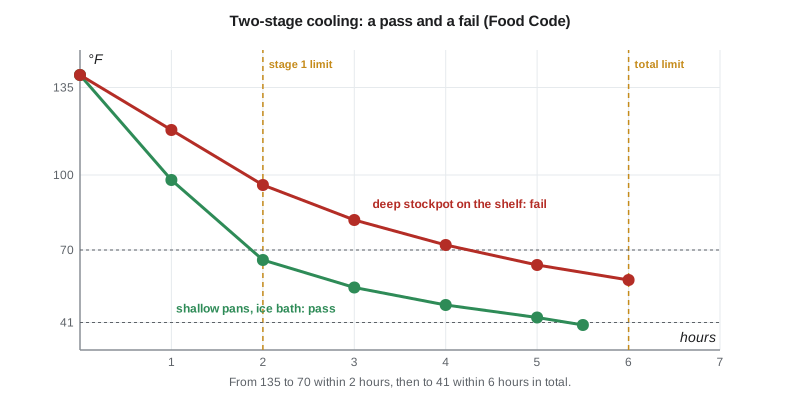
The Food Code uses two-stage cooling: cooked TCS food must cool from 135 °F to 70 °F within 2 hours, and from 135 °F to 41 °F within a total of 6 hours. The first stage is shorter because bacteria grow fastest between about 70 °F and 125 °F. If the food has not reached 70 °F within 2 hours, it must be reheated to 165 °F and the cooling started again, or thrown out; if it does not reach 41 °F within the 6 hours, it is thrown out. Food made from ingredients at room temperature, such as canned tuna salad, must cool to 41 °F within 4 hours.
Cooling methods that work
- Divide it. Pour soups, sauces and stews into shallow pans no more than about 2 inches deep, and cut large roasts into pieces no bigger than about 6 pounds.
- Use an ice bath. Set the pot or pans in a sink of ice and water, and stir often so the warm center moves to the cold edge.
- Use ice paddles. Plastic paddles filled with water and frozen can be stirred through a pot of stock to pull heat out from the inside.
- Add ice as an ingredient. For a soup or sauce made with water, cook it with less water and add the rest as clean ice at the end.
- Use a blast chiller. Juniper bought one in its second year, after the rehearsal dinner, and it cools a full pan of braised short rib to below 41 °F in about 90 minutes.
- Leave it uncovered at first. Food that is still cooling goes on the top shelf of the walk-in, loosely covered or uncovered, with space around it, and is covered once it is cold.
Cooling is a critical control point in Juniper's food safety plan, so every batch of soup, stock, sauce, braised meat, beans and cooked grains is logged: the time it came off the heat and its temperature, then readings at about one, two and later hours until it is cold. The program below checks three entries from the cooling log against the two-stage limits.
# Check invented cooling logs against two-stage limits (Food Code): 135 -> 70 F in 2 h, -> 41 F by 6 h.
logs = {
    "chicken stock (shallow pans, ice bath)": [(0, 140), (1, 100), (2, 66), (4, 45), (5.5, 40)],
    "short rib (blast chiller)":              [(0, 150), (1, 76), (1.5, 38)],
    "black beans (deep pot, walk-in)":        [(0, 142), (1, 120), (2, 97), (4, 72), (6, 56)],
}

def temp_at(log, hour):
    """Latest reading taken at or before the given hour."""
    readings = [t for h, t in log if h <= hour]
    return readings[-1] if readings else None

for name, log in logs.items():
    stage1 = temp_at(log, 2)
    final = temp_at(log, 6)
    problems = []
    if stage1 is None or stage1 > 70:
        problems.append(f"stage 1 failed ({stage1} F at 2 h): reheat to 165 F and restart, or discard")
    if final is None or final > 41:
        problems.append(f"not at 41 F by 6 h ({final} F): discard")
    print(name)
print(" " + ("PASS" if not problems else " / ".join(problems)))chicken stock (shallow pans, ice bath) PASS short rib (blast chiller) PASS black beans (deep pot, walk-in) stage 1 failed (97 F at 2 h): reheat to 165 F and restart, or discard / not at 41 F by 6 h (56 F): discard
The stock in shallow pans and the short rib in the blast chiller both pass. The black beans, cooled in a deep pot in the walk-in, fail the first stage, and because nobody acted at the two-hour check, they also fail the second. At the two-hour mark, the cook could have reheated them and restarted the cooling in shallow pans; by the six-hour mark, the only safe choice is to throw them out. That is the value of the log: it turns a hidden problem into a clear decision while there is still time to make it.
Reheating
Food that was cooked and cooled properly and is being reheated to be held hot must be reheated quickly: to an internal temperature of 165 °F for 15 seconds, within 2 hours. Commercially processed, ready-to-eat foods from an intact package, such as a canned soup, need to reach 135 °F for hot holding. Food reheated for immediate service to a single guest, such as a leftover roast beef sandwich, can be served at any temperature as long as it was cooked and cooled properly. Reheating slowly in a steam table or a warming cabinet is not allowed for hot holding, because the food would spend too long in the danger zone. Juniper reheats on the range, in the combi oven or in the microwave, probes the food, and only then moves it to the hot holding unit.
For supervisors: planning for safe batches
- Make batches no larger than you can cool. A 40-liter stockpot of chili is easy to cook and very hard to cool; two 20-liter batches made at different times, or one batch split into shallow pans, are much safer.
- Schedule cooling for when people are around. A batch that comes off the heat at 9:30 p.m. needs someone to check it at 11:30 p.m. and later. If nobody will be there, cook it earlier or use the blast chiller.
- Thaw by plan, not by panic. A thawing schedule on the walk-in door, filled in when the next day's prep list is written, keeps cooks from reaching for the counter or a hot water tap.
- Probe and log, then train with the log. The cooling and cooking logs show which batches cause trouble and which cooks need help.
Summary and key terms
- Thaw in the cooler, under cold running water, in a microwave just before cooking, or as part of cooking, and never at room temperature.
- Cook to the Food Code's minimum temperatures, such as 165 °F for poultry, 155 °F for ground meat and 145 °F for steaks and fish, checked with a probe.
- Cool cooked food from 135 °F to 70 °F within 2 hours and to 41 °F within 6 hours in total, using shallow pans, ice baths, ice paddles or a blast chiller.
- Reheat food for hot holding to 165 °F for 15 seconds within 2 hours.
- Logs of cooking and cooling turn hidden problems into clear decisions while there is still time to act.
- Two-stage cooling
- Cooling cooked food from 135 °F to 70 °F within 2 hours and to 41 °F within 6 hours in total.
- Ice paddle
- A sealed plastic paddle filled with water and frozen, stirred through hot liquids to cool them from the inside.
- Blast chiller
- A refrigeration unit that blows very cold air over food to cool it much faster than a normal cooler.
- Consumer advisory
- A notice on the menu identifying raw or undercooked animal foods and reminding guests of the higher risk.
- Reheating for hot holding
- Bringing cooked and cooled food back up to a safe temperature quickly before keeping it hot for service.
Common mistakes
MistakePutting a hot pot of stock straight into the walk-in is the fastest way to cool it.
InsteadA deep pot cools far too slowly and warms everything around it; divide it into shallow pans and use an ice bath first.
MistakeBrown ground beef and clear chicken juices mean the meat is cooked.
InsteadColor is not a reliable sign; only a probe thermometer in the thickest part shows whether food is safe.
MistakeA frozen chicken can thaw on the counter overnight if the kitchen is cool.
InsteadThe surface spends hours in the danger zone while the center thaws; thaw in the cooler or under cold running water.
Practice problems
Work each problem on paper first, then reveal the answer to check.
A soup came off the heat at 135 °F at 2:00 p.m. and read 78 °F at 4:00 p.m. What should the cook do?
Show answer
It failed the first stage; reheat it to 165 °F and restart the cooling in shallow pans with an ice bath, or discard it.
Why do ground meats need a higher cooking temperature than whole steaks?
Show answer
Grinding spreads surface bacteria all through the meat, while the inside of an intact steak is normally free of bacteria.
Give two ways to make a large batch of chili cool faster.
Show answer
Any two of: divide it into shallow pans, use an ice bath and stir, use ice paddles, use a blast chiller, make smaller batches.
Lesson quiz · 5 questions
Score 60% or more to complete this lesson.
Create a free account to save your progress, take quizzes and earn a certificate.