
HSE-381 · Lesson 7 of 12 · 20 min
Preventing cross-contamination
▶ Video coming soon A video version of this lesson is on the way.
Cooking kills the pathogens in raw chicken. It does nothing for the salad that was cut on the same board ten minutes later. Cross-contamination is the transfer of harmful microorganisms, or of allergens, from one food or surface to another, and it is the reason a kitchen can cook every item to the right temperature and still make people sick. Outbreak investigations in Canada and the United States regularly trace illness back to a ready-to-eat food that picked up bacteria from raw meat, from a worker's hands or from equipment that was not cleaned between jobs.
This lesson follows the routes that germs take through a kitchen and the barriers that block each one. It uses Juniper Street Kitchen and Bar, the restaurant from the earlier lessons, where raw chicken thighs, ground beef, halibut, oysters and a lot of fresh produce all pass through one kitchen of 1,600 ft² (about 150 m²) every day.
What cross-contamination is
Food safety courses usually describe three kinds of transfer. In food-to-food transfer, juices or particles from one food reach another, as when raw chicken drips onto lettuce in the cooler. In surface-to-food transfer, a cutting board, knife, slicer, cloth or counter that touched raw food passes bacteria to the next food it touches. In person-to-food transfer, hands, gloves, clothing or a worker who is ill carry germs from raw food, the washroom, the garbage or the worker's own body to the plate.
The danger is highest for ready-to-eat food: food that will not be cooked again before it is eaten. At Juniper that includes salads, sliced fruit, garnishes, cooked chicken for the club sandwich, sliced bread, desserts, cut lemons for the bar, and the oyster platter. Once one of these foods picks up Salmonella or E. coli, nothing later in the process will remove it.
Allergen cross-contact works the same way. A spoon used for the peanut sauce and then for the noodles, or fries cooked in oil that was used for battered fish, can carry enough protein to cause a severe reaction. Lesson 10 covers allergens in detail; the barriers in this lesson protect against both germs and allergens.
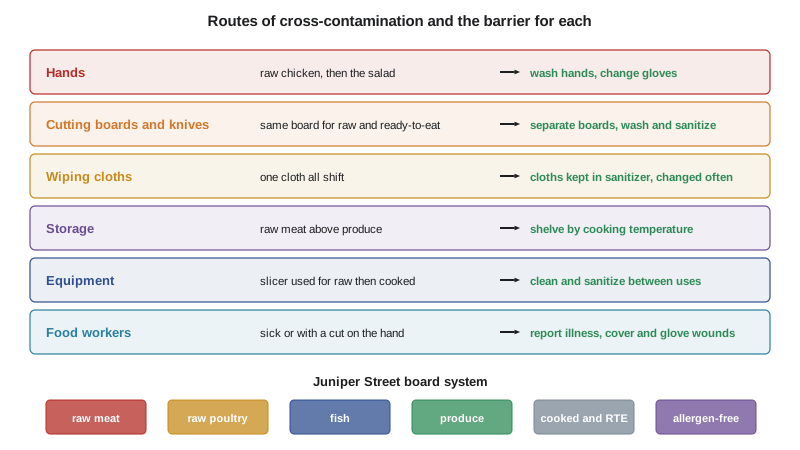
Route 1: hands
Hands are the most common route. A prep cook breaks down a case of chicken thighs, wipes a hand on an apron and reaches for the parsley. A line cook handles raw burger patties on the grill and then picks up the bun. A server clears a table, carries the bus tub to the dish pit and then picks up lemon wedges for the bar. In each case the hands look clean and feel clean.
The barriers are handwashing at the right times and keeping bare hands off ready-to-eat food. Lesson 8 covers handwashing in full. For cross-contamination the key moments are after handling raw meat, poultry, fish or eggs, after touching garbage, dirty dishes or cleaning chemicals, and before starting any task with ready-to-eat food. Changing tasks means washing hands, even when the cook is wearing gloves.
Gloves are a tool, not a cure. A glove that touched raw chicken carries exactly as many bacteria as a bare hand that touched raw chicken. Single-use gloves are changed when they tear, when they become soiled, when the worker changes tasks, and after handling raw animal foods. Hands are washed before putting on a fresh pair. The Food Code goes further than most Canadian rules: food employees may not touch ready-to-eat food with bare hands, and must use suitable utensils such as deli tissue, spatulas, tongs or single-use gloves, unless the regulatory authority has approved a written alternative plan.
Route 2: cutting boards, knives and utensils
A cutting board used for raw meat picks up a film of juice and fat that soaks into knife scores. Rinsing it under the tap or wiping it with a cloth does not remove the bacteria. Neither does scraping it with the back of a knife. The board has to be washed with detergent, rinsed, sanitized and air-dried before it touches ready-to-eat food. The same applies to knives, tongs, spoons, whisks, food processor bowls, thermometer probes and the inside of mixing bowls.
Most commercial kitchens use color-coded cutting boards and knife handles so that boards are not mixed up during a busy shift. There is no single required color scheme in the Food Code, but the most common one is red for raw meat, yellow for raw poultry, blue for raw fish, green for produce, white for dairy and bread, and tan or brown for cooked meat. Some kitchens add purple for allergen-free orders. What matters is that everyone in the kitchen uses the same scheme, that it is posted, and that worn or deeply scored boards are replaced, because the Food Code requires cutting surfaces that are scratched or scored to be resurfaced or discarded when they can no longer be effectively cleaned and sanitized.
| Board at Juniper Street | Used for | Where it lives |
|---|---|---|
| Red | Raw beef, pork and lamb; burger patties | Raw station, lower rack |
| Yellow | Raw chicken thighs, wings and duck | Raw station, lower rack |
| Blue | Raw halibut, salmon and shellfish | Raw station, separate slot |
| Green | Fruit, vegetables, herbs and salad greens | Cold station and prep table |
| White | Bread, cheese and desserts | Pastry corner |
| Tan | Cooked meats for sandwiches and salads | Cold station |
| Purple | Allergy orders only | Sealed bin beside the expo window |
Boards are only part of the answer. Juniper also separates the work in space and time. Raw meat is prepared at the raw station near the walk-in, which has its own hand sink, and never at the cold station where salads are built. When the same table has to be used for both, the work is done in order: ready-to-eat items first, then fish, then whole cuts of meat, then ground meat, and poultry last, with the table washed, rinsed and sanitized at the end. That order follows the cooking temperatures from Lesson 6: each food on the list is cooked to a higher temperature than the one before it, so if a little contamination does pass forward, the next food will be cooked enough to kill it.
The program below plans Luis's morning prep list in that order and adds a clean-and-sanitize step whenever the work moves from raw to ready-to-eat food or from one raw category to another. The ranks are kitchen categories rather than temperatures, so the same program works for both countries.
# Order a prep list so the riskiest raw foods are handled last,
# and insert a clean-and-sanitize step between categories.
RANK = {"ready-to-eat": 0, "fish": 1, "whole cut": 2, "ground meat": 3, "poultry": 4}

tasks = [
    ("trim chicken thighs", "poultry"),
    ("cut lemons and limes for the bar", "ready-to-eat"),
    ("portion halibut", "fish"),
    ("form burger patties", "ground meat"),
    ("wash and spin salad greens", "ready-to-eat"),
    ("cut pork shoulder for braise", "whole cut"),
    ("slice tomatoes for burgers", "ready-to-eat"),
]

plan = sorted(tasks, key=lambda t: (RANK[t[1]], t[0]))
step = 1
last = None
for name, kind in plan:
    if last is not None and kind != last:
        print(f"{step:2d}. clean, rinse and sanitize table, board and knife")
        step += 1
    print(f"{step:2d}. {name} [{kind}]")
    step += 1
    last = kind
print(f"{step:2d}. clean, rinse and sanitize table, board and knife")1. cut lemons and limes for the bar [ready-to-eat] 2. slice tomatoes for burgers [ready-to-eat] 3. wash and spin salad greens [ready-to-eat] 4. clean, rinse and sanitize table, board and knife 5. portion halibut [fish] 6. clean, rinse and sanitize table, board and knife 7. cut pork shoulder for braise [whole cut] 8. clean, rinse and sanitize table, board and knife 9. form burger patties [ground meat] 10. clean, rinse and sanitize table, board and knife 11. trim chicken thighs [poultry] 12. clean, rinse and sanitize table, board and knife
The output shows seven food tasks and five sanitizing steps. Luis does not have to remember the order every morning; it is printed at the top of the prep sheet, and the sanitizing steps are part of the job rather than an extra.
Route 3: wiping cloths and sponges
A wet cloth that is used all shift to wipe counters, boards and hands becomes one of the dirtiest objects in the kitchen. Bacteria grow in the damp fabric and are spread to every surface it touches. Sponges are worse, because they hold food particles deep inside and cannot be properly sanitized; most health authorities discourage or forbid them on food-contact surfaces.
Juniper follows the Food Code's rules for wiping cloths. Wet cloths used for counters and other food-contact surfaces are held between uses in a chemical sanitizer solution at the concentration on the label, and the solution is changed when it gets dirty and often enough to keep it at strength. Cloths used with raw animal foods are kept separate from cloths used for other purposes. Dry cloths are used only for wiping spills or handling hot items and are kept clean and dry. Single-use paper towels are used for spills of raw meat juice.
Sanitizer buckets lose strength over time. Food debris, grease and the cloths themselves use up the active chemical, and chlorine also breaks down in light and heat. A bucket that tested at the right strength at 9 a.m. may be close to plain water by the middle of lunch. That is why Juniper's buckets carry a small label with the time they were made up, and why the cold-station cook tests them with a strip at each change.
# Review the sanitizer bucket log: change on schedule, keep strength in range.
QUAT_MIN, QUAT_MAX = 200, 400   # ppm, from the product label used at Juniper

def minutes(hhmm):
    h, m = hhmm.split(":")
    return int(h) * 60 + int(m)

log = [
    # (station, time made up, time tested, strength in ppm)
    ("cold station", "09:00", "12:40", 200),
    ("raw station",  "09:00", "13:30", 150),
    ("line",         "11:15", "14:05", 200),
    ("bar",          "10:30", "16:00", 200),
]

HOUSE_LIMIT = 240   # minutes; Juniper's house rule, stricter than the Food Code
for station, made, tested, ppm in log:
    age = minutes(tested) - minutes(made)
    problems = []
    if age > HOUSE_LIMIT:
        problems.append(f"bucket is {age // 60} h {age % 60} min old")
    if ppm < QUAT_MIN:
        problems.append(f"only {ppm} ppm")
    if ppm > QUAT_MAX:
        problems.append(f"{ppm} ppm is above the label range")
    status = "OK" if not problems else "REMAKE: " + "; ".join(problems)
print(f"{station:13s} {status}")cold station OK raw station REMAKE: bucket is 4 h 30 min old; only 150 ppm line OK bar REMAKE: bucket is 5 h 30 min old
Two buckets fail. The raw-station bucket has dropped below the label strength, probably because raw meat juices used up the quat, and the bar bucket is five and a half hours old. Both are remade, and the times go on the log so that the kitchen manager can see whether the problem is a one-off or a pattern.
Route 4: storage
Lesson 5 set out the storage order for the walk-in cooler: ready-to-eat food on top, then whole fish, whole cuts of meat, ground meat, and poultry on the bottom. The rule exists because of drips. A tray of raw chicken thighs on the top shelf can drip onto everything below it, and the people who build salads the next day have no way of knowing.
Cross-contamination in storage also comes from open containers, from boxes stacked on top of uncovered food, from raw shell eggs placed above produce, and from cardboard delivery cases that have sat on a truck floor. Juniper's storage rules add three details to the shelf order: everything is covered or wrapped, raw meat and poultry sit on drip trays or in lidded tubs, and cardboard cases are broken down and the food moved into clean containers before they go into the walk-in, because the boxes can carry dirt and pests.
Route 5: equipment
Some equipment is used for both raw and ready-to-eat food, and it is especially hard to clean. At Juniper the riskiest items are the meat slicer, which is used for house-roasted turkey and ham for sandwiches, the food processor, the immersion blender, the vacuum sealer and the ice machine. A slicer that is not taken apart and cleaned can hold meat residue in the blade guard, the carriage and the gaps around the knife for days. Listeria monocytogenes, which can grow at refrigerator temperatures, has caused deadly outbreaks traced to deli slicers.
The Food Code requires food-contact surfaces of equipment to be cleaned between uses with different raw animal foods, when moving from raw to ready-to-eat food, whenever contamination may have occurred, and at least every four hours when the equipment is in constant use with time and temperature control for safety foods. The slicer is cleaned according to the manufacturer's instructions with the power off and unplugged, using cut-resistant gloves; at Juniper only trained adult staff take it apart, as HSE-380 explained.
Ice deserves its own mention. Ice is a food. It is scooped with a scoop that is stored in a holder outside the ice, never with a glass, which can chip, and never with hands. The ice machine is cleaned on the manufacturer's schedule, and the ice used to chill bottles or seafood displays is never later used in drinks.
Route 6: the people
The last route is the people themselves. A cook with a cut on a finger, a server with a runny nose, or a dishwasher who had diarrhea the night before can pass bacteria and viruses to food even with perfect cleaning. Norovirus, the most common cause of foodborne illness in both countries, is spread mostly by infected food workers. Lesson 8 covers the rules on illness and wounds. For this lesson the point is that every barrier in the kitchen depends on people who are well and who follow the routines even when they are behind.
Clothing and personal items matter too. Aprons that were worn at the raw station are changed before working at the cold station. Phones, which are touched constantly and rarely cleaned, stay off the prep tables. Staff food and drinks are kept in a separate area so that a half-eaten sandwich does not end up beside the salad bins.
Cross-contamination at Juniper: a Saturday walk
Aisha Rahman, the sous chef and safety lead, walks the kitchen every Saturday just before dinner service. In one walk this spring she found five problems, all of them ordinary.
- A tray of raw wings had been put on the top shelf of the line reach-in because the bottom shelf was full of sauces.
- Ben had used the tongs from the grill, which had touched raw patties, to move cooked fries.
- The cold station's sanitizer bucket had no cloth in it; the cloth was lying on the counter, half dry.
- A case of romaine was sitting on the floor of the walk-in beside the drain.
- A new server was cutting lemons on the bar's cutting board after using it for limes that had been dropped on the floor and rinsed.
None of these took more than a few minutes to fix. The wings went to the bottom shelf and the sauces were moved; the fries that touched the tongs were thrown out and Ben was given a second set of tongs for cooked food; the cloth went back into the bucket; the romaine went onto a shelf; and the dropped limes were thrown out, with a quick talk about why rinsing does not make floor food safe. What Aisha did afterwards mattered more. She asked why each one happened. The reach-in was too small for the sauces, so a second sauce rail was added. The line had only one set of tongs per cook, so the kitchen bought more and marked the cooked-food tongs with a band of tape. Fixing the system means the same problem does not come back next Saturday.
Summary and key terms
- Cross-contamination moves germs or allergens from raw food, surfaces, equipment or people onto food that will not be cooked again.
- Wash hands when changing tasks and after handling raw food, and use gloves or utensils for ready-to-eat food; gloves are changed as often as hands are washed.
- Use separate, color-coded boards and utensils, and wash, rinse and sanitize them between raw and ready-to-eat use.
- Keep wiping cloths in sanitizer at the right strength, change the solution on schedule, and keep raw-meat cloths separate.
- Store ready-to-eat food above raw food, with poultry on the bottom, and clean slicers and other equipment between uses and on a fixed schedule.
- Cross-contamination
- The transfer of harmful microorganisms from one food, surface, piece of equipment or person to another food.
- Cross-contact
- The transfer of an allergen from one food or surface to a food that is not supposed to contain it.
- Ready-to-eat food
- Food that will be eaten without further cooking or washing, such as salads, cooked meats, bread and desserts.
- Color-coded equipment
- Cutting boards, knife handles and containers in different colors so that raw and ready-to-eat tasks are kept apart.
- Wiping cloth bucket
- A container of sanitizer at a tested strength in which wet cloths are kept between uses.
Common mistakes
MistakeRinsing a cutting board under the tap is enough between raw chicken and salad.
InsteadRinsing leaves bacteria in the scores; the board must be washed, rinsed, sanitized and air-dried, or replaced with a clean one.
MistakeGloves protect the food, so a cook can keep the same pair on all morning.
InsteadGloves pick up germs like hands do; change them when changing tasks, after raw food, and when they tear or get dirty.
MistakeA sanitizer bucket made up in the morning will still work at the end of the day.
InsteadSanitizer loses strength as it is used; test it with strips and remake it on schedule or when it is dirty.
Practice problems
Work each problem on paper first, then reveal the answer to check.
A cook needs to cut onions for a salsa and chicken breasts for a stir-fry on the same table. In what order, and what happens in between?
Show answer
Onions first, because the salsa is ready-to-eat; then the table, board and knife are washed, rinsed and sanitized before the chicken, and again afterwards.
Why is poultry stored on the bottom shelf of the walk-in cooler?
Show answer
Poultry is cooked to the highest temperature and is most likely to carry Salmonella; on the bottom its drips cannot reach other foods.
The bar uses the same scoop for ice in drinks and for ice in the oyster display. What is wrong?
Show answer
Ice in the seafood display can pick up bacteria from the raw shellfish; the scoop and the ice for drinks must be kept separate, with the scoop stored outside the ice.
Lesson quiz · 5 questions
Score 60% or more to complete this lesson.
Create a free account to save your progress, take quizzes and earn a certificate.