
HSE-390 · Lesson 4 of 12 · 23 min
Slips, trips and falls in clinical areas
▶ Video coming soon A video version of this lesson is on the way.
Slips, trips and falls are one of the three biggest causes of injury in healthcare, alongside patient handling and violence. At Northbridge they produced 39 reports and 6 lost-time injuries last year. They rarely look serious when they happen. A housekeeper slips on a patch of gel, a transporter catches his foot on a bed cord, a nurse misses the last step on a stairwell during a code. But a fall onto a hard hospital floor can break a wrist, a hip or a kneecap, and an injury that looks minor on the day can keep someone off work for months.
In hospitals, slips, trips and falls have long been one of the leading causes of injuries that lead to days away from work, and NIOSH has published guidance specifically for healthcare floors. HSE-106 Slips, Trips, Falls and Housekeeping covers the general principles. This lesson looks at what is different in clinical areas: fluids, cords, crowded rooms, night lighting, rushing, and the homes that home health staff walk into.
Why clinical floors are slippery
Hospital floors are usually smooth, hard and easy to clean, because they have to be. The same qualities make them slippery as soon as anything lands on them, and in a hospital something is always landing on them.
- Fluids from patients: urine, vomit, blood, wound drainage. These are slip hazards and biological hazards at the same time.
- Water: from hand washing, bathing, ice machines, leaking sinks, wet umbrellas and boots at entrances, and floor cleaning.
- Hand sanitizer and lotion: alcohol-based gel dripping from wall dispensers is one of the most common causes of slips in corridors. It is clear, so it is hard to see.
- IV fluids, tube feeds and medications spilled during care.
- Food and drink near patient rooms, in cafeterias and in staff lounges.
- Floor finish: some floor polishes are slippery when freshly applied or when they build up.
- Powder: glove powder and talc, now much less common than they once were.
Trips come from a different set of hazards: bed and equipment cords, oxygen tubing, IV lines, the wheels of beds, poles and lifts, uneven thresholds between floor types, damaged tiles, mats with curled edges, and equipment parked in corridors because there is nowhere else to put it.
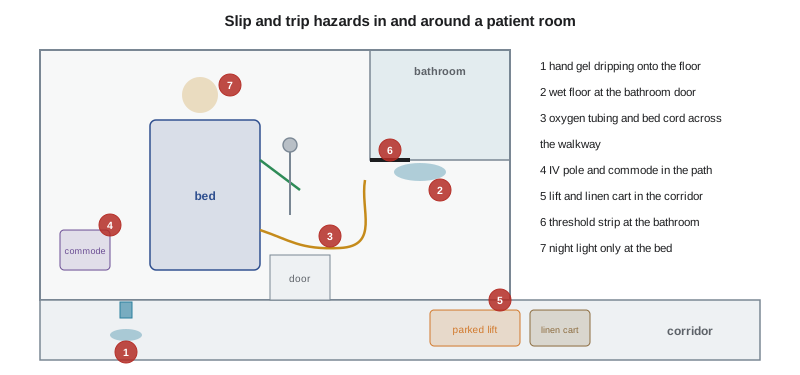
The patient room
A single patient room is one of the most crowded workspaces in any industry. Around the bed there may be an IV pole, a pump, a monitor, oxygen, a suction unit, a lift, a commode, a chair, a meal tray table, a visitor and two or three staff, all within a few square meters. Most of the equipment has a cord or a tube. The bathroom floor is wet after every shower. And much of the work happens at night, with the room lights dimmed so the patient can sleep.
Amira's habits in patient rooms are simple and fast:
- Route cords and tubing along the bed or the wall, never across the walkway between the bed and the door. Use the cord management clips on the bed and the pump.
- Keep a clear path from the bed to the door and from the bed to the bathroom. Move the commode, the chair and the tray table back after use.
- Turn on enough light to see the floor before moving around the room at night. A small flashlight or the bed's floor light is better than working in the dark.
- Look at the floor before you move, especially beside the bed and at the bathroom door.
- Clean up or report a spill as soon as you see it, even if it is not yours.
Who cleans up a spill
Every hospital needs a clear answer to the question of who cleans up a spill, because spills that belong to nobody stay on the floor. At Northbridge the rule is:
- The person who finds a spill owns it until it is safe. Stand by it or put a wet floor sign over it, and do not walk away.
- Small spills of water or other non-hazardous liquids can be wiped up by anyone, using the paper towels or spill pads on the unit.
- Spills of blood or body fluids are cleaned by trained staff using gloves, the unit's spill kit and an EPA-registered disinfectant, following standard precautions and the hospital's exposure control plan. On 4 West that is usually the nurse or certified nursing assistant caring for the patient, or environmental services if the spill is large. HSE-392 covers body fluid spills in detail.
- Chemical spills follow the spill procedure for that product, described in Lesson 6.
- Anything large, or anything you are not trained to clean, is called in to environmental services by phone, and you stay with it until they arrive.
Cleaning floors without creating hazards
Environmental services staff clean floors many times a day, and wet cleaning is itself a cause of slips. Marta's department works to a few rules. Corridors are mopped one half at a time so there is always a dry path. Wet floor signs go out before the floor is wet and come in only when it is dry, because a sign left out all day teaches people to ignore signs. Flat mops with reusable cloth pads use much less water than string mops, and the floor dries faster. Floors are cleaned in patient rooms when the patient is in bed or out of the room, not while they are walking to the bathroom. And floor finish is applied at night in areas that can be closed off, with the area kept closed until it has cured.
Entrances are a special problem, especially in winter in Northbridge, Minnesota. Snow and slush come in on boots, wheels and stretchers, and the first few meters inside the door become a skating rink. Northbridge uses long entrance mats, which need to be long enough for several steps on each foot to dry the sole, more mats laid out in bad weather, and extra mopping during the morning rush at the main and emergency entrances.
Footwear
Most hospitals have a footwear rule for clinical staff, and Northbridge's is typical: closed toes and heels, slip-resistant soles, and no fabric uppers in areas where fluids or sharps could fall on the foot. Open-backed clogs are not allowed on the units, because they come off when staff move fast. Environmental services, laundry and kitchen staff are given slip-resistant shoes or a yearly allowance to buy them. Slip-resistant soles wear out, and a pair that has done a year of 12-hour shifts on hospital floors may no longer grip.
Rushing
Healthcare is one of the few workplaces where rushing is built into the job. Call bells, alarms, codes and emergencies demand a fast response, and the fastest route is often the one with the hazard on it. Amira's unit has a simple rule for codes: move fast, but walk, and take the stairs one at a time with a hand on the rail. A nurse who falls on the way to a code does not help the patient, and now there are two people who need help.
Falls from height
Most falls in healthcare happen on the level, but some happen from height. Staff stand on chairs, beds or bins to reach a privacy curtain, a high shelf in a supply room, a light or a television bracket. Every unit should have a step stool with a handrail for these jobs, and anything higher than that is a job for maintenance with a proper ladder. HSE-213 Ladder and Scaffold Safety covers ladders.
When the patient falls
A related hazard is the patient who falls. Many workers have been seriously hurt trying to catch a falling patient or lift one off the floor. The rule at Northbridge is clear: do not try to catch a falling patient. If you are close enough and the patient is already on their way down, you can guide them to the floor while keeping your own back straight, but never take their weight. Once the patient is down, make them comfortable, call for help and use a lift to get them up. HSE-391 covers controlled lowering and lifting from the floor.
Home health: other people's floors
Nadia and her colleagues at Northbridge Home Health walk into homes the hospital does not control. In winter, the most dangerous part of a visit can be the walk from the car to the door. Inside, the hazards include loose rugs, clutter, pets, steep or unlit stairs, wet bathroom floors and poor lighting. The team carries ice cleats in winter, a small flashlight all year, and uses the client's first-visit safety check to record any home hazards and how to deal with them. Where a hazard cannot be fixed, such as an unlit, icy path at a rural farmhouse, the visit can be rescheduled or the client asked to have the path cleared before staff will come.
For supervisors: corridor clutter
Equipment parked in corridors is a trip hazard and, in a fire, a barrier to evacuating patients. It is also a sign that the unit does not have enough storage. Telling staff to keep corridors clear rarely works for long if there is nowhere else to put the lift, the linen cart and the isolation cart. Walk your corridors at the busiest time of day, count what is parked there, and treat it as a storage problem to be solved, not a discipline problem.
Looking at the pattern
Joanne looked at all 39 slip, trip and fall reports from last year to see where and when they happened.
# Northbridge slip, trip and fall reports last year: (area, cause, shift)
reports = (
    [("corridor", "hand gel", "day")] * 6 + [("corridor", "hand gel", "night")] * 2 +
    [("entrance", "snow and water", "day")] * 7 + [("entrance", "snow and water", "evening")] * 2 +
    [("patient room", "fluids", "night")] * 4 + [("patient room", "fluids", "day")] * 2 +
    [("patient room", "cords and tubing", "night")] * 3 + [("patient room", "cords and tubing", "day")] * 1 +
    [("bathroom", "wet floor", "day")] * 3 +
    [("stairs", "rushing", "day")] * 2 + [("stairs", "rushing", "night")] * 1 +
    [("kitchen", "grease and water", "day")] * 3 +
    [("home care", "ice outside", "day")] * 3
)
print("total reports:", len(reports))

def tally(index):
    t = {}
    for r in reports:
        t[r[index]] = t.get(r[index], 0) + 1
    return sorted(t.items(), key=lambda kv: -kv[1])

for name, index in (("by area", 0), ("by cause", 1), ("by shift", 2)):
    print(name)
    for k, v in tally(index):
        print(f"  {k:18} {v:2}  " + "#" * v)

night_room = sum(1 for a, c, s in reports if a == "patient room" and s == "night")
print("\npatient room falls at night:", night_room, "of", sum(1 for r in reports if r[0] == "patient room"))total reports: 39 by area patient room 10 ########## entrance 9 ######### corridor 8 ######## bathroom 3 ### stairs 3 ### kitchen 3 ### home care 3 ### by cause snow and water 9 ######### hand gel 8 ######## fluids 6 ###### cords and tubing 4 #### wet floor 3 ### rushing 3 ### grease and water 3 ### ice outside 3 ### by shift day 27 ########################### night 10 ########## evening 2 ## patient room falls at night: 7 of 10
Three patterns stand out. Entrances in winter and hand gel in corridors account for 17 of the 39 reports, and both have engineering fixes: longer mats and more of them, and drip trays under every gel dispenser. Patient room falls happen mostly at night, when the lights are low and staff are moving around equipment and tubing in the dark. And three falls happened to home health staff outside clients' homes, all in winter. Joanne takes the list to the safety committee, and the committee recommends drip trays, a winter matting plan, a supply of small flashlights for night staff, and ice cleats for the whole home health team.
Worked problem
The gel dispenser on 4 West
Lesson 3 found a hand gel dispenser outside room 406 that drips onto the corridor floor. Marta has mopped under it twice a day for a month, and a visitor slipped there last week. How should this hazard be dealt with using the hierarchy of controls?
Show solution
- Elimination: the dispenser cannot simply be removed, because hand hygiene is essential for infection control. But the drip can be eliminated by fixing or replacing the faulty pump.
- Engineering: a drip tray under the dispenser catches anything that still drips, and moving the dispenser from above the walkway to above a counter or a wall-mounted tray keeps any drips off the floor.
- Administrative: Marta's department adds the dispenser to the daily check list until the repair is done, and the unit reports any new drips through the work order system rather than mopping them up silently.
- PPE: slip-resistant footwear for staff helps, but it does nothing for visitors and patients, which is why the higher controls matter most here.
Answer: Fix the pump, add a drip tray or move the dispenser, check it daily until repaired, and rely on footwear only as a backup.
Common mistakes
MistakeWalking past a spill because it is not yours.
InsteadThe person who finds a spill owns it until it is safe.
MistakeLeaving wet floor signs out all day.
InsteadPut signs out before the floor is wet and bring them in when it is dry, so people take them seriously.
MistakeTrying to catch a falling patient.
InsteadDo not take their weight; guide them down if you can do it safely, then use a lift.
MistakeRunning to a code on the stairs.
InsteadMove fast but walk, and keep a hand on the rail.
MistakeMopping up the same leak every day without reporting it.
InsteadReport the source so it can be fixed.
Summary and key terms
- Slips, trips and falls are one of the three biggest causes of healthcare injuries.
- Clinical floors are smooth and hard, and fluids, gel, water and floor finish make them slippery.
- Cords, tubing, equipment and clutter in patient rooms and corridors cause trips, especially at night.
- The person who finds a spill owns it until it is safe; body fluid and chemical spills need trained staff and the right procedure.
- Cleaning, matting, footwear and lighting all reduce slips, but fixing the source is best.
- Never try to catch a falling patient.
- Home care staff face other people's floors, steps and icy paths, and need their own checks and equipment.
- Slip
- A loss of grip between the foot and the floor.
- Trip
- When the foot strikes an object or a change in level and the body keeps moving.
- Spill kit
- A set of supplies for cleaning up a spill safely, including absorbent material, gloves and disinfectant or neutralizer.
- Drip tray
- A tray mounted under a dispenser to catch drips before they reach the floor.
- Controlled lowering
- Guiding a falling patient to the floor without taking their weight.
Practice problems
Work each problem on paper first, then reveal the answer to check.
Name four sources of fluids that make clinical floors slippery.
Show answer
Any four of: body fluids, water from washing or bathing, hand sanitizer or lotion, IV fluids and tube feeds, food and drink, wet mopping, snow and slush at entrances.
What should you do when you find a spill of urine on a patient room floor?
Show answer
Stay with it or sign it, then clean it with gloves, the spill kit and disinfectant if trained, or call environmental services.
Why should wet floor signs be brought in when the floor is dry?
Show answer
Signs left out all the time teach people to ignore them.
Give two habits that reduce trips in a patient room at night.
Show answer
Route cords and tubing away from the walkway, keep a clear path to the door and bathroom, and turn on enough light to see the floor.
What did Joanne's analysis find about patient room falls?
Show answer
Most happened at night, when the lights were low and staff moved around equipment and tubing.
What equipment did the committee recommend for the home care team?
Show answer
Ice cleats, along with flashlights for night staff on the units.
Lesson quiz · 5 questions
Score 60% or more to complete this lesson.
Create a free account to save your progress, take quizzes and earn a certificate.