
HSE-390 · Lesson 5 of 12 · 22 min
Infection hazards for workers
▶ Video coming soon A video version of this lesson is on the way.
Infection control in hospitals is usually discussed as a way of protecting patients, and it is. But the same germs that spread from patient to patient also spread from patients to staff, and from staff to their families. Healthcare workers have caught tuberculosis, influenza, norovirus, hepatitis B, COVID-19 and many other infections at work, and some have died of them. This lesson looks at infection as a hazard to workers. HSE-245 Infection Prevention and Control covers the subject in depth, HSE-240 Respiratory Protection covers N95 respirators and fit testing, and HSE-392 covers sharps and bloodborne pathogens. Here the focus is on what every worker in a hospital, a care home or a client's home needs to know and do.
Nothing in this lesson is medical advice. Questions about your own vaccinations, symptoms, exposures or treatment belong with the hospital's occupational health nurse or your own doctor.
The chain of infection
For an infection to spread, six links have to connect. Break any one of them and the chain is broken.
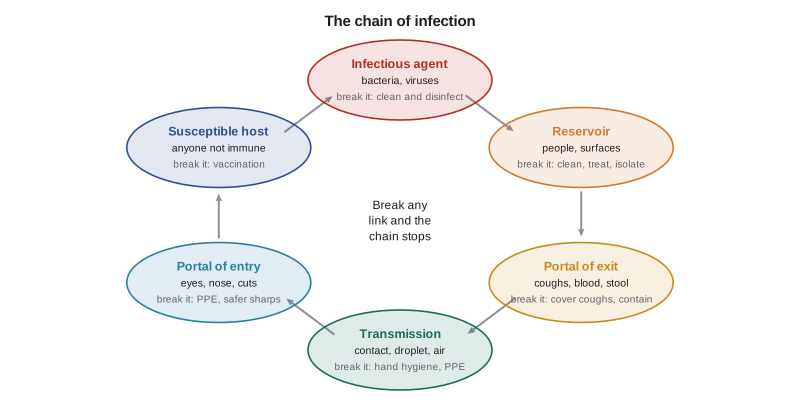
- The infectious agent: the bacterium, virus, fungus or parasite.
- The reservoir: where it lives, such as an infected patient, a contaminated surface, standing water or a piece of equipment.
- The portal of exit: how it leaves the reservoir, such as a cough, blood, stool or a wound.
- The mode of transmission: how it travels to the next person.
- The portal of entry: how it gets in, such as the mouth, nose, eyes, broken skin or a needlestick.
- The susceptible host: a person who can be infected, which includes every worker who is not immune.
Most of what workers do to protect themselves targets the middle links. Hand hygiene and cleaning break the contact route. Masks, respirators and eye protection block portals of entry. Safety-engineered sharps prevent the most direct route of all. Vaccination makes the host less susceptible.
How infections reach workers
| Route | How it spreads | Examples | Main worker protections |
|---|---|---|---|
| Contact | Touching an infected person, a contaminated surface or equipment, then touching the face or a cut | Norovirus, C. difficile, MRSA, scabies | Hand hygiene, gloves, gowns, cleaning and disinfection |
| Droplet | Larger respiratory droplets from coughs, sneezes and talking, over short distances | Influenza, pertussis, many common colds | Mask and eye protection within about 2 meters (6 feet), hand hygiene |
| Airborne | Small particles that stay in the air and travel further | Tuberculosis, measles, chickenpox | N95 respirator, isolation room with negative pressure, immunity where possible |
| Mixed respiratory | Both droplets and smaller particles, depending on the setting | COVID-19, RSV | Masks or respirators as the hospital's policy requires, ventilation, eye protection |
| Bloodborne | Sharps injuries and splashes of blood or body fluids onto mucous membranes or broken skin | Hepatitis B, hepatitis C, HIV | Safety-engineered sharps, eye and face protection, hepatitis B vaccination |
| Ingestion | Contaminated hands or food reaching the mouth | Norovirus, hepatitis A | Hand hygiene, no eating in clinical areas |
Some groups of workers face particular routes. Environmental services staff and laundry workers handle contaminated linen, waste and surfaces many times a day. Transporters spend minutes at a time beside patients in elevators and corridors, often before anyone knows what infection the patient has. Lab staff handle specimens of blood, stool, sputum and tissue. Home health staff work in homes where the usual hospital controls, such as isolation rooms and ventilation, do not exist.
Standard precautions for every patient
Because staff cannot know which patients are infectious, the basic protections are used with everyone. In the United States these are called standard precautions, based on CDC guidance. They include:
- Hand hygiene at the right moments: before touching a patient or their surroundings, before a clean or aseptic procedure, after a risk of exposure to body fluids, and after touching a patient or their surroundings. Alcohol-based hand rub is the default; soap and water are used when hands are visibly soiled and for some infections, such as C. difficile and norovirus, that alcohol does not kill well.
- A risk assessment before each interaction, as described in Lesson 3, to decide what protection is needed.
- Personal protective equipment for the exposure you expect: gloves when touching blood, body fluids, broken skin or contaminated items; a gown when clothing could be soiled; a mask and eye protection when splashes or sprays are likely.
- Respiratory etiquette: covering coughs, offering masks to coughing patients and visitors.
- Safe handling and disposal of sharps.
- Cleaning and disinfection of equipment and the environment.
- Safe handling of linen and waste.
When a patient is known or suspected to have an infection that spreads in a particular way, transmission-based precautions are added: contact precautions (gloves and gown), droplet precautions (mask and eye protection), or airborne precautions (an N95 respirator and an airborne infection isolation room). A sign on the door tells staff which ones apply, and an isolation cart outside the room holds the supplies. Nursing homes also use enhanced barrier precautions, gowns and gloves for high-contact care of residents with certain wounds, devices or drug-resistant organisms.
Putting on and taking off PPE
Protective equipment protects you only if it is put on in an order that leaves no gaps and taken off in an order that does not contaminate you. Taking it off is the risky part, because the outside of the gloves and gown is now contaminated.
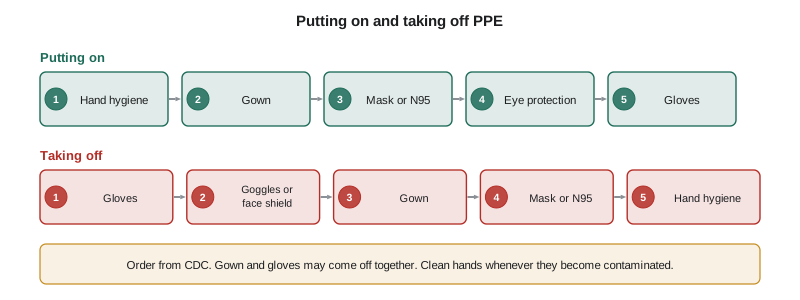
Amira's tips for taking PPE off are the ones the infection control team teaches. Take it off slowly. Touch the outside only with gloved hands and the inside only with bare hands. Roll the gown inside out as it comes off. Remove eye protection and masks by the straps or ear loops, never by the front. Clean your hands whenever you think they might be contaminated, not only at the end. And for airborne precautions, take off the respirator after leaving the room and closing the door.
N95 respirators
An N95 respirator protects only if it seals to the face, which is why every worker who may need one must be fit tested with the exact make, model and size they will use, and trained to do a seal check each time they put it on. OSHA's Respiratory Protection standard (29 CFR 1910.134) requires a written program, a medical evaluation, fit testing before first use and at least once a year after that, and training. Northbridge tests every clinical worker, transporter and environmental services worker who may enter an airborne isolation room. HSE-240 covers respirators in depth.
Vaccination and immunity
Vaccination protects workers and, by preventing staff from passing infections on, their patients. The Bloodborne Pathogens standard requires employers to offer the hepatitis B vaccine, at no cost, to every worker with occupational exposure to blood, within 10 working days of starting the job, and a worker who declines must sign a declination and can change their mind later. Northbridge's employee health office also checks each new worker's immunity to measles, mumps, rubella and chickenpox, offers the vaccines that are recommended for healthcare workers, screens new staff for tuberculosis, and runs a yearly influenza and COVID-19 vaccination clinic. The details of what each worker needs are a matter for employee health, not the unit.
Coming to work sick
One of the most common ways infections spread in hospitals is through staff who come to work ill. Healthcare workers do it because they do not want to leave the unit short, because they feel guilty, or because they cannot afford to lose the pay. An outbreak of norovirus or influenza on a unit can sicken dozens of patients and staff and close beds for weeks. Northbridge's rule is that staff with symptoms of a contagious illness, such as fever, vomiting, diarrhea or a new cough, report to occupational health or their manager before the shift and stay home until they are cleared. A rule like this only works if staffing and sick pay make it realistic to follow.
For supervisors: the isolation cart
The most common reason staff go into an isolation room without the right protection is that the right protection is not there. Check isolation carts at every shift change: gowns, gloves in every size, masks, eye protection, the right N95 models and sizes for the staff on shift, hand rub and a waste container. Know which of your staff are fit tested and for which models. When supplies run short, tell your manager and the infection control team at once, and never let a shortage become an unspoken reason to skip protection.
Exposures and what to do
An exposure happens when a worker has contact with an infection in a way that could transmit it: a needlestick, a splash of blood in the eye, caring for a patient with tuberculosis before anyone knew, or feeding a resident who turns out to have norovirus. The worker should report it to their supervisor and occupational health right away, because for some exposures, especially needlesticks and blood splashes, follow-up is time-sensitive and should begin within hours. Lesson 11 covers reporting, and HSE-392 covers bloodborne exposures in detail.
Joanne tracks every exposure report and how quickly it was made.
# Infection-related exposure reports at Northbridge last year:
# (type, hours from exposure to report)
exposures = [
    ("needlestick", 0.5), ("needlestick", 1), ("needlestick", 0.3), ("needlestick", 6),
    ("needlestick", 0.8), ("needlestick", 26), ("needlestick", 1.5), ("needlestick", 0.4),
    ("needlestick", 2), ("needlestick", 0.6), ("needlestick", 1.2), ("needlestick", 0.5),
    ("blood splash", 0.7), ("blood splash", 3), ("blood splash", 0.5), ("blood splash", 12),
    ("TB contact", 48), ("TB contact", 48), ("TB contact", 48), ("TB contact", 50),
    ("norovirus", 24), ("norovirus", 30),
    ("scabies", 72), ("scabies", 72), ("measles contact", 20),
]
types = {}
for t, h in exposures:
    types.setdefault(t, []).append(h)

print(f"{'type':16}{'count':>6}{'median hours':>14}{'within 2 h':>12}")
for t, hs in sorted(types.items(), key=lambda kv: -len(kv[1])):
    hs = sorted(hs)
    n = len(hs)
    median = hs[n // 2] if n % 2 else (hs[n // 2 - 1] + hs[n // 2]) / 2
    fast = sum(1 for h in hs if h <= 2)
    print(f"{t:16}{n:6}{median:14.1f}{fast:9} of {n}")

blood = types["needlestick"] + types["blood splash"]
late = [h for h in blood if h > 2]
print(f"\nblood exposures reported after 2 hours: {len(late)} of {len(blood)}")type count median hours within 2 h needlestick 12 0.9 10 of 12 blood splash 4 1.9 2 of 4 TB contact 4 48.0 0 of 4 norovirus 2 27.0 0 of 2 scabies 2 72.0 0 of 2 measles contact 1 20.0 0 of 1 blood exposures reported after 2 hours: 4 of 16
Most needlesticks are reported within an hour, which is good. Four of the 16 blood exposures were reported more than two hours later, including one needlestick reported the next day, which is too slow for the follow-up to work as intended. The tuberculosis and scabies contacts are reported late for a different reason: nobody knew the patient was infectious until test results came back, and occupational health then traced the staff who had been in contact. Those delays cannot be fixed by telling staff to report faster. They are fixed by faster recognition and isolation of patients with symptoms, which is why the emergency department screens for cough and fever at triage.
Worked problem
Kevin and the patient in room 406
On Monday, Kevin takes a patient from 4 West to imaging and back, about 40 minutes in elevators and waiting areas. The patient is coughing and is on droplet precautions while the cause is investigated. Kevin wears a surgical mask and eye protection. On Wednesday, the lab reports that the patient has active tuberculosis. What happens now, and what could have been done differently?
Show solution
- The infection control team moves the patient to an airborne isolation room and lists every worker who spent time near the patient before Wednesday. Kevin is on the list.
- Occupational health contacts Kevin, explains the exposure and arranges follow-up testing on the schedule that the TB guidelines recommend. Kevin does not need to stay off work, because a recent exposure does not make him infectious. Any questions about his own health go to occupational health, not to the unit.
- Kevin's mask and eye protection were what droplet precautions require, but a surgical mask does not protect reliably against airborne tuberculosis. The investigation asks why the patient was not on airborne precautions while TB was still possible.
- The answer is that the admitting team did not consider TB until a chest X-ray was read the next day. The infection control team adds a prompt to the admission screen: a cough for more than three weeks with weight loss or night sweats means airborne precautions until TB is ruled out.
Answer: Trace and follow up exposed staff through occupational health, and fix the gap that let a possible airborne infection be managed with droplet precautions.
Common mistakes
MistakeUsing PPE only for patients with a known infection.
InsteadUse standard precautions with every patient, and add transmission-based precautions when an infection is suspected.
MistakeTaking off a contaminated gown and gloves in a hurry.
InsteadFollow the removal order slowly, and clean your hands whenever they may be contaminated.
MistakeWearing an N95 model you have not been fit tested on.
InsteadUse only the make, model and size you were fit tested for, and do a seal check every time.
MistakeComing to work with vomiting or a fever to avoid leaving the unit short.
InsteadReport symptoms before the shift and stay home until cleared.
MistakeWaiting until the end of a shift to report a needlestick.
InsteadReport right away, because follow-up is time-sensitive.
Summary and key terms
- Infections spread to healthcare workers as well as to patients, and the same chain of infection applies.
- The main routes are contact, droplet, airborne, bloodborne and ingestion.
- Standard precautions are used with every patient; transmission-based precautions are added for suspected infections.
- Putting on and taking off PPE in the right order prevents self-contamination; removal is the risky part.
- N95 respirators work only if they are fit tested and seal checked.
- Vaccination protects workers and patients; details are a matter for occupational health.
- Report exposures right away; some follow-up must start within hours.
- Chain of infection
- The six links that must connect for an infection to spread: agent, reservoir, portal of exit, mode of transmission, portal of entry and susceptible host.
- Routine practices / standard precautions
- The basic infection control practices used with every patient, regardless of diagnosis.
- Additional / transmission-based precautions
- Extra precautions for contact, droplet or airborne spread when a specific infection is known or suspected.
- Fit test
- A test that checks that a specific respirator model and size seals to a worker's face.
- Exposure
- Contact with an infection in a way that could transmit it to the worker.
Practice problems
Work each problem on paper first, then reveal the answer to check.
Name the six links of the chain of infection.
Show answer
Infectious agent, reservoir, portal of exit, mode of transmission, portal of entry, susceptible host.
Which route of transmission needs an N95 respirator?
Show answer
Airborne, as for tuberculosis, measles and chickenpox.
Why is taking off PPE riskier than putting it on?
Show answer
The outside of the gloves, gown and eye protection is contaminated, and touching it can transfer germs to hands, face or clothing.
When must hands be cleaned with soap and water rather than hand rub?
Show answer
When they are visibly soiled, and for infections such as C. difficile and norovirus that alcohol does not kill well.
Why were the TB contacts reported 48 hours after exposure?
Show answer
Nobody knew the patient was infectious until the test results came back.
What should a supervisor check on isolation carts at each shift change?
Show answer
Gowns, gloves in every size, masks, eye protection, the right N95 models and sizes, hand rub and a waste container.
Lesson quiz · 5 questions
Score 60% or more to complete this lesson.
Create a free account to save your progress, take quizzes and earn a certificate.