
ITIL-130 · Lesson 12 of 12 · 32 min
Governance, improvement and practices in the value system, and capstone
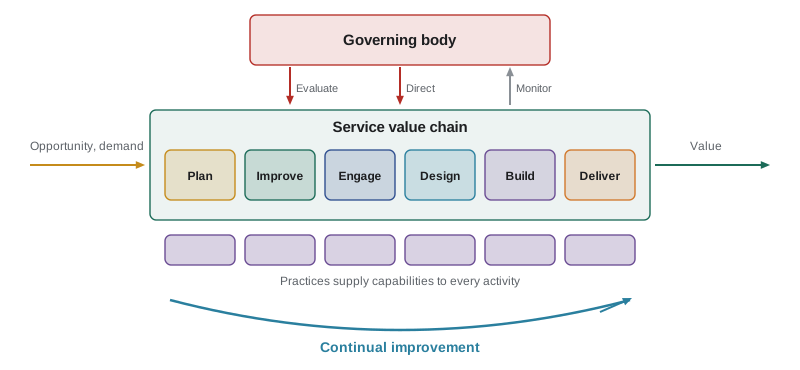
The earlier lessons examined the value chain, value streams, the four dimensions and partners and suppliers. This final lesson brings the whole system together. It looks at how governance directs and oversees the value system, how continual improvement keeps it healthy, and how practices supply the capabilities every activity needs. It ends with a capstone in which you map and improve a value stream for an invented service provider, drawing on everything in the course.
Governance in the value system
ITIL-120 introduced governance as the means by which an organization is directed and controlled, using the evaluate, direct and monitor model. In the value system, governance sits above the value chain. The governing body evaluates the organization's situation, its stakeholders' needs and the external environment; directs the organization by assigning responsibility, setting strategy and approving policies; and monitors performance and conformance against that direction.
Governance shapes every other component. It sets the policies within which plan works, the risk appetite that determines how much change design and transition can introduce, the rules for supplier selection that obtain/build follows, and the performance measures that improve tracks. Without governance, a value system can be efficient at doing the wrong things.
| Governance activity | What it means for the value system | Example |
|---|---|---|
| Evaluate | Assess the organization, its stakeholders and its environment | Review whether the service portfolio still meets customer needs |
| Direct | Set strategy, policies and responsibilities | Approve a policy that all new services must meet accessibility standards |
| Monitor | Track performance and conformance | Review quarterly value stream measures and audit findings |
Continual improvement across the system
Continual improvement is both a component of the value system and the purpose of the improve activity. ITIL-120 described the continual improvement model and register. In the value system, improvement applies at every level: to the value system itself (for example, its governance arrangements), to value streams (as lessons 8 and 9 showed), to individual activities and practices, and to products and services. A healthy organization improves at all these levels simultaneously, with governance making sure improvement efforts align with strategy.
Worked problem
Measuring progress toward an improvement target
A value stream for software requests has a baseline lead time of 8 working days. The improvement target is 3 days within a year. After six months, lead time is 5.5 days. What share of the improvement gap has been closed?
Show solution
- Gap from baseline to target: 8 − 3 = 5 days.
- Improvement achieved so far: 8 − 5.5 = 2.5 days.
- Share closed: 2.5 ÷ 5 = 50 %.
- Halfway through the year, the team has closed half the gap, which is on track if progress continues.
Answer: 50 % of the gap has been closed after six months.
Practices in the value system
Practices are sets of organizational resources designed for performing work or accomplishing an objective. ITIL 4 describes 34 practices in three groups: general management practices (such as portfolio management, relationship management and supplier management), service management practices (such as incident management, service level management and change enablement) and technical management practices (such as deployment management and infrastructure and platform management). Published ITIL (Version 5) course outlines refer to management practices, and ITIL-101 noted that Version 5 also describes 34 practices.
Each practice contributes to several value chain activities, and each activity draws on several practices. Value streams use practices at each step. ITIL-140 and ITIL-141 examine the practices individually; this course has shown where they fit in the system.
| Practice | Value chain activities it contributes to most |
|---|---|
| Relationship management | Engage; plan; improve |
| Service level management | Engage; plan; deliver and support; improve |
| Change enablement | Design and transition; obtain/build; deliver and support |
| Incident management | Deliver and support; engage; improve |
| Supplier management | Obtain/build; engage; plan |
| Portfolio management | Plan; improve |
Bringing the components together
A value system works well when its components reinforce each other. The guiding principles shape behavior; governance sets direction; the value chain organizes work; value streams make that work concrete; practices supply capability; continual improvement keeps everything moving forward; and the four dimensions make sure nothing is overlooked. When one component is weak, the others compensate only partly. Strong practices cannot rescue a value stream that is badly designed, and good value streams cannot rescue an organization with no clear direction.
Capstone: Harbourline Managed Services
Harbourline Managed Services is an invented managed IT provider with 140 staff serving 60 small and medium-sized clients. Its main service is a fully managed workplace: laptops, accounts, email, collaboration tools, security and support. Clients complain that onboarding a new employee takes too long and often goes wrong. Harbourline has asked you to apply what you have learned.
| Step | Process time (h) | Wait before step (h) | %C&A |
|---|---|---|---|
| 1. Client submits new-starter form | 0.5 | 0 | 60 % |
| 2. Account manager checks and approves | 0.25 | 16 | 90 % |
| 3. Service desk creates accounts | 1.0 | 24 | 85 % |
| 4. Laptop ordered from supplier | 0.5 | 8 | 95 % |
| 5. Laptop delivered by supplier | 0 | 48 | 90 % |
| 6. Engineer configures laptop | 2.0 | 16 | 90 % |
| 7. Courier delivers to new starter | 0.5 | 16 | 95 % |
Worked problem
Capstone part 1: analyze the current state
Using the table, calculate process time, lead time, flow efficiency and rolled %C&A, and identify the biggest problems.
Show solution
- Process time: 0.5 + 0.25 + 1.0 + 0.5 + 0 + 2.0 + 0.5 = 4.75 hours.
- Waiting time: 0 + 16 + 24 + 8 + 48 + 16 + 16 = 128 hours. Lead time: 132.75 working hours, about 16.6 eight-hour days.
- Flow efficiency: 4.75 ÷ 132.75 ≈ 3.6 %.
- Rolled %C&A: 0.60 × 0.90 × 0.85 × 0.95 × 0.90 × 0.90 × 0.95 ≈ 0.336, so only about one onboarding in three goes through without rework.
- Biggest problems: the 48-hour supplier delivery wait, the 24-hour wait before accounts are created, and the 60 % accuracy of the client's form, which causes rework downstream.
Answer: Lead time about 133 working hours, flow efficiency about 3.6 %, rolled %C&A about 34 %. The supplier wait, the account-creation queue and the poor-quality initial form stand out.
Worked problem
Capstone part 2: design improvements across the four dimensions
Propose improvements for Harbourline, covering each of the four dimensions, and estimate the new figures if: the form becomes a guided portal (%C&A 90 %, 0.25 h); approval is removed for clients with standard profiles (step 2 gone); accounts are created automatically on form submission (0.1 h, no wait, %C&A 98 %); Harbourline keeps a stock of pre-configured laptops, so steps 4 to 6 become one 1-hour step after a 4-hour wait with %C&A 95 %; and courier wait stays 16 h.
Show solution
- Organizations and people: train engineers on the new stock process; give account managers time back for client relationships.
- Information and technology: build the guided portal and automate account creation using client role templates.
- Partners and suppliers: renegotiate with the laptop supplier to hold consigned stock; agree a replenishment service level.
- Value streams and processes: remove the approval for standard profiles; replace three laptop steps with one.
- New process time: 0.25 + 0.1 + 1.0 + 0.5 = 1.85 hours. New waiting: 0 + 0 + 4 + 16 = 20 hours. Lead time: 21.85 hours (about 2.7 days).
- New flow efficiency: 1.85 ÷ 21.85 ≈ 8.5 %. New rolled %C&A: 0.90 × 0.98 × 0.95 × 0.95 ≈ 0.80.
Answer: Lead time falls from about 133 to about 22 working hours, flow efficiency rises from 3.6 % to about 8.5 %, and rolled %C&A rises from about 34 % to about 80 %.
Worked problem
Capstone part 3: governance, suppliers and improvement
Harbourline's laptop supplier is classified as having high value impact (V8) and moderate supply risk (R6), using 5 as the dividing line. Holding consigned stock of 30 laptops at $1,400 each will be funded by the supplier in exchange for a three-year commitment. Classify the supplier, describe how governance should oversee the change, and define two measures to monitor.
Show solution
- Classification: high value and high risk, so strategic. Manage it as a partnership with joint planning and an exit plan.
- Governance: the leadership team evaluates the risk of a three-year commitment, directs the change through an approved business case and policy on consigned stock, and monitors results quarterly.
- Stock value at risk: 30 × $1,400 = $42,000, funded by the supplier but to be protected by insurance and stock controls.
- Measures: onboarding lead time (target under 24 working hours) and rolled %C&A (target above 80 %), plus client satisfaction with onboarding.
Answer: Treat the supplier as strategic, oversee the change with evaluate, direct and monitor, and track lead time, rolled %C&A and client satisfaction against targets.
What the capstone shows
The Harbourline case uses nearly every idea from the course. Opportunity and demand enter as client requests and as the opportunity to fix a painful journey. The value chain activities appear in each step. A value stream map exposes waiting and rework. Improvements address all four dimensions. A strategic supplier is managed as a partner. Governance oversees the change, and continual improvement measures progress against a baseline. No single component would have solved the problem alone.
If Harbourline served US public-sector clients, it would also need to check FedRAMP or state cloud requirements for client data and the accessibility of its new portal under Section 508 or the ADA.
Looking ahead
With the value system in place, the next courses examine its parts in more detail. ITIL-140 and ITIL-141 cover the practices that supply the system's capabilities. ITIL-150 examines digital products, automation, AI and transformation. ITIL-160 prepares you for the Foundation exam. Throughout, remember to answer exam questions in the terms of the edition you are sitting.
Self-check: is your value system working?
Before finishing the course, it is worth applying a short self-check to an organization you know. Can you name its main value streams and roughly how long each takes? Do teams understand how their work connects to value for consumers? Does governance set clear direction and look at outcome measures, not just activity counts? Are suppliers managed according to their importance? Is there protected time for improvement, and are improvements measured against baselines? A "no" to any of these questions points to the component of the value system most in need of attention.
Worked problem
Turning the self-check into a score
A team answers the six self-check questions for its organization and scores each from 0 (not at all) to 2 (fully): value streams known 1; link to value understood 2; governance uses outcome measures 0; suppliers managed by importance 1; protected improvement time 0; baselines used 1. What is the total out of 12, and where should the team start?
Show solution
- Total: 1 + 2 + 0 + 1 + 0 + 1 = 5 out of 12.
- The two zeros are governance measures and protected improvement time.
- Starting with protected improvement time creates capacity to fix the other gaps; governance measures need leadership support.
Answer: 5 out of 12. Start with protected improvement time and outcome-focused governance measures.
Common mistakes
MistakeTreating governance as separate from day-to-day service management.
InsteadSee governance as directing and monitoring the whole value system through evaluate, direct and monitor.
MistakeImproving only at the level of individual tasks.
InsteadImprove the value system, value streams, activities, practices and services together.
MistakeEquating practices with value chain activities.
InsteadPractices supply resources; activities describe the work; the relationship is many-to-many.
MistakeFixing one component and expecting the system to improve.
InsteadAddress all components and the four dimensions so they reinforce each other.
MistakeDeclaring an improvement successful without a baseline.
InsteadMeasure against the baseline and track the share of the gap closed.
Summary and key terms
- Governance evaluates, directs and monitors the value system and shapes every other component.
- Continual improvement applies at every level, from the value system itself to individual services.
- Practices supply capabilities to the value chain activities in a many-to-many relationship.
- The components reinforce each other; weakness in one limits the whole system.
- The Harbourline capstone shows how value stream mapping, the four dimensions, supplier strategy and governance combine.
- Measuring progress against a baseline shows how much of an improvement gap has been closed.
- Answer exam questions in the terms of the edition you are sitting.
- Governing body
- The group accountable for the performance and conformance of the organization.
- Evaluate, direct and monitor
- The three governance activities used in ISO/IEC 38500 and COBIT.
- Risk appetite
- The amount and type of risk an organization is willing to accept.
- General management practice
- A practice adopted from general business management, such as portfolio or supplier management.
- Service management practice
- A practice developed in service management, such as incident or service level management.
- Technical management practice
- A practice adapted from technology management, such as deployment management.
- Improvement gap
- The difference between a baseline and a target.
- Consigned stock
- Inventory held at the customer's site but owned by the supplier until used.
- Business case
- A justification for a course of action, setting out costs, benefits and risks.
- Capstone
- A final exercise that integrates the main ideas of a course.
Practice problems
Work each problem on paper first, then reveal the answer to check.
Name the three governance activities.
Show answer
Evaluate, direct and monitor.
Give one way governance shapes the value chain.
Show answer
It sets policies and risk appetite that limit how much change design and transition can introduce.
Baseline 12 days, target 4 days, current 8 days. What share of the gap is closed?
Show answer
(12 − 8) ÷ (12 − 4) = 4 ÷ 8 = 50 %.
Name the three groups of ITIL 4 practices.
Show answer
General management, service management and technical management practices.
How many practices does ITIL 4 describe?
Show answer
34.
In the capstone, what was the current flow efficiency?
Show answer
About 3.6 %.
Why did the client form's 60 % %C&A matter so much?
Show answer
Errors at the first step cause rework in every later step.
Which dimension did consigned laptop stock mainly address?
Show answer
Partners and suppliers (with value streams and processes).
Why must improvements be measured against a baseline?
Show answer
Without a baseline, there is no evidence that the change improved anything.
Which course covers the individual practices next?
Show answer
ITIL-140 and ITIL-141.
Lesson quiz · 5 questions
Score 60% or more to complete this lesson.
Create a free account to save your progress, take quizzes and earn a certificate.