
ITIL-130 · Lesson 4 of 12 · 31 min
Plan and improve
Two of the six value chain activities steer the whole chain rather than handling individual pieces of demand. Plan creates a shared understanding of where the organization is going, where it stands now and how it intends to improve. Improve makes sure that products, services, practices and the value chain itself keep getting better. This lesson examines both activities: their purposes, inputs and outputs, the levels at which they operate, and how they connect to governance and the rest of the chain.
The purpose of plan
In plain terms, the plan activity ensures that everyone shares an understanding of the vision, the current status and the direction of improvement, across all four dimensions and all products and services. Without that shared understanding, teams pull in different directions. One team invests in a new platform while another commits to a customer roadmap that assumes the old platform; a third prepares a budget that funds neither.
Plan is not one annual event. It happens at three broad levels, each with its own time horizon and audience.
| Level | Typical horizon | Typical outputs | Example |
|---|---|---|---|
| Strategic | Two to five years | Vision, strategy, portfolio direction, major investment decisions | Move 70 % of workloads to cloud services by year three |
| Tactical | Quarter to a year | Roadmaps, budgets, capacity plans, program plans | Migrate the finance platform in the second half of the year |
| Operational | Days to weeks | Schedules, rosters, release calendars, sprint plans | Cut over the finance database on the third weekend of October |
Inputs and outputs of plan
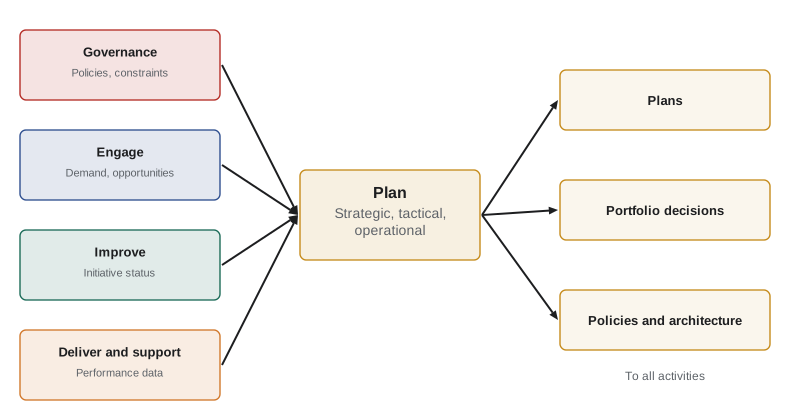
Plan draws inputs from governance (policies, requirements and constraints set by the governing body), from engage (consolidated demand and opportunities), from improve (improvement initiatives and their status), from deliver and support (performance information) and from outside the organization (market changes, regulation, supplier roadmaps). Its outputs include strategic, tactical and operational plans; portfolio decisions; architectures and policies for the value chain; and improvement opportunities it identifies along the way.
Portfolio decisions
A key planning output is the set of decisions about which products, services and initiatives the organization will invest in, keep, change or retire. This is portfolio management, one of the general management practices. The plan activity uses it to keep the total work in progress within capacity and aligned with strategy.
Worked problem
Balancing a portfolio against capacity
An IT department has 1,200 person-days of project capacity for the next half-year. Proposed initiatives: A (security upgrade, mandatory) 300 days; B (customer portal) 500 days, expected annual benefit $400,000; C (reporting refresh) 250 days, benefit $90,000; D (automation of onboarding) 350 days, benefit $260,000. Which combination fits, and which maximizes benefit per day after mandatory work?
Show solution
- Reserve mandatory A: 1,200 − 300 = 900 days remaining.
- Benefit per day: B $400,000 ÷ 500 = $800; C $90,000 ÷ 250 = $360; D $260,000 ÷ 350 ≈ $743.
- Rank: B ($800), D ($743), C ($360).
- B + D = 850 days, which fits within 900. Adding C (250) would exceed capacity.
- Total benefit: $400,000 + $260,000 = $660,000 a year; 50 days remain as a buffer.
Answer: Fund A, B and D; defer C. The plan respects capacity, meets the mandatory requirement and maximizes benefit per day.
Planning and the four dimensions
A plan that considers only technology is incomplete. Plan should address all four dimensions: organizations and people (skills, roles, culture), information and technology (systems, data, tools), partners and suppliers (contracts, dependencies), and value streams and processes (how work will flow). A cloud migration plan, for example, must cover staff training and role changes, data migration and tooling, contract changes with the hosting provider and new deployment and support workflows. Lesson 10 examines the four dimensions in depth.
The purpose of improve
In plain terms, the improve activity ensures continual improvement of products, services and practices across all value chain activities and all four dimensions. Improve is the value chain's expression of the continual improvement component of the system. Where continual improvement describes the habit and the model, improve is the activity through which improvement work is identified, organized and tracked.
ITIL-120 introduced the continual improvement model (from "What is the vision?" through "How do we keep the momentum going?") and the continual improvement register. This lesson focuses on how improve connects with the rest of the value chain.
Inputs and outputs of improve
Improve receives inputs from every other activity: performance information from deliver and support, feedback from engage, knowledge about new components from obtain/build, information about new and changed products from design and transition, and plans and policies from plan. It also receives improvement initiatives raised anywhere in the organization. Its outputs include improvement initiatives and plans, value stream performance information, contract and agreement requirements, service performance information and status reports on improvement work.
Worked problem
Turning performance data into an improvement initiative
Deliver and support reports that a payroll service had 14 incidents last quarter, 9 of them caused by the same failing nightly batch job. Each incident cost about 6 hours of staff time at $75 per hour and delayed pay for some employees. What should improve do?
Show solution
- Quantify the cost: 9 × 6 × $75 = $4,050 in staff time for the quarter, plus reputational and employee-impact costs.
- Record an improvement opportunity in the register: fix the root cause of batch job failures.
- Hand investigation to problem management (a practice) and track progress in improve.
- Define a measure of success: batch-related incidents fall from 9 to zero within two quarters.
Answer: Improve records the opportunity, quantifies its value, assigns the work and sets a measurable target, then tracks the result.
Improvement at every level
Improvement happens at all levels: strategic (changing which services the organization offers), tactical (redesigning a value stream) and operational (fixing a recurring defect). It also happens in every activity. Engage can improve how it captures requirements; obtain/build can improve supplier selection; plan can improve its own planning process. A mature organization expects everyone to contribute to improvement, not only a dedicated improvement team.
| Activity | Example improvement |
|---|---|
| Plan | Shorten the annual planning cycle by moving to quarterly rolling plans |
| Engage | Introduce a single intake form to replace five request channels |
| Design and transition | Add automated tests to the release pipeline |
| Obtain/build | Pre-approve a catalog of standard cloud components |
| Deliver and support | Add a knowledge article for each of the ten most common incidents |
| Improve | Review the improvement register monthly instead of yearly |
Prioritizing improvements
Improvement opportunities compete for capacity with demand. Organizations often protect a fixed share of capacity for improvement, much as they reserve capacity for mandatory work. Without that protection, urgent demand tends to consume everything, and improvement is postponed indefinitely. A common rule of thumb is to protect somewhere between 10 % and 20 % of a team's capacity for improvement work, though the right figure depends on context.
Worked problem
Measuring the return on protected improvement time
A team of eight protects 10 % of its time (about 4 hours per person per week) for improvement. Over a quarter of 13 weeks, the improvements it completes reduce recurring work by 22 hours a week. How long until the time invested is repaid, assuming the savings continue?
Show solution
- Time invested per week: 8 × 4 = 32 hours; over 13 weeks: 416 hours.
- Savings after the quarter: 22 hours a week.
- Payback: 416 ÷ 22 ≈ 19 weeks after the improvements take effect.
- If the team keeps investing, savings compound as each round of improvement reduces recurring work further.
Answer: The investment is repaid in about 19 weeks, after which the savings are pure gain, and further improvement adds to them.
Plan and improve together
Plan and improve are closely linked. Plan sets direction; improve finds the gaps between where the organization is and where the plan says it should be, and closes them. Improve also produces information that changes plans: if a value stream turns out to be slower than assumed, the tactical plan must change. Together, they form a feedback loop that keeps the value chain aligned with the organization's goals and responsive to change.
Both activities also connect to governance. The governing body evaluates the organization's situation, directs it through strategy and policy, and monitors performance. Plan translates direction into action; improve feeds monitoring information back. Lesson 12 returns to this relationship.
In the US federal government, agency strategic plans and annual performance plans and reports, required under the GPRA Modernization Act of 2010, are an example of planning and improvement working at the strategic level: each agency publishes goals and later reports progress against them.
Plan and improve in ITIL (Version 5)
ITIL (Version 5) keeps the value chain as a component of the value system, and published course outlines describe key success metrics for value chain activities. The lifecycle activities it adds (discover, design, acquire, build, transition, operate, deliver and support) all need direction and improvement, so the ideas in this lesson apply in both editions. If you are studying for a Version 5 exam, check how your materials name and group these activities before relying on the six ITIL 4 names.
Rolling plans and planning cadence
Many organizations have moved away from a single annual plan toward rolling plans that are reviewed on a regular cadence. A common pattern is a strategic review once a year, a tactical review every quarter and operational planning every week or two. At each review, the plan is extended by one period and adjusted for what has been learned. Rolling plans keep direction stable while allowing priorities to shift as demand, opportunities and performance information change.
A cadence also helps the rest of the value chain. Engage knows when consolidated demand must be ready for the next tactical review. Improve knows when to present the status of improvement initiatives. Deliver and support knows when performance information will be used. Predictable timing reduces the scramble that often surrounds planning.
Worked problem
Measuring plan stability
At the start of a quarter, a team commits to 20 initiatives. By the end of the quarter, 14 are complete, 3 were deliberately deferred at the mid-quarter review and 3 were dropped without discussion. What share of the committed work was completed, and what does the pattern suggest?
Show solution
- Completion rate: 14 ÷ 20 = 70 %.
- Deliberate changes: 3 deferred at a review, which is healthy adaptation.
- Silent drops: 3 initiatives disappeared without discussion, 15 % of commitments.
- The silent drops suggest either over-commitment or weak communication between plan and the teams doing the work.
Answer: 70 % was completed. Deferring at a review is healthy; the 15 % dropped silently points to over-commitment or poor feedback to plan.
The key point is that a plan is a tool for shared understanding, not a fixed contract. Its value lies in keeping everyone aligned on direction while the details change.
Common mistakes
MistakeTreating planning as a once-a-year budgeting exercise.
InsteadPlan at strategic, tactical and operational levels, with plans that are reviewed and updated.
MistakePlanning only the technology.
InsteadAddress all four dimensions: people, information and technology, partners and suppliers, and value streams and processes.
MistakeLeaving improvement to a separate team.
InsteadExpect improvement in every activity and from everyone, coordinated through the improve activity.
MistakeLetting urgent demand consume all improvement time.
InsteadProtect a share of capacity for improvement and measure its return.
MistakeApproving more initiatives than capacity allows.
InsteadUse portfolio decisions to keep work in progress within capacity and aligned with strategy.
Summary and key terms
- Plan creates a shared understanding of vision, current status and direction across all four dimensions.
- Planning happens at strategic, tactical and operational levels with different horizons and outputs.
- Portfolio decisions keep total work within capacity and aligned with strategy.
- Improve ensures continual improvement of products, services and practices across all activities and dimensions.
- Improve takes inputs from every activity and outputs initiatives, plans and performance information.
- Protecting a share of capacity for improvement prevents it from being crowded out by urgent demand.
- Plan and improve form a feedback loop with each other and with governance.
- Strategic plan
- A long-term plan setting vision, strategy and major investment direction.
- Tactical plan
- A medium-term plan such as a roadmap, budget or capacity plan.
- Operational plan
- A short-term plan such as a schedule, roster or release calendar.
- Portfolio management
- The practice of deciding which products, services and initiatives to invest in, keep, change or retire.
- Work in progress
- Work that has started but is not yet finished.
- Improvement initiative
- A planned piece of work intended to improve a product, service, practice or activity.
- Continual improvement register
- A record of improvement ideas and initiatives, their status and value.
- Benefit per day
- Expected benefit divided by effort, used to compare initiatives.
- Payback period
- The time needed for savings to repay an investment.
- Feedback loop
- A cycle in which results of an action inform the next action.
Practice problems
Work each problem on paper first, then reveal the answer to check.
State the purpose of the plan activity in your own words.
Show answer
To create a shared understanding of vision, current status and direction of improvement across the organization.
Name the three levels of planning.
Show answer
Strategic, tactical and operational.
Initiative X gives $300,000 a year for 400 days of effort. What is its benefit per day?
Show answer
$750 per day.
Name three activities that provide inputs to improve.
Show answer
Deliver and support, engage and design and transition (also obtain/build and plan).
Why protect capacity for improvement?
Show answer
Urgent demand otherwise consumes all capacity and improvement never happens.
A team invests 200 hours and saves 10 hours a week. What is the payback?
Show answer
20 weeks.
Give an improvement that could apply to the engage activity.
Show answer
Replacing several request channels with a single intake form.
How does plan relate to governance?
Show answer
Governance sets direction and policy; plan translates them into plans for the value chain.
Why must plans address all four dimensions?
Show answer
Changes affect people, information and technology, partners and processes; ignoring any creates gaps.
Which practice supports portfolio decisions?
Show answer
Portfolio management.
Lesson quiz · 5 questions
Score 60% or more to complete this lesson.
Create a free account to save your progress, take quizzes and earn a certificate.