
ITIL-141 · Lesson 2 of 12 · 31 min
Service level management I: SLAs, SLOs and agreements
Every service carries expectations. Users expect the shipment portal to be available when customers book freight; managers expect password resets to take minutes, not days; the finance team expects month-end reports on time. Unless those expectations are discussed and written down, the provider and its customers will judge the same service by different yardsticks, and both will be disappointed. Service level management is the practice that turns vague expectations into clear, agreed targets and then checks whether they are met.
This lesson covers the purpose of service level management, the kinds of agreement it produces, how to design good service level targets, and the arithmetic of availability and downtime that sits behind many of them. Lesson 3 covers measuring, reporting and reviewing service levels, including the watermelon effect.
Purpose of service level management
In plain words, the purpose of the service level management practice is to set clear business-based targets for service levels, and to ensure that delivery of services is properly assessed, monitored and managed against these targets. Each phrase matters. Clear means both sides understand the target in the same way. Business-based means the target reflects what the customer needs to achieve, not merely what is easy for IT to measure. Assessed, monitored and managed means the practice does not stop when an agreement is signed: it watches performance and acts when it slips.
Service level management is about more than documents. ITIL 4 emphasizes that it requires engagement: listening to customers, understanding their business, capturing their experience and building a shared view of what good looks like. A provider that writes agreements without talking to customers usually ends up measuring the wrong things.
Kinds of agreement
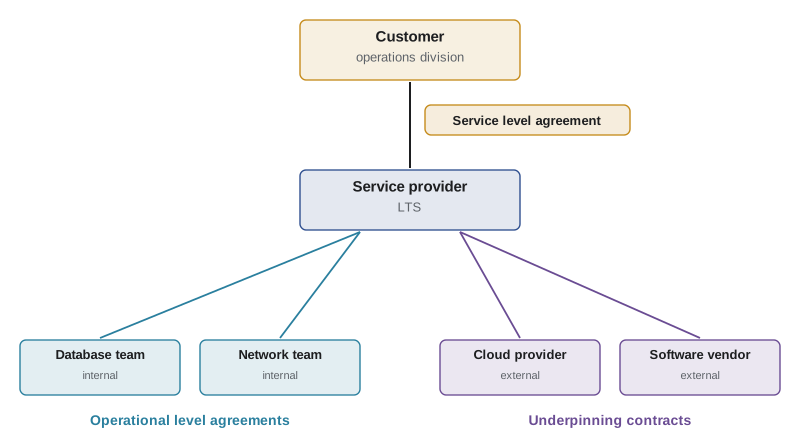
A service level agreement (SLA) is a documented agreement between a service provider and a customer that identifies both the services required and the expected level of service. An SLA can be a formal contract with an external customer or an internal agreement between IT and a business unit. Internal SLAs are not usually legally enforceable, but they are still valuable as a shared statement of expectations.
An operational level agreement (OLA) is an agreement between two parts of the same organization, for example between the service desk and the network team, setting out what each will do to support the SLA. An underpinning contract is a legally binding agreement with an external supplier that supports the provider's commitments, such as a cloud provider's availability commitment or a hardware vendor's four-hour on-site repair. If the targets in OLAs and underpinning contracts do not support the SLA, the provider has promised something it cannot deliver.
| Agreement | Between | Purpose | Larchmont example |
|---|---|---|---|
| Service level agreement | Provider and customer | States the service and the agreed service levels | LTS and the operations division: shipment portal available 99.9 % during booking hours |
| Operational level agreement | Two internal teams | States what each internal team does to support the SLA | Database team restores the portal database within 1 hour of a failure |
| Underpinning contract | Provider and external supplier | Legally binds the supplier to support the SLA | Cloud provider commits to 99.95 % monthly availability for the hosting region |
Structuring SLAs
Organizations structure their SLAs in different ways. A service-based SLA covers one service for all customers who use it, for example a single email SLA for the whole company. A customer-based SLA covers all the services used by one customer group, for example everything LTS provides to the finance division. A multi-level SLA combines the two: a corporate level covers issues common to everyone, a customer level covers issues specific to a customer group, and a service level covers issues specific to a service. Multi-level structures reduce duplication and make updates easier in large organizations.
| Structure | Strengths | Weaknesses |
|---|---|---|
| Service-based | Simple, one document per service | Ignores different needs of different customers |
| Customer-based | Matches how a customer sees its services | Duplicates common terms across many documents |
| Multi-level | Reduces duplication, scales well | More complex to design and explain |
What a good SLA contains
A useful SLA is short, written in plain language and focused on outcomes. It typically includes a description of the service in business terms; the hours of service; the service levels, such as availability, performance, support response and resolution targets; how service levels will be measured and reported; the responsibilities of both the provider and the customer; how changes to the agreement are made; and how and when the agreement is reviewed. Some SLAs also include service credits or other consequences when targets are missed, especially with external customers.
The customer's responsibilities are often forgotten. A provider cannot meet a resolution target if the customer's staff do not respond to requests for information, or meet an availability target if the customer installs unapproved software on supported devices. Writing these responsibilities down makes the agreement fair.
SLIs, SLOs and SLAs
Site reliability engineering (SRE), a discipline that began at Google and is now widely used, adds useful vocabulary. A service level indicator (SLI) is a carefully defined quantitative measure of some aspect of the service, such as the share of portal requests that succeed or the share served within 300 milliseconds. A service level objective (SLO) is a target value or range for an SLI, such as 99.9 % of requests succeeding over a rolling 28 days. An SLA, in SRE language, is an agreement with consequences, usually commercial, that applies when an SLO is missed.
The SRE vocabulary fits well with ITIL. SLOs are often set internally at a tighter level than the external SLA, so the team has warning before the agreement is breached. ITIL-140 lesson 9 showed how SLOs and error budgets drive monitoring thresholds. Here the focus is on choosing the right indicators and targets in the first place.
| Term | Meaning | Example |
|---|---|---|
| Service level indicator (SLI) | A precisely defined measure | Share of booking requests returning a successful response |
| Service level objective (SLO) | A target for an SLI over a period | 99.9 % of booking requests succeed over a rolling 28 days |
| Service level agreement (SLA) | An agreement, often with consequences, about service levels | Customer receives a 5 % credit if monthly availability falls below 99.5 % |
Designing good service level targets
Poor targets are one of the most common failures in service level management. A target can be easy to measure but meaningless to the customer, such as server uptime when users care whether they can complete a booking. It can be impossible to measure, such as "the system will be fast". It can be set without regard to cost, such as five nines of availability for a service whose users would accept far less. Or it can be one of dozens of targets that nobody reads.
Good targets share several features. They are expressed in terms the customer recognizes, measured from the user's point of view where possible, specific about what counts and what does not, achievable at a cost the customer accepts and few in number. A helpful test is to ask the customer: if this target were met, would you be satisfied? If the answer is "not necessarily", the target is measuring the wrong thing.
| Weak target | Problem | Better target |
|---|---|---|
| Servers available 99.99 % | Measures components, not the service users experience | 99.9 % of booking attempts succeed during booking hours, measured by synthetic transactions and real user data |
| The portal will be fast | Not measurable | 95 % of page loads complete within 2 seconds for users on the corporate network |
| All incidents resolved in 4 hours | Ignores priority and business impact | Priority 1 incidents restored within 4 hours on 95 % of occasions; priority 3 within 3 business days |
| Respond to all requests promptly | Vague, no measure | Standard access requests fulfilled within 1 business day on 90 % of occasions |
Availability, nines and downtime budgets
Availability is the most common service level, so every service level manager needs to be comfortable with its arithmetic. Availability is usually expressed as the percentage of agreed service time during which the service was available. Agreed service time matters: a service promised from 06:00 to 22:00 on weekdays has far fewer hours to protect than one promised around the clock, and planned maintenance outside agreed hours does not count against it.
Targets are often quoted as nines: 99 % is two nines, 99.9 % is three nines, 99.99 % is four nines and 99.999 % is five nines. Each extra nine cuts the allowed downtime by a factor of ten and usually raises cost sharply, because it requires redundancy, automation, testing and around-the-clock staff. The downtime budget is the amount of unavailability allowed by the target over a period.
Worked problem
Downtime budget
The Larchmont shipment portal has an availability target of 99.9 % during agreed hours of 05:00 to 23:00, seven days a week. How many minutes of downtime are allowed in a 30-day month?
Show solution
- Agreed hours per day = 18; agreed minutes per month = 18 × 60 × 30 = 32,400.
- Allowed unavailability = 0.1 % of 32,400 = 32.4 minutes.
- If the same target applied around the clock, agreed minutes would be 43,200 and the budget 43.2 minutes.
Answer: About 32 minutes per month during agreed hours. Maintenance between 23:00 and 05:00 does not use the budget.
# Downtime budgets for common availability targets
periods = {"30-day month": 30 * 24 * 60, "quarter (91 days)": 91 * 24 * 60, "year (365 days)": 365 * 24 * 60}
targets = [99.0, 99.5, 99.9, 99.95, 99.99, 99.999]

def fmt(minutes):
    if minutes >= 60:
        return f"{minutes / 60:.1f} h"
    if minutes >= 1:
        return f"{minutes:.1f} min"
    return f"{minutes * 60:.0f} s"

print(f"{'target':>8} " + " ".join(f"{p:>18}" for p in periods))
for t in targets:
    cells = [fmt(m * (1 - t / 100)) for m in periods.values()]
print(f"{t:>7}% " + " ".join(f"{c:>18}" for c in cells))target 30-day month quarter (91 days) year (365 days) 99.0% 7.2 h 21.8 h 87.6 h 99.5% 3.6 h 10.9 h 43.8 h 99.9% 43.2 min 2.2 h 8.8 h 99.95% 21.6 min 1.1 h 4.4 h 99.99% 4.3 min 13.1 min 52.6 min 99.999% 26 s 1.3 min 5.3 min
The table shows why a jump from three nines to four is a big decision. At 99.9 % a 24×7 service may be down for about 43 minutes a month, which a well-run team can absorb with one incident and a careful change. At 99.99 % the budget is about four minutes, which leaves no room for a slow manual recovery. A service that needs four nines needs automated failover and very safe change practices, and the customer should understand that cost before agreeing.
Composite availability
Services are built from components, and the availability users experience depends on how those components are combined. ITIL-130 lesson 11 showed that suppliers in series multiply their availabilities. The same logic applies inside the provider. When components are in series, all must work, so the service availability is the product of their availabilities and is lower than any one of them. When components are in parallel, the service works if at least one works, so the unavailability is the product of their unavailabilities and the service availability is higher than any one.
Real services combine both. The Larchmont portal depends on a network link, a pair of load-balanced web servers, an application server and a database. The web servers are in parallel with each other; the whole chain is in series. Working out the composite availability tells LTS whether its 99.9 % SLA is realistic and where redundancy would help most.
Worked problem
Composite availability
The portal chain has a network link at 99.95 %, two web servers in parallel each at 99.5 %, an application server at 99.9 % and a database at 99.95 %. What is the expected availability of the chain?
Show solution
- Two web servers in parallel: unavailability = 0.005 × 0.005 = 0.000025, so availability = 99.9975 %.
- Series product = 0.9995 × 0.999975 × 0.999 × 0.9995.
- 0.9995 × 0.999975 ≈ 0.999475; × 0.999 ≈ 0.998476; × 0.9995 ≈ 0.997977.
Answer: About 99.80 %, below the 99.9 % target. The single application server and the network link are the weakest points; adding a second application server would raise the chain to about 99.90 %.
# Composite availability: series of blocks, where a block may be redundant (parallel)
def parallel(*a):
    u = 1.0
    for x in a:
        u *= (1 - x)
    return 1 - u

def series(*a):
    p = 1.0
    for x in a:
        p *= x
    return p

net, web, app, db = 0.9995, 0.995, 0.999, 0.9995
designs = {
    "current (2 web, 1 app)": series(net, parallel(web, web), app, db),
    "add 2nd app server": series(net, parallel(web, web), parallel(app, app), db),
    "add 2nd app + 2nd network link": series(parallel(net, net), parallel(web, web), parallel(app, app), db),
}
minutes = 30 * 24 * 60
for name, a in designs.items():
print(f"{name:<32} {a * 100:8.3f} % expected downtime {minutes * (1 - a):6.1f} min per 30 days")current (2 web, 1 app) 99.798 % expected downtime 87.4 min per 30 days add 2nd app server 99.897 % expected downtime 44.3 min per 30 days add 2nd app + 2nd network link 99.947 % expected downtime 22.7 min per 30 days
These calculations assume components fail independently, which is often not true. A power failure, a bad change or a shared software bug can take down both web servers at once. Redundancy helps only against failures it actually separates. That is one reason service level managers work closely with availability management, change enablement and service configuration management.
Support targets: response and resolution
Alongside availability, most SLAs include support targets: how quickly the provider will acknowledge and resolve incidents and fulfill requests. ITIL-140 covered how these targets connect to priority. The service level manager's role is to make sure the targets are agreed with customers, supported by OLAs and underpinning contracts, and expressed in a way that can be measured fairly. Targets stated as percentages, such as 90 % of priority 2 incidents resolved within 8 business hours, are more honest than absolute promises, because a few outliers are inevitable.
Negotiating and agreeing service levels
Agreeing service levels is a negotiation, but a cooperative one. The service level manager brings knowledge of what the provider can deliver and at what cost; the customer brings knowledge of what the business needs. Good negotiation starts from business outcomes: what happens if the portal is unavailable for an hour on a Monday morning? How much revenue or reputation is at risk? From there, the parties can discuss whether the cost of higher availability is justified.
Some customers ask for the highest possible levels without considering cost. Showing a simple table of targets, downtime budgets and costs often helps. A customer who learns that moving from 99.9 % to 99.99 % would triple hosting costs and require a second data center may decide that 99.9 % with faster recovery during business hours is a better deal.
Legal and public-sector context
In the United States, agreements with external customers are governed by state contract law and, for goods, the Uniform Commercial Code. Federal agencies buying IT services set service levels in contracts under the Federal Acquisition Regulation (FAR), often using performance-based acquisition with measurable standards and quality assurance surveillance plans. Accessibility targets, such as conformance with the Section 508 standards, can also appear as service levels for public-facing digital services.
Whatever the jurisdiction, an SLA that will be legally binding should be reviewed by people qualified in contract law. This course teaches the service management side, not legal drafting.
ITIL (Version 5) note
Published summaries of ITIL (Version 5), checked in October 2026, list service level management as a product and service management practice, as it was a service management practice in ITIL 4. Its name and core purpose are unchanged in those summaries.
Common mistakes
MistakeWriting SLAs without talking to customers.
InsteadEngage customers to understand outcomes, then express targets in their terms.
MistakeMeasuring component uptime and calling it service availability.
InsteadMeasure availability from the user's point of view, ideally with end-to-end indicators.
MistakeAgreeing SLA targets that OLAs and underpinning contracts cannot support.
InsteadCheck that internal and supplier commitments add up to the SLA before signing it.
MistakeOffering five nines because the customer asked for it.
InsteadShow downtime budgets and costs so the customer can choose a level worth paying for.
MistakeAssuming redundant components fail independently.
InsteadLook for common causes such as shared power, changes and software, and design redundancy to separate them.
Summary and key terms
- Service level management sets clear business-based targets and ensures delivery is assessed, monitored and managed against them.
- SLAs are with customers, OLAs are between internal teams, and underpinning contracts are with suppliers; all must fit together.
- SLAs can be service-based, customer-based or multi-level.
- SLIs measure, SLOs set targets for SLIs and SLAs are agreements, often with consequences.
- Good targets are user-focused, measurable, specific, achievable and few.
- Each extra nine of availability cuts the downtime budget by a factor of ten and usually raises cost sharply.
- Series components multiply availabilities; parallel components multiply unavailabilities, but only if failures are independent.
- Service level management
- The practice of setting business-based service level targets and managing delivery against them.
- Service level agreement
- A documented agreement between a provider and a customer that identifies services and expected service levels.
- Operational level agreement
- An agreement between two parts of the same organization supporting an SLA.
- Underpinning contract
- A legally binding agreement with an external supplier that supports the provider's commitments.
- Service level indicator
- A precisely defined quantitative measure of an aspect of a service.
- Service level objective
- A target value or range for a service level indicator over a period.
- Agreed service time
- The period during which a service is agreed to be available.
- Downtime budget
- The amount of unavailability allowed by an availability target over a period.
- Multi-level SLA
- An SLA structure with corporate, customer and service levels.
- Composite availability
- The availability of a service calculated from the availabilities of its components.
Practice problems
Work each problem on paper first, then reveal the answer to check.
State the purpose of service level management in plain words.
Show answer
To set clear business-based service level targets and ensure delivery is properly assessed, monitored and managed against them.
What is the difference between an OLA and an underpinning contract?
Show answer
An OLA is between two internal teams; an underpinning contract is a legally binding agreement with an external supplier.
What is a multi-level SLA?
Show answer
An SLA with corporate, customer and service levels, reducing duplication.
Distinguish an SLI from an SLO.
Show answer
An SLI is a defined measure; an SLO is a target value for that measure over a period.
A service is agreed 24×7 at 99.95 %. How many minutes of downtime are allowed in a 30-day month?
Show answer
43,200 × 0.0005 = 21.6 minutes.
Two components in series are each 99.9 % available. What is the composite availability?
Show answer
0.999 × 0.999 ≈ 99.80 %.
Two components in parallel are each 99 % available. What is the composite availability?
Show answer
1 − 0.01 × 0.01 = 99.99 %.
Rewrite "the portal will be fast" as a measurable target.
Show answer
For example: 95 % of page loads complete within 2 seconds for users on the corporate network.
Why should customer responsibilities appear in an SLA?
Show answer
Because the provider cannot meet some targets unless the customer does its part, such as responding to requests for information.
Why might a parallel design not deliver its calculated availability?
Show answer
Because shared causes such as power, changes or software bugs can make both components fail together.
Lesson quiz · 5 questions
Score 60% or more to complete this lesson.
Create a free account to save your progress, take quizzes and earn a certificate.