
ITIL-141 · Lesson 8 of 12 · 27 min
Relationship management
Services are delivered through technology, but they are co-created through relationships. When the head of warehouse operations at Larchmont trusts LTS, she shares her plans early, accepts the occasional outage with patience and helps prioritize fairly. When that trust breaks, every incident becomes an escalation, every request becomes a negotiation and plans are made without IT until it is too late. Relationship management is the practice that builds and protects that trust deliberately rather than leaving it to chance.
ITIL-110 introduced service relationships and the idea that value is co-created by providers and consumers, and ITIL-130 described the engage value chain activity and relationship types. This lesson looks at relationship management as a practice: its purpose and activities, stakeholder analysis, the role of business relationship managers, handling conflict and complaints, and measuring relationship health.
Purpose of relationship management
In plain words, the purpose of the relationship management practice is to establish and nurture the links between the organization and its stakeholders at strategic and tactical levels. It includes the identification, analysis, monitoring and continual improvement of relationships with and between stakeholders. Three points stand out. Relationships are with stakeholders broadly, not only customers: users, sponsors, suppliers, regulators, partners and internal teams all count. The practice works at strategic and tactical levels, which distinguishes it from the day-to-day contact of the service desk. And it covers relationships between stakeholders, not only with them: helping two business units agree on shared priorities is relationship management too.
Relationship management is a general management practice in ITIL 4. Published summaries of ITIL (Version 5), checked in October 2026, keep it in the general management group with the same name.
What relationship management does
ITIL describes the practice as ensuring that stakeholders' needs and drivers are understood and that products and services are prioritized appropriately; that stakeholder satisfaction is high and a constructive relationship is maintained; that new and changed services are effectively proposed and developed; that conflicts between stakeholders are resolved; and that the organization's portfolio of products and services supports stakeholder needs. In practical terms, relationship managers listen, translate, broker, advocate and follow through.
| Activity | What it involves | Larchmont example |
|---|---|---|
| Understand needs and drivers | Learn the stakeholder's goals, pressures and plans | Operations plans two new distribution centers next year |
| Translate | Explain business needs to IT and IT constraints to the business | Turn "faster dispatch" into requirements for search speed and data quality |
| Broker priorities | Help stakeholders agree on what matters most | Balance finance's reporting project against operations' scanner refresh |
| Advocate | Represent stakeholder interests inside the provider | Argue for morning peak reporting in the portal SLA |
| Resolve conflict | Address disputes before they damage the relationship | Mediate a disagreement over who pays for cloud overspending |
| Follow through | Make sure commitments are kept and reported | Track promised improvements in service reviews |
Identifying and analyzing stakeholders
Relationship management starts with knowing who the stakeholders are. A stakeholder is a person or organization that has an interest or involvement in an organization, product, service, practice or other entity. For an internal IT provider like LTS, stakeholders include executives who set direction and approve budgets, business unit leaders who consume services, users, suppliers, auditors and regulators, IT staff, and sometimes external customers who use the shipment portal.
A common tool is the power and interest grid. Stakeholders with high power and high interest are managed closely, through regular personal contact and involvement in decisions. Those with high power but low interest are kept satisfied, with concise updates and early warning of issues that might draw their attention. Those with low power but high interest are kept informed, through regular communication and opportunities to give feedback. Those with low power and low interest are monitored, with general communication. Stakeholders move between quadrants as circumstances change: an executive with little interest in IT may become highly interested after a major outage.
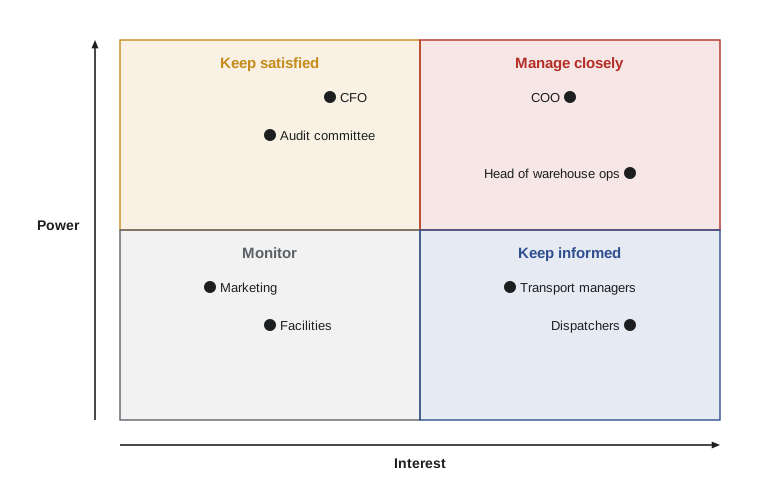
# Place stakeholders on a power/interest grid and suggest an engagement approach
stakeholders = [
    # name, power (1-10), interest (1-10)
    ("Chief operating officer", 9, 8),
    ("Head of warehouse operations", 7, 9),
    ("Chief financial officer", 9, 4),
    ("Board audit committee", 8, 3),
    ("Dispatchers", 3, 9),
    ("Transport managers", 4, 7),
    ("Facilities team", 3, 3),
    ("Marketing", 4, 2),
    ("Cloud provider account team", 5, 6),
]
approach = {(True, True): "manage closely", (True, False): "keep satisfied",
            (False, True): "keep informed", (False, False): "monitor"}
for name, p, i in sorted(stakeholders, key=lambda s: (-s[1], -s[2])):
    q = approach[(p >= 6, i >= 6)]
print(f"{name:<30} power {p:>2} interest {i:>2} -> {q}")Chief operating officer power 9 interest 8 -> manage closely Chief financial officer power 9 interest 4 -> keep satisfied Board audit committee power 8 interest 3 -> keep satisfied Head of warehouse operations power 7 interest 9 -> manage closely Cloud provider account team power 5 interest 6 -> keep informed Transport managers power 4 interest 7 -> keep informed Marketing power 4 interest 2 -> monitor Dispatchers power 3 interest 9 -> keep informed Facilities team power 3 interest 3 -> monitor
A grid is a starting point, not a verdict. It should be revisited regularly and combined with richer information: each stakeholder's goals, concerns, preferred communication style, current satisfaction and the history of the relationship.
Relationship managers
Many organizations appoint business relationship managers (BRMs) to lead relationship management with major stakeholder groups. A BRM for operations at Larchmont would know the operations strategy, attend operations leadership meetings, understand the pressures on dispatchers and warehouse supervisors, and represent their needs inside LTS. The BRM is not a salesperson or a messenger. Effective BRMs combine business understanding, technical literacy, facilitation skills, credibility on both sides and the ability to deliver bad news honestly.
The BRM role overlaps with service level management and service owners, and organizations should clarify the boundaries. A common split is that the BRM handles strategic and tactical relationship issues across all services used by a stakeholder group, service level managers handle agreements and reviews for particular services, and service owners are accountable for individual services. In smaller organizations, one person may play several of these roles.
| Role | Focus | Typical questions |
|---|---|---|
| Business relationship manager | The whole relationship with a stakeholder group | What are your plans? How can technology help? How are we doing overall? |
| Service level manager | Agreements and performance for services | Are the targets right? Did we meet them? What needs to change? |
| Service owner | Accountability for a specific service | Is this service delivering value? What should its roadmap be? |
| Service desk | Day-to-day contact with users | What do you need right now? |
Relationship maturity
Relationships between providers and consumers vary in depth. ITIL-130 described basic, cooperative and partnership relationships. In a basic relationship, the provider is an order-taker: the consumer specifies what it wants and the provider delivers. In a cooperative relationship, the parties share information and work together on specific outcomes. In a partnership, they share goals and risks and plan together. Relationship management helps move relationships toward the depth that suits them. Not every relationship needs to be a partnership: a stakeholder that uses only a standard email service may be best served by a basic, well-run relationship.
One useful way to judge relationship maturity is to look at when the provider learns about business plans. If LTS learns about a new distribution center when the operations team asks for network connections two weeks before opening, the relationship is basic. If LTS is involved when the site is chosen, the relationship is closer to a partnership.
Managing demand and priorities together
Stakeholders always want more than the provider can deliver. Relationship management helps stakeholders make trade-offs together rather than competing for attention. Techniques include shared roadmaps that show what is planned for each stakeholder, joint prioritization sessions using methods such as weighted shortest job first from lesson 1, transparent capacity information and regular portfolio reviews. When stakeholders see the whole picture, they are more likely to accept that their request is not first in line.
Worked problem
Brokering competing priorities
Finance wants a new month-end reporting tool and operations wants its scanner refresh brought forward. LTS has capacity for one major project this quarter. How should the relationship manager handle it?
Show solution
- Gather the facts: business value, deadlines, risks and effort for each request.
- Bring the two leaders together, ideally with the executive sponsor who sets priorities across both.
- Present the trade-off openly, for example using WSJF scores, and discuss risks such as scanners falling out of vendor support.
- Agree a decision and a plan for the other request, record it and communicate it to both teams.
Answer: The relationship manager does not decide alone or let the louder voice win. They broker an informed decision by the right people and make sure both parties understand and accept it.
Handling conflict, complaints and compliments
Conflicts arise between providers and stakeholders and between stakeholders themselves. Common sources include unmet expectations, competing priorities, cost allocation, poor communication and blame after incidents. Relationship managers address conflict early, listen to understand each party's interests rather than their stated positions, separate people from problems, look for options that serve both sides and escalate only when necessary.
Complaints and compliments are valuable relationship information. A complaint handled well can strengthen a relationship; one ignored can poison it. Good practice is to acknowledge complaints quickly, investigate fairly, explain what happened and what will change, and follow up to check the stakeholder is satisfied. Compliments should be passed to the people involved and analyzed for what went right. Both should feed continual improvement.
| Step | Good practice for complaints |
|---|---|
| Acknowledge | Respond quickly and thank the person for raising it |
| Understand | Listen to what happened and what impact it had |
| Investigate | Find the facts and causes without defensiveness |
| Respond | Explain findings, apologize where appropriate, describe actions |
| Act | Carry out improvements and record them in the register |
| Follow up | Check that the stakeholder is satisfied and the fix worked |
Measuring relationship health
Relationship health is harder to measure than availability, but it can be assessed. Measures include stakeholder satisfaction surveys, often short and periodic; the timeliness of involvement in business plans; the number and severity of escalations; the share of commitments kept; net promoter or similar scores from key stakeholders; and qualitative feedback from relationship conversations. Some organizations combine several indicators into a relationship scorecard reviewed with each major stakeholder.
# A simple relationship health scorecard combining several indicators (invented data)
weights = {"satisfaction": 0.30, "commitments kept": 0.25, "early involvement": 0.20,
           "escalations (inverse)": 0.15, "review attendance": 0.10}
groups = {
    "Operations": {"satisfaction": 3.4 / 5, "commitments kept": 0.78, "early involvement": 0.40,
                   "escalations (inverse)": 1 - 9 / 20, "review attendance": 0.92},
    "Finance":    {"satisfaction": 4.2 / 5, "commitments kept": 0.91, "early involvement": 0.75,
                   "escalations (inverse)": 1 - 2 / 20, "review attendance": 0.83},
    "Sales":      {"satisfaction": 3.9 / 5, "commitments kept": 0.85, "early involvement": 0.55,
                   "escalations (inverse)": 1 - 4 / 20, "review attendance": 0.58},
}
for g, ind in groups.items():
    score = sum(weights[k] * ind[k] for k in weights) * 100
    weakest = min(weights, key=lambda k: ind[k])
print(f"{g:<11} health {score:5.1f}/100 weakest indicator: {weakest} ({ind[weakest]:.2f})")Operations health 65.3/100 weakest indicator: early involvement (0.40) Finance health 84.8/100 weakest indicator: early involvement (0.75) Sales health 73.4/100 weakest indicator: early involvement (0.55)
The scorecard suggests that the relationship with operations is the weakest, mainly because LTS is involved late in operations planning. That finding is more useful than the score itself: it points to an action, such as the BRM joining operations planning meetings.
Public-sector and external stakeholders
Public-sector providers have additional stakeholders and obligations. A state agency's IT organization must manage relationships with the governor's office, legislative committees, inspectors general and state auditors, unions, tribal governments and the public, as well as with internal program areas. Federally, the 21st Century Integrated Digital Experience Act and OMB guidance set expectations for customer-centered digital services and for engaging users.
For external customers, relationship management overlaps with account management in the commercial sense. The ITIL view is broader: the aim is not only to sell more but to co-create value over the long term.
Connections to other practices
Relationship management connects with service level management, which formalizes expectations; portfolio management, which decides which services and projects to invest in; business analysis, which elicits requirements; supplier management, which manages relationships with suppliers (lesson 9); continual improvement, which acts on feedback; and the service desk, whose daily contacts shape how users feel. A provider whose relationship managers know nothing about current incidents or supplier issues will struggle to be credible.
Common mistakes
MistakeThinking relationship management is only about customers.
InsteadIt covers all stakeholders, including users, sponsors, suppliers, regulators and internal teams.
MistakeTreating the BRM as a messenger who passes requests to IT.
InsteadThe BRM understands needs, translates, brokers priorities, advocates and follows through.
MistakeLetting the loudest stakeholder win priority contests.
InsteadBroker informed decisions using transparent criteria and the right decision makers.
MistakeAiming for partnership with every stakeholder.
InsteadDevelop each relationship to the depth that suits it.
MistakeIgnoring complaints or compliments.
InsteadHandle complaints promptly and fairly, pass on compliments and feed both into improvement.
Summary and key terms
- Relationship management establishes and nurtures links between the organization and its stakeholders at strategic and tactical levels.
- It identifies, analyses, monitors and improves relationships with and between stakeholders.
- Power and interest grids help decide how to engage each stakeholder, but must be revisited.
- Business relationship managers understand, translate, broker, advocate and follow through.
- Relationships range from basic to cooperative to partnership; each should reach the depth that suits it.
- Conflict, complaints and compliments, handled well, strengthen relationships and feed improvement.
- Relationship health can be assessed through satisfaction, commitments kept, early involvement and escalations.
- Relationship management
- The practice of establishing and nurturing links between the organization and its stakeholders.
- Stakeholder
- A person or organization with an interest or involvement in an organization, product, service or practice.
- Power and interest grid
- A tool that groups stakeholders by their power and interest to guide engagement.
- Business relationship manager
- A role that leads the relationship with a major stakeholder group.
- Basic relationship
- A relationship in which the provider mainly fulfills the consumer's specified requests.
- Partnership
- A relationship in which parties share goals, risks and planning.
- Brokering
- Helping stakeholders reach informed agreement on competing priorities.
- Relationship scorecard
- A set of indicators used to assess and discuss relationship health.
- Escalation
- Raising an issue to higher authority because it is not being resolved satisfactorily.
- Shared roadmap
- A plan showing upcoming work for stakeholders, used to discuss priorities openly.
Practice problems
Work each problem on paper first, then reveal the answer to check.
State the purpose of relationship management in plain words.
Show answer
To establish and nurture the links between the organization and its stakeholders at strategic and tactical levels.
Name four types of stakeholder for an internal IT provider.
Show answer
Any four of: executives, business unit leaders, users, suppliers, auditors, regulators, IT staff, external customers.
How should a high-power, low-interest stakeholder be engaged?
Show answer
Keep satisfied: concise updates and early warning of issues that might draw their attention.
What distinguishes a BRM from a service level manager?
Show answer
The BRM handles the whole relationship with a stakeholder group; the service level manager handles agreements and performance for services.
Give a sign that a relationship is basic rather than a partnership.
Show answer
The provider learns of business plans only when requests arrive shortly before they are needed.
How should a relationship manager handle two stakeholders competing for one slot?
Show answer
Gather facts, bring the parties and sponsor together, present trade-offs transparently, agree and communicate a decision.
List the steps for handling a complaint.
Show answer
Acknowledge, understand, investigate, respond, act and follow up.
Name three measures of relationship health.
Show answer
Any three of: satisfaction, commitments kept, early involvement, escalations, NPS, review attendance, qualitative feedback.
Does every relationship need to become a partnership?
Show answer
No; each should reach the depth that suits it.
In which ITIL 4 group is relationship management?
Show answer
General management practices, and Version 5 summaries keep it there.
Lesson quiz · 5 questions
Score 60% or more to complete this lesson.
Create a free account to save your progress, take quizzes and earn a certificate.