
LES-104 · Lesson 1 of 12 · 23 min
Communication in police work: why words matter
▶ Video coming soon A video version of this lesson is on the way.
On the first evening of the course, Professor Ray Desjardins puts a single page on the screen. It is a report he wrote as a young officer, thirty years ago, about a bar fight on Harbor Street in Port Ardent. He has kept it, he says, because it is the worst thing he ever wrote. The narrative says that 'the accused male became aggressive and a physical altercation ensued.' It does not say who threw the first punch, what the man said, how far apart the two men were standing, or what the officer saw with his own eyes rather than heard from the bartender. Eight months later, at trial, the defense lawyer asked him what 'became aggressive' meant. He could not remember. The charge was dismissed. 'I was a good street cop,' he tells the class, 'and none of it mattered, because the only thing the court ever saw of my work was that page.'
This course is about the part of police work that the public rarely sees and that new officers often underestimate: communication. Students in the criminal justice program at Maumee Valley Community College usually arrive expecting to learn about patrol, investigations and arrest. They are often surprised to learn how much of an officer's shift is spent talking, listening, writing and reading. An officer communicates with callers, victims, witnesses, suspects, supervisors, dispatchers, prosecutors, judges and the public, and almost every one of those exchanges leaves a written trace. This lesson explains why communication sits at the center of the job and introduces the skills the rest of the course develops.
How much of policing is communication?
Studies of what patrol officers actually do have found the same thing for decades. Most calls for service do not involve crime in progress. They involve disputes, disturbances, people in crisis, collisions, alarms, complaints and requests for help, and they are resolved mainly by talking. Even when an arrest is made, the arrest itself may take a few minutes, while the paperwork that follows can take hours. Research in several countries has found that officers spend somewhere between a fifth and a third of their working time on administrative tasks, most of it writing and filing reports, and that report writing is one of the parts of the job officers most often say they were least prepared for.
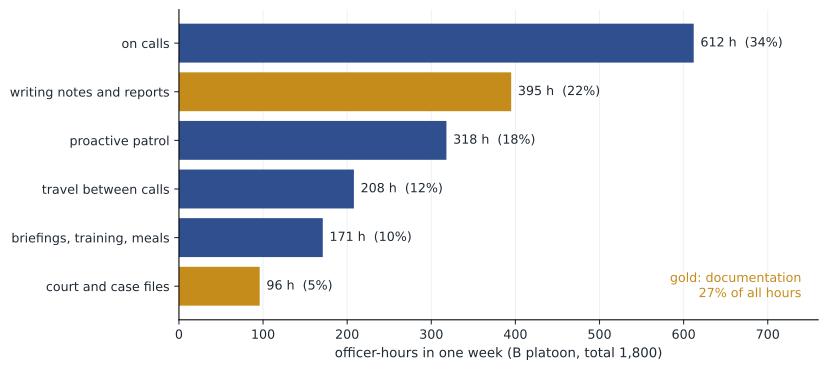
Port Ardent's own records tell the same story. Sergeant Lisa Haddad, who supervises B platoon, keeps a simple log of how her officers spend their twelve-hour shifts. Her figures come from the computer-aided dispatch system, which records when officers are assigned to calls and when they clear, and from the records management system, which shows when reports are opened and submitted. The code below summarizes a typical week for her platoon.
# B platoon, one week: officer-hours by activity (from CAD and RMS time stamps)
hours = {
    "on calls (talking, assessing, resolving)": 612,
    "writing notes and reports": 395,
    "proactive patrol": 318,
    "court, disclosure and case files": 96,
    "briefings, training and meals": 171,
    "travel between calls": 208,
}
total = sum(hours.values())
print(f"total officer-hours: {total}")
for task, h in sorted(hours.items(), key=lambda kv: -kv[1]):
    print(f"  {task:42s} {h:4d}  {h / total:6.1%}")
paper = hours["writing notes and reports"] + hours["court, disclosure and case files"]
print(f"documentation of every kind: {paper} hours, {paper / total:.1%} of the week")
print(f"per officer per 12-hour shift: about {paper / total * 12:.1f} hours")total officer-hours: 1800 on calls (talking, assessing, resolving) 612 34.0% writing notes and reports 395 21.9% proactive patrol 318 17.7% travel between calls 208 11.6% briefings, training and meals 171 9.5% court, disclosure and case files 96 5.3% documentation of every kind: 491 hours, 27.3% of the week per officer per 12-hour shift: about 3.3 hours
More than a quarter of the platoon's time went to writing and case files, a little over three hours of every twelve-hour shift. Calls themselves took the largest share, and most of that time was spent talking with people. When the two are combined, communication in one form or another fills most of an officer's working day. Sergeant Haddad uses these figures when she explains to new officers why she returns reports that are unclear: a report that has to be rewritten costs time that could have been spent on patrol, and a report that is never rewritten may cost a case.
The many audiences of police communication
An officer's words travel much further than the person in front of them. A note jotted in a notebook at 2 a.m. may be read by a supervisor in the morning, by a detective a week later, by a Crown attorney or prosecutor deciding whether to lay or approve a charge, by a defense lawyer looking for weaknesses, by a judge or jury at trial, by an insurance adjuster, by an oversight body investigating a complaint and, in some cases, by journalists or the public. Each of these readers wants something different. The supervisor wants to know that the call was handled properly. The detective wants facts to follow up. The prosecutor wants evidence of each element of the offense. The defense wants inconsistencies. The court wants an accurate, honest account.
Because a single document serves all of these readers, police writing has to meet a demanding standard. It must be complete enough for the detective, precise enough for the prosecutor, fair enough to survive the defense and clear enough for a juror with no police experience. Professor Desjardins sums it up with a rule he learned from his first training officer: write every report as if it will be read aloud in court, by someone who does not like you, in front of the person you arrested.
| Reader | What the reader needs | What goes wrong when the report is weak |
|---|---|---|
| Supervisor | Evidence the call was handled lawfully and according to policy | Missed training needs, unnoticed risks, complaints that cannot be answered |
| Investigator | Names, times, observations and leads to follow up | Witnesses lost, evidence not collected, work repeated |
| Prosecutor | Facts that prove each element of the offense | Charges not approved, weak cases, plea bargains on poor terms |
| Defense lawyer | Gaps, contradictions and opinions presented as fact | Officer discredited in cross-examination, evidence excluded |
| Court | An honest, accurate, complete account | Acquittals, findings that the officer was not credible |
| Oversight bodies and the public | Transparency and accountability | Loss of trust, adverse findings, discipline |
Communication and legitimacy
Communication matters for another reason that goes beyond paperwork. In the first course you studied procedural justice, the finding that people judge police less by the outcome of an encounter than by whether they were treated fairly. Four elements make up procedural justice: giving people a voice, being neutral and transparent in decisions, treating people with dignity and respect, and showing trustworthy motives. Every one of them is delivered through communication. An officer who explains why a car was stopped, listens to the driver's side, speaks courteously and explains what happens next can issue a ticket and still leave the driver with a better view of the police. An officer who barks orders, ignores questions and gives no reasons can let a driver go with a warning and still leave resentment behind.
The same research shows that the way officers communicate affects safety. Clear, calm, respectful language tends to reduce resistance, while confusing or contradictory commands increase it. Later in the program you will study de-escalation in depth. For now, the important point is that the skills taught in this course, listening carefully, speaking clearly and recording accurately, are not separate from good street policing. They are part of it.
Linh Tran, who hopes to work in a communications center, adds a perspective from her own family. Her cousin Bao was stopped four times in one year while walking home from work. He was never charged. What he remembers is not the stops themselves but that, on three of the four occasions, nobody told him why he had been stopped. On the fourth, the officer explained that a break-in had just been reported nearby and that Bao matched the clothing description, thanked him for his patience and let him go. 'He still did not enjoy it,' Linh says, 'but that was the one he did not complain about.'
The written record and the law
Police officers do not write for their own convenience. The law expects them to keep records, and the courts rely on those records. In the United States, department policies, state standards and court rules require officers to document their work, and under the rules that follow from Brady v. Maryland (1963) and Giglio v. United States (1972) prosecutors must give the defense evidence favorable to the accused, including information that could be used to challenge an officer's credibility. Officers' notes and reports are among the first things requested in discovery.
These rules mean that every word an officer writes may be examined by the other side. They also mean that what is left out can matter as much as what is put in. A report that leaves out a fact helpful to the accused, such as a witness who said the suspect was not the man who threw the punch, can lead to a stay of proceedings, a mistrial or a wrongful conviction. An officer who is found to have written something false can lose credibility in every future case. Later lessons look closely at notes, reports, statements and court testimony. In each, the same principle applies: the record must be accurate, complete and honest.
Barriers to clear communication
Communication fails in predictable ways, and much of this course is about recognizing those failures before they happen. Some barriers come from the situation itself. Calls are often noisy, frightening and fast-moving. People are drunk, injured, angry, grieving or in crisis. Witnesses disagree. Officers are tired at the end of a long shift and under pressure to clear the call and take the next one. Other barriers come from language and culture. Port Ardent residents speak more than fifty languages, and some newcomers have learned to fear police in the countries they left. Some people are deaf or hard of hearing, have speech or intellectual disabilities, or are autistic, and communicate in ways an untrained officer may misread.
Still other barriers come from the officer. Police develop a professional vocabulary that is efficient among colleagues but confusing to everyone else, and they can slip into it without noticing. Officers can also hear what they expect to hear. A sergeant who has attended twenty domestic calls at the same address may stop listening to what is said at the twenty-first. Each of these barriers can be reduced with training and habits, which later lessons cover: interviewing techniques, interpreters and accessible communication, plain language, careful note-taking and structured radio procedure.
A simple model helps organize these ideas. Communication involves a sender who encodes a message, a channel through which it travels, a receiver who decodes it and feedback that tells the sender whether the message was understood. Noise can interfere at every step. On a radio, noise is literal static and other traffic. In an interview, it may be fear, a language gap or a distracting setting. In a report, it may be jargon, vague wording or missing context. Feedback is the step most often skipped. Good communicators check that they have been understood, by asking a witness to repeat directions, by reading back a license plate over the radio, or by having a colleague read a draft report before it is submitted.
The skills this course develops
The rest of the course follows the path of a typical incident from the street to the courtroom. Lessons 2 and 3 cover officers' notes and the observation and memory that go into them. Lessons 4, 5 and 6 cover writing incident reports: structure, plain language and the precise description of people, vehicles, property and scenes. Lessons 7 and 8 turn to interviewing and taking statements from victims, witnesses and complainants. Lesson 9 covers radio procedure and working with the communications center, and lesson 10 covers spoken communication with the public, including people who face communication barriers. Lesson 11 explains how notes and reports are disclosed and used in court, and lesson 12 brings everything together in a complete report package.
Throughout the course, you will follow one incident in detail: a break-in at Lakeshore Hardware on Harbor Street in Port Ardent, reported by a burglar alarm at 2:14 on a Saturday morning in March. Constable Dev Malhotra and a probationary officer respond. A neighbor in an upstairs apartment saw a man run from the store, the owner arrives to check the damage, and a suspect is found three blocks away. You will see the notes, radio traffic, reports, interviews and court testimony that this single call produces, and you will practice writing many of them yourself. The class's five students, Amara Okafor, Jesse Morningstar, Priya Sandhu, Marco DiSanto and Linh Tran, will each take on part of the work.
Worked problem
Who will read this note?
At 2:31 a.m., Constable Malhotra writes in her notebook: 'Male seen running E on Harbor from store. Neighbor says white hoodie.' List the readers who may eventually see this line and one question each might ask about it.
Show solution
- The supervisor may ask whether the description was broadcast to other units and how quickly.
- The investigator may ask who the neighbor is, where exactly she was standing and how she can be contacted.
- The prosecutor may ask whether the neighbor saw the man leave the store itself or only saw him running on the street, which matters for identification.
- The defense lawyer may ask how far away the neighbor was, what the lighting was like and whether 'white hoodie' was her word or the officer's.
- The court will want to know what the officer observed personally and what she was told.
Answer: Even a two-line note will be read by several people with different purposes. A better note records the neighbor's name and location, her exact words in quotation marks, the time she gave and the source of each fact, so that every later reader can rely on it.
Common mistakes
MistakeReport writing is a clerical task separate from real police work.
InsteadReports are often the only part of an officer's work that a prosecutor, judge or jury ever sees; poor writing can lose a case that good police work built.
MistakeCommunication is mainly about speaking clearly.
InsteadListening, checking understanding and recording accurately matter just as much as speaking.
MistakeA short report is a good report.
InsteadA good report is as long as it needs to be to record every relevant fact clearly; brevity that leaves out facts is a weakness.
MistakeOnly the officer's supervisor will read the notes.
InsteadNotes may be read by investigators, prosecutors, defense lawyers, courts and oversight bodies, and must be written with all of them in mind.
Summary and key terms
- Officers spend much of every shift communicating: on calls, which are resolved mostly by talking, and on notes, reports and case files.
- A single police record serves many readers, including supervisors, investigators, prosecutors, defense lawyers, courts and oversight bodies.
- Procedural justice, which builds public trust, is delivered through communication: voice, neutrality, respect and trustworthy motives.
- The law requires accurate records, and disclosure rules mean the defense will see officers' notes and reports.
- Barriers to communication come from the situation, from language, culture and disability, and from the officer's own jargon and assumptions.
- The communication loop of sender, message, channel, receiver and feedback shows where misunderstandings arise; checking understanding closes the loop.
- Procedural justice
- Fair treatment in encounters with authorities, made up of voice, neutrality, respect and trustworthy motives.
- Disclosure
- The process by which the prosecution gives the defense the relevant information it holds, including officers' notes and reports; in the United States it is usually called discovery.
- Computer-aided dispatch (CAD)
- The system that records calls for service, unit assignments and time stamps.
- Records management system (RMS)
- The database in which police reports and case records are written, stored and retrieved.
- Feedback
- The response that tells a sender whether a message was understood.
- Noise
- Anything that interferes with sending or understanding a message.
Practice problems
Work each problem on paper first, then reveal the answer to check.
Give three readers, other than the officer's supervisor, who may read a police report.
Show answer
For example an investigator, a prosecutor, a defense lawyer, a judge, a jury, an oversight body or an insurance adjuster.
A platoon logs 1,800 officer-hours in a week, of which 450 are spent on notes, reports and case files. What share is that, and how many hours is it per 12-hour shift?
Show answer
450 / 1,800 = 25%; 0.25 x 12 = 3 hours per shift.
Name the four elements of procedural justice.
Show answer
Voice, neutrality, respect and trustworthy motives.
Why does leaving a fact out of a report matter as much as writing something wrong?
Show answer
Because the defense is entitled to relevant information, and a missing fact, especially one helpful to the accused, can damage the case and the officer's credibility.
Give an example of feedback in radio communication.
Show answer
Reading back a license plate or address so the dispatcher can confirm it was heard correctly.
Lesson quiz · 5 questions
Score 60% or more to complete this lesson.
Create a free account to save your progress, take quizzes and earn a certificate.