
LES-104 · Lesson 6 of 12 · 23 min
Describing people, vehicles, property and scenes
▶ Video coming soon A video version of this lesson is on the way.
At 2:22 a.m. on the night of the Lakeshore Hardware break-in, Constable Malhotra keys her radio and broadcasts a description to every unit in Port Ardent. What she says in the next fifteen seconds will decide who gets stopped. If it is too vague, officers may stop half the young men walking home from the bars on Harbor Street. If it is wrong, they may let the right man walk past. Seven minutes later a unit on Pine Street finds a man who matches what she said, and the case turns, as so many cases do, on how well the description was taken and how well it was given.
Descriptions run through every stage of police work: in radio broadcasts, in notes, in reports, in witness statements and in court. This lesson covers how to describe people, vehicles, property and scenes in a way that is accurate, complete, consistent and fair. It also covers the sketches and photographs that support written descriptions of scenes. The underlying skill is the one introduced in lesson 3: separating what was observed from what was assumed, and recording how each detail was obtained.
Describing people
A description of a person is useful only if it helps someone pick that person out from others. Some features are much more useful than others. Height, build and age range narrow the field, but many people share them. Distinctive features, such as a scar, a tattoo, an unusual hairstyle, a limp or a particular jacket, can identify a person almost on their own. Clothing is useful in the first hour, while the person is probably still wearing it, but much less useful the next day. The best descriptions combine general features with at least one distinctive one.
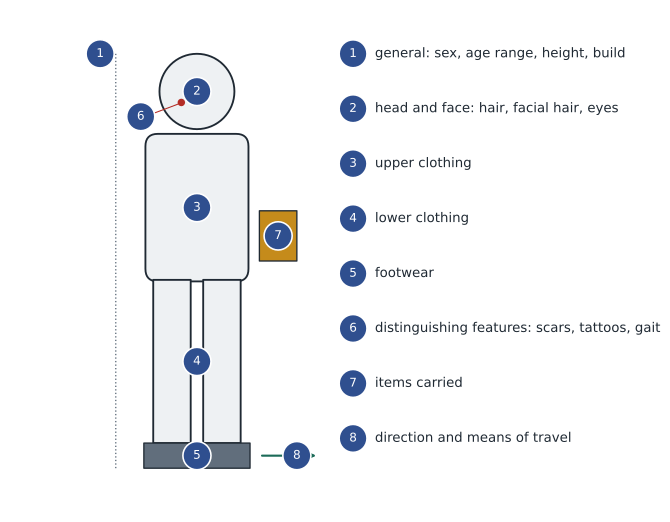
Officers are taught to describe people in a fixed order, so that nothing is missed and so that listeners know where each detail will come. A common order starts with general features and works from head to toe:
- General: sex or gender as perceived, apparent age range, height, build and complexion. Give height and weight as ranges and say how they were estimated.
- Head and face: hair (color, length, style), facial hair, eyes and glasses, shape of face, and any marks such as scars, piercings or tattoos.
- Clothing, top to bottom: headwear, outer layer, upper body, lower body, footwear, with colors, logos and any damage or stains.
- Distinguishing features: tattoos, scars, birthmarks, missing teeth, a limp or an unusual way of walking, an accent or speech pattern, jewelry.
- Items carried: bags, weapons, phones, bicycles.
- Direction and means of travel: on foot, by bicycle or in a vehicle, and which way.
Race and ethnicity are among the most sensitive parts of a description. They can help identify a person, but descriptions that rely mainly on race, such as 'a young Black man in a hoodie', cast suspicion on large numbers of innocent people and have contributed to unfair stops. Many police services now follow guidelines that a description should not be broadcast or acted on unless it contains enough other detail to distinguish the person, and that race should be described only as part of a fuller description. Many US agencies have adopted policies, often prompted by community complaints, against broadcasting descriptions that consist mainly of race, sex and generic clothing, and some states require the collection of race data on stops. Jesse Morningstar points out that a description such as 'Native male, long hair' would fit half his cousins.
When the description comes from a witness, the officer should record the witness's own words where possible, and should not translate them into police terms. If a witness says 'he was kind of chunky', the report should say so, perhaps followed by the officer's question and the answer: 'I asked her to compare his build to mine. She said he was heavier than me.' The witness's conditions of observation, which lesson 3 described, belong with the description: distance, lighting, duration and anything that obstructed the view.
Taking a description from a witness
Witnesses rarely give a description in a neat order. They start with whatever made the strongest impression, often the most distinctive feature or the most frightening one, such as a weapon. The officer's job is to let the witness tell it in their own way first, then to fill in the gaps with open, non-leading questions. Lesson 7 covers interviewing in detail, but a few principles apply here. Ask open questions: 'What was he wearing?' rather than 'Was he wearing a jacket?' Use reference points: 'Was he taller or shorter than me?' Ask about distinctive features directly but neutrally: 'Did you notice anything unusual about him?' And ask how confident the witness is in each detail, recording the answer.
When several witnesses saw the same person, each description should be taken separately and recorded separately. Officers should resist the temptation to combine them into a single 'best' description in the notes. Differences between witnesses are normal and are themselves evidence. A broadcast description, by contrast, may need to combine what witnesses agree on, and the officer should broadcast only the details that are consistent or that come from the best-placed witness, noting the uncertainty: 'possibly in his twenties, height uncertain, estimates from 5 ft 7 in to 6 ft 1 in.'
Describing vehicles
Vehicles are often described using a mnemonic. One widely taught version is CYMBAL: color, year, make, body style, anything distinctive and license plate. Another is CMYLD or similar orders. The specific mnemonic matters less than describing every vehicle in the same order every time.
| Element | What to record | Example |
|---|---|---|
| Color | Main color, and two-tone or primer patches | Dark blue with gray primer on the driver's door |
| Year | Model year or range, if known | About 2012 to 2016 |
| Make and model | Manufacturer and model, if known | Honda Civic |
| Body style | Sedan, hatchback, pickup, van, SUV, number of doors | Four-door sedan |
| Anything distinctive | Damage, stickers, roof racks, aftermarket wheels, tinted windows, noisy exhaust | Cracked windshield, missing front hubcap |
| License plate | Province or state, characters, and any partial plate | Ohio plate starting HKR |
License plates are often the single most valuable detail, and witnesses frequently remember only part of a plate. A partial plate combined with a make, model and color can still narrow a search to a handful of vehicles in the registration database. When a witness gives a partial plate, the officer should record exactly what was given, including the characters the witness was unsure of, rather than guessing the rest. On the radio, plates are read using the phonetic alphabet, which lesson 9 covers, so that similar-sounding letters are not confused.
Matching a description
Officers who stop someone on the strength of a broadcast description must be able to explain, in their report and in court, how that person matched it. The match is rarely perfect, and courts look at the whole picture: how specific the description was, how many features matched, whether any features clearly did not match, and how close in time and place the person was to the offense. The officer who stopped the man on Pine Street wrote down the broadcast description and the man's appearance side by side. A short program can do the same comparison and make the reasoning visible.
# Compare a stopped person with the broadcast description
broadcast = {
    "sex": "male", "age": "20s", "top": "white hoodie, hood up",
    "bottoms": "dark pants", "carrying": "unknown", "direction": "east toward Pine",
}
observed = {
    "sex": "male", "age": "23 (from ID)", "top": "white hoodie, hood down",
    "bottoms": "black jeans", "carrying": "black backpack, heavy",
    "direction": "walking north on Pine, 3 blocks east of store",
}
verdicts = {
    "sex": "match", "age": "match", "top": "match (hood now down)",
    "bottoms": "match (dark)", "carrying": "new detail, not in broadcast",
    "direction": "consistent with route",
}
for k in broadcast:
    print(f"{k:9s} broadcast: {broadcast[k]:24s} observed: {observed[k]:42s} -> {verdicts[k]}")
matches = sum(v.startswith(("match", "consistent")) for v in verdicts.values())
print(f"{matches} of {len(verdicts)} features match or are consistent; none contradict")
minutes_after, blocks_away = 15, 3
print(f"found {minutes_after} minutes after the alarm, {blocks_away} blocks from the store")sex broadcast: male observed: male -> match age broadcast: 20s observed: 23 (from ID) -> match top broadcast: white hoodie, hood up observed: white hoodie, hood down -> match (hood now down) bottoms broadcast: dark pants observed: black jeans -> match (dark) carrying broadcast: unknown observed: black backpack, heavy -> new detail, not in broadcast direction broadcast: east toward Pine observed: walking north on Pine, 3 blocks east of store -> consistent with route 5 of 6 features match or are consistent; none contradict found 15 minutes after the alarm, 3 blocks from the store
The comparison shows five of six features matching or consistent with the broadcast and none contradicting it, and the man was found fifteen minutes after the alarm, three blocks away, on the route the witness described. That is a reasonable basis for an investigative detention. On its own, however, a white hoodie on a young man in a bar district on a Saturday night is weak, which is why the time, place and direction matter so much, and why the backpack, a new detail, had to be investigated before the officer could form grounds to arrest. The report should set out exactly this reasoning, including the features that changed (the hood was down) and the details that were not in the broadcast.
Describing property
Property descriptions serve two purposes: to identify items that were stolen, lost or found, and to link items in police possession to a particular person or crime. A good description includes everything that distinguishes one item from others of the same kind: type, brand, model, color, size, serial number, quantity, condition and any marks, engravings or damage. Serial numbers are the most valuable detail because they are unique. Owners should be asked for receipts, photographs or the original packaging, which often carry serial numbers, and for distinctive damage or modifications only the owner would know.
In the Lakeshore Hardware case, the owner, Ruth Lindqvist, gave officers a list of the tools missing from the display: four cordless drills, two impact drivers and a reciprocating saw, all of one brand, with the store's price labels attached. The backpack the suspect carried held three drills and the saw. The report records each item by brand, model and serial number and notes that the serial numbers match the store's receiving records for that week's delivery. 'Power tools' would have been useless in court; four serial numbers are nearly conclusive. Cash, jewelry and drugs require particular care. Cash should be counted, ideally by two officers, and recorded by denomination. Jewelry should be described without assuming value or material: 'yellow metal ring with clear stone', not 'gold diamond ring', unless the officer knows. Drugs should be described by appearance, packaging and weight, not by what the officer believes them to be, until they are tested.
Describing scenes
A scene description gives a reader who was not there a picture of the place where an incident happened. The usual approach is to work from the general to the specific: the location and surroundings, the building or area, then the particular room or spot, then the items within it. Weather, lighting, time of day and any changes made to the scene before or after police arrived should be recorded, because they may later matter. Officers should note anything they themselves moved or touched, such as turning on a light or opening a door to check for injured people.
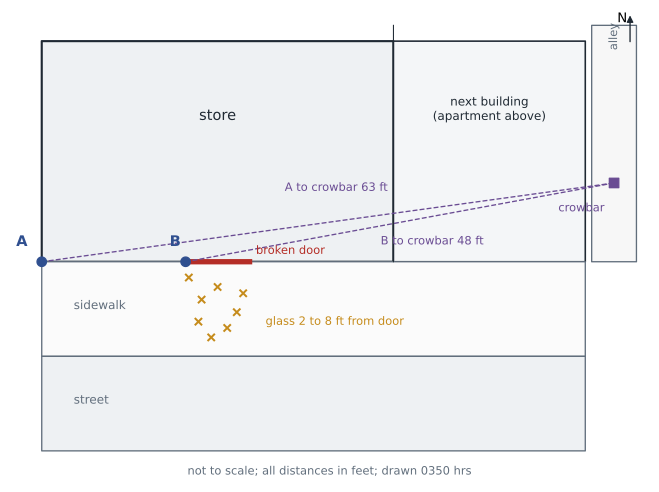
Written descriptions are supported by sketches and photographs. A sketch shows the layout and the position of important features and evidence, with measurements. It need not be artistic, but it should be accurate and should include a north arrow, a scale or measurements, a legend, the date, time and the name of the person who drew it. Measurements are commonly taken from fixed reference points, such as the corner of a building, using one of two methods: the baseline method, in which items are located by their distance along and perpendicular to a measured line, and triangulation, in which each item is located by its distance from two fixed points.
Photographs should be taken in a logical sequence, from overall views that show where the scene is, to mid-range views that show how items relate to each other, to close-ups of individual items, ideally with and without a scale. A photo log records each photograph's number, time, subject and the direction it was taken from. Photographs do not replace written descriptions, because a photograph shows only what the camera captured and cannot show what the officer smelled, heard or measured, or why something was significant.
Worked problem
A complete person description
From her notes, the probationary officer has: male, about 20 to 25, white hoodie with a small red logo on the left chest, black jeans, white running shoes with a black stripe, black backpack, thin build, short dark hair, small scar through right eyebrow, walked with a slight limp. Height measured at the station: 5 ft 8 in. Write the description for the arrest report in standard order.
Show solution
- Start with general features and how height was obtained: 'Male, age 23 (from driver's license), 5 ft 8 in (measured at the station), thin build.'
- Head and face: 'Short dark hair, no facial hair, small scar through the right eyebrow.'
- Clothing, top to bottom: 'White hooded sweatshirt with a small red logo on the left chest, black jeans, white running shoes with a black stripe.'
- Distinguishing features and items: 'Walked with a slight limp on the left side. Carrying a black backpack.'
Answer: The finished description follows the standard order, records sources for age and height, and includes two distinctive features, the scar and the limp, that would help a witness or another officer identify him. It also allows a direct comparison with the witness's earlier description.
Common mistakes
MistakeA description should give the suspect's race first because it is the most visible feature.
InsteadRace alone identifies no one; lead with a full description and include distinctive features, and never act on a description too vague to distinguish one person.
MistakeCombine all witnesses' descriptions into one in the notes.
InsteadRecord each witness's description separately; differences between witnesses are evidence.
Mistake'Gold ring' and 'cocaine' are good property descriptions.
InsteadDescribe what was observed ('yellow metal ring', 'white powder in a knotted plastic bag, 3.2 g') until the item is tested or appraised.
MistakePhotographs make scene descriptions and sketches unnecessary.
InsteadPhotographs show only what the camera captured; sketches add measurements and notes add what the officer perceived.
Summary and key terms
- Useful descriptions combine general features with at least one distinctive feature and are given in a fixed order, general to specific and head to toe.
- Race should be part of a fuller description, never the main identifier; many agencies will not broadcast descriptions too vague to distinguish a person.
- Take witness descriptions separately, in the witness's own words, with open questions, reference points and conditions of observation.
- Describe vehicles in a fixed order such as CYMBAL; record partial license plates exactly as given.
- Describe property by type, brand, model, serial number, quantity and marks; describe cash, jewelry and drugs by what is observed.
- Describe scenes from general to specific and support them with measured sketches (baseline or triangulation) and a logged photo sequence.
- Distinguishing feature
- A feature, such as a scar, tattoo or limp, that helps identify a particular person.
- CYMBAL
- A vehicle description order: color, year, make, body style, anything distinctive, license plate.
- Partial plate
- Some but not all characters of a license plate.
- Triangulation
- Locating an item in a sketch by measuring its distance from two fixed reference points.
- Baseline method
- Locating items by their distance along and at right angles to a measured line.
- Photo log
- A record of each photograph's number, time, subject and direction.
Practice problems
Work each problem on paper first, then reveal the answer to check.
List the standard order for describing a person.
Show answer
General features (sex, age, height, build), head and face, clothing top to bottom, distinguishing features, items carried, direction of travel.
What does CYMBAL stand for?
Show answer
Color, year, make, body style, anything distinctive and license plate.
Why should clothing be treated as less reliable for identification the day after an offense?
Show answer
Because the person may have changed clothes; clothing is most useful soon after the event.
Describe a seized item a witness calls 'a silver watch'.
Show answer
For example: 'white metal wristwatch, round face, black dial, metal link band, engraving on back reading “To R. 2019”.'
Name two methods of locating evidence on a scene sketch.
Show answer
The baseline method and triangulation.
Lesson quiz · 5 questions
Score 60% or more to complete this lesson.
Create a free account to save your progress, take quizzes and earn a certificate.