
LES-105 · Lesson 12 of 12 · 20 min
Capstone: an ethics case portfolio and a plan for earning public trust
▶ Video coming soon A video version of this lesson is on the way.
The final assignment in Ethics and Professionalism asks each student to build an ethics case portfolio: three real or realistic cases from the student's own experience, ride-alongs or reading, each analyzed with the tools from the course, plus a short personal statement of professional values and a proposal for one change that would strengthen public trust in Port Ardent's police. Desjardins tells the class the portfolio has two audiences. One is the hiring panel that may one day ask them about an ethical dilemma, where a well-analyzed case is far more convincing than a rehearsed answer. The other is the officer each of them will be in ten years, who will face situations no course can predict and will need the habits of thought the portfolio is meant to build. This lesson walks through the portfolio's structure, shows a model case, and uses Port Ardent data to frame the trust proposal.
The structure of a case analysis
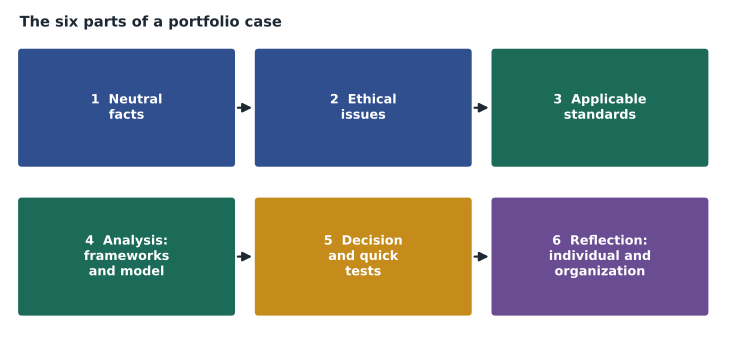
Each case in the portfolio follows the same structure, drawn from the lessons. First, a neutral description of the facts, written the way Lesson 8 taught: observations, not conclusions, with uncertainties stated. Second, identification of the ethical issues, naming them precisely: is this a question of honesty, discretion, bias, conflict of interest, use of authority, loyalty to colleagues or something else? Third, the applicable standards: law, the code of conduct, service policy and the oath. Fourth, analysis using the four frameworks from Lesson 2 and the decision model from Lesson 3, including the options available and the rationalizations that might tempt someone toward the wrong one. Fifth, a decision and the reasons for it, tested against the publicity, reversibility and precedent tests. Sixth, reflection: what made the case hard, what the student learned and what an organization could do to make the right choice easier.
Desjardins insists on the last part. Many ethics assignments stop at the individual decision, as though everything depends on personal virtue. But Lessons 7, 10 and 11 showed that culture, supervision, policy and accountability systems shape what individuals do. A strong portfolio asks not only what the officer should have done but what would make it more likely that most officers in the same position would do it.
A model case: Amara's ride-along
Amara volunteers her first case for the class to discuss. During her Friday night ride-along with Constable Dev Malhotra, described in LES-101, the shift included a bar fight. One of the men involved, visibly intoxicated, shouted insults at Malhotra and called him a racial slur. Malhotra cautioned the man and sent him home in a taxi with a friend. Afterward, in the cruiser, Amara asked why he had not arrested the man, since he had been abusive. Malhotra said that being rude to a police officer is not an offense, that the man's friend was sober and willing to take responsibility, and that arresting him would have meant hours in the station for a man who would be embarrassed in the morning. He added, more quietly, that the slur had stung, and that he had needed a minute to make sure his decision was about the law and not about his feelings.
Amara's analysis identified the main ethical issue as discretion under personal provocation, connected to Lesson 5's point that punishing disrespect confuses the officer's ego with the public interest. The applicable standards included the law on causing a disturbance and public intoxication, Port Ardent's general order on alternatives to arrest for intoxicated persons and the code of conduct's requirements on lawful use of authority. Under the frameworks, consequences favored the caution, because the man was safely removed and no one was harmed; duties were satisfied because the response was lawful and proportionate; virtue was shown in the self-control Malhotra described; and justice was served because a similar person who had not insulted the officer would have received the same treatment. The quick tests all passed. Her reflection noted that the slur was itself harmful, and that a service should support officers who are targets of abuse, for example through debriefing and through recording such incidents so that patterns can be addressed, without encouraging officers to retaliate through enforcement.
The class discussion pushed further. Linh asked whether the outcome would have been the same if the man had been Black and had insulted a white officer. Marco said it should be. Linh said that was her point: the test of Malhotra's decision is whether he would make it for everyone, and the test of the service is whether its data show that officers do. Desjardins said that was exactly the kind of organizational question he wanted the portfolios to raise.
A personal statement of professional values
The second part of the portfolio is a personal statement of no more than one page describing the values the student intends to bring to policing and how they connect to the oath and the code. Desjardins asks for specific commitments rather than general virtues. Saying I will be honest is less useful than saying I will write my notes before discussing an incident with anyone, I will record facts that help the defense, and I will correct mistakes as soon as I find them. Saying I will be fair is less useful than saying I will state the reason for every stop and I will ask myself whether I would make the same decision for anyone else. The statement is meant to be reread. Desjardins tells the class he still has his own, written at the end of his training, and that he reread it on the day he decided to report a colleague for the first time.
Jesse shares a draft of his statement with the class. He writes that he intends to police his community the way he would want his grandmother policed: with patience, with respect for its own ways of resolving conflict, and with the courage to tell his colleagues when something they are doing will damage trust that took generations to rebuild. Priya writes about honesty with money and with evidence, drawing on her bank fraud work. Marco writes about restraint and about accepting intervention from colleagues. Linh writes that she wants to be part of the system that measures fairness, so that families like hers do not have to rely on anecdotes.
Measuring trust for the proposal
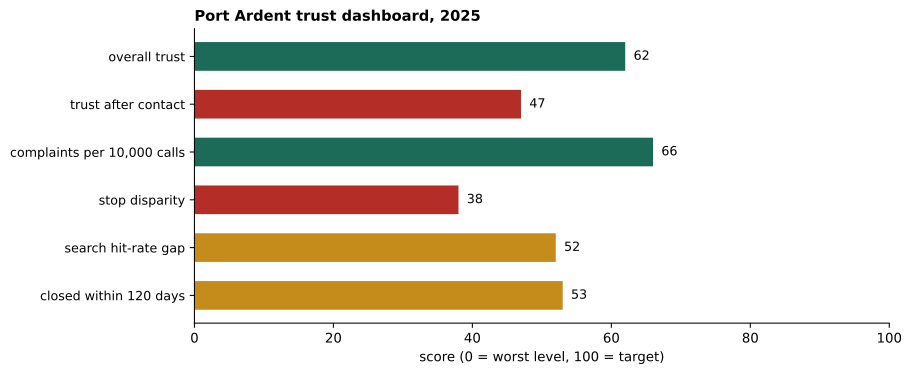
The third part of the portfolio is a proposal for one change that would strengthen public trust. To ground the proposals, Desjardins gives the class a simple trust dashboard built from indicators the course has used: the community survey, complaint figures, stop data and complaint timeliness. Each indicator is scaled from 0 to 100 against a target, so that the weakest areas stand out. The code below builds the dashboard from Port Ardent's figures. The scaling is a judgment, not a law of nature, and students are expected to explain and defend the targets they would use.
# Port Ardent trust dashboard: each indicator scaled 0 to 100 against a target (2025 figures)
indicators = [
    # name, value, worst, target, higher_is_better
    ("overall trust in survey (share)",        0.68, 0.40, 0.85, True),
    ("trust among residents with contact",     0.61, 0.40, 0.85, True),
    ("complaints per 10,000 calls",            11.8, 25.0, 5.0,  False),
    ("stop disparity, Black residents",        2.23, 3.00, 1.00, False),
    ("search hit-rate gap (white minus Black)", 0.12, 0.25, 0.00, False),
    ("investigations closed within 120 days",  0.60, 0.20, 0.95, True),
]
def scale(value, worst, target, higher):
    score = (value - worst) / (target - worst)
    return round(100 * max(0.0, min(1.0, score)))
scores = []
for name, value, worst, target, higher in indicators:
    s = scale(value, worst, target, higher)
    scores.append((s, name))
    print(f"{name:42s} value {value:6.2f}  score {s:3d}")
print("weakest areas:", ", ".join(n for s, n in sorted(scores)[:2]))overall trust in survey (share) value 0.68 score 62 trust among residents with contact value 0.61 score 47 complaints per 10,000 calls value 11.80 score 66 stop disparity, Black residents value 2.23 score 38 search hit-rate gap (white minus Black) value 0.12 score 52 investigations closed within 120 days value 0.60 score 53 weakest areas: stop disparity, Black residents, trust among residents with contact
The output shows the service's strongest areas are overall trust and complaint rates, and its weakest are the stop disparity for Black residents and trust among residents who had recent contact with police, followed by the search hit-rate gap. The disparity and the hit-rate gap point to the same underlying problem from Lesson 9, and the contact gap suggests that ordinary encounters are where trust is being lost. Several students therefore built their proposals around stops: expanding the stop receipt program, requiring supervisor review of consent searches, publishing stop and search data quarterly, and involving community members in reviewing the results. Others focused on the gap in trust among residents who had contact with police, proposing procedural justice training and follow-up calls to people who had recent contact. The best proposals, Desjardins says, define what success would look like in the dashboard a year later, so that the change can be evaluated rather than simply announced.
Bringing it together
Desjardins closes the course where he began, with the sentence on the board about citizens in uniform lent extraordinary powers. Everything in the course, he says, comes back to the conditions on that loan. The public lends officers power on the understanding that it will be used lawfully, fairly and honestly, for the public's benefit rather than the officer's, and that when it is misused there will be consequences. Frameworks, decision models, codes, discretion, honesty, fairness, intervention and accountability are all ways of keeping those conditions. Officers who keep them earn the legitimacy that makes policing work. Officers who break them, even for noble reasons, spend down a trust that belongs to every officer who will ever wear the uniform.
He then tells the class how the story of the slap in the cruiser ended. Years after he stayed silent, he became a sergeant and saw a young officer in his platoon begin to treat prisoners roughly. This time he spoke to the officer that night, documented it and arranged training. The officer went on to a long and respected career and, years later, thanked him. Desjardins says that both moments, the silence and the intervention, taught him more than any course, and that he hopes the class will need only the second kind.
| Course lesson | Key idea | Portfolio use |
|---|---|---|
| 1 Why ethics matters | Legitimacy depends on fair treatment | Explain why the case matters for trust |
| 2 and 3 Frameworks and decisions | Four frameworks and a five-step model | Structure the analysis |
| 4 and 5 Codes and discretion | Standards and consistent judgment | Identify the rules and options |
| 6 and 7 Noble cause and corruption | How good officers go wrong | Name the rationalizations |
| 8 Honesty | Records and testimony must be true | Write the neutral facts |
| 9 Bias | Patterns can be unfair even when acts are lawful | Ask whether the decision would apply to everyone |
| 10 and 11 Silence and accountability | Intervention, reporting and fair systems | Propose organizational changes |
Worked problem
Writing the neutral facts
Marco drafts the facts section for a case from his Sunday day shift ride-along, in which an officer told a man sleeping in a bus shelter to move along. His first draft reads: An aggressive homeless man was refusing to leave the shelter and the officer had to be firm with him.
Show solution
- Remove conclusions: aggressive and had to be firm are judgments, not observations.
- Describe observable facts: what the man did and said, what the officer did and said, and the time, place and weather.
- Separate observation from information from others: the bus driver's complaint that the man had been there all night is hearsay and should be attributed.
- State uncertainties: Marco did not hear the first exchange because he was still in the cruiser.
- Revise: At 08:15 on a rainy Sunday, Officer Garcia approached a man lying on the bench of the Main Street bus shelter after a bus driver reported he had been there overnight. The man sat up and said, loudly, I've got nowhere else to go. Officer Garcia told him he could not sleep in the shelter and offered a ride to the drop-in center. The man declined, picked up his bag and walked away. I did not hear their first exchange.
Answer: The revised facts let a reader judge the officer's conduct without being steered. They also reveal ethical questions the first draft hid: whether the request was lawful and necessary, whether the offer of help was genuine and adequate, and what the city provides for people with nowhere else to sleep. Neutral facts are the foundation of every good analysis.
Common mistakes
MistakeA case analysis only needs to decide what the officer should have done.
InsteadStrong analyses also ask what culture, supervision, policy and accountability systems would make the right choice more likely for most officers.
MistakeA personal values statement should list general virtues.
InsteadSpecific, practical commitments, such as writing notes before discussing an incident, are more useful and easier to keep.
MistakeA trust dashboard measures trust objectively.
InsteadIndicators and targets are judgments that must be explained; the dashboard highlights areas to examine, not final verdicts.
MistakeA proposal is complete once the change is announced.
InsteadGood proposals define measurable success so that the change can be evaluated after a set period.
Summary and key terms
- The ethics case portfolio applies every tool in the course to real or realistic cases.
- Each case follows six parts: neutral facts, issues, standards, analysis, decision and reflection.
- Reflection should address organizational factors as well as individual choices.
- A personal statement of specific professional commitments supports ethical habits over a career.
- A trust dashboard built from survey, complaint, stop and timeliness data identifies weak areas for proposals.
- Public power is lent on conditions of lawfulness, fairness, honesty and service, and every officer shares responsibility for keeping them.
- Ethics case portfolio
- A collection of analyzed cases, a values statement and a trust proposal that apply the course tools.
- Neutral facts
- A description of events limited to observations, with sources and uncertainties stated.
- Values statement
- A short, specific statement of the commitments an officer intends to keep.
- Trust dashboard
- A set of indicators scaled against targets to show where public trust is strongest and weakest.
- Indicator
- A measurable figure, such as complaints per 10,000 calls, used to track performance.
- Evaluation
- Checking whether a change achieved its intended results, using measures defined in advance.
Practice problems
Work each problem on paper first, then reveal the answer to check.
List the six parts of a case analysis in the portfolio.
Show answer
Neutral facts; ethical issues; applicable standards; analysis with frameworks and the decision model; decision tested against quick tests; reflection.
Why did Malhotra's caution in Amara's case pass the justice framework?
Show answer
Because a similar person who had not insulted the officer would have received the same treatment; the decision did not depend on the officer's feelings.
Which two dashboard indicators score lowest, and what do they have in common?
Show answer
The stop disparity for Black residents and trust among residents with contact (also the search hit-rate gap); both relate to how stops and contacts are conducted.
Rewrite this conclusion as a neutral fact: The suspect was uncooperative.
Show answer
For example: When asked his name, the man said he did not have to tell me and turned away; he did not answer three further questions.
Lesson quiz · 5 questions
Score 60% or more to complete this lesson.
Create a free account to save your progress, take quizzes and earn a certificate.