
LES-105 · Lesson 2 of 12 · 21 min
Ethical frameworks: duty, consequences, virtue and justice
▶ Video coming soon A video version of this lesson is on the way.
Desjardins opens the second class with a scenario every police ethics course eventually reaches. Officers have arrested a man who they have good reason to believe has hidden a kidnapped child somewhere cold, and the child may die within hours. The man refuses to talk. Marco says officers should do whatever it takes. Linh says officers can never threaten or hurt a person in custody. Priya asks whether it matters how sure the officers are. Desjardins lets the argument run for ten minutes and then points out that the class has just rediscovered three of the oldest traditions in moral philosophy. Marco was reasoning from consequences, Linh from duties and rules, and Priya was asking what a wise person would weigh. This lesson introduces those frameworks and a fourth, justice, so that students can name the kinds of reasons they and others give, and test those reasons against each other.
Why frameworks help
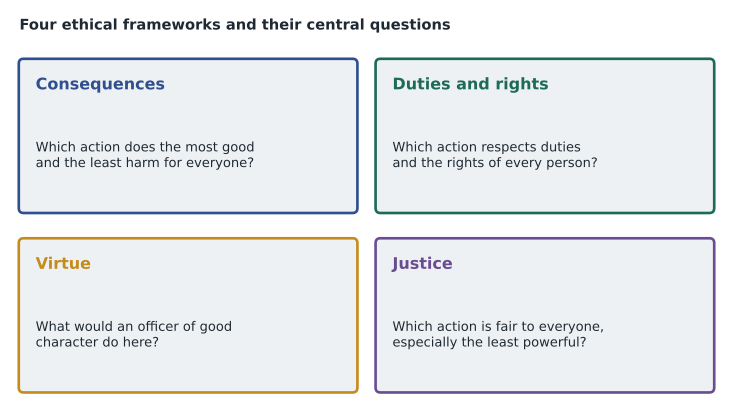
Most ethical decisions in policing are not made by consulting a philosophy text. They are made quickly, on instinct shaped by training, culture and character. Frameworks matter anyway, for three reasons. First, they slow down thinking when there is time to think, which is more often than officers assume: the decision to write a report a certain way, to report a colleague or to accept a gift can almost always wait a few minutes. Second, they help officers explain decisions to supervisors, courts and the public, because a decision supported by more than one kind of reason is easier to defend. Third, they reveal blind spots. An officer who reasons only from consequences may justify cutting corners; one who reasons only from rules may follow a policy into an absurd result. Using several frameworks is like checking a measurement with two instruments.
Consequences: utilitarian thinking
Consequentialist ethics judges actions by their results. Its best-known form, utilitarianism, associated with Jeremy Bentham and John Stuart Mill, says the right action is the one that produces the greatest overall good, or the least harm, for everyone affected. Police work is full of consequentialist reasoning, much of it sound. Deciding where to deploy patrols based on where harm is concentrated, choosing to warn rather than charge because a charge would do more damage than good, and prioritizing calls by threat to life are all consequentialist judgments. Utilitarian thinking forces officers to consider everyone affected, including people who are not in the room, such as future victims and the wider community.
Its weakness is that it can justify almost anything if the predicted benefits are large enough. If torturing one suspect might save several lives, a strict utilitarian may say it is required. The problem is not only that the conclusion feels wrong. In practice, officers are rarely as certain about consequences as the thought experiment assumes. They overestimate how guilty a suspect is, how much good a shortcut will do and how unlikely they are to be caught. They also tend to leave out long-term consequences that are harder to see, such as wrongful convictions, the loss of public trust and the damage done to the officer's own character. This is why Lesson 6 treats noble cause corruption, which is consequentialist reasoning gone wrong, as one of the most dangerous temptations in policing.
Duties and rules: deontological thinking
Deontological ethics, most closely associated with Immanuel Kant, holds that some actions are right or wrong in themselves, regardless of their results. People have duties, such as telling the truth and keeping promises, and rights, such as not being tortured or treated merely as a means to someone else's end. Kant offered a test: act only on a principle you could will to become a universal law. An officer tempted to lie in a report to secure a conviction should ask what would happen if every officer did the same whenever they were sure of guilt. Courts would stop believing police evidence, and the justice system would collapse. The lie fails the test even if this particular defendant is guilty.
Much of the law that governs police reflects deontological thinking. The Fourth, Fifth and Sixth Amendments, the Miranda warnings and the exclusionary rule exist because some methods are off limits even when they would work. Duty-based thinking gives officers firm lines. Its weakness is rigidity: duties can conflict, and rules applied without judgment can produce cruelty or absurdity. The duty to enforce the law conflicts with the duty to protect someone in crisis; the duty to keep information confidential conflicts with the duty to warn someone in danger. Deontology tells officers what matters but not always how to choose between competing duties.
Character: virtue ethics
Virtue ethics, which goes back to Aristotle, shifts attention from individual actions to the kind of person acting. A virtue is a stable trait of character, such as courage, honesty, fairness, compassion or self-control, that lies between two vices. Courage lies between cowardice and recklessness; compassion between coldness and naivety. The central question is not which rule applies or which outcome is best but what a person of good character would do here. Virtue ethics fits policing well because so much of the work depends on judgment that rules cannot capture. Desjardins describes the virtues he looked for when he supervised young officers: courage to enter a dangerous situation and also to admit a mistake; honesty, especially when it costs something; fairness; patience; and practical wisdom, which Aristotle called phronesis, the ability to see what a situation requires.
Virtue ethics also explains how character is formed: by practice. People become honest by telling the truth when it is difficult, and they become dishonest by small lies that become habits. This is why later lessons pay close attention to small things such as a free coffee or a rounded-off time in a report. They matter less for their own sake than for what they make of the officer. The weakness of virtue ethics is that it can be vague. Two good people may disagree about what courage or compassion requires, and appealing to character can become a way of excusing a person who is generally admired.
Fairness: justice-based thinking
A fourth approach focuses on justice and fairness. John Rawls asked people to imagine choosing the rules of a society from behind a veil of ignorance, not knowing whether they would be rich or poor, majority or minority, police officer or suspect. Rules chosen that way, he argued, would protect basic liberties for all and arrange inequalities to benefit the least advantaged. For police, justice-based thinking asks whether a practice treats like cases alike, whether it burdens some groups more than others without good reason and how it looks to the people with the least power in the encounter. Linh points out that this is exactly the question her family asks when her cousin Bao is stopped walking home. Justice-based thinking is essential for understanding issues such as racial profiling, street checks and the uneven effects of enforcement, which Lesson 9 examines.
Justice also has a procedural side that connects back to Lesson 1. Fair procedures, such as explaining decisions, allowing people to respond and applying rules consistently, are part of what makes outcomes acceptable. A decision that is substantively correct can still be unjust if it is reached by a biased or careless process.
Putting the frameworks together
No single framework settles every case, and professional ethics does not require choosing one. A practical approach is to run a decision through all four questions and look for agreement. When the frameworks agree, the decision is usually clear. When they disagree, the disagreement shows what is at stake. The code below scores three possible responses to the kidnapping scenario using an illustrative scale for each framework. The numbers are not measurements; they are a way of making the class's reasoning explicit so it can be discussed. Students are invited to change the scores and see whether the ranking changes.
# Illustrative scores (0 = fails badly, 5 = fully satisfies) for the kidnapping scenario
options = {
    "threaten or hurt the suspect": {"consequences": 2, "duties": 0, "virtue": 1, "justice": 0},
    "intensive lawful interview and search": {"consequences": 4, "duties": 5, "virtue": 5, "justice": 5},
    "release him and follow him": {"consequences": 3, "duties": 4, "virtue": 3, "justice": 4},
}
frameworks = ["consequences", "duties", "virtue", "justice"]

def summary(scores):
    total = sum(scores[f] for f in frameworks)
    weakest = min(frameworks, key=lambda f: scores[f])
    return total, weakest, scores[weakest]

ranked = sorted(options.items(), key=lambda kv: summary(kv[1])[0], reverse=True)
for name, scores in ranked:
    total, weakest, low = summary(scores)
    flag = "  <- fails a framework" if low <= 1 else ""
print(f"{name:40s} total {total:2d} weakest: {weakest} ({low}){flag}")intensive lawful interview and search total 19 weakest: consequences (4) release him and follow him total 14 weakest: consequences (3) threaten or hurt the suspect total 3 weakest: duties (0) <- fails a framework
The output ranks the intensive lawful interview first and flags the coercive option as failing two frameworks badly, even though some students gave it a reasonable consequences score. Desjardins points out a second lesson hidden in the numbers: the coercive option's consequences score is itself doubtful, because coerced statements are unreliable, may be excluded from court and can lead investigators in the wrong direction. When officers are honest about consequences, the frameworks often agree more than they first appear to.
| Framework | Key thinkers | Central question | Typical police application | Main weakness |
|---|---|---|---|---|
| Consequences | Bentham, Mill | What produces the most good and least harm? | Deploying resources, diversion decisions | Can justify harmful means; outcomes are uncertain |
| Duties | Kant | What do duties and rights require? | Charter or constitutional limits, honesty in testimony | Duties conflict; rules can be rigid |
| Virtue | Aristotle | What would a good officer do? | Judgment in new situations, mentoring | Can be vague; excuses admired people |
| Justice | Rawls | Is it fair to everyone, especially the least powerful? | Profiling, fair treatment, equal service | Disagreement about what fairness requires |
Ethical relativism and its limits
Students sometimes conclude from all this that ethics is a matter of opinion. Desjardins pushes back. People do disagree about hard cases, and cultures differ in many customs. But there is wide agreement on core matters: lying in court is wrong, beating a handcuffed prisoner is wrong, taking money to ignore crime is wrong, and treating people worse because of their race is wrong. Professional codes, international human rights standards and the law of the United States all reflect that agreement. The frameworks are tools for working through the hard cases, not evidence that there are no easy ones. An officer who says that everyone has their own ethics usually means that he or she wants permission to do something the frameworks would condemn.
International standards show how widely the core commitments are shared. The United Nations Code of Conduct for Law Enforcement Officials, adopted by the General Assembly in 1979, says officers must respect and protect human dignity, may use force only when strictly necessary and to the extent required, must keep confidential matters confidential, may never inflict or tolerate torture or cruel treatment even under orders or in an emergency, must protect the health of people in custody and must not commit or tolerate corruption. The UN Basic Principles on the Use of Force and Firearms, adopted in 1990, add necessity, proportionality and accountability. These documents were written by states with very different legal systems and cultures, and they describe the same lines that the four frameworks draw.
Worked problem
The informant who wants a favor
Priya, on a ride-along with the investigations unit, watches a detective meet a confidential informant who has provided reliable information about a fentanyl supplier. The informant asks the detective to make a recent impaired driving charge against his brother go away. The detective seems tempted, saying the supplier is responsible for overdoses and the brother's charge is minor.
Show solution
- Consequences: helping might keep the informant cooperating and lead to the supplier, but it also lets an impaired driver escape accountability and gives the informant leverage over the detective.
- Duties: the detective has no lawful authority to make a charge disappear, and doing so would deceive the prosecutor and the court.
- Virtue: an honest officer does not trade favors, and doing so once makes it easier the next time.
- Justice: the brother would receive treatment no ordinary driver could get, simply because of family connections.
- Lawful alternatives: informant assistance can be documented and brought to the attention of the prosecutor through proper channels, with the decision left to them.
Answer: All four frameworks reject the favor. The proper response is to refuse, explain the lawful process for recognizing informant cooperation and record the request. The case shows how a consequentialist argument that sounds strong in the moment collapses when the other frameworks are applied.
Common mistakes
MistakeUtilitarian thinking means anything is justified if the result is good.
InsteadUtilitarianism counts all consequences, including long-term harm to trust, wrongful convictions and the officer's own integrity, which strict ends-justify-the-means reasoning ignores.
MistakeFollowing the rules is always enough.
InsteadRules can conflict and can produce absurd or cruel results if applied without judgment; virtue and justice help officers decide how to apply them.
MistakeVirtue ethics is just about having a good personality.
InsteadVirtue is built through practice and habit; small choices shape character over time.
MistakeBecause people disagree about hard cases, ethics is just opinion.
InsteadThere is broad agreement on core wrongs such as lying in court, abusing prisoners and corruption; frameworks help with the hard cases.
Summary and key terms
- Ethical frameworks give officers vocabulary to explain decisions and expose blind spots.
- Consequentialist thinking weighs outcomes for everyone affected but can justify harmful means if consequences are misjudged.
- Deontological thinking emphasizes duties and rights that hold regardless of results, and is reflected in constitutional limits on police.
- Virtue ethics asks what a person of good character would do and stresses that character is built through practice.
- Justice-based thinking asks whether practices treat people fairly, especially the least powerful.
- Running a decision through all four frameworks and looking for agreement is a practical professional method.
- Utilitarianism
- The view that the right action produces the greatest overall good or least harm for everyone affected.
- Deontology
- Ethics based on duties and rights that hold regardless of consequences.
- Categorical imperative
- Kant's test: act only on a principle you could will to be a universal law.
- Virtue
- A stable trait of good character, such as honesty, courage or fairness.
- Practical wisdom
- The ability to see what a situation requires and act well in it; Aristotle's phronesis.
- Veil of ignorance
- Rawls's thought experiment of choosing rules without knowing one's own position in society.
Practice problems
Work each problem on paper first, then reveal the answer to check.
An officer reasons that planting a small amount of drugs on a known dealer is justified because it will get him off the street. Which framework is being misused, and why?
Show answer
Consequentialism; the officer ignores the likely harms, including wrongful conviction risk, loss of trust, criminal liability and damage to the officer's integrity.
Apply Kant's universal law test to lying in a report.
Show answer
If every officer lied whenever sure of guilt, courts could not trust police evidence and the justice system would fail, so the principle cannot be universalized.
How does virtue ethics explain why small ethical lapses matter?
Show answer
Character is formed by habits; small lapses make larger ones easier and gradually change the kind of person the officer becomes.
Give a policing question that justice-based thinking is especially suited to.
Show answer
Whether a stop or street check practice burdens a particular racial or social group without good reason.
Lesson quiz · 5 questions
Score 60% or more to complete this lesson.
Create a free account to save your progress, take quizzes and earn a certificate.