
MEC-250 · Lesson 10 of 12 · 28 min
Polymers: structure, properties and processing
Not every part at Kestrel is metal. The seed-metering drive on its planters uses molded nylon gears that run quietly without lubrication. Hydraulic cylinders are sealed with nitrile rubber O-rings and polyurethane wiper seals. Pivot bushings on the forestry line are acetal, and covers and guards are glass-fiber-reinforced polyamide. Last winter a dealer in the north reported hydraulic leaks on machines started at −42 °C after sitting outside overnight. The seals were not damaged; they had simply become stiff and glassy in the cold and could not follow the movement of the rod. Understanding why takes us into polymer structure and the glass transition, which is the theme of this lesson.
Polymer molecules
Polymers are built from long chain molecules, often tens of thousands of atoms long, made by joining many small molecules called monomers. Most engineering polymers have a backbone of carbon atoms joined by covalent bonds, with hydrogen and other atoms or groups attached. Polyethylene is the simplest: a chain of \(\text{–CH}_2\text{–CH}_2\text{–}\) repeat units. Replacing one hydrogen in each repeat unit with another group gives a family of familiar plastics: a methyl group gives polypropylene, chlorine gives PVC, a benzene ring gives polystyrene. Other polymers have oxygen or nitrogen in the backbone, such as the amide group in nylon, the carbonate group in polycarbonate and the ester group in PET.
Polymers are made by two broad routes. In addition (chain-growth) polymerization, monomers with a carbon–carbon double bond are opened and added one at a time to a growing chain, as in polyethylene and polypropylene. In condensation (step-growth) polymerization, two kinds of monomer react with each other, usually releasing a small molecule such as water, as in nylon 6,6 and polyester. Either way, a batch of polymer contains chains of many lengths, so molecular weight is described by averages.
The number-average molecular weight \(\bar{M}_n\) weights each chain length by the number fraction \(x_i\) of chains; the weight average \(\bar{M}_w\) by the mass fraction \(w_i\). Because long chains carry more mass, \(\bar{M}_w\) is always at least as large as \(\bar{M}_n\), and their ratio, the dispersity, measures the breadth of the distribution. Dividing \(\bar{M}_n\) by the mass of a repeat unit gives the degree of polymerization, the average number of repeat units in a chain. Longer chains entangle more, giving higher strength, toughness and melt viscosity, which is why ultra-high-molecular-weight polyethylene, with chains of several million g/mol, is used for wear strips and hip joint liners but cannot be injection molded.
Worked problem
Molecular weight of a polyethylene
A polyethylene grade has the molecular weight distribution in the program below, given as mass fractions. Find \(\bar{M}_n\), \(\bar{M}_w\), the dispersity and the degree of polymerization. The \(\text{C}_2\text{H}_4\) repeat unit has a mass of 28.05 g/mol.
Show solution
- The weight average is direct: \(\bar{M}_w = \sum w_i M_i = 150\,000\ \text{g/mol}\).
- With mass fractions, the number average is \(\bar{M}_n = 1/\sum (w_i/M_i) = 111\,000\ \text{g/mol}\).
- Dispersity \(= 150\,000/111\,000 = 1.35\). Degree of polymerization \(= 111\,000/28.05 \approx 3960\).
Answer: An average chain has about four thousand repeat units, roughly eight thousand carbon atoms in a row. Commercial polyethylenes often have much broader distributions, with dispersities of 3 to 10.
Chain architecture
How the chains are arranged matters as much as their length. Linear chains are single strands that can pack closely; high-density polyethylene is mostly linear. Branched chains have side branches that prevent close packing; low-density polyethylene is branched and therefore less dense, softer and more flexible. Crosslinked polymers have adjacent chains joined by covalent bonds at intervals; vulcanized rubber is lightly crosslinked by sulfur bridges. Network polymers are so heavily crosslinked that the whole part is effectively one molecule; epoxies and phenolics are networks. Copolymers contain two or more kinds of repeat unit, arranged randomly, alternately, in blocks or as grafts, which lets chemists combine properties, as in ABS, a tough copolymer of acrylonitrile, butadiene and styrene.
The distinction between thermoplastics and thermosets follows from architecture. Thermoplastics have linear or branched chains held together by secondary bonds; they soften when heated and harden when cooled, repeatedly, so they can be molded, extruded, welded and recycled by remelting. Thermosets are crosslinked networks formed by a curing reaction; once cured they do not soften on heating but char and decompose. Thermosets are stiffer and more heat and creep resistant, and they are the matrices of most fiber composites. Elastomers are lightly crosslinked polymers above their glass transition, able to stretch several times their length and snap back.
Crystallinity
Polymer chains can pack into ordered crystalline regions, but because they are so long and tangled, polymers are never completely crystalline. Semicrystalline polymers, such as polyethylene, polypropylene, nylon, acetal and PEEK, contain thin crystalline lamellae of folded chains, often arranged in radiating spherulites, embedded in amorphous material. Amorphous polymers, such as polystyrene, PMMA, polycarbonate and PVC, cannot crystallize because their chains are irregular or have bulky side groups; they are often transparent. Crystallinity is favored by linear chains, regular structure, strong secondary bonds and slow cooling, and it increases density, stiffness, strength, chemical resistance and the maximum service temperature, while reducing toughness and transparency.
Because crystalline regions are denser than amorphous ones, the degree of crystallinity can be found from density:
Here \(\rho_s\) is the density of the sample and \(\rho_c\) and \(\rho_a\) are the densities of completely crystalline and completely amorphous polymer, about 1.00 and 0.855 g/cm³ for polyethylene.
Worked problem
Crystallinity of a high-density polyethylene
A high-density polyethylene has a density of 0.955 g/cm³. Estimate its percent crystallinity.
Show solution
- \[\%\,c = \frac{1.000(0.955 - 0.855)}{0.955(1.000 - 0.855)} \times 100 = \frac{0.100}{0.1385} \times 100 = 72\,\%\]
Answer: High-density polyethylene is about 70 percent crystalline; low-density polyethylene, at about 0.920 g/cm³, is only about half crystalline. That difference explains why milk jugs (HDPE) are stiff and opaque while plastic film (LDPE) is soft and translucent.
The glass transition and melting
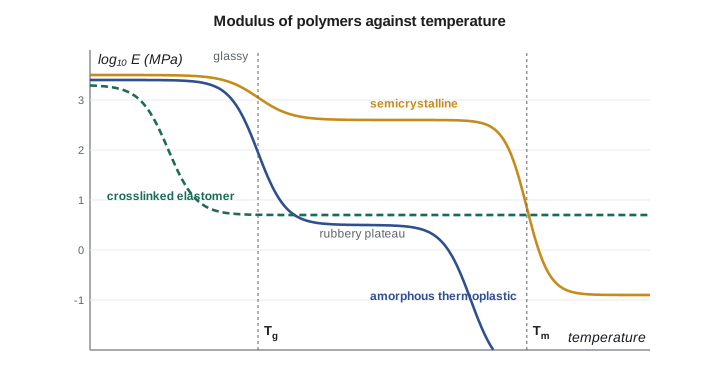
Amorphous regions of a polymer undergo a glass transition at a temperature \(T_g\). Above it, chain segments can rotate and slide past one another, and the material is rubbery or leathery. Below it, segment motion freezes, and the material is a rigid, often brittle glass. The modulus can change by a factor of a thousand across the transition. Crystalline regions melt at a higher temperature \(T_m\), typically with \(T_g\) between about one-half and two-thirds of \(T_m\) in kelvin. Amorphous polymers have only a \(T_g\); semicrystalline polymers have both.
| Polymer | Structure | T_g (°C) | T_m (°C) | Typical use at Kestrel |
|---|---|---|---|---|
| Polyethylene (HDPE) | Semicrystalline | about −110 | about 135 | Fuel and fluid tanks |
| Polypropylene | Semicrystalline | about −10 | about 165 | Battery boxes, ducts |
| Nylon 6,6 | Semicrystalline | about 50–70 (dry) | about 265 | Seed-meter gears |
| Acetal (POM) | Semicrystalline | about −60 | about 175 | Bushings, clips |
| Polycarbonate | Amorphous | about 150 | — | Cab windows, light lenses |
| Nitrile rubber (NBR) | Crosslinked elastomer | about −25 to −40 | — | Hydraulic O-rings |
| Silicone rubber | Crosslinked elastomer | about −120 | — | Low-temperature seals and gaskets |
An elastomer is useful only above its glass transition. Standard nitrile rubbers have glass transitions in the range of about −25 to −40 °C, depending on their acrylonitrile content, and become stiff well before that because the transition is spread over a range of temperature. At −42 °C, Kestrel's standard O-rings were glassy. The fix was a low-temperature nitrile grade for machines sold into cold regions, with a lower glass transition, and a warning in the operator's manual to cycle the cylinders gently after a cold start. For the coldest service, silicone or special fluorocarbon grades are used, each with its own trade-offs in oil resistance and wear.
Mechanical behavior of polymers
Polymers show three broad kinds of stress–strain behavior at room temperature. Brittle polymers, such as polystyrene and thermosets well below their glass transition, behave elastically up to fracture at a few percent strain. Plastic polymers, such as polyethylene, nylon and polycarbonate, yield, form a neck, and then the neck spreads along the specimen as the chains in it are drawn out and aligned, a process called cold drawing that can produce elongations of several hundred percent. Elastomers deform elastically to very large strains, uncoiling their crosslinked chains. The moduli of plastics, 0.2 to 4 GPa, and their strengths, 10 to 100 MPa, are low compared with metals, but their densities are also low.
More important for design, polymer properties depend strongly on temperature and on time. A polymer near its glass transition is viscoelastic: it combines the elastic response of a solid with the viscous flow of a liquid. Under constant load it creeps, continuing to deform over hours, months and years. Under constant strain, as in a press fit, a snap fit or a bolted joint, its stress relaxes. A simple model, a spring in series with a viscous dashpot (the Maxwell model), predicts that stress decays exponentially, \(\sigma(t) = \sigma_0\exp(-t/\tau)\), with a relaxation time \(\tau\) that falls sharply as temperature rises. Real polymers have a spectrum of relaxation times, so the decay is more gradual, but the model captures the essential point.
Worked problem
Loss of press-fit pressure in a polymer bushing
An acetal bushing is pressed into a steel housing with an initial contact pressure of 12 MPa. Modeled as a single Maxwell element, its relaxation time is about 40 000 h at 20 °C and 2000 h at 50 °C. What pressure remains after 1000 h at each temperature?
Show solution
- At 20 °C: \(\sigma = 12\exp(-1000/40\,000) = 12(0.975) = 11.7\ \text{MPa}\).
- At 50 °C: \(\sigma = 12\exp(-1000/2000) = 12(0.607) = 7.3\ \text{MPa}\).
Answer: Warm service loses about 40 percent of the fit pressure in six weeks, enough for a bushing to spin in its bore. Designers of polymer press fits and snap fits use long-term data at the service temperature, often supplied by resin manufacturers as creep and relaxation curves, rather than short-term moduli.
# Polymers: molecular weight averages, crystallinity from density, stress relaxation
import math

# 1. Molecular weight averages from a measured distribution (illustrative polyethylene)
#    (mean molecular weight of each fraction in g/mol, mass fraction w_i)
dist = [(20e3, 0.03), (60e3, 0.10), (100e3, 0.20), (140e3, 0.26), (180e3, 0.20),
        (220e3, 0.12), (260e3, 0.06), (300e3, 0.03)]
assert abs(sum(w for _, w in dist) - 1) < 1e-9
Mw = sum(M * w for M, w in dist)                 # weight average
Mn = 1 / sum(w / M for M, w in dist)             # number average (from mass fractions)
m_repeat = 2 * 12.011 + 4 * 1.008                # C2H4 repeat unit
print(f"Mn = {Mn:,.0f} g/mol, Mw = {Mw:,.0f} g/mol, dispersity Mw/Mn = {Mw / Mn:.2f}")
print(f"degree of polymerization (number average) = {Mn / m_repeat:,.0f} repeat units")

# 2. Percent crystallinity from density: %c = rho_c (rho_s - rho_a) / [rho_s (rho_c - rho_a)]
rho_c, rho_a = 1.000, 0.855                      # crystalline and amorphous polyethylene, g/cm3
print("\ndensity (g/cm3)   crystallinity")
for rho_s in (0.915, 0.925, 0.940, 0.955, 0.965):
    pc = 100 * rho_c * (rho_s - rho_a) / (rho_s * (rho_c - rho_a))
    print(f"    {rho_s:.3f}          {pc:5.1f} %")

# 3. Stress relaxation in a press-fitted polymer bushing (Maxwell model)
#    sigma(t) = sigma0 * exp(-t / tau); tau falls sharply with temperature
sigma0 = 12.0                                    # MPa, initial contact pressure
for Tc, tau in ((20, 4.0e4), (50, 2.0e3)):       # relaxation time in hours (illustrative)
    print(f"\nat {Tc} C (tau = {tau:,.0f} h):")
    for t in (1, 100, 1000, 10000):
        print(f"  after {t:6d} h: {sigma0 * math.exp(-t / tau):5.2f} MPa")

# 4. Relaxation modulus: E_r(t) = sigma(t) / strain0 for a fixed strain of 1 %
eps0 = 0.01
print(f"\nrelaxation modulus at 20 C after 1000 h: {sigma0 * math.exp(-1000 / 4.0e4) / eps0:,.0f} MPa")Mn = 110,974 g/mol, Mw = 150,000 g/mol, dispersity Mw/Mn = 1.35
degree of polymerization (number average) = 3,956 repeat units
density (g/cm3) crystallinity
0.915 45.2 %
0.925 52.2 %
0.940 62.4 %
0.955 72.2 %
0.965 78.6 %
at 20 C (tau = 40,000 h):
after 1 h: 12.00 MPa
after 100 h: 11.97 MPa
after 1000 h: 11.70 MPa
after 10000 h: 9.35 MPa
at 50 C (tau = 2,000 h):
after 1 h: 11.99 MPa
after 100 h: 11.41 MPa
after 1000 h: 7.28 MPa
after 10000 h: 0.08 MPa
relaxation modulus at 20 C after 1000 h: 1,170 MPaOther temperature limits appear in data sheets. The heat deflection temperature (HDT) is the temperature at which a standard bar deflects a set amount under a fixed bending stress; it is a useful ranking but not a design limit. Continuous use temperatures based on long-term aging tests are more relevant for parts that stay hot. Polymers can also degrade chemically: ultraviolet light breaks bonds in polyolefins and many others unless stabilizers or carbon black are added; hydrolysis attacks polyesters and polyurethanes in hot water; and solvents can cause amorphous polymers such as polycarbonate to crack under stress, a failure called environmental stress cracking. Nylons absorb several percent of water from humid air, which plasticizes them, lowers stiffness and swells dimensions, so nylon gear center distances and backlash must allow for moisture.
Additives and reinforcement
Commercial plastics are compounds of a base polymer with additives. Plasticizers make PVC flexible; fillers such as talc or calcium carbonate add stiffness and reduce cost; glass or carbon fibers greatly increase stiffness, strength and heat resistance; stabilizers protect against heat and ultraviolet light; flame retardants, pigments, lubricants and impact modifiers each serve a purpose. A 30 percent glass-filled nylon has roughly three times the modulus of the unfilled resin and a much higher heat deflection temperature, which is why Kestrel uses it for covers near the hydraulic pump. Lesson 11 treats fiber reinforcement in detail.
Processing polymers
Most thermoplastic parts are injection molded. Pellets are melted in a heated barrel by a rotating screw, injected under high pressure into a cooled steel mold, held while they solidify, and ejected, in cycles of seconds to a minute. Tooling is expensive, but part costs are very low in volume. The process affects structure: chains and fibers align with the flow, giving anisotropic properties; thick sections cool slowly and crystallize more, or shrink and form sink marks; and the meeting of two flow fronts forms a weld line with lower strength. Extrusion makes continuous profiles, pipe and film; blow molding makes hollow parts such as tanks; thermoforming shapes heated sheet over a mold; rotational molding makes large hollow tanks; and thermosets are made by compression molding, transfer molding and resin casting.
Recycling is easier for thermoplastics than for thermosets, but mixed and filled plastics are difficult to separate and degrade with each melting cycle. Designing for recycling means using fewer polymer types, marking parts, and avoiding unnecessary fillers and coatings, a theme taken up in Lesson 12.
Common mistakes
MistakeUsing room-temperature short-term modulus for a polymer part under long-term load.
InsteadPolymers creep and relax; use long-term data at the service temperature.
MistakeChoosing an elastomer without checking its glass transition against the lowest service temperature.
InsteadBelow T_g an elastomer becomes glassy and loses its sealing ability.
MistakeTreating nylon dimensions as stable.
InsteadNylon absorbs moisture and swells, and its stiffness falls.
MistakeAssuming a thermoset can be remelted and remoulded.
InsteadThermosets are crosslinked and decompose rather than melt.
MistakeConfusing M_n and M_w.
InsteadM_w weights chains by mass and is always at least as large as M_n.
Summary and key terms
- Polymers are long chain molecules made by addition or condensation polymerization.
- Molecular weight is described by M_n and M_w; their ratio is the dispersity.
- Linear, branched, crosslinked and network architectures give thermoplastics, elastomers and thermosets.
- Semicrystalline polymers have crystalline lamellae in an amorphous matrix; crystallinity can be found from density.
- Below T_g amorphous regions are glassy; above it they are rubbery; crystals melt at T_m.
- Polymers are viscoelastic: they creep under load and relax under fixed strain, strongly depending on temperature.
- Additives, fiber reinforcement and processing conditions largely set the properties of plastic parts.
- Monomer
- A small molecule that joins with others to form a polymer.
- Degree of polymerization
- The average number of repeat units in a polymer chain.
- Thermoplastic
- A polymer that softens on heating and can be reshaped repeatedly.
- Thermoset
- A crosslinked polymer that does not soften on heating once cured.
- Elastomer
- A lightly crosslinked polymer above its glass transition, capable of large elastic strains.
- Glass transition temperature
- The temperature below which amorphous polymer segments are frozen into a glassy state.
- Viscoelasticity
- Combined elastic and viscous response, causing creep and stress relaxation.
- Spherulite
- A spherical aggregate of crystalline lamellae in a semicrystalline polymer.
Practice problems
Work each problem on paper first, then reveal the answer to check.
A polypropylene has M_n = 120 000 g/mol. The repeat unit C₃H₆ is 42.08 g/mol. Find the degree of polymerization.
Show answer
About 2850.
Find the crystallinity of a polyethylene with density 0.925 g/cm³.
Show answer
About 52 %.
Why is polycarbonate transparent but nylon usually opaque?
Show answer
Polycarbonate is amorphous; nylon's crystalline regions scatter light.
A seal must work at −50 °C. Which of NBR and silicone rubber is the safer starting choice, and why?
Show answer
Silicone, because its T_g is far below −50 °C; standard NBR becomes glassy.
Using the Maxwell model, how long does it take for stress to fall to half its initial value when τ = 2000 h?
Show answer
t = τ ln 2 ≈ 1390 h.
Change the program's relaxation time at 50 °C to 8000 h. What pressure remains after 1000 h?
Show answer
About 10.6 MPa.
Lesson quiz · 5 questions
Score 60% or more to complete this lesson.
Create a free account to save your progress, take quizzes and earn a certificate.