
MEC-250 · Lesson 7 of 12 · 26 min
Phase diagrams and the lever rule
Kestrel's gearbox housings are sand cast from an aluminum–silicon alloy containing about 7 percent silicon, poured at a foundry in central Illinois. When a batch arrived with porosity and a coarse, needle-like silicon structure that made the housings brittle, Jonah asked the foundry for its melt records and showed Amira how to read them against a phase diagram. Phase diagrams are maps that show which phases are stable at each combination of temperature and composition. They are the single most useful tool for understanding alloys, because they show how a metal solidifies, what microstructure it will have, and which heat treatments are possible. This lesson covers the rules for reading them; Lesson 8 applies them to steel.
Components, phases and equilibrium
The components of an alloy are the pure elements or compounds it is made from: copper and nickel in cupronickel, aluminum and silicon in a casting alloy, iron and carbon in steel. A phase is a region of material with uniform physical and chemical characteristics, separated from other phases by a definite boundary. Ice and water in a glass are two phases of one component. A steel may contain two solid phases, ferrite and cementite, finely mixed. A microconstituent is a recognizable feature of the microstructure, which may itself contain more than one phase, such as the eutectic mixture in a casting alloy.
A solubility limit is the maximum concentration of one component that can dissolve in another to form a single phase. Sugar dissolves in water until the syrup is saturated; any more sugar stays as crystals at the bottom. Solid metals behave the same way: silicon dissolves in solid aluminum up to 1.65 percent by weight at 577 °C and much less at room temperature. Beyond the solubility limit, a second phase forms. Solubility usually increases with temperature, which is the key to precipitation hardening.
Phase diagrams show equilibrium, the state of lowest free energy, which a system reaches if it is given enough time. In solids, atoms move by diffusion, so equilibrium can take a very long time to reach at low temperatures, and many useful structures are not equilibrium structures at all. Martensite in quenched steel is the outstanding example. Phase diagrams still tell us what the system is trying to do, and how far from equilibrium a given structure is.
The Gibbs phase rule connects the number of phases \(P\) that can coexist, the number of components \(C\), and the number of variables \(F\) (temperature, pressure, compositions) that can be changed independently without changing the number of phases. At constant pressure, which is the usual case for metals,
For a pure metal (\(C = 1\)), solid and liquid can coexist only at one temperature, the melting point (\(P = 2\), \(F = 0\)). For a binary alloy (\(C = 2\)), two phases can coexist over a range of temperatures, but three phases can coexist only at a fixed temperature and fixed compositions, which is why eutectic and eutectoid reactions occur at a single temperature.
Binary isomorphous systems
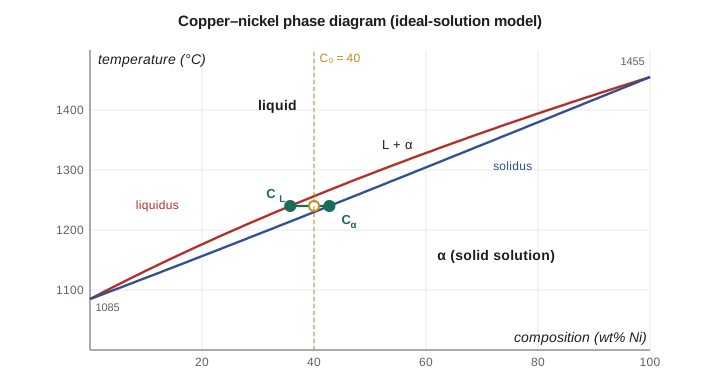
The simplest binary phase diagram belongs to a pair of metals that are completely soluble in each other in both the liquid and the solid state. Copper and nickel meet all the Hume-Rothery rules, so they form one FCC solid solution, called alpha (α), at every composition. Such a system is called isomorphous. Its diagram has three regions: liquid at high temperatures, α at low temperatures, and a two-phase region, liquid plus α, between them. The upper boundary of the two-phase region is the liquidus, above which the alloy is completely liquid; the lower boundary is the solidus, below which it is completely solid. Unlike a pure metal, an alloy melts and freezes over a range of temperatures.
Reading a binary diagram: three questions
For any point on a binary phase diagram, three questions can be answered. Which phases are present? Read the region the point falls in. What are their compositions? In a single-phase region, the phase has the overall composition of the alloy. In a two-phase region, draw a horizontal line through the point, called a tie line or isotherm, to the phase boundaries on either side; the compositions of the two phases are read where the tie line meets the boundaries. How much of each phase is present? Use the lever rule.
The lever rule follows from a mass balance. If an alloy of overall composition \(C_0\) consists of liquid of composition \(C_L\) and solid α of composition \(C_\alpha\), with mass fractions \(W_L\) and \(W_\alpha\) that add to 1, then \(W_L C_L + W_\alpha C_\alpha = C_0\). Solving gives
The name comes from the analogy with a lever balanced on a fulcrum at \(C_0\): the fraction of each phase is the length of the opposite arm of the tie line divided by the total length. Students often reverse the arms; a quick check is that as the overall composition approaches the α boundary, the fraction of α must approach 1.
Worked problem
Phases in a cupronickel alloy
An alloy of 40 wt% Ni and 60 wt% Cu is held at 1240 °C. Using the model diagram, the tie line meets the liquidus at \(C_L = 35.8\) wt% Ni and the solidus at \(C_\alpha = 42.7\) wt% Ni. Find the phases, their compositions and their mass fractions.
Show solution
- The point lies in the liquid plus α region, so both phases are present. Their compositions are the ends of the tie line: liquid 35.8 wt% Ni and α 42.7 wt% Ni.
- \[W_L = \frac{42.7 - 40.0}{42.7 - 35.8} = \frac{2.7}{6.9} = 0.39 \qquad W_\alpha = 1 - 0.39 = 0.61\]
Answer: At 1240 °C the alloy is 39 percent liquid and 61 percent solid, and the solid is richer in nickel, the higher-melting component, than the alloy as a whole. Note that neither phase has the overall composition of 40 percent. The real copper–nickel system has a slightly wider two-phase region than the ideal model gives, but the method is identical.
Microstructure during solidification
If the 40 percent nickel alloy cools very slowly from the liquid, its first solid appears at the liquidus temperature with a composition richer in nickel than the alloy. As cooling continues, more solid forms, and by diffusion the compositions of both phases shift along the solidus and liquidus. The last liquid freezes at the solidus temperature, and with enough time the solid ends with a uniform composition of 40 percent nickel. Under equilibrium conditions, the program below tracks the fractions and compositions step by step.
# An ideal-solution model of the copper-nickel phase diagram, tie lines and the lever rule
import math

R = 8.314
TA, HA, MA = 1358.0, 13.3e3, 63.55     # copper: melting point K, heat of fusion J/mol, g/mol
TB, HB, MB = 1728.0, 17.5e3, 58.69     # nickel

def wt(x_ni):                          # mole fraction Ni -> weight percent Ni
    return 100 * x_ni * MB / (x_ni * MB + (1 - x_ni) * MA)

def tie_line(Tc):
    """Return (C_liquid, C_solid) in wt% Ni at temperature Tc (C), ideal liquid and solid."""
    T = Tc + 273.15
    kA = math.exp(HA / R * (1 / TA - 1 / T))
    kB = math.exp(HB / R * (1 / TB - 1 / T))
    xs = (1 - kA) / (kB - kA)
    xl = kB * xs
    return wt(xl), wt(xs)

print(" T (C)   liquidus comp.   solidus comp.  (wt% Ni)")
for Tc in range(1100, 1451, 50):
    cl, cs = tie_line(Tc)
    print(f"{Tc:6d}     {cl:6.1f}          {cs:6.1f}")

def lever(C0, Tc):
    cl, ca = tie_line(Tc)
    if C0 <= cl: return 'all liquid', 1.0, 0.0, cl, ca
    if C0 >= ca: return 'all solid (alpha)', 0.0, 1.0, cl, ca
    WL = (ca - C0) / (ca - cl)
    return 'liquid + alpha', WL, 1 - WL, cl, ca

C0 = 40.0
print(f"\nalloy with {C0} wt% Ni, cooled slowly:")
for Tc in (1270, 1260, 1250, 1240, 1230, 1220):
    region, WL, Wa, cl, ca = lever(C0, Tc)
    print(f"  {Tc} C: {region:18s} W_L = {WL:.2f}, W_alpha = {Wa:.2f}  (C_L = {cl:.1f}, C_alpha = {ca:.1f})")

# Eutectic lever rule for an Al-Si casting alloy just below 577 C
C0, Ca, Ce, Cb = 7.0, 1.65, 12.6, 99.9          # wt% Si: alloy, alpha limit, eutectic, silicon
W_primary = (Ce - C0) / (Ce - Ca)                 # primary alpha formed above the eutectic
W_alpha_total = (Cb - C0) / (Cb - Ca)
print(f"\nAl-7Si just below 577 C: primary alpha {W_primary:.2f}, eutectic {1 - W_primary:.2f}")
print(f" total alpha {W_alpha_total:.3f}, total silicon phase {1 - W_alpha_total:.3f}")T (C) liquidus comp. solidus comp. (wt% Ni) 1100 3.1 4.3 1150 14.0 18.2 1200 25.7 31.9 1250 38.4 45.4 1300 51.9 58.8 1350 66.4 72.1 1400 81.9 85.4 1450 98.3 98.7 alloy with 40.0 wt% Ni, cooled slowly: 1270 C: all liquid W_L = 1.00, W_alpha = 0.00 (C_L = 43.7, C_alpha = 50.8) 1260 C: all liquid W_L = 1.00, W_alpha = 0.00 (C_L = 41.0, C_alpha = 48.1) 1250 C: liquid + alpha W_L = 0.77, W_alpha = 0.23 (C_L = 38.4, C_alpha = 45.4) 1240 C: liquid + alpha W_L = 0.39, W_alpha = 0.61 (C_L = 35.8, C_alpha = 42.7) 1230 C: liquid + alpha W_L = 0.01, W_alpha = 0.99 (C_L = 33.2, C_alpha = 40.0) 1220 C: all solid (alpha) W_L = 0.00, W_alpha = 1.00 (C_L = 30.7, C_alpha = 37.3) Al-7Si just below 577 C: primary alpha 0.51, eutectic 0.49 total alpha 0.946, total silicon phase 0.054
Real castings cool too fast for diffusion in the solid to keep up. The center of each grain, which froze first, stays rich in the higher-melting component, and the outer regions, which froze later, are richer in the lower-melting component. This non-equilibrium structure is called coring or microsegregation. The final liquid also freezes below the equilibrium solidus. Cored structures can have poorer properties, and when reheated, the regions that froze last can melt below the expected temperature, a hazard in hot working and welding. A long homogenization anneal below the solidus lets diffusion even out the composition.
Binary eutectic systems
Many pairs of metals have limited solid solubility. The aluminum–silicon system, the basis of most aluminum casting alloys, is an example. It has two solid phases: α, aluminum with a little dissolved silicon, and nearly pure silicon. Their solubility limits, the solvus lines, are near the edges of the diagram. The liquidus has two branches that descend from the melting points of the components and meet at a minimum, the eutectic point, at 12.6 wt% Si and 577 °C. At that point a liquid transforms directly into two solid phases on cooling:
A eutectic reaction is invariant: it occurs at one temperature, and the three phases have fixed compositions while it proceeds, just as the phase rule requires. The eutectic alloy has the lowest melting point in the system and solidifies at a single temperature like a pure metal, which makes it very fluid and easy to cast. The solid forms as a fine mixture of the two phases, often in alternating plates or as fibers, because the atoms only need to diffuse short distances to sort themselves into the two compositions.
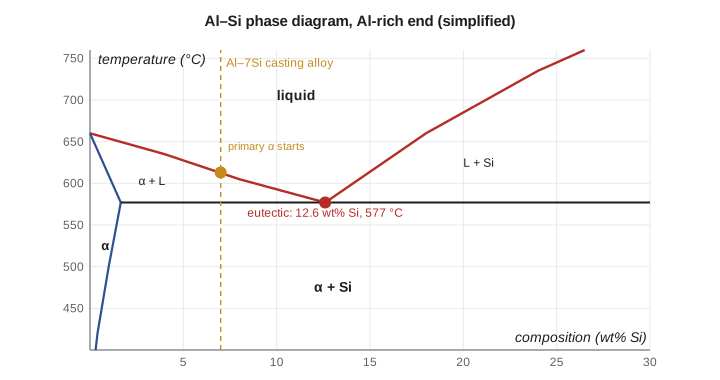
Alloys to the left of the eutectic composition are hypoeutectic, and those to the right hypereutectic. Kestrel's 7 percent silicon alloy is hypoeutectic. As it cools through the two-phase region, it first forms primary α, solid aluminum crystals with a branched, tree-like shape called dendrites. The remaining liquid becomes richer in silicon until, at 577 °C, it reaches the eutectic composition and freezes as eutectic. The final microstructure has two microconstituents: primary α dendrites surrounded by eutectic.
Worked problem
Microconstituents in the housing alloy
For the Al–7 wt% Si casting alloy just below 577 °C, find (a) the fractions of primary α and eutectic, and (b) the total fractions of α and silicon phases. The α phase contains 1.65 wt% Si and the silicon phase is essentially pure.
Show solution
- (a) Just above 577 °C, the alloy is primary α (1.65 wt% Si) plus liquid of eutectic composition (12.6 wt% Si). All that liquid becomes eutectic, so
- \[W_{\text{primary}\,\alpha} = \frac{12.6 - 7.0}{12.6 - 1.65} = 0.51 \qquad W_{\text{eutectic}} = 0.49\]
- (b) Below 577 °C, the tie line runs from α at 1.65 wt% Si to silicon at 100 wt% Si: \(W_{\text{Si}} = (7.0 - 1.65)/(100 - 1.65) = 0.054\), so \(W_\alpha = 0.946\).
Answer: About half the casting is primary α and half eutectic, but only about 5 percent of it is silicon phase, all of it inside the eutectic. The shape of those silicon particles controls ductility: coarse plates crack easily, while fine fibers do not.
That was the problem with the brittle housings. Foundries refine the eutectic silicon from coarse plates to fine fibers by adding a few hundred parts per million of strontium or sodium to the melt, a treatment called modification, and they refine the primary α grains with titanium–boron grain refiners. The melt records showed that the strontium addition had faded because the metal was held too long before pouring. A re-cast batch with correct modification passed inspection.
Other invariant reactions and intermediate phases
Several other three-phase reactions appear in binary diagrams. In a eutectoid reaction, one solid phase transforms on cooling into two other solid phases, \(\gamma \to \alpha + \beta\); the eutectoid in iron–carbon alloys at 727 °C is the most important reaction in metallurgy and the subject of Lesson 8. In a peritectic reaction, a liquid and a solid react on cooling to form a different solid, \(L + \delta \to \gamma\); one occurs in iron–carbon alloys at 1493 °C, and many copper and steel alloys have them. Some systems form intermediate phases or intermetallic compounds with definite or narrow ranges of composition, such as \(\text{CuAl}_2\) in aluminum–copper alloys and \(\text{Mg}_2\text{Si}\) in aluminum–magnesium–silicon alloys. Many intermetallics are hard and brittle, which makes them useful as fine strengthening precipitates but harmful as coarse particles.
Tin–lead solder is a classic eutectic system, with its eutectic at 61.9 wt% Sn and 183 °C. Because lead is toxic, electronics solders are now mostly lead-free tin–silver–copper alloys melting at around 217 to 220 °C, and the higher reflow temperatures needed have changed circuit board design. Kestrel's electronic control units for hydraulic valves use lead-free solder, and its long-term reliability under vibration and thermal cycling is a materials question in its own right.
Common mistakes
MistakeReading phase compositions as the overall alloy composition in a two-phase region.
InsteadDraw the tie line; the phase compositions are where it meets the phase boundaries.
MistakeReversing the arms in the lever rule.
InsteadThe fraction of a phase uses the arm on the opposite side of C₀; check limiting cases.
MistakeAssuming castings have the equilibrium microstructure.
InsteadFast cooling causes coring; homogenization is needed to remove it.
MistakeCalling the eutectic a phase.
InsteadThe eutectic is a microconstituent made of two phases.
MistakeExpecting a three-phase reaction to occur over a temperature range in a binary alloy.
InsteadBy the phase rule, three phases coexist only at a fixed temperature.
Summary and key terms
- A phase is a region of uniform structure and composition; a microconstituent may contain several phases.
- The phase rule at constant pressure is P + F = C + 1.
- Isomorphous systems, such as Cu–Ni, have complete solubility and a lens-shaped liquid plus α region.
- Tie lines give phase compositions; the lever rule gives phase fractions.
- Non-equilibrium cooling produces coring; homogenization removes it.
- A eutectic reaction L → α + β occurs at one temperature and composition and gives a fine two-phase mixture.
- Eutectoid, peritectic and intermetallic phases appear in many engineering alloys.
- Component
- A pure element or compound from which an alloy is made.
- Phase
- A region of material with uniform physical and chemical characteristics.
- Solubility limit
- The maximum concentration of solute that can dissolve to form a single phase.
- Liquidus
- The line above which an alloy is completely liquid.
- Solidus
- The line below which an alloy is completely solid.
- Tie line
- A horizontal line across a two-phase region joining the compositions of the two phases.
- Lever rule
- The mass-balance rule giving phase fractions from tie-line lengths.
- Eutectic
- An invariant reaction in which a liquid transforms into two solid phases.
- Coring
- Non-uniform composition within grains caused by non-equilibrium solidification.
Practice problems
Work each problem on paper first, then reveal the answer to check.
Use the phase rule to find how many degrees of freedom exist when liquid and α coexist in a binary alloy at constant pressure.
Show answer
F = C + 1 − P = 2 + 1 − 2 = 1.
At 1250 °C the model gives C_L = 38.4 and C_α = 45.4 wt% Ni. Find W_L for the 40 % Ni alloy.
Show answer
W_L = (45.4 − 40)/(45.4 − 38.4) = 0.77.
Find the fractions of primary α and eutectic in an Al–10 wt% Si alloy just below 577 °C.
Show answer
Primary α = 0.24; eutectic = 0.76.
Why is a eutectic alloy attractive for casting and soldering?
Show answer
It has the lowest melting point and freezes at one temperature, so it is very fluid.
An Al–Si alloy with 18 wt% Si is cooled from the liquid. What forms first?
Show answer
Primary silicon, because the alloy is hypereutectic.
Run the program at 1200 °C for an alloy of 28 wt% Ni. What fraction is liquid?
Show answer
C_L = 25.7, C_α = 31.9, so W_L = (31.9 − 28)/(31.9 − 25.7) ≈ 0.63.
Lesson quiz · 5 questions
Score 60% or more to complete this lesson.
Create a free account to save your progress, take quizzes and earn a certificate.