
MELU-219 · Lesson 12 of 12 · 20 min
Practice exam review and test-day strategy
▶ Video coming soon A video version of this lesson is on the way.
It is November 2026, and Nadia's exam is booked for Tuesday, January 12, 2027. She has finished her first pass through the core review topics and has taken three full practice tests under timed conditions. Her first two scores were 63 and 68, close to the 70 she needs but not safely above it. Art has seen this pattern many times: candidates who know the material but lose points to time, to misread questions and to lookups that go to the wrong article. This lesson is about closing that gap. It covers how to review a practice test, how to build an error log, how to pace a four-hour open book exam, how to handle calculations and Maine law questions, and what to do on the day.
The exam facts used here come from the April 2026 PROV bulletin: 100 questions, four hours, a passing score of 70, one softcover code book of the edition the bulletin names, permanent tabs and pen marks allowed, and a simple four-function calculator. Check the bulletin that applies on your exam date, especially the code edition.
Reviewing a practice test
A practice test is worth little if you only look at the score. The value is in the review. After each test, Nadia goes through every question she missed and every question she got right but guessed or took too long on. For each one, she writes down the topic, the section that answers it, why she missed it and how long it took. Then she sorts the reasons. Most misses fall into a handful of categories: did not know the rule, knew the rule but could not find it in time, found the wrong section, misread a condition word in the question, made an arithmetic or calculator error, or ran out of time.
The categories point to different fixes. Not knowing a rule calls for study of that article. Not finding it calls for lookup drills and better tabs. Finding the wrong section calls for reading the scope of articles and the index more carefully. Misreading calls for a habit of underlining condition words in your head. Arithmetic errors call for slower, written steps. Running out of time calls for a pacing plan. Studying harder in general fixes none of these as well as studying the right thing.
| Reason for the miss | Fix |
|---|---|
| Did not know the rule | Study the article; work five questions on it |
| Could not find it in time | Lookup drills; add or move a tab |
| Found the wrong section | Read article scopes; use the index |
| Misread a condition word | Pause on dwelling, copper, continuous, wet |
| Arithmetic or calculator error | Write each step; recheck the units |
| Ran out of time | Use the three-pass plan below |
Nadia's error log
After her second practice test, Nadia's log showed 32 questions missed or flagged. Eleven were lookups she could not complete in time, mostly in Article 310 for ampacity adjustment and in Article 430 for motor circuits. Seven were rules she did not know, scattered across special occupancies. Six were misread conditions, four of them dwelling versus non-dwelling. Five were calculation errors, three in a single service calculation where she used the wrong demand factor. Three were Maine law questions on supervision limits and permit exceptions. The log told her where the next three weeks should go: lookup drills on two articles, a careful rework of service calculations, a page of Maine law facts, and a habit change on reading questions.
# Summarize an error log by reason (Nadia's second practice test)
from collections import Counter
log = (["lookup too slow"] * 11 + ["did not know rule"] * 7 + ["misread condition"] * 6 +
       ["calculation error"] * 5 + ["Maine law"] * 3)
for reason, n in Counter(log).most_common():
    print(f"{reason:20s} {n:2d} {'#' * n}")
print("total flagged:", len(log))lookup too slow 11 ########### did not know rule 7 ####### misread condition 6 ###### calculation error 5 ##### Maine law 3 ### total flagged: 32
A pacing plan
With 100 questions and 240 minutes, the average is 2.4 minutes per question, but the questions are not equal. The three-pass plan uses that difference. In the first pass, about 110 minutes, answer every question you can answer quickly from memory or with a single, sure lookup, and flag the rest. In the second pass, about 90 minutes, work the flagged lookups and the shorter calculations. In the third pass, about 40 minutes, do the longest calculations, make reasoned guesses on anything left, and make sure no question is blank. The exam does not penalize wrong answers more than blank ones under the bulletin summarized here, so a blank is always a lost chance.
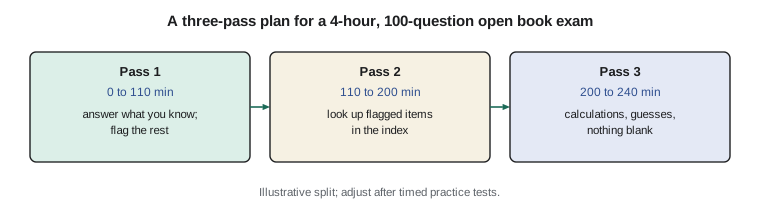
The plan only works if it is practiced. On her third practice test, Nadia used it for the first time and finished her first pass at question 100 with 58 answered and 42 flagged, at 104 minutes. Her second pass cleared 30 more by the 195-minute mark. Her third pass handled the last 12. Her score rose to 74, mostly because she no longer ran out of time with easy questions still unanswered.
Calculations
Calculation questions take the most time and offer the most chances for error. The core course on load calculations covers the methods; on exam day, the discipline matters more. Write each step on the scratch paper provided. Note the code section for each factor you use, such as a demand factor or an adjustment factor, so you can check it. Keep units visible. On a four-function calculator, enter constants like 1.732 carefully and repeat the calculation once to check. If an answer does not match any option, look first for a missed condition, such as continuous load or a different conductor material, before redoing the arithmetic.
Worked problem
A voltage drop check under time
A 120-volt, single-phase branch circuit with 12 AWG copper conductors runs 90 feet one way to a 13-ampere load. Using a resistance of about 1.98 ohms per 1,000 feet for 12 AWG copper, what is the approximate voltage drop?
Show solution
- Total conductor length is twice the one-way length: 180 feet.
- Resistance: 1.98 times 180, divided by 1,000, is about 0.356 ohm.
- Voltage drop: 13 amperes times 0.356 ohm is about 4.6 volts.
- As a share of 120 volts: 4.6 divided by 120 is about 0.039.
Answer: About 4.6 volts, or about 0.039 of the supply voltage, slightly above the 0.03 often recommended for a branch circuit in the informational notes.
Maine law questions
The Maine questions are usually the quickest points on the exam for a candidate who has studied them, and the most frustrating for one who has not, because the code book does not contain the answers. Nadia made a single page of facts to review in the last week: the license ladder and who may supervise whom; the master routes of 12,000, 6,000 and 4,000 hours with the 576-hour program; the 45-hour code course within two years before licensing; permits filed by a master or limited electrician before work begins; the main permit exceptions; inspection before wiring is enclosed; appeals within 30 days to the board or 48 hours to Superior Court; the two-year term; the 15-hour update course; the 90-day late renewal window; and the facts from Lessons 9 and 10 on liens, home contracts and reporting clocks.
| Topic | Number to remember |
|---|---|
| Journeyman route to master | 4,000 hours plus the 576-hour program |
| Initial licensing code course | 45 hours within 2 years |
| Apprentices a master may supervise | 2 |
| Board appeal of an inspector's order | 30 days |
| Renewal code course | 15 hours |
| Late renewal window | 90 days |
| Subcontractor lien filing / lien action | 90 days / 120 days |
| WCB report of a lost-day injury | 7 days |
Making practice tests realistic
A practice test only predicts the real one if the conditions match. Nadia sets a timer for four hours, uses the same softcover book with the same tabs she will bring, uses the same four-function calculator, sits at a table with nothing else on it, and leaves her phone in another room. She takes the test at the same time of day as her real appointment. She does not pause the timer for coffee or a phone call. The first time she did this, she found that her focus faded after about two and a half hours, so she began building her endurance with longer study sessions and planned a short stretch at the two-hour mark.
Question sources matter too. Practice questions from commercial prep materials vary in quality and in which code edition they use. Nadia checks that each question set is written for the edition her bulletin names, and when a practice answer disagrees with her own reading of the code, she treats the code as the authority and notes the disagreement in her log rather than memorizing a possibly wrong answer. She also mixes in the quizzes and final exams from this course and the core courses, which are tied to specific code sections.
The last week
The last week is for consolidation, not new material. Nadia plans one final full practice test the Saturday before the exam, under real conditions: same start time, same book, same calculator, no phone, four hours. After that, she will review her error log and her Maine facts page, check her book against the bulletin rules, and stop studying the evening before. Sleep does more for a score on the morning of an exam than an extra hour of reading the night before.
She also has a checklist for the morning: current photo identification, the approved code book with permanent tabs only and nothing inserted, the four-function calculator with a fresh battery, the confirmation of her appointment, directions to the site and enough time to arrive early. Everything else, including her phone, stays in the car or in the locker the site provides.
During the exam
Start by settling in. Read the instructions on the screen, note the clock and begin the first pass. Read each question twice, once for the subject and once for the conditions. When you look something up, go to the section, read the whole requirement including exceptions, and then choose the answer. If two options look right, reread the question for the condition that separates them. Flag and move on when a question will take more than about three minutes in the first pass. Check the clock at the checkpoints you practiced: about question 45 at 60 minutes in the first pass, all 100 seen by 110 minutes.
Stay calm about hard questions. Every candidate meets questions they cannot answer. A question that seems impossible is worth exactly as much as one that takes ten seconds, so it should never cost the time needed for three easier ones. If anxiety rises, take a few slow breaths, look away from the screen for ten seconds, and return to the next question.
After the exam
The bulletin describes how results are delivered. If Nadia passes, her next steps are the license application with proof of passing, the 45-hour course certificate and the fee, as Lesson 3 explained. If she does not, the bulletin sets no waiting period, but she should not rebook the next week. She should get whatever score report is provided, compare it with her error log, fix the weak areas, and rebook when her practice scores are consistently above 75. The approval window is two years, so there is time to do it properly.
Common mistakes
MistakeReviewing only the score after a practice test.
InsteadReview every miss and slow answer, and record the reason.
MistakeAnswering questions in order and spending eight minutes on question 12.
InsteadUse passes: quick answers first, flagged lookups second, long calculations last.
MistakeLeaving questions blank.
InsteadMake a reasoned guess; a blank is always wrong.
MistakeIgnoring Maine law because it is not in the code book.
InsteadLearn the statute facts; they are quick points.
MistakeStudying new topics the night before.
InsteadUse the last week to consolidate and rest.
Summary and key terms
- Review practice tests by reason for each miss, not by score alone.
- An error log points to specific fixes: study, lookup drills, careful reading, written arithmetic or pacing.
- Use a three-pass plan for 100 questions in 240 minutes and practice it under time.
- Show calculation steps, note code sections and recheck units.
- Learn the Maine numbers: hours, course lengths, supervision limits, appeal and renewal deadlines.
- Prepare the book, calculator and identification well before exam day.
- Error log
- A record of each missed or slow practice question with its topic, section and reason.
- Three-pass plan
- A pacing method that answers quick questions first and long calculations last.
- Condition word
- A word in a question that changes which code value applies.
- Checkpoint
- A planned time to check progress against the pacing plan.
- Reasoned guess
- An answer chosen by eliminating options when time runs short.
Practice problems
Work each problem on paper first, then reveal the answer to check.
How many minutes per question does the master exam allow on average?
Show answer
2.4 minutes.
Nadia's log shows most misses are slow lookups. What should she do first?
Show answer
Lookup drills and better tabs on the articles involved.
Should she leave a question blank if she cannot find the answer?
Show answer
No; make a reasoned guess.
When should she rebook after a failed attempt?
Show answer
When her practice scores are consistently above 75, inside the two-year window.
What must she bring on exam day?
Show answer
Current photo ID, the approved softcover code book and a four-function calculator.
Lesson quiz · 5 questions
Score 60% or more to complete this lesson.
Create a free account to save your progress, take quizzes and earn a certificate.