
MELU-219 · Lesson 2 of 12 · 23 min
Eligibility for the Master Electrician License
▶ Video coming soon A video version of this lesson is on the way.
Before Nadia spends money on a code course or an application fee, she needs to know whether she qualifies. Art's own path is no help; he was licensed in 1994 under rules that have since been rewritten more than once. So one evening after work Nadia sat down with section 1202-B of Title 32, the board's master electrician page and her own records, and built a checklist. This lesson walks through that checklist: the routes to eligibility, the 576-hour program, how hours are counted and proved, the 45-hour code course, reciprocity, and the questions that trip candidates up.
As in every lesson, the facts here were checked in November 2026 against the statute and the board's pages. The board can accept comparable experience or training, and it decides individual cases. If your history does not fit a route neatly, ask the board before you apply rather than guessing.
The routes in section 1202-B
Section 1202-B, subsection 5 sets the qualifications for a master electrician. Every candidate must pass an examination approved by the board. In addition, the candidate must meet one of four routes. The first is 12,000 hours of work as a helper or apprentice electrician, plus successful completion of a 576-hour course of study approved by the board. The second is 4,000 hours of work as a licensed journeyman electrician, plus the 576-hour course. The third is 6,000 hours of work as a journeyman-in-training, plus the 576-hour course. The fourth is comparable experience or training acceptable to the board.
The routes reflect where the candidate starts. Someone who never took the journeyman exam can reach the master exam directly, but must show the largest number of hours, 12,000, roughly six years of full-time work. A journeyman-in-training shows 6,000 hours in that license. A licensed journeyman, the most common candidate, shows 4,000 hours in the journeyman license, roughly two years of full-time work after earning it. The 576-hour program is common to the first three routes.
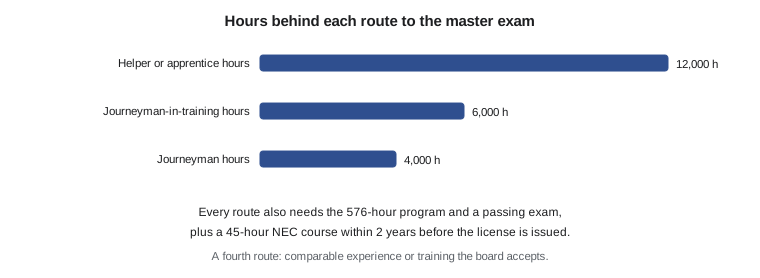
The board's master electrician page summarizes the first two routes as at least 4,000 hours of service as a journeyman electrician or at least 12,000 hours of experience in electrical installations as defined in section 1101, together with the program of study. Read the statute and the page together. The statute is the law; the page is the board's summary of how it applies it.
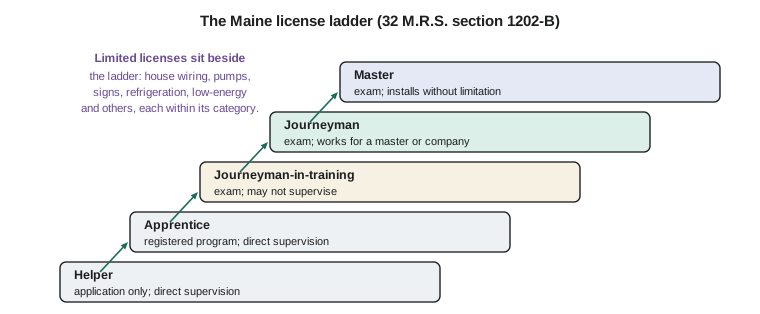
The 576-hour program
The 576-hour program is the educational core of the Maine license system. The board's master page describes it as ten courses of 45 hours each, Electricity I, Electricity II, Electronics I, Math I, Controls I, Controls II, Motors, Blueprint Reading and Drafting, Transformers, and a current National Electrical Code course, plus 126 hours of degree-related courses approved by the board or taken at an accredited institution. Ten courses at 45 hours make 450 hours, and the 126 related hours bring the total to 576.
Maine's community colleges and several adult education and career programs offer the 576-hour sequence, often in the evening for working helpers. Apprenticeship programs build the same subjects into their related instruction. Nadia finished hers at a community college while she worked as a helper, and she kept the transcript, which is the proof the board will want. A candidate who took the program long ago, or in pieces at different schools, should gather every transcript early, because a missing course can delay an application by months.
# Checking the 576-hour program arithmetic
core_courses = ["Electricity I", "Electricity II", "Electronics I", "Math I",
                "Controls I", "Controls II", "Motors", "Blueprint Reading/Drafting",
                "Transformers", "National Electrical Code"]
hours_each = 45
related_hours = 126
core_total = len(core_courses) * hours_each
print("core courses:", len(core_courses), "x", hours_each, "=", core_total, "hours")
print("related courses:", related_hours, "hours")
print("program total:", core_total + related_hours, "hours")core courses: 10 x 45 = 450 hours related courses: 126 hours program total: 576 hours
Counting hours
The hours in section 1202-B are hours of work in electrical installations under the license named in the route. Section 1101 defines electrical installations broadly: the installation, repair, alteration and maintenance of electrical conductors, fittings, devices and fixtures, including systems for photovoltaic, fuel cell and wind power generation. Hours spent driving, in the shop, on sales or on non-electrical trades do not count. For the journeyman route, the hours must be worked while holding the journeyman license, so hours from Nadia's helper years count toward nothing on this route; they already earned her the journeyman license.
Proof matters as much as the count. Applicants document hours with employer affidavits or verification forms, and the board may ask for payroll records. Self-employed applicants and those whose former employers have closed face the hardest proof problems. A sensible habit for anyone on the ladder is to keep a yearly record: the employer, the dates, the license held, an estimate of hours and the kind of work, signed by a supervisor while everyone still remembers.
Worked problem
Nadia's journeyman hours
Nadia earned her journeyman license in June 2022. Since then she has worked an average of 42 weeks a year at Casco Tide at about 44 hours a week, with roughly 85 of every 100 hours on electrical installations. How many qualifying hours does she have by October 2026?
Show solution
- Count the years: June 2022 to October 2026 is about 4.3 years.
- Hours worked: 4.3 years times 42 weeks times 44 hours is about 7,950 hours.
- Qualifying share: 7,950 times 0.85 is about 6,750 hours.
- Compare with 4,000 hours for the journeyman route.
Answer: About 6,750 qualifying hours, well over 4,000. She qualifies on the journeyman route, provided her employer verifies the hours.
The 45-hour code course
Passing the exam and showing hours is not quite the end. Section 1202-B, subsection 5, paragraph C says the license is issued on payment of the fee and evidence that the applicant has completed a 45-hour course on the National Electrical Code within the two years before applying for the license. The same requirement applies to journeymen, journeymen-in-training and limited electricians. It ensures that every new licensee has studied the current code recently, even if the 576-hour program was finished years ago.
Timing matters. A course taken more than two years before the license application does not count, so a candidate who took the course, then failed the exam twice and waited, may need to take it again. Nadia took a board-approved 45-hour course in the summer of 2026, finished it in August, and plans to apply for the license as soon as she passes, well inside the window.
| Requirement | Source | Nadia's status in November 2026 |
|---|---|---|
| Pass the board-approved master exam | Section 1202-B(5)(B) | Approved; exam booked for January 12, 2027 |
| 4,000 hours as a licensed journeyman | Section 1202-B(5)(B)(2) | About 6,750 hours |
| 576-hour program | Section 1202-B(5)(B)(2) | Completed; transcript on file |
| 45-hour NEC course within 2 years | Section 1202-B(5)(C) | Completed August 2026 |
| License fee | Board fee schedule | To be paid after passing |
Comparable experience and training
The fourth route gives the board discretion. A candidate who trained in the military, worked under a license in another state, or completed a different program can ask the board to accept that experience or training as comparable. The board decides each case, and it may accept part of a record and ask for more. Because the decision is discretionary, a candidate on this route should apply early and expect questions.
Reciprocity
Maine also licenses masters by reciprocity. The board's master page in November 2026 describes issuing a license to a person who files a sworn application, holds a license from a state with which Maine has a reciprocity agreement, has passed a written examination in that state, and has been actively engaged in work as an electrician for at least six years. The page names New Hampshire and Vermont. An older board FAQ, dated 2020, listed New Hampshire, Massachusetts, Rhode Island and Vermont for masters. Because the lists differ, a candidate relying on reciprocity should confirm the current agreements with the board before applying. Section 1201-B also provides for licensure by endorsement in some cases.
Helper and apprentice supervision as background
Eligibility questions often hide in supervision questions. A helper or apprentice works under direct supervision, and the hours count only if the work was lawful. Hours worked as an unlicensed helper, or under no supervision, are hard to prove and may not be accepted. Lesson 7 covers the supervision ratios in detail; for eligibility, the point is that the hours on every route must be lawful hours under the license named.
Common eligibility problems
The board's staff see the same problems again and again. Hours are claimed under the wrong license. The 576-hour transcript is missing a course or comes from a program the board did not approve. The 45-hour course was finished more than two years before the license application. An employer will not sign a verification because the parting was unhappy. Experience out of state is described vaguely. Each of these can be solved, but each takes time, which is why Nadia started her checklist more than a year before Art planned to leave.
Why Maine pairs hours with schooling
Maine is one of the states that requires classroom study as well as field hours at every licensed level above helper. The reasoning is that field work teaches the how of an installation, while the program teaches the why: the theory of circuits and magnetism, the mathematics of loads and voltage drop, the logic of motor controls and the structure of the code. A master is expected to design and lay out systems, calculate services and feeders, and answer an inspector's question with a code section, not just a habit. The 576-hour program supplies the vocabulary and the calculation skills that the master exam tests and that the core courses in this series, MELU-101 through MELU-107, review.
The pairing also explains why the board treats the program as a fixed requirement rather than something to be traded for extra hours. A candidate with twenty years of field experience and no program still needs the program, or must persuade the board under the comparable experience route that other training covered the same ground. Candidates who learned the trade informally, or in another country, should raise this early with the board, because finishing the program can take a year or more of evening classes.
Building a realistic timeline
Eligibility is a calendar problem as much as a legal one. Nadia counted backward from Art's planned retirement. The license must be issued before Art leaves, which means the exam must be passed some weeks before that, which means approval must come before the exam can be booked, which means the application, with all its proof, must be complete before that. Each step has its own waiting time. Approval can take a few weeks. Exam seats at the nearest site may be booked out. A failed attempt adds at least the time to rebook and restudy.
She also checked the two-year windows. Her 45-hour code course, finished in August 2026, will support a license application until about August 2028. The exam approval runs inside the testing company's two-year window. Neither is likely to expire on her current plan, but both would matter if illness, a slow season or a failed attempt pushed her plans back by a year. Writing the expiry dates on the same page as the plan keeps them from becoming a surprise.
Worked problem
A candidate on the 12,000-hour route
Owen Paquette, Casco Tide's helper, has worked about 1,800 qualifying hours a year since he started in 2023 and plans to finish the 576-hour program by 2028. If he never takes the journeyman exam, in about what year will he reach 12,000 helper hours?
Show solution
- Hours needed: 12,000.
- Years needed: 12,000 divided by 1,800 is about 6.7 years.
- Starting in 2023, 6.7 years later is late 2029.
Answer: Around late 2029. Most helpers instead take the journeyman exam after 8,000 hours and then work toward the 4,000-hour journeyman route.
Common mistakes
MistakeCounting helper hours toward the 4,000-hour journeyman route.
InsteadThe 4,000 hours must be worked as a licensed journeyman; helper hours belong to the 12,000-hour route.
MistakeAssuming the 45-hour course can be any age.
InsteadIt must be completed within the two years before the license application.
MistakeTreating the 576-hour program as optional for journeymen.
InsteadThe program is part of the first three master routes in section 1202-B.
MistakeRelying on an old reciprocity list.
InsteadConfirm the current agreements; the board's pages have listed different states over time.
MistakeAssuming the exam alone earns the license.
InsteadThe license also needs the hours, the program, the 45-hour course and the fee.
Summary and key terms
- Every master candidate must pass the board-approved exam.
- The routes are 12,000 hours as a helper or apprentice, 6,000 as a journeyman-in-training, or 4,000 as a journeyman, each with the 576-hour program, or comparable experience the board accepts.
- The 576-hour program is ten 45-hour courses plus 126 hours of related study.
- A 45-hour NEC course must be completed within two years before the license application.
- Hours must be lawful work in electrical installations under the license named, and must be proved.
- Reciprocity depends on current agreements; confirm them with the board.
- 576-hour program
- The board-approved course of study required on the main routes to the journeyman and master licenses.
- Journeyman route
- The master route requiring 4,000 hours as a licensed journeyman plus the 576-hour program.
- 45-hour NEC course
- A code course that must be completed within two years before a license is issued.
- Comparable experience
- Training or experience the board accepts in place of a listed route.
- Reciprocity
- Licensing based on a license from a state with which Maine has an agreement.
Practice problems
Work each problem on paper first, then reveal the answer to check.
Nadia has 3,600 hours as a journeyman. Does she qualify on the journeyman route?
Show answer
Not yet; she needs 4,000 hours as a licensed journeyman.
How many hours does a helper who never became a journeyman need?
Show answer
12,000 hours plus the 576-hour program.
Nadia's 45-hour course ended in August 2026. Until about when can she use it for a license application?
Show answer
Until about August 2028, two years later.
How many core courses of 45 hours are in the 576-hour program?
Show answer
Ten, plus 126 related hours.
Which states did the board's master page name for reciprocity in November 2026?
Show answer
New Hampshire and Vermont; confirm before relying on it.
Lesson quiz · 5 questions
Score 60% or more to complete this lesson.
Create a free account to save your progress, take quizzes and earn a certificate.