
PHOT-101 · Lesson 4 of 12 · 28 min
Shutter speed and motion
A photograph records a slice of time. Make the slice short enough and a hummingbird's wings stop in mid-beat, a splash of water hangs in the air and a sprinter's foot hovers above the track. Make it long and a river turns to mist, headlights become streams of light and stars draw arcs across the sky. Shutter speed, how long the sensor collects light, controls exposure and decides how motion appears in the picture. This lesson covers the shutter speed scale, how to calculate the shutter speed needed to freeze a moving subject, camera shake and stabilization, deliberate blur with panning and long exposures, neutral density filters, night and star photography, and the behavior of mechanical and electronic shutters, including rolling shutter, flicker and flash synchronization.
The shutter speed scale
Shutter speeds are expressed in seconds or fractions of a second. The full-stop sequence doubles each time: 1/8000, 1/4000, 1/2000, 1/1000, 1/500, 1/250, 1/125, 1/60, 1/30, 1/15, 1/8, 1/4, 1/2, 1, 2, 4, 8, 15, 30 seconds. (Values such as 1/125 and 1/60 are rounded doublings.) Cameras also offer thirds of a stop in between, and a Bulb mode in which the shutter stays open as long as the button or a remote is held, for exposures longer than 30 seconds. Displays often show fractions without the 1/: "250" means 1/250 s, and seconds are marked with a double prime, as in 2".
Each step to a longer time doubles the light, one stop, exactly like opening the aperture one stop (Lesson 3). The choice between them is made by the side effect: shutter speed controls motion, aperture controls depth of field.
Freezing motion
A moving subject blurs if its image moves noticeably across the sensor while the shutter is open. How far it moves depends on the subject's speed, its direction relative to the camera, its distance and the focal length. For motion across the frame, the speed of the image on the sensor is approximately v × f/d, where v is the subject's speed, f the focal length and d the distance. Multiply by the exposure time to get the length of the blur.
Worked problem
How fast to freeze a runner?
A runner moves across the frame at 5 m/s, 10 m from a full-frame camera with a 50 mm lens. The sensor has 6,000 pixels across 36 mm (6 µm pitch). How long is the blur at 1/125 s and at 1/1000 s?
Show solution
- Image speed on the sensor: 5 m/s × 50 mm/10,000 mm = 0.025 m/s = 25 mm/s.
- At 1/125 s: blur = 25/125 = 0.20 mm = 200 µm, or about 33 pixels.
- At 1/1000 s: blur = 0.025 mm = 25 µm, about 4 pixels.
Answer: At 1/125 s the runner is visibly blurred; at 1/1000 s the blur is a few pixels, invisible in most uses. Parts of a subject move faster than the whole: arms and legs, a ball, a bird's wingtips. Motion toward or away from the camera blurs much less than motion across the frame, which is why sport photographers often shoot athletes running toward them.
| Subject | Typical shutter speed to freeze |
|---|---|
| People walking | 1/250 s |
| Children playing, pets | 1/500 s |
| Running, cycling, team sports | 1/1000 s |
| Cars, birds in flight | 1/1600–1/2000 s |
| Splashing water, bursting balloon | 1/4000 s or flash |
Flash freezes motion too, because a small flash at low power lasts only about 1/10,000 s or less. In a dark room, the flash duration, not the shutter speed, sets the effective exposure time, the basis of high-speed photography of splashes and bullets (PHOT-102).
Camera shake and stabilization
Even a still subject blurs if the camera moves during the exposure. Long focal lengths magnify small tremors, so the safe handheld shutter speed depends on focal length. A traditional rule of thumb, the reciprocal rule, says to use a shutter speed no longer than 1/(focal length × crop factor) seconds: 1/50 s with a 50 mm lens on full frame, 1/300 s with a 200 mm lens on APS-C. High-resolution sensors show blur more readily, so many photographers use twice the reciprocal for critical work.
Image stabilization, in the lens or by moving the sensor (in-body stabilization), counteracts hand movement. Manufacturers rate it in stops: 5 stops of stabilization means that a shot with a 200 mm lens on full frame, which would need about 1/200 s, might be held sharp at about 1/6 s, five stops slower. Stabilization helps with camera shake only; it does nothing for a moving subject, and it should usually be switched off on a tripod unless the system detects tripod use.
Worked problem
Handholding in a dim church
You photograph a church interior with a 35 mm lens on APS-C (crop 1.5), with 4 stops of stabilization. What is the slowest reasonable handheld shutter speed?
Show solution
- Reciprocal rule: 1/(35 × 1.5) ≈ 1/50 s.
- Four stops of stabilization: 1/50 → 1/25 → 1/12 → 1/6 → 1/3 s.
- Allow a margin: practical results vary between people and shots.
Answer: About 1/3 s in theory; take several frames at 1/4 to 1/8 s and check sharpness at full magnification. People walking through the scene will blur, which may be acceptable or even attractive.
When stabilization is not enough, use support. A tripod lets you use any shutter speed for a still subject; trigger the shutter with a two-second self-timer or a remote so that pressing the button does not shake the camera. Beanbags, walls, railings and monopods are lighter alternatives.
Deliberate blur
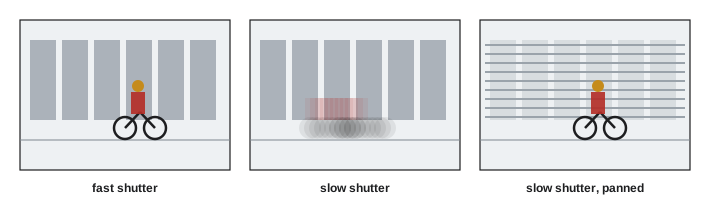
Blur can express motion better than a frozen instant. A frozen waterfall can look like glass; a frozen racing car can look parked. Photographers use slower shutter speeds deliberately:
- Subject blur with a steady camera: moving water at 1/4 s to several seconds becomes smooth and silky; crowds at 1 s become ghostly streams; waving branches show the wind.
- Panning: following a moving subject with the camera during an exposure of about 1/30 to 1/125 s keeps the subject relatively sharp while the background streaks, a classic way to show speed in motor sport, cycling and wildlife. Smooth, continuous movement of the whole upper body, continuing after the shutter closes, gives the best results, and many frames are needed for one sharp one.
- Intentional camera movement: moving the camera during a long exposure for painterly abstractions.
- Light trails: at night, a tripod and several seconds' exposure turn car headlights and tail lights into ribbons of light.
Neutral density filters
In bright daylight, long exposures are impossible at normal settings: even at ISO 100 and f/16, a sunny scene needs about 1/100 s. A neutral density (ND) filter is a darkened glass that reduces light evenly across all colors by a stated number of stops. An ND8 (also labeled 0.9 or 3-stop) cuts 3 stops, an ND64 (1.8) cuts 6, and an ND1000 (3.0) cuts 10. The new shutter time is the original multiplied by 2 to the power of the stop count.
Worked problem
Smoothing a river at midday
At ISO 100 and f/11, a river scene meters at 1/125 s. You want an exposure of about 8 s to smooth the water. Which ND filter do you need?
Show solution
- From 1/125 s to 8 s is a factor of 1,000.
- log₂(1000) ≈ 10 stops.
- A 10-stop filter (ND1000) gives 1/125 × 2¹⁰ ≈ 8 s.
Answer: A 10-stop ND filter. Focus and compose before fitting it, because the viewfinder becomes very dark, and use a tripod and remote release. Variable ND filters, two polarizers that rotate against each other, offer a range of strengths and are popular for video, but they can produce uneven darkening at wide angles and strong settings.
Graduated ND filters, dark at the top and clear at the bottom, darken a bright sky while leaving the land unchanged; today many photographers achieve the same effect by combining two exposures (Lesson 6) or with careful raw processing.
Night and star photography
At night, exposures of many seconds are normal: city scenes at dusk might need 4 to 15 s at f/8 and ISO 100, which also turns traffic into light trails. Star photography uses a wide, fast lens at its widest aperture and high ISO to gather faint light. Because the Earth rotates, stars move across the frame, and long exposures turn points into short trails. A simple guide is the "500 rule": the longest exposure before trails become visible is about 500/(focal length × crop factor) seconds, so about 25 s with a 20 mm lens on full frame. High-resolution sensors reveal trails sooner, so many photographers use stricter rules or calculators. Deliberate star trails are made with many shorter exposures stacked in software, or one very long exposure, often centered on the celestial pole to make circles.
How shutters work
Most interchangeable-lens cameras have a focal-plane shutter of two curtains just in front of the sensor. The first curtain opens to start the exposure, the second follows to end it. At fast speeds, the second curtain starts before the first has finished, so the exposure is made by a narrow slit traveling across the sensor. This matters for two reasons:
- Flash synchronization: a flash fires in an instant, so the whole sensor must be uncovered at once. The fastest speed at which this happens, the flash sync speed, is typically 1/160 to 1/250 s. Faster speeds with flash need high-speed sync, in which the flash pulses rapidly with reduced power (PHOT-102).
- Rolling shutter: electronic shutters read the sensor line by line, which takes time, typically 1/30 to 1/200 s on many cameras and much less on newer stacked sensors. Fast-moving subjects or a fast pan appear skewed (vertical poles lean), and spinning propellers take bizarre shapes. Some new cameras use global shutters that read every pixel at once.
Electronic shutters are silent and vibration-free and allow extremely fast speeds and burst rates, which suits weddings, wildlife and sport. Under some artificial lights, they cause banding: LED and fluorescent lights flicker at twice the mains frequency, 120 times a second in North America (100 times in Europe and many other regions), so rows read at different moments are lit differently. Shutter speeds that are whole multiples of the flicker period (such as 1/120 or 1/60 s in North America) avoid it, and many cameras have anti-flicker modes.
Burst shooting and timing
Continuous (burst) mode takes frames as long as the shutter button is held, from a few to more than 30 frames per second, and some cameras pre-capture frames buffered before the button is fully pressed. Burst shooting helps with unpredictable action, but it is not a substitute for timing: at 10 frames per second, there are still 100 ms between frames, long enough to miss the instant a ball meets a bat. Anticipate the peak of the action, such as the top of a jump or the moment a gesture completes, and begin shooting just before it. Lesson 9 returns to timing as a creative choice.
Common mistakes
MistakeAssuming image stabilization freezes moving subjects.
InsteadStabilization counters camera shake only; subject motion needs a faster shutter speed.
MistakeUsing the reciprocal rule without the crop factor.
InsteadUse 1/(focal length × crop factor), and faster for high-resolution sensors.
MistakePressing the shutter button by hand for long tripod exposures.
InsteadUse a self-timer or remote release.
MistakeUsing flash above the sync speed without high-speed sync.
InsteadStay at or below the sync speed, or use high-speed sync.
MistakeIgnoring banding under LED lights with an electronic shutter.
InsteadUse flicker-safe shutter speeds or the mechanical shutter.
Summary and key terms
- Shutter speeds double in full stops from 1/8000 s to 30 s, with Bulb for longer.
- Blur length ≈ subject speed × focal length/distance × exposure time.
- Motion across the frame blurs most; fast action needs about 1/1000 s or faster.
- Reciprocal rule: handhold no slower than 1/(focal length × crop factor); stabilization adds stops.
- Slow shutter speeds, panning and light trails express motion deliberately.
- ND filters cut light by stated stops for long daylight exposures.
- Focal-plane shutters set a flash sync speed; electronic shutters can cause rolling-shutter skew and flicker banding.
- Shutter speed
- The duration for which the sensor collects light.
- Bulb mode
- A setting that keeps the shutter open while the button or remote is held.
- Motion blur
- Blur caused by subject movement during exposure.
- Camera shake
- Blur caused by camera movement during exposure.
- Reciprocal rule
- A guideline for the slowest handheld shutter speed.
- Image stabilization
- Lens or sensor movement that counteracts camera shake.
- Panning
- Following a moving subject with the camera during exposure.
- Neutral density filter
- A filter that reduces light evenly by a stated number of stops.
- Flash sync speed
- The fastest shutter speed at which the whole sensor is exposed at once.
- Rolling shutter
- Line-by-line sensor readout that skews fast motion.
Practice problems
Work each problem on paper first, then reveal the answer to check.
How many stops separate 1/1000 s and 1/125 s?
Show answer
Three stops.
A car at 20 m/s crosses the frame 30 m away; you use a 100 mm lens. Find the image speed on the sensor.
Show answer
20 × 100/30,000 m/s ≈ 0.067 m/s = 67 mm/s.
What blur results at 1/1000 s in the previous question, with 6 µm pixels?
Show answer
0.067 mm ≈ 11 pixels; use 1/2000 s or faster for crisp detail.
What is the reciprocal-rule speed for a 300 mm lens on Micro Four Thirds?
Show answer
1/(300 × 2) = 1/600 s.
With 5 stops of stabilization, how slow could that become?
Show answer
About 1/20 s (1/600 → 1/300 → 1/150 → 1/75 → 1/40 → 1/20).
Suggest a shutter speed range for panning a cyclist.
Show answer
About 1/30 to 1/60 s.
A scene meters at 1/250 s. What shutter speed results with a 6-stop ND filter?
Show answer
1/250 × 64 ≈ 1/4 s.
Using the 500 rule, what is the maximum exposure for a 14 mm lens on full frame?
Show answer
About 35 s.
Why does a flash photo above the sync speed show a dark band?
Show answer
The shutter curtains cover part of the sensor when the flash fires.
At what shutter speeds do you avoid LED flicker banding in North America?
Show answer
Multiples of the 1/120 s flicker period, such as 1/120 or 1/60 s.
Lesson quiz · 5 questions
Score 60% or more to complete this lesson.
Create a free account to save your progress, take quizzes and earn a certificate.