
PHOT-201 · Lesson 12 of 12 · 27 min
Choosing, testing and maintaining a system
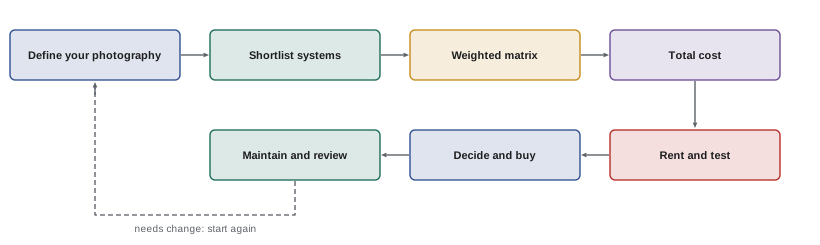
With an understanding of sensors, lenses, autofocus, shutters, processing and the practical features around them, a photographer can make informed equipment decisions. This final lesson brings the course together into a method: analyze what your photography needs, compare systems against those needs, consider the total cost over time, test equipment before committing, and maintain it so that it keeps working. It ends with the course capstone, a system proposal and test report for a photographic specialty of your choice.
Start with the photography
Equipment decisions should start from the work, not from the equipment. Describe the subjects you photograph, the conditions, the output and the constraints. A wildlife photographer needs fast, reliable subject tracking, long lenses and good high-ISO performance, and values compact telephoto reach; a landscape photographer needs resolution, dynamic range, sharp wide-angle lenses, weather sealing and light weight for hiking; a wedding photographer needs silent shooting, dual slots, reliable eye detection in dim light, fast lenses and two bodies; an architecture photographer needs tilt-shift lenses, high resolution and precise leveling; a street photographer values discretion, small size and quick handling. Writing these needs down, and ranking them, makes it far easier to compare options objectively.
| Specialty | Key requirements | Less important |
|---|---|---|
| Wildlife and birds | Tracking AF, long lenses, burst and pre-capture, high ISO | Ultimate resolution for landscapes |
| Landscape | Resolution, dynamic range, wide lenses, sealing, weight | Burst rate |
| Wedding and events | Silent shutter, dual slots, low-light AF, fast lenses, two bodies | Extreme resolution |
| Architecture and interiors | Tilt-shift lenses, resolution, leveling, dynamic range | AF speed |
| Sports | Tracking AF, fast telephotos, high burst, fast cards, FTP | Small size |
| Street and documentary | Small size, quiet shutter, quick handling, reliable AF | Very long lenses |
| Product and studio | Resolution, color accuracy, tethering, leaf shutter or flash sync | Weather sealing |
Comparing systems
With requirements ranked, compare candidate systems using a weighted scoring matrix: list the requirements, assign each a weight, score each system from published specifications, independent tests and hands-on experience, and multiply and sum. The matrix makes trade-offs explicit and reveals each system's weak points. Important factors often overlooked include the availability and cost of the specific lenses you need, rental availability in your area, repair and professional support services, compatibility with lighting equipment you already own, the handling and menu system, and the availability of the system in the used market.
Total cost of ownership
The purchase price of a body is only part of the cost of a system. Over several years, total cost includes lenses, which often cost more than the body; batteries, cards and chargers; flashes and accessories; insurance; servicing and repairs; software subscriptions; and eventual replacement, offset by resale value. Lenses from major manufacturers usually hold their value well, while bodies depreciate faster as new models appear. Renting specialist equipment, such as super-telephoto or tilt-shift lenses, for occasional jobs can be much cheaper than owning it, and renting before buying is the best test of all.
Worked problem
Estimating five-year cost
A landscape photographer considers a system costing $3,200 for the body and $4,800 for three lenses, plus $600 in batteries, cards and filters. Expected costs over five years include $150 per year for insurance and servicing. The lenses are expected to resell for 55 % of their cost and the body for 30 %. What is the estimated net cost over five years?
Show solution
- Purchase: 3,200 + 4,800 + 600 = $8,600.
- Running costs: 150 × 5 = $750.
- Resale: 0.55 × 4,800 + 0.30 × 3,200 = 2,640 + 960 = $3,600.
- Net cost: 8,600 + 750 − 3,600 = $5,750, about $1,150 per year.
Answer: About $5,750 over five years; lenses retain much more value than the body.
Testing before committing
Specifications and reviews narrow the choice; testing confirms it. Rent or borrow the camera and lenses you are considering, and test them on the work you actually do. Useful tests include:
- Handling: how the camera feels in your hands for hours, whether controls fall naturally under your fingers, and whether the menus and custom buttons suit your workflow.
- Autofocus: tracking your real subjects in your real conditions, including low light and cluttered backgrounds.
- Image quality: noise at the ISO settings you use, dynamic range in high-contrast scenes, and color rendering of your typical subjects, processed in your usual software.
- Lens sharpness: photographs of a detailed, flat subject at each aperture, checking center and corners, and a check for decentering by comparing the left and right sides.
- Reliability features: battery life on a typical day, buffer depth for your shooting style, weather resistance and heat behavior for video.
Record results systematically, with sample files at 100 %, so that you can compare systems fairly.
Testing a lens you already own
Lenses vary from sample to sample within manufacturing tolerances, and a lens can be damaged by impact. A simple test checks sharpness and alignment: photograph a flat, detailed subject, such as a brick wall or a printed test chart, squarely from a tripod at each aperture, with careful focus, and compare the four corners. If one side or corner is consistently softer, the lens may be decentered or have a tilted element and need service. Testing focus accuracy, by photographing a target at an angle and checking where the sharpest point falls, matters especially for DSLRs with separate autofocus modules and for fast lenses.
Buying used equipment
The used market offers excellent value, especially for lenses and recent bodies replaced by new models. Check shutter count, which many cameras record, against the rated durability; inspect for impact damage, worn grips, scratched or fungus-affected lens elements, haze, loose mounts, and sticky aperture blades; test all controls, autofocus, stabilization and card slots; and buy from dealers offering a warranty or return period where possible. Check that the serial number has not been reported stolen.
Maintenance
Regular maintenance keeps equipment reliable. Clean lens elements with a blower, then a soft brush and lens cloth or tissue with lens cleaning fluid, never pressing hard on grit. Keep caps on lenses when not in use and use hoods to protect front elements. Clean the sensor when dust appears (Lesson 2). Wipe down cameras after use in rain, salt spray or dust, and let them dry with doors open. Store equipment in a dry place; in humid climates, use a dry cabinet or silica gel to prevent fungus growth on lens elements. Have professional cameras serviced periodically, especially before major projects, and keep firmware up to date (Lesson 11). Keep a record of serial numbers, purchase receipts and insurance details.
When to upgrade
New cameras are released constantly, and marketing encourages frequent upgrades. A good reason to upgrade is a specific limitation that affects your photographs or business: autofocus that misses moving subjects you need, noise that limits your low-light work, resolution that prevents client deliverables, reliability problems or lack of a feature you need, such as silent shooting. If you cannot identify such a limitation, improving technique, lighting or lenses usually brings more benefit than a new body. When upgrading, consider whether a lens would help more than a body.
Capstone: system proposal and test report
The capstone asks you to choose a photographic specialty and prepare a system proposal with supporting tests. It should include:
- A description of the specialty, typical subjects, conditions and outputs, with ranked requirements.
- A weighted comparison of at least three systems, with reasoning based on the concepts of this course: sensor size and dynamic range, autofocus, lenses, shutter and stabilization, processing and practical features.
- A recommended kit list with lenses and accessories, and a five-year cost of ownership estimate.
- A test report on equipment available to you: at least an ISO and dynamic range test, a lens sharpness test across apertures, and an autofocus or stabilization test relevant to the specialty, with sample images and conclusions.
- A maintenance and data backup plan.
Present the proposal as a short report with images, as you would to a client or employer justifying an equipment purchase.
Building a weighted scoring matrix
A weighted scoring matrix turns a complex decision into a transparent calculation. List the requirements down the side, assign each a weight reflecting its importance, for example from 1 to 5, and list the candidate systems across the top. Score each system on each requirement, for example from 1 to 10, using specifications, independent reviews and hands-on tests. Multiply each score by its weight, and sum the results for each system. The numbers do not make the decision for you, since weights and scores involve judgment, but they make the reasoning visible and expose surprises, such as a system that scores highly overall but very poorly on an essential requirement. Treat any requirement that is non-negotiable, such as the availability of a specific lens or dual card slots for weddings, as a gate that a system must pass before scoring.
Worked problem
Scoring three systems for wildlife photography
A wildlife photographer weights tracking autofocus 5, telephoto lens options 5, high-ISO quality 4, weight 3 and cost 3. System A scores 9, 8, 8, 6, 5; System B scores 8, 9, 7, 8, 7; System C scores 7, 6, 9, 7, 8. Which scores highest?
Show solution
- System A: 45 + 40 + 32 + 18 + 15 = 150.
- System B: 40 + 45 + 28 + 24 + 21 = 158.
- System C: 35 + 30 + 36 + 21 + 24 = 146.
- System B scores highest, though System A leads on tracking; testing both on real subjects would confirm the choice.
Answer: System B, with 158 points, ahead of System A at 150 and System C at 146.
Buying new: warranties, gray market and support
Buying from authorized dealers usually brings the manufacturer's local warranty and access to repair services. Gray-market equipment, imported outside the manufacturer's official distribution, may be cheaper but often lacks a valid local warranty, and the manufacturer may refuse to repair it under warranty or at all. Professional service programs offered by the major manufacturers provide faster repairs, loan equipment, priority support at major events, and discounts on maintenance for photographers who meet membership criteria, usually based on owning professional equipment and earning income from photography. For working photographers, the availability of fast repairs or loaner equipment can matter as much as the equipment itself, and extended warranties or equipment insurance that covers accidental damage, theft and business use are worth considering.
Renting equipment
Rental houses offer camera bodies, lenses, lighting and accessories by the day, weekend or week, often at a few percent of the purchase price per day. Renting lets photographers try equipment before buying, take on jobs that require specialist lenses, add a second body for an important event, or replace equipment under repair. Book early for busy seasons, inspect and test rented equipment on collection, check that insurance covers rented gear, and return it clean and complete. Online rental services ship equipment, broadening the choice for photographers outside major cities. For occasional needs, renting is almost always cheaper than owning, and many working photographers add rental fees to their client invoices.
Building a kit over time
Few photographers buy a complete system at once. A sensible approach is to start with a body and one or two versatile lenses that cover most of your work, use them extensively, and add equipment only when you identify a specific limitation. Many photographers find that a fast prime, a standard zoom and a telephoto zoom cover most needs, with specialist lenses added as their work develops. Investing in good lenses, which outlast several bodies, usually brings more lasting benefit than frequent body upgrades. Accessories such as a sturdy tripod, a reliable flash, good bags, spare batteries and fast cards are less exciting than cameras but strongly affect how well a system works in practice.
Insurance and records
Keep a list of every item of equipment with its serial number, purchase date, price and photographs, stored securely away from the equipment itself. This record supports insurance claims, helps police recover stolen equipment, and simplifies selling. Home insurance policies often exclude or limit equipment used for business, so working photographers usually need specialist equipment insurance, and many clients and venues also require photographers to carry liability insurance. PHOT-410 covers business insurance in more depth.
Bringing the course together
Choosing and maintaining a system draws on every lesson in this course. Sensor knowledge informs decisions about resolution, size and dynamic range; lens knowledge guides choices of focal lengths, apertures and quality; autofocus, shutter and stabilization knowledge determines which bodies suit fast or slow subjects; and processing, storage and power knowledge shapes the workflow from capture to delivery. The capstone gives you a chance to apply all of these to a specialty you care about, and the resulting proposal is a practical document you can use when you next buy or rent equipment.
Common mistakes
MistakeChoosing equipment before defining needs.
InsteadRank requirements for your photography first.
MistakeComparing only body prices.
InsteadEstimate total cost of ownership including lenses and resale.
MistakeBuying without testing.
InsteadRent or borrow and test on real work.
MistakeIgnoring lens sample variation.
InsteadTest new and used lenses for sharpness and centering.
MistakeUpgrading without a specific limitation.
InsteadImprove technique or lenses first.
Summary and key terms
- Start from the photography: subjects, conditions, outputs and constraints.
- Rank requirements and compare systems in a weighted matrix.
- Total cost includes lenses, accessories, running costs and resale.
- Rent and test candidate systems on real work.
- Test lenses for sharpness, centering and focus accuracy.
- Maintain equipment with cleaning, dry storage and servicing.
- Upgrade for specific limitations; the capstone integrates the course.
- Requirements
- Ranked needs of a photographic specialty.
- Weighted matrix
- Scoring options against weighted criteria.
- Total cost of ownership
- All costs over the life of equipment.
- Resale value
- Expected selling price of used equipment.
- Decentering
- Misalignment of lens elements causing uneven sharpness.
- Sample variation
- Differences between units of the same lens.
- Shutter count
- Number of shutter actuations recorded.
- Fungus
- Mold growing on lens elements in humidity.
- Dry cabinet
- Humidity-controlled storage.
- System proposal
- Justified recommendation of equipment.
Practice problems
Work each problem on paper first, then reveal the answer to check.
Name three requirements for wildlife photography.
Show answer
Tracking AF, long lenses, burst, high ISO, pre-capture.
Name three requirements for architecture.
Show answer
Tilt-shift lenses, resolution, leveling, dynamic range.
What does a weighted matrix reveal?
Show answer
Trade-offs and weak points.
Which usually holds value better, bodies or lenses?
Show answer
Lenses.
Net five-year cost: $5,000 purchase, $500 running, $2,000 resale?
Show answer
$3,500.
Name three things to test before buying.
Show answer
Handling, AF, noise and DR, lens sharpness, battery, buffer.
How do you test a lens for decentering?
Show answer
Compare corners of a flat detailed subject shot squarely.
What should you check on a used camera?
Show answer
Shutter count, damage, controls, card slots, AF, serial number.
How do you prevent lens fungus?
Show answer
Dry storage with a dry cabinet or silica gel.
When is upgrading justified?
Show answer
When a specific limitation affects your photographs.
Lesson quiz · 5 questions
Score 60% or more to complete this lesson.
Create a free account to save your progress, take quizzes and earn a certificate.