
PHOT-201 · Lesson 8 of 12 · 30 min
Shutters, stabilization and capture modes
The shutter controls when and for how long the sensor is exposed, and the way it does this affects flash photography, fast action, silent shooting and image distortion. Stabilization systems counteract camera movement, allowing sharp handheld images at slower shutter speeds. Burst modes, buffers and pre-capture features determine whether you can catch fleeting moments. This lesson covers mechanical focal-plane shutters and flash sync, leaf shutters, electronic shutters and rolling-shutter effects, global shutters, high-speed sync, burst rates and buffers, pre-capture, and lens and sensor stabilization.
The mechanical focal-plane shutter
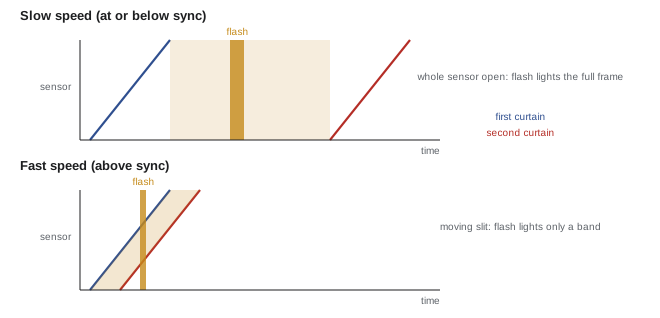
Most interchangeable-lens cameras use a focal-plane shutter just in front of the sensor, with two curtains that travel vertically. To make an exposure, the first curtain opens to uncover the sensor and, after the exposure time, the second curtain follows to cover it again. At slow shutter speeds, the whole sensor is uncovered at once between the two curtain movements. At fast speeds, the second curtain starts before the first has finished, so the exposure is made by a narrow slit that travels across the sensor: every part of the sensor receives the same exposure time, but different parts are exposed at slightly different moments. Curtains travel in a few milliseconds, typically 2 to 4 ms in full-frame cameras.
Flash sync speed
An ordinary flash pulse lasts a few thousandths of a second or less. For the flash to light the whole frame, the entire sensor must be uncovered at the moment it fires, which happens only at shutter speeds slower than the time the curtains take to travel. The fastest such speed is the flash sync speed, typically 1/200 s to 1/250 s for full-frame cameras, and sometimes faster for smaller formats. At faster shutter speeds, a single flash pulse lights only a band of the frame, leaving the rest dark. This limits photographers who want to use flash outdoors in bright sun at wide apertures, since they cannot raise the shutter speed above sync to control ambient exposure.
High-speed sync and leaf shutters
Two solutions extend flash use beyond sync speed. High-speed sync (HSS) makes the flash emit a rapid series of pulses that act like continuous light while the slit crosses the sensor. HSS works at any shutter speed but wastes much of the flash's power, reducing effective output by two stops or more. Leaf shutters, located inside the lens rather than in front of the sensor, open from the center outward like an iris and expose the whole frame at once at every speed, allowing flash sync at speeds such as 1/2000 s or faster. They are found in many medium format lenses and some compact cameras, and are valued by portrait and fashion photographers working with flash outdoors.
Worked problem
Overpowering the sun with flash
A photographer wants a portrait at f/2.8 in bright sun, where correct ambient exposure is f/2.8 at 1/4000 s at ISO 100, and wants to darken the background by one stop using flash for the subject. What are the options with a camera whose sync speed is 1/250 s?
Show solution
- Target ambient: one stop under, f/2.8 at 1/8000 s, ISO 100, far above the sync speed.
- Option 1: high-speed sync at 1/8000 s, which requires a powerful flash close to the subject because HSS loses much of its output.
- Option 2: an ND filter of five stops (ND32), allowing 1/250 s at f/2.8 for one stop under ambient, with normal flash sync.
- Option 3: a lens or camera with a leaf shutter that syncs at 1/2000 s or faster, combined with a smaller ND filter.
Answer: Use HSS with ample power, an ND filter to bring the shutter speed down to sync, or a leaf shutter.
Electronic shutters
An electronic shutter starts and ends exposure by resetting and reading out the sensor, with no moving parts. It is silent and vibration-free, allows extremely fast shutter speeds such as 1/32,000 s, enables very high burst rates without mechanical wear, and is essential for silent shooting at weddings, theaters and wildlife. Most sensors read out row by row, so an electronic shutter is a rolling shutter: the bottom of the frame is captured slightly later than the top. If the readout takes 1/20 s, as on some older sensors, fast-moving subjects or camera pans are distorted: vertical lines lean, propellers bend and golf clubs curve. Flickering artificial lights can produce bands. And flash use is limited or impossible with many electronic shutters. Stacked sensors with fast readout, around 1/200 s or less, reduce these problems greatly.
Many cameras also offer an electronic first-curtain shutter, which starts the exposure electronically and ends it with the mechanical second curtain, eliminating the vibration of the first curtain, a cause of slight blur at middle shutter speeds, while avoiding most rolling-shutter effects.
Global shutters
A global shutter exposes and reads all pixels at the same instant, eliminating rolling-shutter distortion and banding, and allowing flash sync at any shutter speed. Global shutters have long been common in industrial and scientific cameras but were rare in photography because the extra circuitry in each pixel reduced dynamic range and increased noise. Sony's Alpha 9 III, announced in 2023, became the first full-frame mirrorless camera with a global shutter, offering flash sync up to its fastest shutter speed and distortion-free bursts at 120 frames per second, at some cost in base ISO and dynamic range. As the technology improves, global shutters may become common.
| Shutter type | Advantages | Limitations |
|---|---|---|
| Mechanical focal plane | No rolling distortion at normal speeds; flash sync | Noise, vibration, wear; sync limit about 1/250 s |
| Electronic first curtain | Reduces vibration blur | Slight bokeh truncation at very fast speeds |
| Electronic (rolling) | Silent, very fast, high bursts | Distortion, banding, limited flash |
| Global electronic | No distortion; flash at any speed | Historically lower dynamic range |
| Leaf (in lens) | Flash sync at high speeds, quiet | Limited maximum speed; only certain lenses |
Burst rates, buffers and pre-capture
Burst rate, the number of frames per second in continuous shooting, ranges from a few frames per second to 120 or more with electronic shutters. Higher rates increase the chance of catching the peak of action, but even at 20 fps the interval between frames is 50 ms, during which a tennis ball travels several meters. Images first go into the camera's buffer, fast internal memory, before being written to the card; when the buffer fills, the camera slows dramatically. Buffer depth depends on the file type: many more JPEG or compressed raw files fit than uncompressed raw. Fast cards (Lesson 11) clear the buffer faster.
Pre-capture modes, also called pre-burst or pro capture, continuously record frames into the buffer while the shutter button is half-pressed, and when it is fully pressed, save frames from up to a second or so before. This compensates for human reaction time, which averages about 0.2 to 0.3 seconds, and is invaluable for unpredictable events such as birds taking off or lightning.
Stabilization
Camera shake blurs images when the camera moves during the exposure. A traditional guideline for handheld shooting is the reciprocal rule: use a shutter speed of at least 1 over the effective focal length, for example 1/200 s with a 200 mm lens on full frame, and faster on high-resolution sensors, where small blur is more visible. Stabilization systems detect camera motion with gyroscopic sensors and counteract it in real time. Optical image stabilization (OIS) moves a group of lens elements; in-body image stabilization (IBIS) moves the sensor itself on a floating platform, working with any lens, including adapted and vintage lenses. Many systems combine both. Stabilization is rated in stops of improvement, measured under the CIPA standard; modern systems claim 5 to 8 stops, meaning a photographer who could hold 1/250 s might achieve sharp results at 1/8 s or slower, though real results vary with technique and focal length.
Worked problem
How slow can you go?
A photographer uses a 100 mm lens on an APS-C camera (crop factor 1.5) in a dim museum. Stabilization is rated at 5 stops. Estimate the slowest reliable handheld shutter speed.
Show solution
- Effective focal length: 100 × 1.5 = 150 mm, so the reciprocal rule suggests about 1/150 s, rounded to 1/160 s.
- Five stops slower: 1/160 → 1/80 → 1/40 → 1/20 → 1/10 → 1/5 s.
- In practice, take a burst and allow a margin: about 1/10 s is a realistic target for most people.
- Stabilization does not freeze subject movement; visitors walking will still blur.
Answer: Around 1/5 s in theory, about 1/10 s in practice; subject motion still needs faster speeds.
Stabilization should usually be turned off on a tripod with some older systems, which can drift when there is no motion to correct, though many modern systems detect tripod use automatically. Panning modes stabilize only vertical movement so that horizontal panning with a moving subject is allowed. Sensor-shift mechanisms also enable pixel-shift modes (Lesson 4) and features such as automatic horizon leveling and star tracking for short astrophotography exposures.
Shutter shock and electronic first curtain
At certain shutter speeds, roughly 1/8 to 1/125 s, the vibration of the mechanical shutter's first curtain starting its travel can blur fine detail, especially with high-resolution sensors, long lenses and light tripods. This is called shutter shock. Electronic first-curtain shutter (EFCS) avoids it by starting the exposure electronically, resetting each row of the sensor in sequence, and ending it with the mechanical second curtain. EFCS combines the vibration-free start of an electronic shutter with the distortion-free end of a mechanical one and has become the default in many cameras. At very fast shutter speeds and wide apertures, EFCS can slightly alter the out-of-focus rendering, causing uneven bokeh, so some photographers switch to a fully mechanical shutter at 1/2000 s and above.
Flicker under artificial light
Many light sources flicker at twice the mains frequency: 120 Hz in North America and 100 Hz in regions with 50 Hz power. Fluorescent lights, some LED fixtures and sodium lamps vary in brightness and color during each cycle. At fast shutter speeds, successive frames may show different brightness and color, and electronic shutters, reading row by row, may show horizontal bands across the frame. Anti-flicker modes detect the flicker frequency and time each exposure to the peak of the light's brightness cycle, giving consistent results with the mechanical shutter. High-frequency flicker modes let the photographer fine-tune the shutter speed in small increments to match the flicker of LED screens and lights, removing banding with electronic shutters and in video. Choosing shutter speeds that are whole multiples of the flicker period, such as 1/60 s or 1/120 s in North America, also avoids banding.
Worked problem
Avoiding banding at an indoor sports event
A photographer shoots basketball under LED arena lights in Canada or the United States using the electronic shutter at 1/1000 s, and sees bands across the frame. What can be done?
Show solution
- Recognize the cause: the lights flicker at 120 Hz, and the rolling readout captures different parts of the cycle in different rows.
- Switch to the mechanical shutter with anti-flicker enabled, accepting a lower burst rate, if the camera allows.
- Or use the high-frequency flicker setting to find a shutter speed close to the desired one that minimizes banding.
- If speed allows, use 1/120 s multiples, though this is usually too slow for action.
Answer: Use the mechanical shutter with anti-flicker, or fine-tune the electronic shutter speed with a high-frequency flicker mode.
Silent shooting and its uses
The electronic shutter allows completely silent shooting, which is invaluable at weddings, during speeches, in theaters and concerts, in courtrooms where permitted, in wildlife hides and in street photography. Before electronic shutters, photographers used soundproof enclosures called blimps for film sets and quiet venues. Silent shooting should be used with awareness of its limitations: rolling shutter distortion with fast subjects or panning, banding under artificial light, and sometimes lower bit depth or dynamic range in electronic shutter mode on some cameras. Photographers also need to consider ethics and law, since silent shooting does not change the rules about where and whom one may photograph.
Intervals, time-lapse and long exposures
Cameras offer several capture modes beyond single frames and bursts. Interval timers, built into most modern cameras, take a series of frames at set intervals for time-lapse sequences of clouds, construction, plants or night skies; using the electronic shutter avoids wearing out the mechanical shutter over thousands of frames. Bulb mode holds the shutter open as long as the button or a remote release is pressed, for exposures of minutes or hours, and some cameras offer timed long exposures without a remote. Long exposures smooth water and clouds, record star trails and light trails, and may require neutral density filters in daylight. A sturdy tripod, mirror lock-up on DSLRs, a remote release or self-timer, and long-exposure noise reduction help maximize quality.
Stabilization and tripods
Stabilization systems detect and correct the camera's own movement, so they should usually be turned off or set to tripod mode when the camera is on a solid tripod, because some older systems can introduce small corrective movements that blur the image when none is needed. Modern systems often detect tripod use automatically. Stabilization does nothing to freeze subject movement, so a stabilized camera at 1/4 s can produce a sharp background but a blurred person. Panning modes stabilize only the vertical axis, allowing smooth horizontal panning with moving subjects.
Common mistakes
MistakeSetting a shutter speed above sync with normal flash.
InsteadStay at or below sync, or use HSS, ND or a leaf shutter.
MistakeUsing a slow-readout electronic shutter for fast action.
InsteadUse the mechanical shutter or a fast stacked sensor.
MistakeRelying on burst rate alone to catch peak action.
InsteadAnticipate timing or use pre-capture.
MistakeExpecting stabilization to freeze moving subjects.
InsteadIt counters camera shake only.
MistakeIgnoring buffer limits.
InsteadKnow your buffer depth and use fast cards.
Summary and key terms
- Focal-plane shutters expose through a moving slit at fast speeds.
- Flash sync speed, about 1/200–1/250 s, is the fastest full-frame exposure.
- High-speed sync and leaf shutters extend flash beyond sync.
- Electronic shutters are silent and fast but can distort moving subjects.
- Global shutters eliminate rolling distortion and allow flash at any speed.
- Buffers limit bursts; pre-capture compensates for reaction time.
- OIS and IBIS gain several stops against camera shake, not subject motion.
- Focal-plane shutter
- Two-curtain shutter in front of the sensor.
- Flash sync speed
- Fastest shutter speed with the sensor fully open.
- High-speed sync
- Pulsed flash usable above sync speed.
- Leaf shutter
- In-lens shutter exposing the whole frame at once.
- Electronic shutter
- Exposure controlled by sensor reset and readout.
- Rolling shutter
- Row-by-row readout causing distortion.
- Global shutter
- Simultaneous exposure of all pixels.
- Buffer
- Fast memory holding images before writing.
- Pre-capture
- Saving frames from before the shutter press.
- IBIS
- In-body image stabilization.
Practice problems
Work each problem on paper first, then reveal the answer to check.
Why does flash fail above sync speed?
Show answer
Only a slit of the sensor is open when the flash fires.
Typical full-frame sync speed?
Show answer
1/200 to 1/250 s.
What is the cost of high-speed sync?
Show answer
Much lower effective flash power.
Where is a leaf shutter located?
Show answer
In the lens.
Name two benefits of electronic shutters.
Show answer
Silence, no vibration, very fast speeds, high bursts.
What does an electronic first curtain eliminate?
Show answer
First-curtain vibration blur.
What advantage does a global shutter have for flash?
Show answer
Sync at any shutter speed.
Frame interval at 20 fps?
Show answer
50 ms.
Reciprocal rule speed for 300 mm on full frame?
Show answer
About 1/300 s.
What does IBIS move?
Show answer
The sensor.
Lesson quiz · 5 questions
Score 60% or more to complete this lesson.
Create a free account to save your progress, take quizzes and earn a certificate.