
PHOT-230 · Lesson 10 of 12 · 25 min
Sequencing a story and the photo essay
A documentary project becomes a story through editing and sequencing. From hundreds or thousands of frames, the photographer selects a small number of images and arranges them so that each one builds on the last, creating rhythm, revealing information and leading viewers to understanding or feeling. The same photographs sequenced differently can tell very different stories. This lesson covers the difference between editing and sequencing, the elements of a photo essay, narrative structures, openers and closers, variety in shot size and pacing, pairs and spreads, the role of single strong images versus the whole, editing collaboratively, and sequencing for different media, from magazines and websites to books and social media.
Editing and sequencing
In photography, editing means selecting which images to use, and sequencing means deciding their order. Both are creative acts. A strong edit is ruthless: it removes weak images, near-duplicates and photographs that are good individually but do not serve the story. Many photographers find editing their own work difficult because they remember the effort or emotion behind each frame; viewers see only what is in the photograph. Distance helps, as does showing work to trusted editors. Sequencing then arranges the selected images so that the order itself creates meaning: transitions, contrasts, echoes, a build toward a climax, or a gradual revelation.
Elements of a photo essay
Picture editors at magazines in the mid-twentieth century developed a widely used set of image types for photo essays, which remains a useful checklist when shooting and editing:
| Image type | Role in the story |
|---|---|
| Establishing or overall shot | Shows the place and context |
| Signature or key image | Sums up the story in one frame |
| Portraits | Introduces the main people |
| Relationship or interaction | Shows people with each other |
| Detail | Close-ups of hands, objects, textures that add information |
| Action or sequence | Shows what people do or how something unfolds |
| Moment of emotion or climax | The emotional peak of the story |
| Closer | A final image that resolves or leaves a lasting impression |
Not every essay needs every type, and contemporary essays often break these conventions, but shooting with them in mind ensures variety and coverage. W. Eugene Smith's Country Doctor (1948) is often analyzed in these terms: establishing views of the town, portraits of the doctor, scenes of house calls, close details of medical work, and a final image of the exhausted doctor with a cup of coffee after surgery.
Narrative structures
Photo stories can follow several structures:
- Chronological: events in the order they happened, such as a day in someone's life or a year in a community. Simple and clear, though it can feel predictable.
- Thematic: images grouped by theme, such as work, family, faith and leisure, building a portrait of a community.
- Character-driven: following one or a few people through events, inviting viewers to identify with them.
- Problem and response: showing an issue, its causes and effects, and how people respond.
- Associative or poetic: images connected by visual and emotional echoes rather than explicit narrative, common in personal documentary and street photography books, where meaning emerges from juxtaposition and rhythm.
Many essays combine structures, for example a character-driven story within a chronological frame. The structure should suit the subject and the medium.
Openers and closers
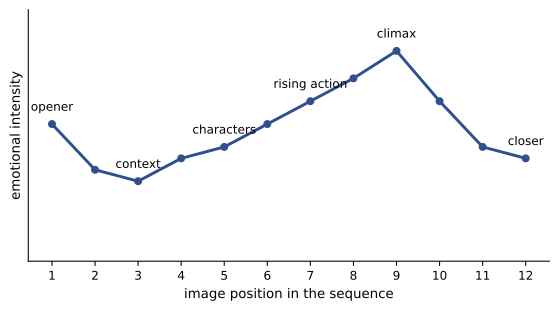
The first image determines whether viewers engage. A strong opener is visually arresting and sets the tone, often a single striking image that raises a question or establishes the place and mood; it need not be the most informative image. The closer is equally important: it leaves the final impression and may resolve the story, offer hope, raise a question or return to a motif from the beginning. Editors often spend more time choosing openers and closers than any other images. A useful exercise is to choose several candidate openers and closers and see how each changes the meaning of the same middle sequence.
Variety, rhythm and pacing
A sequence needs variety to hold attention: wide, medium and close shots; people and places; action and stillness; dense and simple compositions; light and dark images; in color work, changes in palette. Too many similar images in a row, such as five portraits in the same framing, become monotonous, while too much variety without connection feels random. Pacing controls how fast viewers move through the story: a series of quick, busy images creates energy; a quiet image or a full-page spread slows the viewer down. Think of the sequence like music, with themes, variations, crescendos and rests.
Pairs, spreads and transitions
In books and magazines, images are often seen in pairs on facing pages, so their relationship matters. Pairs can echo each other through form, gesture or color; contrast, such as wealth and poverty, young and old; or create a narrative step, such as before and after. Transitions between images can be smooth, through visual echoes such as a similar shape or direction of movement, or abrupt, to create surprise or tension. A full spread across two pages gives an image emphasis. When sequencing for print, lay out small prints in pairs to see how they work together. Online, images are often seen one at a time in a scroll, so transitions between consecutive images matter more than pairs.
Worked problem
Fixing a sequence
A student's essay on a family bakery has twelve images: four portraits of family members in a row at the start, then six images of baking in chronological order, ending with two more portraits. Reviewers say it feels flat. How could it be improved?
Show solution
- Choose a stronger opener: perhaps an early-morning image of light through the bakery window with flour in the air.
- Distribute the portraits through the sequence, placing each family member where their role appears in the process.
- Vary shot sizes: add detail images of hands kneading and a wide view of the shop full of customers.
- Build to a climax, such as the morning rush, then close with a quiet image, such as the family sharing a meal after closing.
- Remove the weakest portrait to tighten the edit.
Answer: Use an evocative opener, spread portraits through the process, vary scale, build to a busy climax and close on a quiet moment, cutting weaker images.
Single images and the whole
Some images are strong on their own; others gain strength only in context. A sequence may include quieter images that would not stand alone but provide information, breathing space or transitions. Conversely, a spectacular image that does not fit the story or tone may weaken the sequence and should be left out, however painful that is. Many photographers distinguish between their portfolio, a selection of strongest single images, and their stories or books, where the sequence matters more than any single image. Learning to judge both is part of becoming a documentary photographer.
Editing with others
Experienced editors, curators, teachers and peers often see what photographers cannot. Working with an editor typically involves sharing a broad selection, perhaps 50 to 200 images for a story, discussing what the story is about, and narrowing and sequencing together. Be open to suggestions, but also clear about your intentions and ethical commitments, such as images you promised not to publish or captions that must accompany certain photographs. Workshops and portfolio reviews offer feedback from several perspectives; take notes and look for patterns in comments rather than following every suggestion.
Sequencing for different media
The medium shapes the sequence. Magazine and newspaper stories usually use 6 to 15 images with captions and text, constrained by page layouts. Online essays can include more images, often 15 to 30, viewed in a vertical scroll or slideshow, and can integrate audio, video and maps. Social media platforms favor carousels of up to 20 images on Instagram, single strong images, and short videos; the first image must stop the scroll, and captions do much of the storytelling. Exhibitions arrange images in space, with sizes, groupings and walls creating the sequence, and viewers may move in different orders. Photobooks allow the most control over pacing, pairing and design (Lesson 12). Many projects are sequenced differently for each outlet.
Sequencing tools
Practical tools include small work prints, about 10 × 15 cm, arranged on a table or pinned on a wall; contact sheets and grids in catalog software, with collections for each draft sequence; layout software for books and magazines; and storyboarding apps. Physical prints remain popular because they let photographers see many images together, move them quickly and step back to judge the whole. Photographing each version of a wall layout with a phone keeps a record of drafts.
Editing exercises
Editing improves with practice. Useful exercises include editing the same set of 100 images into a sequence of 10, then 20, then 5, to see what remains essential; asking three people to choose their favorite 10 images independently and comparing the results; creating two sequences with opposite moods from the same pool of images; studying a photobook you admire and listing its structure, openers, closers and pairs; and re-editing an old project a year later. Each exercise builds the ability to see images as parts of a whole rather than as isolated favorites.
The role of text in sequencing
Text and captions affect how sequences are read. In magazines, headlines, standfirsts and captions guide viewers through the story; in books, text may appear as an introduction, as captions grouped at the back, or interleaved with images. Placing captions separately from images, a common choice in art photobooks, invites viewers to look first and read later, while captions beside images direct interpretation immediately. When sequencing, consider where text will appear and how it will interact with images: a caption revealing that a person in a joyful image later died, for example, transforms the meaning of everything that follows. Lesson 11 covers captions in detail.
Sequencing street photography
Street photography sequences often follow associative logic rather than narrative. Images may be linked by repeated shapes, gestures, colors or moods, or by contrasts, creating a rhythm that evokes a city or a way of seeing rather than telling a story. Many street photography books move through themes or times of day, or simply alternate dense and quiet images to create pacing. When sequencing street work, look for visual rhymes between images, such as a raised arm echoed by a raised arm in the next photograph, and for moments where a change in tone or place gives the viewer a new start. Associative sequences are subtle, and testing them with viewers helps reveal whether connections are perceived.
Testing a sequence
Before finalizing a sequence, test it. Show it to people who do not know the project and ask them to describe the story or mood they perceive; their answers reveal whether the sequence communicates as intended. Watch where they pause, where they hurry, and which images they mention afterward. Try removing an image and see whether anything is lost; if not, it may be unnecessary. Try reversing or shuffling sections to see whether the order matters. A sequence that survives these tests is likely to be strong.
Length and restraint
Beginners often include too many images, diluting strong photographs with weaker ones. A common editorial rule is that a story should be as long as its strongest images allow, and no longer. Twelve excellent photographs make a stronger essay than thirty uneven ones, and viewers remember tight, well-paced sequences. When in doubt, cut: if removing an image does not weaken the story, it was not needed.
Sequencing as authorship
Sequencing is one of the photographer's most personal decisions, and handing it entirely to others means giving up much of the work's meaning. Even when editors and designers are involved, photographers should understand the reasons behind each placement and argue for choices that matter to the story or to the people photographed. Learning to explain why an image belongs in a particular place is a valuable professional skill.
Common mistakes
MistakeIncluding every good image.
InsteadEdit ruthlessly to serve the story.
MistakeGrouping all similar images together.
InsteadVary scale, subject and pace through the sequence.
MistakeWeak openers and closers.
InsteadChoose arresting openers and resonant closers.
MistakeKeeping a spectacular image that does not fit.
InsteadLeave out images that weaken the whole.
MistakeUsing the same sequence for every medium.
InsteadAdapt the edit and order to each outlet.
Summary and key terms
- Editing selects; sequencing orders images to create meaning.
- Classic photo essays use establishing, portrait, detail, action, climax and closing images.
- Structures include chronological, thematic, character-driven, problem-response and associative.
- Openers engage; closers leave the final impression.
- Variety, rhythm and pacing hold attention.
- Pairs and transitions create relationships between images.
- Edit collaboratively and adapt sequences to each medium.
- Edit
- Selection of images for use.
- Sequence
- Order in which images are presented.
- Photo essay
- Sequence of images with text telling a story.
- Establishing shot
- Image showing place and context.
- Signature image
- Single image that sums up the story.
- Opener
- First image of a sequence.
- Closer
- Final image of a sequence.
- Pacing
- Speed at which viewers move through a sequence.
- Spread
- Two facing pages in a book or magazine.
- Associative sequence
- Sequence linked by visual and emotional echoes.
Practice problems
Work each problem on paper first, then reveal the answer to check.
What is the difference between editing and sequencing?
Show answer
Selecting images versus ordering them.
Name four classic photo essay image types.
Show answer
Establishing, portrait, detail, action, interaction, climax, closer.
What closes Country Doctor?
Show answer
The exhausted doctor with coffee after surgery.
Name three narrative structures.
Show answer
Chronological, thematic, character-driven, problem-response, associative.
What makes a strong opener?
Show answer
A visually arresting image that sets tone or raises a question.
How can a sequence avoid monotony?
Show answer
Vary scale, subject, light and pace.
Name two kinds of pairing.
Show answer
Echo, contrast, narrative step.
Why might a strong image be left out?
Show answer
It does not serve the story or tone.
Typical number of images in a magazine story?
Show answer
About 6 to 15.
Why use physical work prints?
Show answer
To see many images and rearrange quickly.
Lesson quiz · 5 questions
Score 60% or more to complete this lesson.
Create a free account to save your progress, take quizzes and earn a certificate.