
PHOT-230 · Lesson 11 of 12 · 25 min
Captions, context and text
Photographs do not explain themselves. The same image of a crowd could show a celebration, a protest, a queue for food or a funeral, and viewers rely on captions and text to know what they are seeing. In documentary work, captions are part of the photograph's truth: an accurate image with a wrong caption misleads as surely as a manipulated one. Text can also deepen a project, adding voices, history and analysis that images alone cannot convey. This lesson covers the purposes of captions, writing documentary captions, accuracy and verification, quotations and the voices of subjects, extended text and essays, combining images with audio and video, context collapse and misinformation, metadata and attribution, and writing about your own work.
What captions do
Captions perform several functions: they identify people, places and dates; explain what is happening and why it matters; correct misleading impressions; add information that is not visible, such as history, statistics or what happened next; and credit the photographer. They also shape interpretation: a caption describing someone as "a victim" or "a survivor", "a migrant" or "an asylum seeker", "rioters" or "protesters" frames how viewers understand the image. Writing captions is therefore both a factual and an ethical task. In street photography, captions are often minimal, giving only place and date, which leaves interpretation open; in documentary and journalistic work, fuller captions are expected.
Writing documentary captions
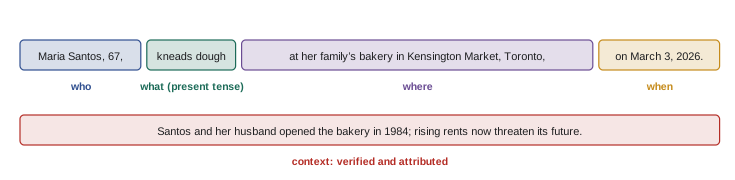
A standard documentary or news caption answers the basic questions: who, what, where, when and why or how. A common structure has two parts: a first sentence in the present tense describing what the photograph shows, and further sentences in the past tense or with background information. For example: "Maria Santos, 67, kneads dough at her family's bakery in Kensington Market, Toronto, on March 3, 2026. Santos and her husband opened the bakery in 1984 after emigrating from Portugal; rising rents now threaten its future." Good captions are specific, using names, ages, places and numbers rather than generalities; neutral in tone, avoiding loaded or emotional words; and concise. Agencies and publications have style guides governing format, abbreviations and terminology, and photographers should follow them.
| Caption element | Example | Tip |
|---|---|---|
| Who | Maria Santos, 67 | Confirm spelling; ask how people wish to be identified |
| What | kneads dough | Describe what the image shows, in the present tense |
| Where | at her family's bakery in Kensington Market, Toronto | Be specific; consider safety before naming exact locations |
| When | on March 3, 2026 | Use the date the photograph was made |
| Why or context | rising rents threaten its future | Add background that is verified and relevant |
Accuracy and verification
Every fact in a caption must be checked. Names should be spelled as the person spells them, confirmed in writing or by photographing an identification card or business card, with consent. Ages, titles, places and dates should be verified. Statements about events, causes and numbers should come from reliable sources and be attributed: "according to the city housing department" rather than presented as the photographer's own claim. Avoid guessing at people's thoughts, feelings, relationships or circumstances: "a woman mourns her son" is a claim that must be confirmed, while "a woman cries at a vigil" describes what is visible. When unsure, say less. Correct errors promptly when they are discovered, and keep notes to support captions (Lesson 9).
Identifying people
Naming people in captions gives them identity and dignity, and is standard in documentary and news work, but naming can also expose them to risk. Consider asking people how they wish to be identified: full name, first name only, or anonymously; and what other details, such as age, occupation or neighborhood, they are comfortable sharing. For people at risk, such as survivors of violence, people with insecure immigration status, activists under repressive governments or children in sensitive situations, anonymity or obscured identities may be necessary, and captions should not include identifying details. Respect people's preferred names, pronouns and terms for their own identities, such as Indigenous nation names, and check terminology with the people concerned and with style guides.
Quotations and the voices of subjects
Quotations bring the voices of the people photographed into the work, allowing them to describe their own lives rather than being described by others. Recording short interviews during fieldwork (Lesson 9) provides accurate quotations; note the context of each quote, and do not edit words in ways that change their meaning. Projects such as Jim Goldberg's Rich and Poor (1985), in which subjects wrote comments by hand on their own portraits, and many contemporary participatory projects, give subjects a direct voice. Quotations should be used fairly, not selected only to fit the photographer's narrative, and translations should be accurate and, where possible, checked.
Extended text and essays
Beyond captions, documentary projects often include longer texts: an introduction explaining the project, essays by writers or experts, oral histories, historical documents or the photographer's own reflections. Collaborations between photographers and writers have produced landmark works, such as Let Us Now Praise Famous Men (Lesson 1). Text can provide context that images cannot, such as history, policy and statistics, but it should not simply repeat what the images show. The relationship between text and image can also be creative: some books place text and images in tension, asking viewers to reconsider what they see. When writing text for a project, aim for clarity, accuracy and respect for subjects, and consider involving the people photographed in reviewing it.
Multimedia and audio
Digital publishing allows documentary stories to combine still photographs with audio interviews, ambient sound, video, maps, data visualizations and interactive elements. Audio slideshows, popular from the mid-2000s, pair sequences of images with recorded voices and sound, giving subjects a direct presence. Short documentary films may combine stills and video. Multimedia can deepen engagement, but it requires additional skills and equipment, and good audio is essential (CRE-130). Accessibility matters in all forms: provide captions for audio and video, and alt text describing images for people using screen readers.
Worked problem
Rewriting a loaded caption
A draft caption reads: "Desperate migrants flood across the border, overwhelming the small town." The photograph shows about twenty people with luggage walking along a road near a town. How should the caption be rewritten?
Show solution
- Remove loaded words: "desperate", "flood" and "overwhelming" are interpretations, not facts visible in the image.
- Describe what is shown: about twenty people carrying luggage walk along a road near the town.
- Use accurate terminology: are they asylum seekers, migrants or refugees? Check with them and with reliable sources.
- Add verified context with attribution: for example, the number of arrivals reported by authorities that week.
- Rewrite: "About 20 people carrying luggage walk along Route 9 toward Lacolle, Quebec, on June 4, 2026. Most told reporters they planned to file asylum claims; officials said 340 people arrived that week."
Answer: Replace loaded language with a factual description, verified terminology and attributed context.
Context collapse and misinformation
Once images circulate online, they often lose their captions and are reused in misleading ways: old photographs presented as recent, images from one country presented as another, or photographs used to support claims they do not show. This "context collapse" can spread misinformation and harm the people in the images. Photographers can reduce the risk by embedding accurate captions and copyright information in image metadata (IPTC fields), using content credentials where available (PHOT-201), publishing images with full context, keeping records of original files, and responding when they find their images misused, for example by contacting platforms or publications. Reverse image search tools help both photographers and audiences trace an image's origin.
Metadata and attribution
Embedding information in image files preserves context as images travel. Important metadata fields include the caption (description), creator, copyright notice, credit line, date created, location fields and keywords (PHOT-202). Agencies and publications rely on these fields. Credit lines matter: photographers should be credited with their work, and collaborators such as writers, fixers and participants who made images should be credited too where appropriate and safe. Remove GPS coordinates from images when location could endanger people or reveal private places.
Writing about your own work
Documentary and street photographers need to write about their work for grant applications, exhibitions, books, websites and submissions. A project statement (Lesson 8) describes what the project is about, why it matters and how it was made, usually in 150 to 500 words. Good statements are clear, specific and honest, avoiding inflated or vague language; they describe the subject and approach rather than telling viewers how to feel. An artist statement describes a photographer's broader practice and concerns. A useful approach is to draft, set it aside, revise for clarity and concision, and ask someone unfamiliar with the work to read it and tell you what they understood.
Captions for street photography
Street photographers often give minimal captions, such as "New York, 1974" or "Montreal, 2025", because their images are meant to be open to interpretation rather than to report events. Even so, accuracy matters: dates and places should be correct, and captions should not invent stories about the people shown. If a street photograph is used in a documentary or journalistic context, such as illustrating an article about housing or the economy, it can imply something about the people in it that is untrue or harmful; photographers should be careful about allowing such uses, and publications should caption such images as illustrations rather than as depictions of specific people's circumstances.
Corrections and accountability
Errors happen even with careful verification. When an error is discovered, correct it promptly and transparently: update captions on your website and social media, notify publications that used the image, and, if the error could harm someone, contact them directly. Professional publications have corrections policies; follow them and keep a record. Accountability builds trust with audiences, editors and the people photographed, and taking errors seriously is a mark of professional practice.
Translating and multilingual captions
Documentary projects in Canada often appear in English and French, and projects involving other language communities may benefit from captions in the languages of the people photographed. Translation requires care: terms for identities, places and events may not have direct equivalents, and machine translation can introduce errors or inappropriate tone. Working with qualified translators, ideally members of the community, ensures accuracy and respect. Presenting captions in the subjects' languages also signals that the work is meant for them as well as for outside audiences.
Captions and archives
Captions become historical records when images enter archives. Many historical photographs in archives carry captions that are inaccurate, incomplete or offensive, reflecting the attitudes of the time; archives increasingly work with communities to correct and enrich them, for example by adding the names of Indigenous people who were recorded only as anonymous "types". Writing careful, respectful captions now, with names and context, ensures that future viewers can understand your photographs and the people in them.
Captions and the people photographed
Where possible, share captions with the people photographed before publication, especially in long-term projects. They can correct names, ages, dates and facts, point out wording that feels unfair, and tell you whether any details could put them at risk. This does not mean giving subjects control over editorial judgment, which journalistic outlets typically reserve, but it greatly improves accuracy and trust. Keep a record of what was checked and when, so that the caption can be defended if questions arise later.
Captions as a habit
Good captioning is easiest when it becomes routine. Many photographers caption selected images on the same day they make them, while names and details are fresh, using templates in their catalog software for recurring information such as location and project name. Batch-applying shared details and then adding individual names and actions keeps the work manageable even on long assignments, and avoids the painful task of reconstructing facts weeks later.
Common mistakes
MistakeGuessing names, ages or relationships.
InsteadVerify every fact and confirm spellings.
MistakeUsing loaded language in captions.
InsteadDescribe what is shown neutrally and attribute claims.
MistakeNaming people who could be endangered.
InsteadAsk how they wish to be identified and protect those at risk.
MistakePublishing images without embedded metadata.
InsteadEmbed captions, credits and copyright.
MistakeVague, inflated project statements.
InsteadWrite clear, specific, honest statements.
Summary and key terms
- Captions identify, explain, correct and frame images.
- Documentary captions answer who, what, where, when and why.
- Every caption fact must be verified and claims attributed.
- Ask people how they wish to be identified; protect those at risk.
- Quotations and collaboration bring subjects' voices into the work.
- Text and multimedia add context; accessibility matters.
- Metadata and content credentials help resist misinformation.
- Caption
- Text accompanying an image to identify and explain it.
- Attribution
- Identifying the source of a claim or image.
- Verification
- Checking that information is accurate.
- Loaded language
- Words that carry judgment or emotion.
- Context collapse
- Loss of original context when images circulate.
- Misinformation
- False or misleading information.
- IPTC metadata
- Embedded descriptive and rights information.
- Credit line
- Text crediting the creator of an image.
- Alt text
- Description of an image for screen readers.
- Project statement
- Short text describing a project.
Practice problems
Work each problem on paper first, then reveal the answer to check.
Name three functions of captions.
Show answer
Identify, explain, correct, add context, credit.
What are the five questions?
Show answer
Who, what, where, when, why or how.
What tense describes the image in the first sentence?
Show answer
Present tense.
How should statistics be presented?
Show answer
Attributed to a reliable source.
Why avoid "a woman mourns her son" without confirmation?
Show answer
It is an unverified claim.
When might anonymity be needed?
Show answer
When identification could endanger someone.
What did Jim Goldberg's Rich and Poor include?
Show answer
Subjects' handwritten comments on their portraits.
What is context collapse?
Show answer
Images losing context when they circulate.
Name two metadata fields.
Show answer
Caption, creator, copyright, credit, date, location, keywords.
How long is a typical project statement?
Show answer
About 150 to 500 words.
Lesson quiz · 5 questions
Score 60% or more to complete this lesson.
Create a free account to save your progress, take quizzes and earn a certificate.