
PHOT-320 · Lesson 5 of 12 · 27 min
Features, picture stories and photo essays
Not all photojournalism is about the day's headlines. Features show how people live, work and celebrate. Picture stories follow a person, place or issue through a sequence of images. Photo essays take a more interpretive approach to a theme. These forms reward patience, observation and trust more than speed, and they produce much of the work that wins awards and stays with readers. This lesson covers how to find feature subjects, build access, shoot a story in sequence and edit it into a coherent narrative.
What a feature is
A feature photograph shows something interesting, moving or revealing about everyday life, not tied to a breaking event. It might be a single picture of children playing in the first snowfall, a portrait of a fisher mending nets, or a picture of a crowded market on the last day before a holiday. Feature pictures fill pages and screens on days when news is thin, give communities a chance to see themselves outside crisis, and let photographers show their eye.
Many newspapers once sent photographers out to find a daily feature, sometimes called enterprise or wild art: an image found on the street with no assignment, run with a caption alone. That practice is rarer now, but the skill of finding pictures by wandering, watching and waiting remains central. Enterprise features require the same accuracy as news: names, places and facts must be checked, and scenes must not be staged.
Finding stories
Feature stories come from curiosity. Read local news, community notices and social media; talk to people; notice what changes in your area. Ask what is happening that people do not know about, what ordinary activity is surprising when seen closely, and what long-term issue affects people's lives. Good feature subjects have something to see, people willing to be photographed, and enough time for the story to unfold.
Pitch the story to an editor with a short description: what the story is, why it matters now, what the pictures will be, what access you have and how long it will take. A strong pitch makes clear that you have thought about the visuals, not just the topic.
Access and trust
Picture stories depend on access: permission to be present in people's homes, workplaces and private moments over time. Access is built through honesty about who you are, what you are doing and where the pictures will appear. Spend time without the camera, or with the camera but not shooting, so people get used to you. Explain how the work will be used, and do not promise what you cannot deliver, such as photo approval or the final selection, which editors usually control.
Respect boundaries people set. If someone asks you not to photograph a moment, honor that, and if you need to discuss it, do so later and calmly. Trust lost on one story can close doors across a community. Lesson 11 discusses informed consent in more depth, especially for vulnerable subjects.
Observation, not direction
In photojournalism, features and picture stories show real life as it happens. Photographers do not direct subjects to perform actions, re-enact moments or pose as if candid. If a moment is missed, wait for it to happen again naturally. Portraits are different: subjects know they are being photographed and may be asked to stand in a particular place or light, and the caption or context should make clear that a picture is a portrait. Mixing the two, by directing a supposedly candid scene, is staging, and it breaks ethics codes, as Lesson 9 explains.
The practical skill is patience. Find a place with good light and a meaningful background, then wait for people to move into it. Learn the rhythms of your subject's day so you can be in the right place before something happens. Many of the best story photographs come after hours of seemingly uneventful time.
Shooting a picture story
A picture story needs a variety of images that work together. A useful checklist is the set of picture types many editors look for. An establishing or overall picture sets the scene. A portrait shows the main subject clearly. Interaction pictures show relationships between people. Detail pictures show hands, objects and textures that carry meaning. A sequence shows a process or action unfolding. A signature picture sums up the story in a single strong image. A closing picture gives a sense of ending. Not every story needs every type, but the variety gives editors and designers material to build a narrative.
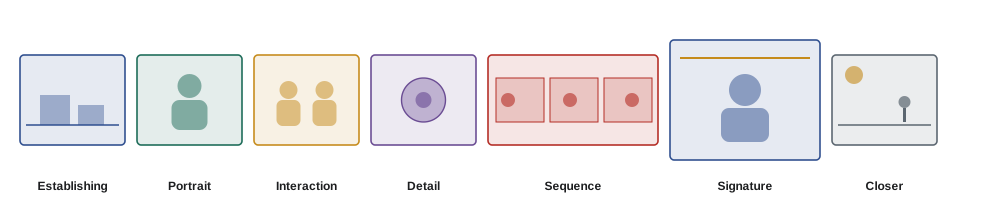
Vary distance and angle: wide, medium and close; high, eye-level and low. Vary moments: quiet and active, public and private. Record captions as you go, because over weeks or months it is easy to forget names, dates and details. Keep a log of who, what, when and where for each shoot.
| Picture type | Purpose | Example in a story about a family farm |
|---|---|---|
| Establishing | Set the scene | The farmhouse and dry fields at dawn |
| Portrait | Introduce the main subject | The farmer in the barn doorway |
| Interaction | Show relationships | Parent and teenager arguing over repairs |
| Detail | Carry meaning in an object | Cracked soil in a cupped hand |
| Sequence | Show a process | Loading cattle for an early sale |
| Signature | Sum up the story | The family watching clouds pass without rain |
| Closer | End the narrative | Lights off in the barn at night |
The photo essay
A photo essay is more interpretive than a picture story. It may not follow a single narrative but explore a theme, such as loneliness, migration or the changing coastline, through images that relate by mood, form or idea. Photo essays allow more personal vision, but the images must still be truthful. Captions should identify people and places, and any departure from straight documentation, such as a constructed portrait series, should be clear to the audience.
Long-form documentary projects often take years, combining assignments, grants and self-funded work. They may end in books, exhibitions and multimedia pieces as well as publication. The discipline of the picture story, with its attention to variety, sequence and captions, remains the foundation.
Editing a story
Editing is where a story takes shape. Start by reviewing everything, marking strong frames. Then narrow down to the best of each moment, and finally choose a set that tells the story with variety and pace. Most editors and photographers recommend editing with someone else, because photographers are attached to pictures for reasons, such as how hard they were to get, that the reader will never know.
Sequence the selected images. Start with a strong opening, often the signature or establishing picture, that draws the reader in. Vary the rhythm, alternating wide and close, quiet and intense. Avoid repeating similar pictures; each image should add something new. End with a picture that closes the narrative or leaves a lasting impression. Online, sequences may be presented as galleries, scrolling layouts or multimedia pieces with audio and video; in print, designers combine large and small images on a spread.
Worked problem
Shooting ratio and edit
Over six weeks you shoot 3,600 frames for a picture story. Your first pass marks 240 frames, the second narrows to 45, and the published story uses 12 images. What fraction of frames is published? What fraction of the first-pass selects?
Show solution
- Published fraction: 12 / 3,600 = 0.0033, or about 0.33 percent, one frame in 300.
- Fraction of first-pass selects: 12 / 240 = 0.05, or 5 percent.
- From second pass to publication: 12 / 45 ≈ 27 percent.
Answer: About one frame in 300 is published, and one in 20 of the first selects. Heavy editing is normal; the shooting ratio reflects waiting for moments, not wasted effort.
Planning time and budgets
Features need time, which costs money. When pitching or accepting a story, estimate the days needed, travel and expenses, and when the subject's key moments will happen. A story about a harvest must be shot at harvest; a story about a school year needs visits across the year. Build in time for editing and captions, often a day for every few days of shooting.
Worked problem
Budgeting a feature
An editor offers a freelance feature on a winter fishing community, 300 km from your base. You estimate 3 shooting days, 1 day of editing and captions, 2 travel days, and two nights' lodging at $150. Driving costs $0.70 per km. The publication pays $450 per day for shooting and editing and $200 per travel day. What is the total fee and expense claim?
Show solution
- Shooting and editing: 4 days × $450 = $1,800.
- Travel days: 2 × $200 = $400.
- Fee total: $1,800 + $400 = $2,200.
- Mileage: 300 km each way = 600 km × $0.70 = $420. Lodging: 2 × $150 = $300. Expenses: $720.
- Total invoice: $2,200 + $720 = $2,920, plus sales tax if registered.
Answer: A fee of $2,200 plus $720 in expenses, $2,920 in all before tax. Agree on days and expenses in writing before you start, and keep receipts.
Ethics in long-term stories
Long-term stories create relationships, and relationships create obligations. Photographers may become close to subjects, learn private information and be asked for help. Ethics codes ask photographers to avoid conflicts of interest and not to pay subjects for access, because payment can change behavior and readers' trust. At the same time, photographers have a human duty to treat subjects decently. Many photographers handle this by being clear about their role, offering prints of family pictures after publication, and keeping in touch. Advocacy, campaigning for a subject's cause, can compromise independence; discuss any such situation with your editor.
Working with writers and designers
Picture stories are often published with a written story by a reporter, and designed by a visual editor or designer. Talk with the writer early about the story's focus so pictures and text complement each other rather than repeat. Share your strongest images with the designer with notes about which picture should lead and which pairs work together. Online presentation offers more space than print, but readers still scroll past weak or repetitive images, so the edit should be just as tight.
Keeping the story honest over time
Long projects drift. A story that began as a portrait of a struggling family can become, over months, a story about a community, a policy or the photographer's own relationship with the subject. Revisit your original pitch from time to time and ask whether the story has changed and whether your editor knows. Captions and introductions should reflect what the story actually became, and the edit should not force pictures into a narrative they no longer support.
When a subject's circumstances change, for example if they move, recover, are arrested or die, discuss with your editor how the story should acknowledge it. Readers who follow a series expect to know what happened next, and subjects deserve to be represented accurately at each stage, not frozen in the moment that first made them a story.
Above all, a picture story is a promise to readers that what they see happened as shown. Keeping that promise across weeks of work, many subjects and hundreds of frames is the real discipline of the form.
Common mistakes
MistakeAsking subjects to repeat an action you missed.
InsteadWait for it to happen again naturally, or let it go.
MistakeShooting only medium-distance pictures of the main subject.
InsteadVary distance, angle, moment and picture type.
MistakePromising subjects they can approve the pictures.
InsteadExplain honestly how pictures will be selected and used.
MistakeEditing alone and keeping favorite frames that do not advance the story.
InsteadEdit with another person and choose pictures that each add something new.
MistakeLeaving captions until the end of a long project.
InsteadLog who, what, when and where after every shoot.
Summary and key terms
- Features show everyday life; picture stories follow a narrative; photo essays explore a theme.
- Good feature stories have something to see, willing subjects and time to unfold.
- Access and trust come from honesty, time and respect for boundaries.
- Photojournalists observe rather than direct; portraits are clearly portraits.
- Stories need establishing, portrait, interaction, detail, sequence, signature and closing pictures.
- Edit with another person, choose a varied set, and sequence with a strong opening and closing.
- Plan time and budgets realistically, and handle long-term relationships ethically.
Practice problems
Work each problem on paper first, then reveal the answer to check.
What is the difference between a picture story and a photo essay?
Show answer
A picture story follows a narrative; a photo essay explores a theme more interpretively.
Name five picture types in a story.
Show answer
Any five of establishing, portrait, interaction, detail, sequence, signature and closer.
What should you do if you miss a moment?
Show answer
Wait for it to happen again naturally, or let it go.
Why edit with another person?
Show answer
Photographers are attached to pictures for reasons readers will never know.
2,000 frames shot, 10 published. Shooting ratio?
Show answer
200 to 1.
What should a pitch include?
Show answer
The story, why now, the pictures, access and time needed.
4 days at $400 and 1 travel day at $200. Fee?
Show answer
$1,800.
Why should you not pay subjects for access?
Show answer
It can change behavior and undermine readers' trust.
How is a portrait different from a staged candid?
Show answer
Subjects know it is a portrait and it is presented as one.
How should a story sequence begin?
Show answer
With a strong opening picture, often the signature or establishing image.
Lesson quiz · 5 questions
Score 60% or more to complete this lesson.
Create a free account to save your progress, take quizzes and earn a certificate.